13
The concentration of the body
‘With my body I thee worship.’
Book of Common Prayer
‘This reciprocal freeing, this calling forth of one from the other, this constant evocation, is the truth of “stimulus and response”. I object to calling physiological stimulus and response the “material” part of life. We find the same life-process – the self-yielding of organism and environment – on every plane; here in the concrete circumstance is the “living” truth. Where then is reality? In the objective situation, or in “the people”? In neither, but in that relating which frees and integrates and creates. Creates what? Always fresh possibilities for the human soul.’
Follett, p. 130
When thinking about the kind of concentration required for making the free drawings I remembered reading:
‘It is no good at all to look at the model as if he were a jug, and try to draw him as such. Having looked at the model and having understood his movement as well as possible, you must then place your subconscious self in the same position. In your own imaginative muscles you must be able to feel the strains of the model’s pose.’
Jan Gordon: A Step Ladder to Painting, p. 206
I had also read:
‘For the creation of works of art there is a condition of the spirit that must be achieved and preserved at all costs. This condition can be compared to what the religious term a state of grace. It is a state of exaltation, of communion with life, nature and his fellow beings which enables the artist unconsciously to exalt, re-create and transcribe the world about him.’
Dunoyer de Segonzac
In a small way the kind of concentration which had produced the free drawings did seem to be a state of grace in that it often did not happen, the dialogic interchange was often not achieved, some essential condition of the spirit was lacking. But when it did happen, although it was certainly a condition of the spirit it essentially also encompassed the body. For the making of any drawing, if it was at all satisfying, seemed to be accomplished by a spreading of the imaginative body in wide awareness and this somehow included one’s physical body as well as what was being drawn. I found a diary note:
‘… this satisfaction in gaining awareness of the object as a whole, through use of repetition and rhythm of symbol, is like the feeling that exercise gives, particularly dancing or skating. In drawing that tree, the spread of the branches and leaves gives an awareness of my shoulders and arms and fingers and I feel its roots in my feet.’
There were also many problems to do with what actually happened when one did succeed in making the imaginative body encompass the physical body. There were questions, for instance, of the kind of experiences the enhanced body awareness included: such as feelings of weight and spatial position, of up-ness and down-ness, of right and left and three-dimensional spreadness, of balance and uprightness and every kind of movement. Clearly this was the set of experiences, with their associated memories and dreams, which distinguish the visual arts from the literary ones, for instance, and they also threw light on my specific problem of how to express the idea about a cat playing in the gutter in graphic rather than in literary form. But if these body dreams were to do with all one’s experiences of movement and posture and internal physiological states they were therefore intimately connected with one’s emotions. Here I thought of Darwin’s The Expression of the Emotions in Man and Animals and of the infinite variety of postural change which is the instinctive aspect of the expression of feeling. I thought how ordinarily this is inhibited in most of us; in our social life, after childhood, we do not jump for joy or kick and stamp with rage, we do not prance for pride and exuberance of life. So surely all these inhibited bodily impulses expend themselves in body dreams, our inner world must be full of dream postures of the body in which the instinctive mood is unfettered. In music perhaps we get nearest to knowing these consciously, or some of us do, and in dancing they are made explicit in actual bodies. But I thought painting also, though less consciously, taps this rich source of body dreams and finds in what painters call the action of the picture a most potent way of affecting our feelings. I remembered now how some of the first drawings made out of my head, before ever discovering how to do free drawings, had been a series of schematic representations of bodily postures expressing emotion (Fig. 45 a); and there had also been another done later as a free drawing (Fig. 45 b).
There was one drawing which touched on this idea of consciousness suffusing the whole body, and also on the effects of that narrow non-embracing kind of attention which cannot by its very nature encompass a wholeness. It also depicted the way in which such narrow focus can shut out parts of oneself, part of one’s wishes and feelings and how such shut-out parts can remain primitive and cruel (Fig. 46). The story of the picture was:
‘It is a two-faced creature, the dog part is sitting up and waiting to do what he is told, the cat part is taking no notice of authority, in fact turns her back on it, to play with a mouse and rudely sticking her tail up in the sun’s face. The animals all round seem to be one’s own products, possessions, children. But in one sense I think they are moods, crabbiness, being the black sheep, or the little pitcher with long ears, or being submerged in day-dreams like the sea-horse under the water. It’s like the
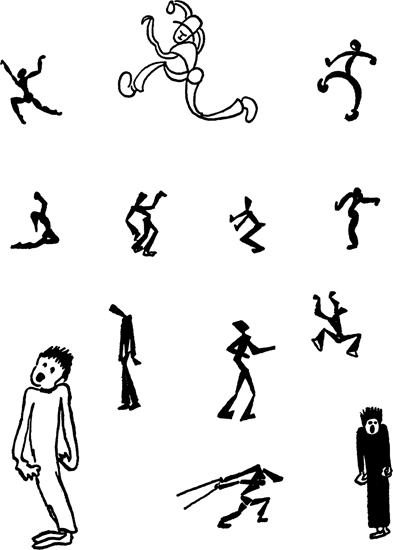
Figure 45 (a)
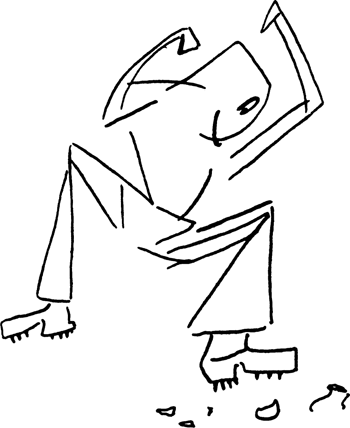
Figure 45 (b)
determination to be oneself, like the rich lavish feeling in childhood of having one’s toys spread all round one on the floor.’
In one sense this picture seemed to refer to all the years one could spend at school in dog-like obedient and narrow-focused concentration on the face of the teacher, shutting out feeling and impulse and trying to be what is expected of one; though it looked as if all the time the cat part of one’s nature could be looking the other way and cruelly playing with a mouse. Also one special thing to be noticed about it was the way the drawing itself made its own frame, except for the cruel claws and the mouse which almost seemed to be coming out of the picture altogether.
Incidentally this reminded me of how difficult it was, when trying to make a picture deliberately rather than by the free drawing method, to keep in mind the frame and to fill the space within it harmoniously. The items in it always
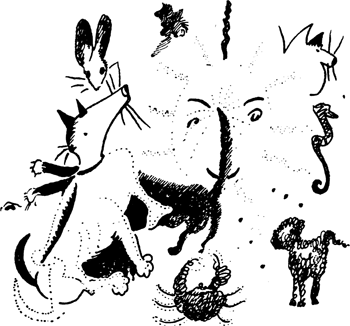
Figure 46
seemed to get arranged in a lop-sided way and to leave certain blank spaces which needed to be filled but I would not know what to put in them. So it looked as if the narrow-focused obedient monologue kind of attention, which shut out wan-dering thoughts and rebellious moods, which was the kind of attention I had so long thought to be the only kind, made it both impossible to create a picture with properly balanced items within a frame; and also impossible to create oneself as a properly balanced whole of integrated moods and desires within a body. In fact, the drawing seemed to depict the inability of the narrow pointed concentration of obedience and reason to educate the emotions, it showed how the destructive wilfulness can exist in all its primitiveness, side by side with a conscious attitude of obedience and co-operation.
Such a state of total body concentration in which the imaginative body suffused the physical body was connected with a special image, and I now realised that this had in fact already appeared before in the Angry Parrot drawing. In this image it was as if an egg-shaped sphere, slightly bigger than one’s physical body, could totally envelop it, envelop it cloudily yet also with a hint of smouldering fire; in fact here I felt was another aspect of the parrot’s egg, only there the parrot was outside it instead of being enveloped in it.
This linking up of the parrot’s egg with the high point of creative body concentration now also led me to see certain aspects of the Angry Parrot’s dilemma which up to now had been obscure. It threw light on some possible effects of scholastic education and the ways in which one is expected to acquire the art of concentration through school learning. The clue was that the Grey Lady of the Angry Parrot picture in part represented a famous head-mistress who had once taught me; for now I saw that the parrot’s fear of losing its precious egg was in part a fear of losing for ever, through submitting to the intellectual academic kind of learning, the capacity for this other kind of total concentration, the kind which both envelops the whole body, and at the same time can be spread out in spiritual envelopment of the object. And without this other kind I felt one would indeed be a parrot, saying only what one had been taught to say.
The idea of a concentration which includes the whole of oneself as well as the whole of the object raised another question. How exactly does the capacity to make a whole picture in which every part is related connect with the capacity to be a whole person? Is the striving for one perhaps partly based on the striving for the other? And when, with infinite labour, such unity is achieved in a picture do we recognise it at once as something of unique value because it expresses one of the most fundamental urges of the force by which we are lived, the urge to form, to wholeness of pattern within ourselves? When we look at such a picture do we get a temporary glimpse of what it would be like to be a truly whole person? Also was my difficulty in understanding all that rhythm means in painting due in part to the fact that it is so closely linked with the essential nature of this force by which one is lived, this force that one can be so fearful of giving in to? Since rhythm itself consists of a two-ness, a continuing relation between two differences, either in space or in time, does it perhaps not represent the most important fact about the way the pattern making force inside works, in active relation to the environment, to achieve a wholeness of the organism? At least it can work towards such a wholeness; but it all depends on whether the arrogant will gives up its omnipotence and devotes itself to providing the conditions under which the natural rhythms can grow; rather than trying to impose artificial ones, as I had done in my first attempts at deliberate picture making.
I now remembered Goethe’s idea of colour as something which happens when white light and darkness meet; although not true of the physicist’s world, it looked as though it might be true metaphorically of the world of psychic experience. For here was the fact to be faced that there was a startling change in the quality of experience itself when imagination was brought down to earth and made incarnate in the body, a sudden richness that was like the sun coming out over a world that had been all greyness. And not only did the weather change in one’s soul when imagination was made incarnate and took its flesh upon it, but the very way one moved was affected. In drawing it was apparent at once in the quality of the line. Without such an incarnation one seemed to move as by the commands of an internal drill master, with it one could achieve the state of wholeness in which:
‘It doth not by another engine work,
But by itself; which in the act doth lurk.’