12
Rhythm and the freedom of the free drawings
‘Every living process is subject to its own authority, that is, the authority evolved by, or involved in, the process itself.’
Follett, p. 206
‘On the level of personality I gain more and more control over myself as I unite various tendencies… . We can always test the validity of power by asking whether it is integral to the process or outside the process.
‘And is not power, thus defined, freedom – freedom and law too? In the life process freedom and law must appear together. We can see that when we unite opposing tendencies in ourselves, the result is freedom, is power, is law. To express the personality I am creating, is to be free. From biology, social psychology, all along the line, we learn one lesson: that man is rising into the consciousness of self as freedom in the forms of law.’
Follett, p. 193
Having been brought to face the fact that there was apparently another kind of order, different from that imposed by conscious planning and willed activity towards a foreseen end, it was now necessary to try to find out more about the non-willed kind. The best way to approach it seemed to be through the matter of rhythm in painting.
Once I had wanted to draw a cat but had found it too difficult and had made a written note instead:
‘… that little cat playing with a fish-bone in the gutter, it’s like a panther, it calls up echoes of dark jungles, I don’t know how to express that idea in terms of the lines of the cat’s body, I feel it as images of huge trees and jungles and remoteness, a far-away-in-Africa feeling.’
I had gathered from reading that such associated ideas evoked by looking at an object were called ‘literary’ and were not the essence and core of painting although they had a secondary usefulness in the task of communicating emotion. But at that time I did not understand at all how to make the lines and shapes and colours, simply by the pattern they made together, produce a direct emotional effect, one that was apart from what objects of the external world were actually depicted in the drawing. In fact, I did not then understand in what sense painting was a sensory organic language rather than an idea language. It followed also that, although having often enough come across the word rhythm in books on painting, it had never seemed quite clear exactly what was meant. Now, however, being brought to face the problem in connection with the idea of non-willed order, I did find a fairly precise definition:
‘The word rhythm is here used to signify the power possessed by lines, tones and colours, by their ordering and arrangement, to affect us, somewhat as different notes and combinations of sounds do in music… . The danger of the naturalistic movement in painting in the nineteenth century has been that it has turned our attention away from this fundamental fact of art to the contemplation of interesting realisations of appearances….
Speed: The Practice and Science of Drawing, p. 127
This seemed clear enough, but I was a little disconcerted to find, by the pencil markings in the book, that I had read this passage before but had apparently forgotten all about it. What was there about rhythm in painting that made it so hard to understand? What was there about the difference between a sensory organic language and an idea language that made it so difficult to think about? Was it more than the strength of an unrecognised nineteenth century influence? I found that a series of my own sketches certainly illustrated the difference, even if it did not explain it. For the first version of the sea-wall sketch, which was realistic (Fig. 11 a) had as it were merely referred to the sea-wall as an idea, but it had not satisfied the impulse to draw, so I had felt impelled to experiment further and also to make a diary note.
‘… with the fourth version (Fig. 11 b) it seems the balance of line and mass that has become the most interesting, not so much the sea-wall as such, it is the heave of that great stone groyne running out into the sea, the weight of it, the encircling quality, as if I had worked through from an idea problem to a muscular feeling problem; though perhaps still dealing with the same essence, the control of upsurging movement, trying to make that great heaving point of solid stone into something balanced, something that stays within the picture.’
Thus the choice of that particular landscape as subject for a sketch seemed to have been determined in the beginning by an association of ideas. If the theory put forward here was correct it was largely the symbolically presented problem of the overlap of inner and outer that had determined the choice of subject, in fact, the problem of illusion that was just beginning to draw attention to itself. But it also looked as if the inspiration of the drawing had developed with the action of the drawing and had become more purely pictorial, more concerned with the inherent emotional quality of the rhythm and sweep of line.
It now appeared that the difficulty with rhythm was not only a private one, for I read:
‘Those harmonic qualities which to some extent painting shares with music enter, as yet, very little into or perhaps even have been lost from the awareness of the ordinary man.’
Cora Gordon: Art for the People
Certainly I had had ample experience that it was a very potent force; for it felt like suddenly emerging into an entirely new world whenever I did manage to become conscious of these rhythmic dialogic give-and-take relations between different items in a picture. But if so potent, why was it lost or else never achieved in one’s ordinary consciousness?
In order to answer this question it seemed necessary to find a further definition of rhythm, one that would be comprehensive enough to include all its aspects. What was needed was one that included the idea of a repeated and ordered interplay between differences and samenesses, whether the samenesses and differences were to do with sounds or movements or physical processes or lines and shapes and colours. But this emphasis on repetition brought with it the thought of the difference between a repetition that is living and one that is dead. I knew that the tendency to repeat experience was looked upon as one of the ultimate qualities of living matter, since all creatures, other things being equal, tend to go on behaving in the way they have behaved in the past; and also that this tendency to repetition was an essential aspect of growth, provided that it was balanced by its opposite, the impulse towards change, variety, new experience. But the two principles, repetition and variety, are discussed in most books on painting. I even remembered being given these two words in a lesson at school on pattern and design, though at that time I had thought the distinction dull and academic. Now, however, it seemed deeply important, a matter of creative life or death; for if repetition was not vitalised by the continual marriage with variety it became utterly dead, like my drawings from nature which were sheer copying, and if variety was not held in check and made coherent by repetition it became chaos, as in the free drawings that were mere scribbling. The difficulty in the happy marriage of these two, however, seemed to be that there were other factors weighting the two sides and liable to upset the proper balance. For in addition to the deep impulse to rhythmic repetition inherent in our being there have been, for all of us, external rhythms and rules imposed by authority and the clock, by bells that ring at school and daily trains to be caught. Thus repetition could become associated not with the deepest springs of our own vital processes, a living form of inner coherence and control, but with something alien imposed from above, the submission to which might seem to involve the loss of one’s whole spontaneous life. While variety, on
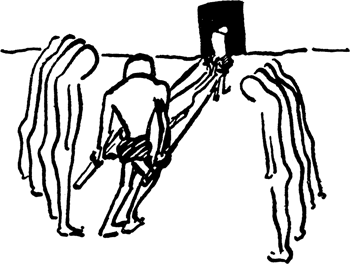
Figure 40
the other hand, with its breaking away from the repetition of routine, could come to stand for the spear-point of one’s own will and identity. It occurred to me now that the row of creatures in Fig. 15, who might be cooks or nurses holding the demanding bottle, perhaps stood for the same idea of a deadening routine. And there were also various items in other drawings which suggested that the idea of deliberately repeating an experience or accepting a rhythm could involve thoughts of danger; for instance the danger of being hauled back over the abyss into that dark murky river where the separate will is lost for ever (Fig. 33). In fact, repetition could mean the overwhelming and drowning of the spirit in blind repetitive instinctive life. I found another image of this danger in the symbol of entombment in a catacomb of rock (Fig. 40). It was not a free drawing but an attempted copy of a half-waking image, one which had appeared just before being plunged into the overwhelming instinctive experience of childbirth.
This difference between a repetition that is living and one that is dead provided another example of the either-or tendency, the tendency to separate and isolate aspects of the living process which should be in active relationship. Thus such a fear of the individual will being lost in the blind repetitive habit life of one’s animal inheritance was probably increased by just such a splitting, one which only made the will more ‘up above’ and tyrannical and the instincts more earthbound and turgid. But although such an excessive splitting was undoubtedly uncomfortable, perhaps it might be an inevitable temporary state, a necessary phase in the great struggle of conscious awareness to develop out of blind organic life. Certainly the difficulty of becoming conscious of the effects of rhythm in painting felt like a struggle with a very primeval force. Also it seemed now that this struggle might have a real basis in the fact that control by rhythm and control by self-conscious willed endeavour are mutually exclusive processes; as illustrated in the story of the centi-pede who could not walk at all when he tried to answer the question which foot he put forward first. Thus to allow a rhythm to develop in one’s hand movement when drawing or even in one’s perception when looking at a picture, did seem to require a temporary throwing to the winds of the dominating will, it involved a kind of plunge which one’s ordinary consciousness could dread. And it could be dreaded in spite of the repeated experience of the rewarding delight and freedom that giving oneself up to the swing of the thing can bring.
The more I thought about it the more profound the issue became; thus it seemed that the blind instinctive repetitive rhythm, which was one term of the two deepest urges of one’s organic existence and which could be such a source of refreshment and renewed life, could also, in its extreme and isolated form, represent death. And apparently it could also become associated with that alien ‘law’ imposed from above, which in the free drawings was symbolised by the castle and the ice-demon and the thundercloud god. Further aspects of the matter also emerged when I began to think about the word ‘form’ in connection with the arts. Just as with rhythm so with this word form; up to now I had found great difficulty in thinking about it at all, and the same conflicting feelings were aroused. Just as it is routine, habit, regularity, ceremonial, formal procedure that stems the impetuous rush of instinct and the capricious wilfulness of immediate desire, so also it is form, shape, pattern, that makes possible any coherent emotional relation to the external world at all. It is by the form of objects that we recognise them, by their shape; a world that is without form is indeed void, there is nothing in it to get hold of; for any external object to become happily significant for us it must have some form by which we can recognise it as likely to satisfy our needs and therefore as relevant to our destiny. So here again surely was the original problem of the Angry Parrot, here was the principle of limitation, outline, patterning, the ordering principle which could be both hated for its restrictiveness and yet loved because utterly needed for one’s very psychic and physical existence.
Such ideas now made clearer the meaning of the drawing called ‘If the Sun and Moon should doubt …’ (Fig. 41). Its story was:
‘… the shapes at the bottom are waves, the sea of feeling again I suppose. Those two whirlpool-like things to left and right seem to be gramophone discs and those three small pillars on the top left are books, my books. The curious flying buttress shapes make me think of architecture and the flat thing at the bottom somehow suggests a spirit-level. It’s odd, I hadn’t thought of that before but I do get a kind of levelling of the spirit when I
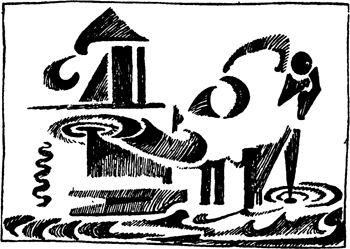
Figure 41
look at a lovely building. I did not see that the drawing had any associations at first, but now it does seem to do with achieving some sort of balance by expression, whether in words or shapes or music. And the title
“If the sun and moon should doubt,
They’d immediately go out.”
that makes me think of the doubt which means doing nothing for fear of the badness of one’s efforts, of being unable to draw because of being unable to see ahead what would come, unable to trust in any order in the result. It reminds me of the Castle of Giant Despair where Christian was tempted to suicide. And the spiral theme, both in the gramophone discs and the corkscrew thing on the left, a spiral always seems to be somehow ordered from inside itself.’
Undoubtedly the sun and moon here did mean the ordering and life-giving principle: that is, in the beginning, the parents. But I suddenly saw from the story that there was a reversal in the title: ‘If the Sun and Moon should doubt …’ meant, for me at least, that if I should doubt the sun and moon I would go out. So it seemed that the thought behind the drawing was an elaboration of the ideas in the earlier ones. It was that if the hate of the restricting and frustrating parent figures becomes too great and is therefore denied they are then felt in imagination to be either destroyed or turned into avengers, they become the giants of the Castle of Despair. Then all belief in one’s own creativeness can fail; one can psychically go out just because of having lost belief in any non-willed order. But by its emphasis on control through an inherent rhythm this drawing did suggest that there was a way of mitigating the original hate of the imposed order.
I found three pictures which seemed to be a kind of graphic reflection upon this problem of the two kinds of order, the imposed and the inherent:
(Fig. 42) … the little man is doing what he is told, he has a termagant wife inside the house who has sent him out to mind the baby. The little dog, walking in the opposite direction, has just pee’d on the lamp post.
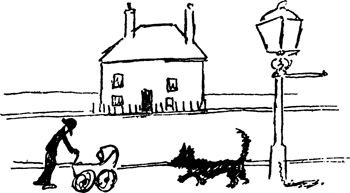
Figure 42
(Fig. 43) … those three figures are drunk and a bit crazy, the middle one looks like the Mad Hatter. On the left is a bonfire, they have made it out of books.
Fearful subservience to an imposed authority either inside or out, or complete abandonment of all controls, neither of these was the solution. The little dog, however, provided a hint of a third way, for he was neither running amok nor resentfully subservient, in fact his controls seemed to be gaily within himself. And this last theme was developed further in the third sketch (Fig. 44).
(Fig. 44) … the flattened figure eight in the middle seems to be a gramophone record, though a rather battered and misshapen one. The three little mannikins that are dancing upon it, leaping and spinning to their feeling of the rhythm of the music, have an exuberance that is not the extravagant abandon of the Mad Hatter, it is a controlled exuberance, controlled by an inner sense of rhythm and repetition and form.
Certainly such an inherent form of control did seem to offer a way out of the predicament of the Angry Parrot. For the inherent form, in contrast with control through subservience to an authority, whether inner or outer, must surely reduce both fear and hatred. It reduced fear of separation and of the chaos that would happen if one lost contact with the external controlling force: but it also reduced the
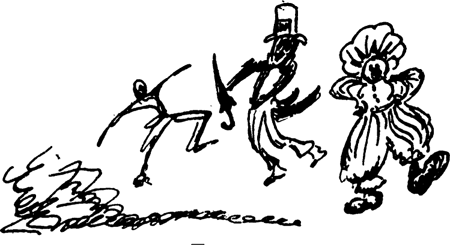
Figure 43
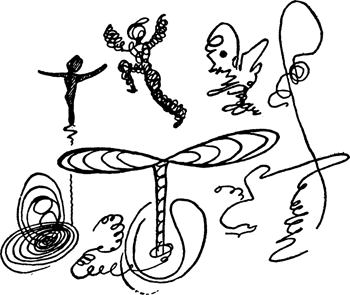
Figure 44
need to hate the controlling force for its interference, because one need no longer rely on that interference. The parrot need no longer hate the Grey Woman because it will no longer need her to save it from the tumultuous waves of feeling, it can in fact deal with the waves itself, it can ‘in the destructive element immerse’ with safety and need no longer be a kingdom divided against itself.
The figure-of-eight drawing, with its dancing figures, also embodied the idea that the spontaneous order, in contrast with the imposed, is essentially the result of free activity. It made me think of how, in spontaneous ordering, the impulses to be controlled become themselves changed because they are fitted into a pattern of wider context and meaning, through the fact of doing something. The authority way of ordering, including so many sermons, says: ‘You must love your parents, love the good things, hate the bad things’; but the other method does not say anything, it simply offers activities by means of which the love and the hate become attached to the good or bad things, through the spontaneous pattern-making associative powers of the organism in action. All parents and teachers know about this activity method of control, they give unruly children something to do, so that the disruptive impulses become changed by fitting into a context beyond themselves. And I thought that the arts do the same, they never say ‘This is what you must love and therefore serve and cherish and protect, this is what you must hate and therefore avoid, get rid of, change’ as moral teaching does; instead, they try to express the loveliness or hatefulness of things so that you cannot help loving or hat-ing them. And I thought such a view of the meaning of the arts held good both for creation and appreciation; since in creative activity one is doing it for oneself, trying to find an order in one’s own loves and hates, and in appreciation one is observing how someone else has tackled the problem and sharing their experience imaginatively.
Now it was necessary to ask another question. If there was in fact this other kind of order which resulted when deliberately willed intention and conscious working to a plan was eliminated, had conscious planning no function at all?
If it were indeed true that one could not hope to create either a genuine picture or oneself as a genuine person, solely by will-power and imposed rules, where did will-power come in? It looked as if the answer to this might come from once more considering the free drawings and their method. For although I had not decided ‘This is what I am going to do’ and done it, there had been some deliberate action involved. Although usually at the beginning the drawing was done on impulse, it was afterwards necessary to impose action according to plan, at least to the extent of forcing oneself to go on drawing in spite of not knowing what was going to appear. And not only did one need will-power to keep one’s hand moving on the paper, but also by will-power one had to maintain the kind of attention which created a gap ahead in time and a willingness to wait and see what was emerging to fill the gap. Also to do this one had to shut out internal or external interruptions which might lead one’s thought away from this framed emptiness ahead.
Here then seemed to be a possible hint as to the role of will-power, both in painting or in any producing of something new. Obviously one could not plan beforehand exactly what was to be produced, for if one knew beforehand it must surely be a repetition of something that had been before. But what one could do was plan the gap into which the new thing was to fit. If it was new knowledge one was looking for one could plan the question, frame the question, work on deliberately planning the empty space into which the new knowledge was to fit. Or if it were a new invention, a new way of doing things, one could specify or plan beforehand the practical need that the invention must satisfy; even though before inventing it one obviously could not say what the exact nature of the solution of the problem would be.
So if one tried to define the real function of will or planning in creative activity was it perhaps something like this: was it possible to say that the business of the will was to provide the framework within which the creative forces could have free play? It is said that no art school can teach you how to paint, in the real sense. But the art school can and does provide the frame, it offers regular times and places and materials for creation. And by the willed act of registering as a student and attending at the proper time one can, as by a protective frame, free oneself from the many distractions of trying to paint at home.
Such a view of the role of the will in creative activity surely was also relevant to the issue in the political world between the planners and the anti-planners. It suggested that both were right in different ways, both wrong in denying the rights of the other. Obviously the foreboding of those who fear planning, that all spontaneous endeavour and creativity will be stunted, is well founded, if the planners fail to understand their true function. If they overstepped their function of providing a secure frame for the free activities and tried to dictate the activities themselves, then there would certainly be sterility and deadness. But also the planners were right in their fear of chaos and its destructive results, in their realisation that without a definite frame human activity can spend itself in a disastrous dissipation of energy and failure of the opposing creative forces ever to confront each other.
Thus I could now say that the freedom of the free drawings was not the illusory freedom of Fig. 16, not the ‘freedom’ of thinking one has got rid of all restraint, which ultimately means being the slave of blind instinct. It was rather a freedom resulting from having entered into active relationship, from having recognised the necessity of difference and from having allowed the two differences, dreaming and doing, a maximum of interplay.