11
Ideals and the fatal prejudice
‘We see experience as an interplay of forces, as the activity of relating leading through fresh relatings to a new activity, not from purpose to deed and deed to purpose with a fatal gap between, as if life moved like the jerks of mechanical toys with only an external wirepuller to account for the jerks, or a too mysterious psychic energy …. Activity always does more than embody purpose, it evolves purpose.’
Follett, pp. 81, 83
Undoubtedly the themes of the last set of drawings had shown that one’s mind could be very concerned with this problem of differences; but also that it tended to run to extremes and having once distinguished opposites then it tried to keep them rigidly apart. Also, if I had interpreted such drawings as the Angry Ape aright, this was partly because of certain painful and intense emotions connected with earliest experiences of difference, particularly the first perceptions of the difference between what one would like and expect people to do and what they do do – in fact, the first experience of the discrepancy between dream and actuality. Of course I knew by now that this again was a central part of psycho-analytic theory: that the childhood spectacle of the parents together and oneself shut out could become a kind of prototype of the difficulties to do with the recognition of difference. I knew the theory that jealousy and fear of the creative activities of the parents can often make it very difficult to believe in creative interplay in general. But the particular part of the problem that psycho-analysis had not so far made clear to me was to do with this creative interplay between dream and external reality.
There was one fact which it was very difficult to keep firmly in mind; this was that both the internal dream and the external reality had value in their own right, provided that they were not kept rigidly apart. I could tell myself intellectually that one’s dreams are one’s own creations, something that one has fashioned out of the vivifying contacts between nature outside and nature within. I could tell myself that we cannot help but dream, completing in imagination the pattern of our necessarily fragmentary experiences of the external world, we cannot help working over in our imagination what happens to us, creating internally the ideal wholeness of what the experience might have been; just as we continually complete the wholeness of the unseen three sides of a cube and recognise it as a solid in our everyday experience of perceptions. And I could tell myself that without such dreams, or expectations of experience refashioned out of memory, our lives would be entirely purposeless and blind. But all the same, I still caught myself using the phrase ‘only imagination’. And I was also at the same time continually caught up in the opposite extreme of so over-valuing the imagination and disparaging the external reality that it was sometimes very difficult to attend to what was going on externally at all. Also although I could tell myself that the inner dream had to be continually tested and enriched by the contact with external reality there still seemed to be great difficulty in letting them meet. There seemed to be a profound fear of losing something; and I realised now that it was not an entirely groundless fear. One did in fact lose something, and one had to face this loss, even though one did in the end gain something so much greater.
There was one drawing which seemed to be depicting the fact of this loss and gain, particularly in connection with those aspects of our dreams which are usually called ideals. It was called ‘The Eagle and the Cave-man’ (Fig. 38).
‘Those little figures are suspended above the earth by curious square balloons, like Chinese lanterns which look
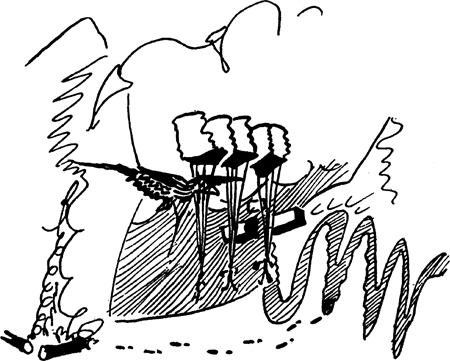
Figure 38
as though they are beginning to crumble. Also there are brick-bats flying about and then also the eagle is just going to fly across the supporting strings. Altogether I think the mannikins hanging on to the lanterns are going to have to come down to earth pretty quickly. And what are they going to find there? Footsteps of a cave-man who has emerged out of a crack in the mountain and gone along to the fire. But there are no footsteps away from the fire, I wonder where he has got to? I do believe he has plunged into the fire and emerged again as the eagle. What’s an eagle? A bird that sees. It seems to be the power of seeing that is destroying the mannikins’ aethereal supports and bringing them down to earth. I always did feel that hitching one’s wagon to a star might end in hanging most uncomfortably in mid-air.’
In one aspect this was a continuation of the argument of the N.B.G. drawing, a pictorial comment on the too extreme division shown there into spirit-flesh, things-above-things-below. Thus I thought the eagle picture was saying that to stop looking to the sky for one’s supports was not necessarily to lose all that distinguishes one from the animal and the cave-man; and in saying this it did seem to show a step towards willingness to bring dreams down to earth and letting them interact with the facts. I thought also it showed a growing realisation that to be so ‘indirect and lumbering’ that one confused the spiritual reality of the internal dream with what in fact can be found externally was a fatal idolatry. Such a confusion must surely lead to an inner tension that was intolerable; to escape it one would tend either to distort the facts and pretend they were better than they actually were, giving everything a rosy light; or else one would degrade the dream, turn against it and deny that one had ever loved it or that it had had any value. In fact I saw now that disillusion, opening one’s eyes to what are called the stern facts of life, meant recognising that the inner dream and the objective fact can never permanently coincide, they can only interact. But I saw also that in order to do this one has to reckon not only with one’s hate of the external world, when it fails to live up to one’s expectations, but also hate of oneself when one similarly fails. Thus the same problem of the gap between the ideal and the actual applied within oneself, the gap between what one is and what one would like to be. Certainly I had long been aware that failure to recognise the inevitability of the gap led to much self-deception and fruitless straining. But what I found now was that, at times, if one could bring oneself to look at the gap, allow oneself to see both the ideal and the failure to live up to it in one moment of vision, and without the urge to interfere and alter oneself to fit the ideal, then the ideal and the fact seemed somehow to enter into relation and produce something quite new, something that had nothing to do with being pleased with oneself for having lived up to an ideal or miserable because of having failed to. In fact it almost seemed that the wide-seeing eagle of the drawing was a way of saying something about a growing belief in a certain watching capacity of the mind; a watching capacity which, when separated from the interfering part, became the
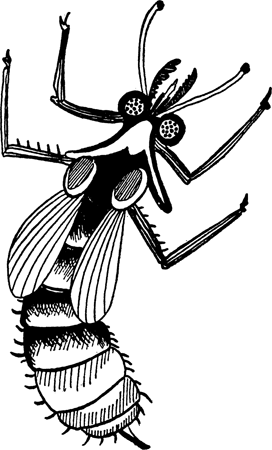
Figure 39
light that could meet darkness and redeem the denied greeds and hates and despairs of the bodily life. For it was a watching part which, by being able to see the two opposing differences of standard, or ideal, and actuality, in relation to each other, was by this very act able to bring about an integration, a new way of being which somehow combined the essence of both.
It now occurred to me that in fact this watching capacity of the mind was depicted in some of the other free drawings, only I had not recognised it as such. For instance in the Angry Ape (Fig. 21) there had been a woodpecker looking on. Also I found one drawing which showed a many-eyed insect with stunted wings (Fig. 39); and this reminded me of the fact that there are people who complain of something in themselves which seems to be always watching and criticising what they do and making them feel that they want to escape from its watchfulness. But supposing one could accept this watching capacity instead of trying to push it into the background. Supposing one could let it develop from an ignored woodpecker picking holes in a tree to a wide-seeing eagle able to see the whole countryside; supposing one could strip from it its interfering and destructive aspects, supposing one could accept self-knowledge, with all its implications, then, if I could believe my own experience, an entirely new way of living opened. It was a way of trying to manage the primitive impulses which was quite different from anything I had been brought up to believe in. So many of us are taught the way of offering the cave-man within us a model or exalted set of standards of how he ought to behave and then brow-beating or cajoling him into copying them as best he can. I had even thought that this was how one would produce pictures. I had intended something great and beautiful and studied the rules and then expected the result to follow from the excellence of the intention. But always the result had been, both in painting and in living, a sense of emptiness and futility. Was this perhaps what a painter meant when he said:
‘No more good will come of giving people a lot of rules for looking at pictures than of telling people how they should put art into their pictures. In each case a fatal prejudice is introduced.’
Graham Bell: The Artist and His Public, p. 28
Was this why, in Pilgrim’s Progress, Christian could find no help in the town of Legality and imposed moral codes, why the fires and terrors of Mount Sinai nearly destroyed him altogether? In fact, it seemed that the difference between the two methods of control was that the second turned the moral struggle against greed and possessiveness in oneself into quite a new direction, it did not demand a labouring to acquire virtuous qualities of unselfishness and such, or deliberate efforts to live up to ideals of behaviour, with all the accompanying dangers of dishonesty and trying to excuse one’s failures and make out one is better than one is. Instead, it pointed to an undaunted determination to know the worst about oneself, not in order to wallow in self-punishment and despair, but because in fact something quite surprising happened, like the breaking down of a prison wall. The phrase ‘resurrection of the body’ kept coming into my mind, and I thought of Stanley Spencer’s picture, ‘The Resurrection’, in which all kinds of people are climbing out of their graves into the summer morning of a country churchyard, looking dazed with unbelief that such a thing could be.
But if willed effort to create a ‘good’ picture or a ‘good’ person only, so far as I could see, led to something which had a counterfeit quality, surely this did not mean that one should never try to learn what a good picture or a good person was like? It seemed rather that one must do two things. One must certainly work at hammering out internally one’s ideal, know as far as possible what one wanted or liked. But then one must forget it, plunge into a kind of action in which the acting and the end were not separate, something which perhaps Traherne was thinking about when he said:
‘It acts not from a centre to
Its object as remote,
But present is, when it doth view,
Being with the Being it doth note;
Whatever it doth do,
It doth not by another engine work,
But by itself; which in the act doth lurk.’
Here I thought of Alice who, when she wanted to get somewhere, found she had to walk in exactly the opposite direction. Also it now seemed possible to say more about where the learning of the rules did come in, in learning how to paint. For the beginner, the chief obstacle emphasised is his lack of skill in managing his medium. Thus he is often expected to spend a long time discovering and learning the laws of optics, finding out how certain arrangements of shapes and colours produce certain regular effects on the eye. If one is going to be a professional painter probably this is all right. But for the Sunday-painter I thought it was not at all all right, at least not for me; for one might spend a lifetime of Sundays and get very little way, if one did not also consider how to become more used to taking the plunge, more able to throw the rules to the winds and forget the separateness of oneself and the object. I thought of child-ren’s drawings in this connection, how often with so little knowledge of proper methods of depicting visual experiences they can yet take the plunge and the results delight us. Probably they can do this because the plunge is less of a plunge to them, since they live so much of their lives, through play, in a state where dream and external reality are fused; it is a familiar element for them, they are like birds and can live both on land and in the sky without complicated machinery to get there.
Now I could also say something about the Eagle and the Cave-man picture in connection with the method of the free drawings. For it seemed that the still poise of the hovering eagle did really stand for that peculiar kind of concentration that had produced the drawings. It was a kind of active stillness of waiting and watching that embraced both inner and outer, subject and object, sky and earth, in a unity which yet recognised duality.
So also it now seemed that the young dragon of the ‘Rats in the Sacristy’ was not altogether mistaken in shying off from the red ball: that is, if the red ball meant trying to live as if one’s thinking mind were entirely separate and self-enclosed, if it meant trying to live without ever being united with what one looked at.
Having arrived so far, it now seemed possible also to say more about those moments of transfiguration which had appeared so out of keeping with common sense reality, moments in which apparently the inner and outer became fused in the transfigured object; for it now seemed likely that these moments need not always be dependent on circumstances entirely beyond one’s own control. I had once heard a painter say that whatever the scene or subject, when he settled down to paint he then gradually became enamoured of the subject and the transfiguration would begin. Certainly I had once found something of this sort happen, not in painting but in early experiments in concentration exercises; I had sat down before an ugly white tin mug and meditated upon it, and gradually found an absorbing excitement in the gradually growing sense of its ‘thingness’, its ‘stresses and strains’, in fact, the sheer ‘thusness’ of its existence in space. But usually, when trying to paint in this way, by attending to the object to be depicted, I forgot the wide concentration of the hovering eagle and got caught up in a mere dry statement of appearances so that the picture became more and more dead. In fact it was not until after I had considered more fully the use of the free drawings (see Chapter XIV), that it became possible to understand more of how this deadness of the picture could arise, more of how the unmitigated objectivity of an object in front of one could actually seduce the mind away from the proper balance and interplay of inner and outer. Thus I did not yet understand how, at certain stages of trying to achieve this interplay, the growing mind could only manage very small doses of objectivity, perhaps only the amount that was here represented by the pencil and paper in contact with one’s hand.