10
Refusal of reciprocity
‘Integration, the most suggestive word of contemporary psychology, is, I believe, the active principle of human intercourse scientifically lived. When differing interests meet, they need not oppose, but only confront each other.’
Follett, p. 156
‘Our “opponents” are our co-creators, for they have something to give which we have not.’
Follett, p. 174
This discovery about the method of the free drawings, that they had emerged from a particular kind of dialogic interplay between the two differences of ‘having ideas’ and ‘making a mark on paper’, led to a further observation. I noticed that in many of the drawings various sorts of antitheses were shown. Not only were there both malevolent and innocent creatures, there were also other kinds of either-or distinctions such as body and mind, spirit and flesh, things above and things below, standing apart and merging, reason and feeling. For instance, N.B.G. (Fig. 33) was to do with ‘things above’ and ‘things below’.
‘The naked female figure is trying to seduce the surprised-looking duck into plunging over the precipice into a great crevasse of earth, it seems to be the Grand Canyon of America, they told us when we went there that if you fall into the Colorado River you are pulled under and drowned by the sheer weight of sand that swirls in the water.
‘The skeleton figure on the right is saying “No, you must not do that, you must set your heart on things above.” But he has got no body and only a plum pudding head instead of brains. He is offering “pie in the sky” but the figure on the coffin under the crucifix is saying, “It’s pretty miserable crucifying the flesh”, and the satyr on the left is saying “Come along with me and dance.” ’
There was another drawing called ‘Rats in the Sacristy’ (Fig. 34).
‘Just above the red ball is that shadowy greenish-blue creature with red eyes, it is a young dragon and it is shying off in terror of the red ball and obviously trying to leap out of its way. In its terror it seems quite oblivious of the fact that a huge grass-green slug-like sucking creature has got hold of its tail and is trying to swallow it up. Above the green sucker are two shadowy grey things which call themselves rats and are ready to eat up anything that may be left over from the struggle, their eyes are red. The red ball is like the sun, it is just itself, an irreducible entity, it makes me think of Woizikovsky in that Tchaikovsky ballet
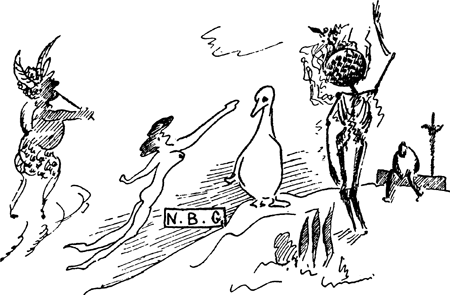
Figure 33
where he comes leaping in as Fate and separates the two lovers. The wraith-like young dragon, having red eyes, has an affinity with the red ball but dare not face it, and because of this is in great danger from the green slug, although it does not know it.’
In one aspect this drawing introduced the same idea as the Angry Ape. Thus the association of the red ball with the figure of Fate, who in the ballet had been dressed as the devil, seemed another way of referring to the Angry Ape and his raging desire to interfere with the chatting serpents. And since the red ball seemed also to stand for the irreducible ‘I’, eye, individual viewpoint, the essence of being a separate person, it looked as if the Ape picture had been describing, amongst other things, an actual experience of dawning self-consciousness.
Thus it seemed that the first taste of fruit from the tree of knowledge of good and evil in oneself might come at a moment when it necessarily tasted bitter; when being temporarily not wanted by one’s father or mother could indeed seem like the loss of all heaven and earth and all belief in any goodness anywhere. And this certainly would explain the title ‘Rats in the Sacristy’, for it was the name given to a book of essays I had once read,* dealing, as I vaguely remembered it, with the sceptical philosophers of history, philosophers who doubted the existence of any goodness of purpose in the universe.
But there was another aspect of the Rats in the Sacristy drawing which linked it to the N.B.G. picture and the splitting of problems into extreme either-or issues. For the predicament of the young dragon, shying off in terror from the irreducible separateness of the red ball, yet at the same time in danger of being swallowed up by the green sucker-slug, brought in another antithesis: on the one hand, trying to live as a completely separate person, as the red ball irreducibly itself, on the other, seeking for total merging and loss of all separate identity, such as in the feeling of complete at-one-ness with nature. And this theme of total submergence in
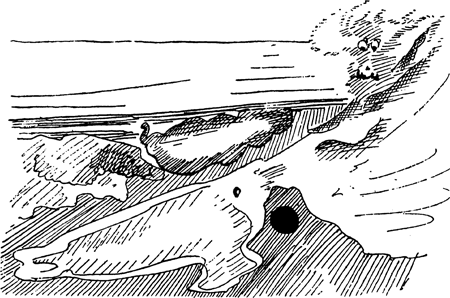
Figure 34
nature also suggested that the rats must stand for those gnawing doubts which could so often break in upon the peace of wholeness with nature. It was as if, in the moments in which one did not have to feel oneself a separate person, the shut out individual will might begin gnawing at the foundations of the mystical union with the other. And even the colours carried out the same theme. Thus the sucker-slug was grass green because in one aspect it did stand for this being swallowed up in and, therefore, one with nature. On the other hand red, in all these pictures, stood for relationship, aspects of love and hate in contrast with undifferentiated wholeness.
The rats picture was reversible. When looked at the other way up it showed the peace of a summer buttercup field, like that peace of wholeness with nature which had in fact inspired the drawing that turned itself into a heath fire. But across the sky there spreads a fearful drama of attack, as if to show the struggle going on in the inner world of feeling. ‘That which is above is within.’ So the drawing also seemed to illustrate the extreme antithesis or attempted separation of inside and outside. Incidentally, I was here reminded of the
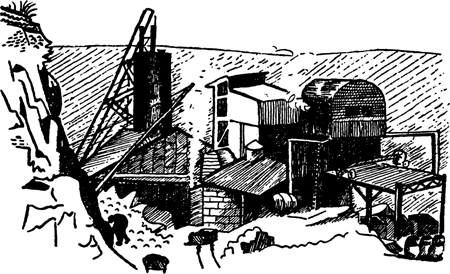
Figure 35
great difficulty I had had when making a landscape sketch in seeing the sky as part of the composition of the whole picture, I had always tended to treat it as something separate.
There was another drawing (Fig. 35) which appeared to be dealing with the same idea as the separateness and invulnerability of the red ball, but depicting it as stony in its separateness, and also linking this stoniness with logic and reason which stands apart from feeling. It was not a free drawing but a landscape sketch from nature, made long before I had any notion of the power to let hand and eye draw freely; at the time it had seemed to be just a simple copy of what was there, a quarry with some sort of machinery for breaking up stones. The drawing had been vaguely unsatisfying, but I had had no idea why. Then, ten years later I had happened to show it to someone who remarked on the curious difference of style between the drawing of the cliff on the left and the buildings and machinery of the main part of the sketch. Not having noticed this before and feeling some disquiet when it was mentioned, I had decided to write down whatever ideas the theme of the drawing suggested.
‘… that yellow cliff on the left with its curious lines like hieroglyphic writing, it makes me think of Cleopatra’s needle, also of the Sphinx, it is half like a person with a kind of crown and tufts of hair and a sharp spiky face. And just below the head, in the bulge of the cliff, is a shape like a heart, like the flint heart in that fairy tale which gave whoever found it omnipotent powers. And the quarryman below looks as if he were doing obeisance to it. A title for the picture keeps coming into my head;
“The Mills of God grind slowly
but they grind exceeding small.”
I think the yellow cliff has got to be ground to powder like the golden calf of the Israelites.
‘… Cleopatra’s needle, believing in the omnipotent magical command, how constantly people try to use it, in newspapers, sermons, everywhere, they say we must do this, that, as if that was enough. And it is made of stone, invulnerable, it stands apart and commands and does not spread itself and give of its own substance. In my mind it is close to the tables of stone of the Mosaic law, but also to the law of reason which stands apart from feelings. I remember that in the evening of the day I drew it we sat on rocks by the sea when the sun was going down and I asked H. something about mathematics, I forget what, and he began drawing graphs on a flat piece of stone to illustrate his answer. And always afterwards I have thought of that stone as the shape of a tombstone, with the ten commandments upon it. Now I feel that all these, the Cleopatra’s needle, the stone of the imposed moral law, and the imposed logic of reason, they are all in various ways, for me, the opposite of this other kind of control, which comes when the mind does not stand apart from the “other” and apart from feeling.’
Certainly these associations, combined with the title, suggested the fear that if one let go the stony insistence on individual will and identity one would be ground to powder and lose that identity for ever. So here again was the antithesis of extreme separateness as against total loss of identity. There was certainly fear, but there was also hope, for the idea of grinding to powder led on to the further thought of the healing quality of the drink made from the ground-up golden calf of the Israelites. Also I thought of the crucifix that had appeared in the corner of the N.B.G. picture and of how the enforced out-spreading of the arms of the crucified figure was linked symbolically with the voluntary outspread-ing of the imaginative body. Thus the crucifix could stand for the fear that spreading the imaginative body to take upon itself the form and identity of the other meant the bearing of intolerable pain, being vulnerable to the pain of the whole world, embracing and taking upon oneself the hurt and suffering thing instead of passing by on the other side. And the theme, again in the N.B.G. drawing, of drowning in the thick waters of the Colorado, also went back to that other fear which I had first guessed at when studying the plunge into colour; fear of the plunge into no separateness from the other when in fact that other was not only hurt, but oneself had done the hurting, in imagination even if not in fact.
I found another drawing which developed the idea of the deadness of reason and logic when separated from feeling (Fig. 36). It showed a mixed male-female creature; the head seemed to be the male part, spouting from its mouth a thun-dercloud and black lightning, and the body the female part, round and full of seeds. I had not before written down the ideas which belonged to it, I think I had not dared to. But now I tried:
‘The head is a clown’s head, it wears a clown’s collar and has a silly little red beard and red sprouts of hair and a red nose. And the thunder-cloud has red veins in it, like that little red parasitic plant which grows in heather, it’s called dodder – O Lord, that’s what the drawing says, the doddering male! And the thundercloud also reminds me of the thundercloud God of the Angry Parrot picture, also of that time when I suddenly saw Blake’s picture of God creating the world with a geometrical instrument, “The Ancient of Days”, as a drunken clown looking down from heaven. The thread-like feathery things coming out of the clown’s mouth are like stinging feelers, stinging words. The blackness of the thundercloud and the black lightning make me think of abstract words, intellectual discussions,
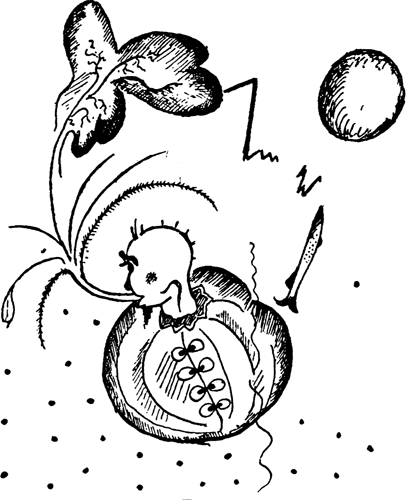
Figure 36
how they so often seem black and dead, none of the colour and life of words when they are used to describe particular things. The fish on the right is going to burst the balloon up above, it makes me think of how Charles II burst the balloon of the learned men’s arguments about the fish when he said, “Is it a fact?” The round body full of seeds reminds me of how I used to think there was an insoluble dilemma for women, “brains versus babies”.’
Here the imposed order from above, and reason, as dependent on abstract words, and maleness, and the wrath of God, seemed all to be identified. In fact the drawing seemed, amongst other things, to be mocking at the mathematical God idea of the physicists, but a mockery that covered fear.
Having seen that all these drawings presented various problems in a rigid either-or form, there was now this whole question of distinguishing differences to be considered. Certainly the particular distinction between thoughts and things was something I had often wondered about. I had often thought of the great undertaking every child has to achieve in coming to recognise that thoughts and things are different. I had thought about it also as a matter of history, what life must have been like before the development of objective science. It would have been so easy then to believe in magic and the evil eye, so easy to give up the task of observing and finding out where one’s practical knowledge was at fault, to relapse instead into feeling oneself the innocent victim of the bad spells and animosity of the witches; and so easy to be content with reciting a spell oneself instead of doing the hard work of finding out. In short, how true it was that
‘… if we do not know our environment, we shall mistake our dreams for part of it, and so spoil our science by making it phantastic, and our dreams by making them obligatory.’
Santayana: ‘The Supreme Poet’, op. cit., p. 154
Yet at the same time it might also be necessary to recognise that we have to pay a price for this achievement. I thought I had learnt, in general, how to look on the world with an objective eye, how to use a narrow focus of attention which shuts out the overtones and haloes of feeling and subjective seeing and keeps itself apart from what it looks at. Or rather, I realised now that I lived with a perpetual sense that one ought to look in this way, there seemed to be something always trying to insist that one should keep on the scientific blinkers and see only the clearly focused objective facts, shutting out the world as seen from the corners of one’s eyes. But it seemed that something else was continually demanding freedom from the blinkers, at any rate at times, insisting that to be without them did not necessarily mean to be mad and see things that are not there. Thus I was being driven to recognise that scientific objectivity was only a partial aspect of one’s relation to the world, and that both ways of looking were sterile without each other. In fact, one had to stand apart in order once more to come together again in a restored wholeness of perception.
I could now also see why I had thought of reason as dead and had had to put the mathematical symbols on a tomb-stone. For at that time I had not yet discovered the wide embracing kind of concentration that gives of its own identity to the particular nature of the other. I had not yet discovered how to link general and abstract ideas to particular ones, for I had not yet discovered the rhythmic interchange of the two kinds of attention. I had still thought that the analytic narrow-focused kind of attention was the only deliberate kind there was, and that deliberate logical thinking was the only kind of thinking there was. And the result had been that most of the vital experiences of living, which cannot be apprehended by the narrow-focused kind of attention, were left unthought about and only blindly lived. For I realised now that the main experiences, main facts of human life which we have to learn how to adjust to are living facts, people, both others and ourselves, living particular wholes existing in their own particular identity. And particular wholes can never be apprehended in their own individual nature by the narrow-focused analytic reasoning power alone; it required the same wide embracing spreading of one’s own identity, to apprehend the unique reality of a person as of a picture.
This antithesis of two kinds of attention could also be thought about in terms of the antithesis between male and female ways of being. Such an idea had been hinted at in the Dodder-Clown drawing and was further developed in another called ‘The Turkey-Conductor’ (Fig. 37). When I had drawn it the first thought had been a quotation from Blake:
‘Thus one portion of being is the Prolific, the other the Devouring. To the Devourer it seems as if the producer was in his chains; but it is not so, he only takes portions of existence and fancies that the whole.
‘But the Prolific would cease to be Prolific unless the Devourer, as a sea, received the excess of his delights.’
The Marriage of Heaven and Hell
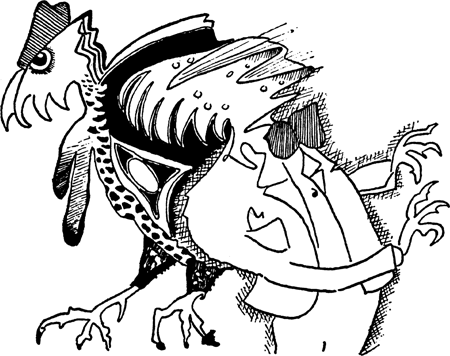
Figure 37
But now it occurred to me as significant that the two figures of the turkey and the conductor, in representing the male and female, were back to back instead of cooperating in creative action; with the result apparently that the turkey cannot give birth to her precious egg, and the conductor has no face and is conducting an audience that is not there.
Thus it seemed that this last set of drawings was concerned with the idea that there is a tendency of the mind to make broad distinctions, to split problems viewed into two extremes, and that the splitting is necessary. Certainly one has to make the distinction between dreams and reality, for instance, or between outside and inside, body and mind, doing and thinking. But having done that it is then necessary to bring the two halves together again, in a complex rhythmic interplay and interchange. And the method of the free drawings illustrated both this interplay and also its surprising results.