9
Reciprocity and ordered freedom
‘… as we perform a certain activity our thought towards it changes and that changes our activity.’
Follett, p. 62
‘… no human relation should serve an anticipatory purpose. Every relation should be a freeing relation with the “purpose” evolving.’
Follett, p. 83
The first and most obvious thing about the free drawings was that they were not according to plan. The idea of the limitations of planning, of consciously willed effort towards a foreseen end, was not of course a new idea to me intellectually. But it was quite another matter to try to act upon the idea and then find oneself up against the full strength of one’s inability to believe in any non-planned, non-willed order, as I was nearly every time I set out to do a free drawing. So often I found it necessary to mobilise every bit of willpower I could find in order to stop trying to use will-power to dictate the result. But when I did succeed in this I had the fact staring me in the face that the free drawings were so much more ordered wholes than those I had made by conscious effort to produce wholes.
The next task was therefore to try to find out something about the conditions under which the spontaneous ordering forces could express themselves.
First amongst the things to be noticed here was the fact that the mood or state of concentration in which the most expressive drawings appeared had a special quality. It was a mood which could be described as one of reciprocity; for although it was certainly a dreamy state of mind it was not a dreaminess that shuts itself off from the outside world or shuts out action. It was more a dreaminess that was the result of restraining conscious intention, or rather, a quick willingness to have it and then forgo it. Quite often there was some conscious intention of what to draw, at the beginning, but the point was that one had to be willing to give up this first idea as soon as the lines drawn suggested something else. And will did come into it to the extent of the determination to go on drawing, to keep one’s hand moving on the paper and one’s eye watching with a peculiar kind of responsive alertness the shapes that it was producing. In fact it was almost like playing a game of psycho-analyst and patient with oneself, one’s hand ‘talked’ at random, the watching part of one’s mind made running comments on what was being produced. (Cf. Fig. 1.) I found an attempt to describe the process in diary notes:
‘… in the meaningless scribble type of drawing the line fails to answer back and suggest the idea of an object or pattern; thought and line, thought and “other”, are quite out of contact. When this happens I often want to take refuge in the “trying-to-draw-something” method, in which one thinks of something, for instance a donkey, and tries to make the lines go right, not letting them have their say at all and allowing no interplay, like a person who monopolises the conversation. This I find produces an infinitely dull drawing, whether I try to draw the object as I remember it goes or try to impose motifs or stylisation. But there is something in between drawing random lines with all thought shut away, and trying consciously to make the lines follow a mental image. This is to draw a little, at random, spots, shadings or lines, then feel what these suggest and let the line go on, holding both it and the idea it suggests in mind, as it were organically with a whole body awareness, not trying to develop any thought line by line but letting the hand go where it will and letting the line call forth an answer from the thought. Often this interplay fails, as in the Ape in the Garden, where the ape grew from an interplay, but the trees on the right are definitely imposed, I had the idea that I would like some trees there and tried to remember how trees would look, but there was no reciprocal influence of the line back on the thought.’
Fig. 31 (a) and Fig. 31 (b) illustrated the difference between these two ways of drawing. Fig. 31 (a) shows a deliberate effort to draw from imagination, it was all I could do after weeks of determination to draw something ‘out of my head’; while drawing it I had said to myself ‘Here I will put a tree, here a dog, a dog surely looks like this, I wonder if
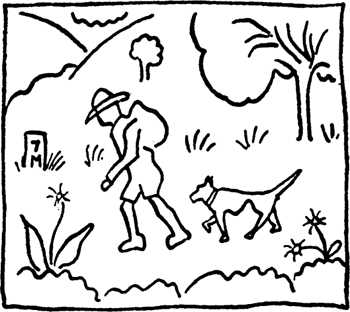
Figure 31 (a)
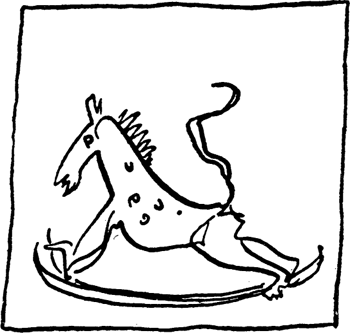
Figure 31 (b)
that’s right, how does a man look when walking, etc., etc.’ And the result was that the lines were like the stilted gestures of a self-conscious person who moves according to the idea of how he ought to behave, rather than by his direct feeling response to the situation. Fig. 31 (b), on the other hand, had been made without any preconceived intention, it emerged solely from interest in the movement of the line made by my hand on the paper.
The main thing about this mood of reciprocity seemed to be that it was an interplay of differences that remained in contact; though it was often tempting to give up the contact, give up the effort of moving one’s hand with the pencil and relapse into simple day-dreaming. The particular pair of differences that was in contact was ideas and action, thinking and making something happen by the movement of one’s body, an inner image and the record of a movement represented by the line actually outside on the paper. And it was when these two interplayed, each taking the lead in turn in a quick interchange or dialogue relation, that the drawings had appeared and had embodied in such a concentrated form a whole set of ideas that I had never known I had.
In one sense such drawings could be certainly looked upon as a kind of waking dream; for the study of the dreams of sleep shows what a richness of meaning can be concentrated in a few visual images. But they were certainly not like the usual waking dreams that one calls day-dreams, most of them were much more than wish-fulfilling fancies of what one might hope would happen; they seemed to be, some of them at least, very complicated reflections upon the central problems of being alive. The difference seemed to lie in the relation to action. In day-dreaming there is no action, thought is just playing with itself, but in the free drawings there was mind and body meeting in expressive action. And it was apparently just this that seemed to be the fertilising factor.
But if the meaningful drawings were the result of such a fertilising interplay, what happened when the drawing that emerged was nothing but an unrecognisable scribble? I did not by any means know the answer as yet. It seemed possible however that there was no recognisable communication in the scribble drawings because some set of ideas and feelings seeking expression had not yet been sufficiently worked over internally, not enough internal work had been done. Of course it might also be that some internal forbidding, based on fear of instinctive forces within, had succeeded in isolating the particular area of feeling and idea stirring at the moment, with the result that it could not become fused with recognisable images and socially meaningful symbols, but would remain private and incommunicable. Or possibly it had so fused with images but they were too instinctively direct and primitive to be acceptable to the conscious self; thus the scribbled line would get no answer from the thought, since thought was in the state of Fig. 22, by self-imposed edict it was blind and deaf and dumb. So what should have been dialogue would degenerate into an extreme monologue of action out of touch with thought, a meaningless babble of lines; just as, to a less extent, the ‘imposed’ kind of drawing represented a monologue of thinking that would not listen to what action had to say. But there was another possibility. The meaningful drawings might certainly be looked upon as the expression of a tendency of nature inside one to form wholes, a formative pattern-making tendency. But if patterns were not to become fixed, if they were to grow, there must obviously be an opposite tendency, one that would break down old patterns in order that new might come. And surely I had found that too, beginning with the first drawings of the heath fire and the blasted beeches. ‘Without contraries there is no progression’, said Blake. So here, perhaps, was another reason why chaotic scribbles sometimes appeared. For it might well be, although I suspected other interfering factors at work as well, that one might happen to draw at a moment when the disruptive forces were for the time being in ascendance, and even necessarily so.
In this connection there was one drawing (Fig. 32) which was hardly more than scribble and yet at the time it had seemed important to keep it. When looked at now it appeared to be a desperate attempt to impose a rhythm and coherent pattern on a chaos of feeling, a need that had apparently been so great that it had broken through the graphic medium and found expressive form in words used as part of the
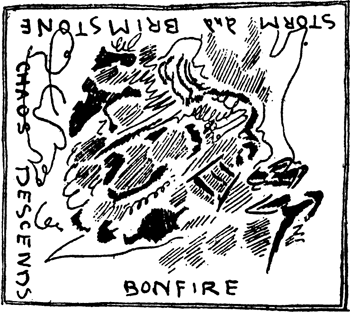
Figure 32
picture. I thought now that it expressed the idea that even chaos, once it has been given a name, is less chaotic. And this reminded me how, when going to a much-discussed Picasso exhibition and arriving ‘all-to-bits’ from the struggle of living, I had been lifted right out of it by the pictures. And this had seemed because here was someone with the courage to recognise and admit such inner chaos; whatever his position as an artist, he at least showed how deceptive the external wholeness of bodies can be, how one can look to the outside world like a whole person and yet be all in bits inside, full of conflicting wishes and chaotic standards, one’s self can be nothing but a caddis-worm shell of bits and pieces, picked up anywhere and stuck on anyhow. And he had managed to show this with a kindness and humour, at least in some of the pictures, which made it a much less intolerable fact to face.
One thing I noticed about certain of my free drawings was that they were somehow bogus and demanded to be torn up as soon as made. They were the kind in which a scribble turned into a recognisable object too soon, as it were; the lines drawn would suggest some object and at once I would develop them to make it look like that object. It seemed almost as if, at these moments, one could not bear the chaos and uncertainty about what was emerging long enough, as if one had to turn the scribble into some recognisable whole when in fact the thought or mood seeking expression had not yet reached that stage. And the result was a sense of false certainty, a compulsive and deceptive sanity, a tyrannical victory of the common sense view which always sees objects as objects, but at the cost of something else that was seeking recognition, something more to do with imaginative than with common sense reality. And here I noticed also how powerful was the intellectual process of recognising a certain shape as depicting a given object; how the naming it to oneself as a potato or a jug or a human face could completely shatter one’s awareness of the rhythmic relations in the scribble. Or rather, as soon as a scribble became recognisable objects the whole rhythmic pattern of it could become violently altered and pushed in another direction.
Certainly the ability to believe in an ordered result arising from the free coming together of the two differences, thought and action, did seem to depend partly on a willingness to accept chaos as a temporary stage. But later it was to become clear that this belief and this willingness were no simple matter. There was a drawing, for instance, called ‘If the Sun and Moon should doubt, they’d immediately go out’ (Fig. 41) which I did not as yet understand at all fully. But it included in its story a reference to the Castle of Giant Despair and certainly had to do with a possible despair about preserving anything good to believe in. For the moment, however, I was more concerned with discovering the exact nature of the creative interplay than with the forces preventing one from believing in it.