8
Preserving what one loves
‘O Rose, thou art sick!
The invisible worm
That flies in the night,
In the howling storm,
Has found out thy bed
Of crimson joy,
And his dark secret love
Does thy life destroy.’
William Blake
The ideas associated with the Angry Parrot and Angry Ape had led to the consideration of this one central hypothesis: that there might be some acute and critical moments in the history of one’s power to accept, emotionally as well as intellectually, the distinction between subjective and objective, self and other, wish and what happens. And not only could these moments include the remembered disillusions of childhood; for the blind and deaf and dumb head of Figure 22 suggested that there could also be other disillusionments, firmly hidden away and either actively forgotten or perhaps themselves belonging to the time before the remembered years.
But was there no way out? Had one no resources against the bitterness of such moments? These questions brought me back to thinking more about the phenomena of spreading the imaginative body to take the form of what one looked at. For might not this power to spread around objects of the outer world something that was nevertheless part of oneself, might it not be a way of trying to deal with the primary human predicament of disillusion through separation and jealousy and loss of love? For instance, I read:
‘In painting one of the prime sources of inspiration is the queer feeling that the subject is “yours”. You have enclosed it in your mind, you have absorbed it spiritually and are going to transform it into art. This sense of your spirit enveloping the subject comes naturally and instinctively.’
Jan Gordon: A Step Ladder to Painting, p. 125
So also Traherne said:
‘Cursed and devised proprieties,
With envy, avarice
And fraud, those friends that spoil even Paradise,
Flew from the splendour of mine eyes,
And so did hedges, ditches, limits, bounds,
I dreamed not aught of those,
But wandered over all men’s grounds,
And found repose.
Proprieties themselves were mine,
And hedges ornaments;
Walls, boxes, coffers, and their rich contents
Did not divide my joys, but all combine.
Clothes, ribbons, jewels, laces, I esteemed
My joys by others worn:
For me they all to wear them seemed
When I was born.
…..
Not fetter’d by an Iron Fate
With vain Affections in my Earthy State
To anything that might Seduce
My Sense, or else bereave it of its use
I was as free
As if there were nor Sin, nor Miserie.’
But surely it was a way out which did not always work? For Traherne also wrote:
But why did it not always work? Was it because, although by such spiritual enveloping of what one saw one did make it, in imagination, part of oneself, this was in fact an illusion, the things one saw were not really one’s own, one’s self was still really bounded with one’s skin; ‘hedges, ditches, limits, bounds’ still existed, although temporarily transcended. Thus however fruitful such illusion might be in enriching the imaginative life, however necessary it might be as a stage in coming to believe in the reality of the real world, it did contain a denial. It contained a denial of the basic fact of one’s bodily life which does not transcend space, and is totally dependent upon the transferring of matter (eating) from outside to inside and from inside to outside (excreting) for its continued existence.
I had already felt that there could be an imaginative connection between this spiritual enveloping of what one loved and eating, for I found an old diary note on this theme:
‘… the impulse to paint those flowers, crimson cyclamen, feels like a desire to perpetuate the momentary glimpse of timeless peace that is given by the extension of their petals in space. I want to taste it continually, swallow it, become merged with it – just like those feelings of wanting to eat a landscape, or even having eaten it; as if there was an equal expanse of space inside one, a sort of through-the-looking-glass land. And like when having drawn an animal at the zoo – eagle, panther, horned beast – with his still vitality, after drawing them I feel that I now possess these lovely vital things – rather like the childhood pleasure of having an animal as a pet.
Golden lads and girls all must
Like chimney sweepers
Come to dust.
That’s partly why I want to paint, in order to preserve.’
But if there was this connection with eating might it not explain why the inspiration of spiritual enveloping often failed as soon as one began to draw? Before beginning one could spiritually envelop the object and feel inspired, transcending space and separateness. But once begun it was necessary to face the fact of being a body that does not transcend space as the spirit can. At the moment of having to realise the limits of the body, when beginning to make marks on the paper, all the anxieties about separation and losing what one loved could come flooding in. And then there could come also, with the anxieties, an attempt to ease them by calling on the imposed moral law, turning to rules for the control of the Angry Ape; yet by that very reliance on rules perhaps stultifying from the start the very thing one was seeking to achieve.
Thus it seemed possible that inspiration of the enveloping kind might fail partly on account of its connection with eating and also on account of the inherent nature of eating. For though eating may satisfy the desire to have the good thing in one’s own possession, it certainly does not preserve that thing’s essential identity and nature, it rather destroys this identity in order to merge it with one’s own. This was also perhaps why the idea of spiritual enveloping had roused slight misgivings; it had suggested that subtle secret posses-siveness which, under the guise of loving consideration, can hardly allow the other to be itself at all.
Now I saw that amongst the free drawings there were in fact several which showed this theme of eating or engulfing.
Fig. 24. ‘I think this is really the Small Porgies creature from Kipling’s story, who came up out of the sea and ate at one gulp all the food that King Solomon had collected to feed all the animals in the world – only here the things he is swallowing look like seeds and he has got no eyes or features, only teeth and those hair-like feelers which seem to be guiding the prey into his mouth.’
Fig. 25. ‘Here again are teeth, they are flame-coloured and about to close on the black ball in the middle. The little red tadpole creature on the right has his hair standing on end in fear and astonishment at witnessing such a relationship. The bird up above was at first going to be the
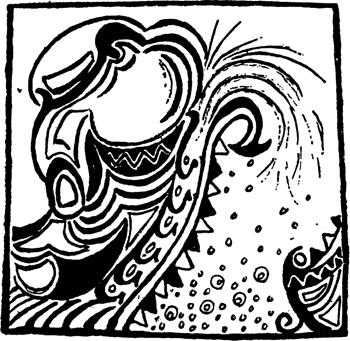
Figure 24
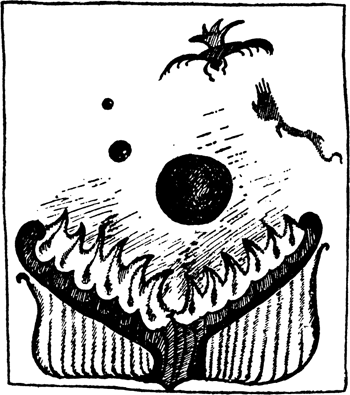
Figure 25
great black crow that frightened Tweedledum and Tweedledee into giving up their battle, but it seems to have dwindled a bit.’
In both these drawings there were teeth, so that the idea of enveloping an object spiritually in order to preserve it, which sounded a kind and loving thing to do, might not seem so if the idea of biting it up was also involved. The cannibal may be prompted to eat his enemy by love for his courage and strength and the wish to preserve these, but it is a love which certainly does not preserve the loved enemy in his original form.
There was another drawing which seemed to depict in quite direct terms the results of such imagined cannibalism, for the drawing itself showed no whole people, only bits of them. It called itself ‘Drawing without a Name’ (Fig. 26). I found the picture slightly horrible, as I had also found most surrealist paintings, a feeling which seemed mainly due to the impression such pictures gave of separate unregulated ‘lives’, the dominance of the accidental and lack of obedience to any laws, like the aimless malevolence of poltergeist phenomena described in books on psychic research. And the first thing I noticed about this drawing was the mouth theme, both in the two red-lipped faces and also in the apparently mouthless mannikin emerging from the eye in the main face; although in fact he has a mouth, but it is represented by the little black blob outside the circle of his face. In fact this last detail suggested that one might wish to push away the thought of the mouth as something too destructive, and pretend that it did not belong to oneself at all. And the eating theme was repeated in the jelly-fish shape on the left, the jelly-fish being a spineless creature that is almost nothing but an enveloping mouth; while the dots below it suggested the breaking into bits that is the result of eating, as did also the rows of dots in the body of the mannikin, though both these sets of dots also seemed to represent spores or seeds. The tufted caterpillar entering the ear also repeated the eating theme, since a caterpillar is always eating, continually making a trail of great holes in leaves, even causing sometimes, I believed, the death of an oak tree by its
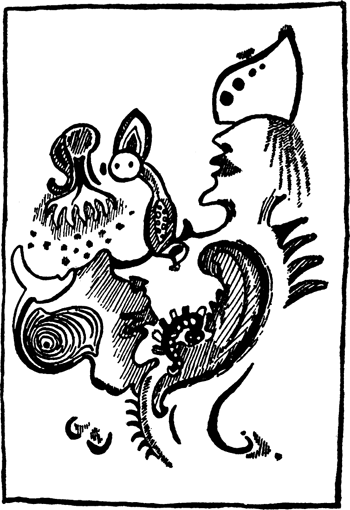
Figure 26
voraciousness. A reference to the fact that the first contact with the ‘other’ is with the mother’s breast seemed to be given by the round breast-like shape on the left; but this is shown surrounded by a shape which my first thought said was the handle of a crutch, as if the breast might have become injured by all these biting mouths. And here I remembered Blake’s words:
‘The caterpillar on the leaf
Repeats to thee thy mother’s grief’,
a remark which had always before seemed quite meaningless; but now I thought it expressed the fear that one’s babyhood greedy kind of loving could have injured the life-giving breast. The row of spikes on the back of the main head also introduced the idea of teeth, though the fear of possible results of biting had apparently led to the teeth being put well out of sight at the back. Here I remembered also the spikes on the back of the Grey Woman in the Angry Parrot drawing. As for the dunce-like eye-less head emerging from the main one, there was (as in Figure 22) the implication that all these meanings must not be seen or known, it was safer to remain ignorant. Finally a connection with the visual arts was implied in the fact that the mannikin whose possession of a mouth is denied actually grows out of the eye, thus suggesting that looking intently at an object, devouring it with one’s eyes, can seem also a potentially destructive act. Needless to say, no notion of such meanings as these was in my conscious thought when drawing this picture, I had merely been experimenting with a new box of chalks and amusing myself with whatever shapes my hand seemed inclined to produce. It was only the insistent way in which the drawing kept coming back into my mind which drove me to find meaning in it, as if it were a ghost persisting in walking until what it had to say was attended to.
Here then was another fact of babyhood experience to be taken into account, the fact that a baby’s first impulses towards the outer world are shown in the attempts to put everything in its mouth. And if one’s first attempts to relate oneself to the outer world are mainly in terms of eating, chewing up, swallowing, must not this fact leave its mark upon one’s subsequent attempts at relationship, especially the relationship of painting from nature; that is, if painting is to be a true exploring of the depths of feeling, not just a recording of matter-of-fact and detached seeing?
Further aspects of this same theme were also hinted at in a drawing of a human finger which turned into something I had not expected. I had intended to draw from memory an outdoor café scene and had begun with the waiter; but after he was drawn it occurred to me that he was not really a waiter but a butcher. What is more, he insisted on being given the title of ‘The Pregnant Butcher’ (Fig. 27). And when looking at this sketch I remembered how, in the ‘Drawing without a Name’ the bits in the body of the mouthless mannikin and the bits falling from the jelly-fish shape, were also 72 ON NOT BEING ABLE TO PAINT
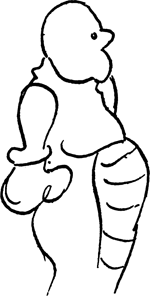
Figure 27
seeds; thus the idea of the butcher being pregnant was surely expressing the idea of giving the object new life as an artistic creation, in fact, the idea of the artist as creator. But this thought brought back my original anxieties, for the butcher, although he might be pregnant, was none the less a butcher. I could not still the doubt that what he created might be bad, since it grew out of an initial destructive act. And there were also other drawings suggesting the potentially sinister aspect of creation: for instance, ‘The Farmer’s Wife’ (Fig. 28), an unpleasant creature who puts the tails of mice into her cauldron. Also this cauldron was associated with those witches in the Macbeth drawing who brewed evil from their pot, and again suggested the doubt whether what was produced from the initial destructive act of cannibalistic incorporation might not be also destructive and evil in itself.
This last idea seemed possibly to explain the quite unreasonable fears that a painting would be ‘no good’, fears which
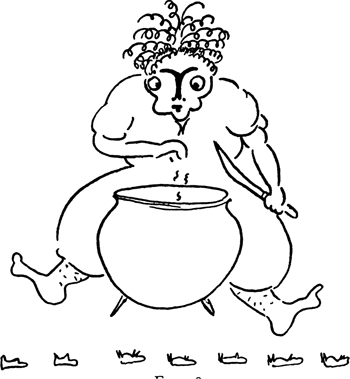
Figure 28
could so often make it impossible even to begin. I say unreasonable because reason said what did it matter if it was not a good picture. If it were bad it could be torn up, it was absurd to feel it so much a matter of life or death whether the picture was good or not. But evidently in one part of the mind they were felt to be life-and-death issues, and this was clear from the associations to another picture (Fig. 29). It was called ‘Queen Elizabeth and the Bashful Parrot’, and the thought that emerged after drawing it was a half-remembered verse, by Kipling, about Queen Elizabeth looking in her mirror:
‘Queen Bess was in her chamber, and she was middling old,
Her petticoat was satin, and her stomacher was gold.
….
Singing, backwards and forwards and sideways may you pass
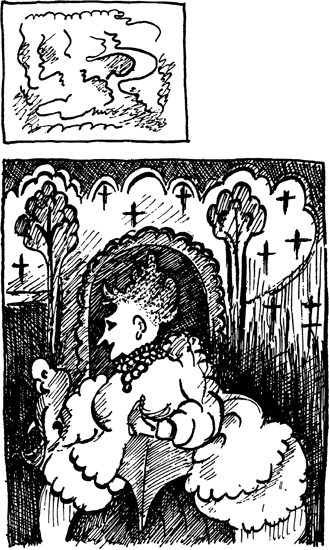
Figure 29
….
But you’ll never see a queen as wicked as you was.’
The crosses in the background stood for graves and I realised as I looked at her that Queen Elizabeth herself was also Hecate, Queen of the Dead. No wonder then that the parrot was bashful and afraid to take the risk of bringing out what it had taken inside, if it could so feel that the inside world might be a world of the dead. The scribble at the top of the page is the first version of the drawing. I had been dissatisfied with it as meaningless bits and had nearly given up the effort to draw altogether.
It seemed then that one could attempt to avoid the sorrow of change and separation and loss by spiritually enveloping what one loved and taking it inside oneself, but that this did not really solve the problem; for there was still the fear that by having it inside one might have destroyed it. To an established painter, who knows that he can successfully bring what he has taken inside himself back to life in the outside world as a painting, there may be less anxiety in this act of spiritual envelopment in order to paint; but for those of us who have no such knowledge it might seem much safer to make the spirit firmly keep itself to itself and not venture out on any enveloping expeditions.
There was one drawing, made later than those so far shown, but it seemed to be a sequel to these so may be appropriately considered here. It was called ‘The Mount of Olives’ (Fig. 30), and its story was:
‘… the bones sticking up out of the sand make me think of “The Skeleton under the Sea”, the blasted olive tree on the left is a little like the blasted beeches, and also brings to mind the storm in King Lear. And the top of this stunted tree reminds me of the frightened little tadpole creature who was witnessing some primitive devouring process (Fig. 25). The shadowy path in the centre seems to stop at the bones, as if the path forward were blocked by the skeleton.’
I did not understand its significance at all, especially the idea of the skeleton blocking the path ahead, until after
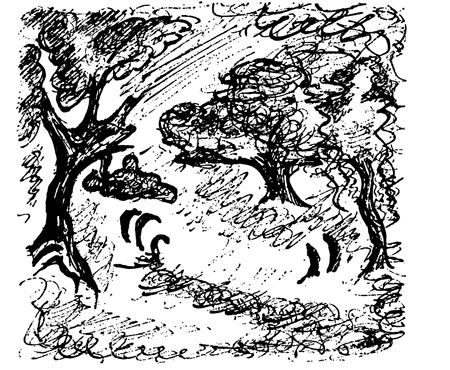
Figure 30
thinking for a long time about the meaning of the earlier drawings. In fact I did not see what it was about until I saw the aspect of the earlier ones which was to do with the magical fulfilment of a wish. For then it became clear that the Mount of Olives drawing showed the sequel, in feeling, to the magically fulfilled destructive wishes of some of the earlier drawings. Thus, by its reference to the horror-struck tadpole of the flaming mouth picture it hinted at an emerging horror at what had been done in thought and wish; both in the primitive devouring relationship and in the storms of rage at frustration, storms linked with the thought of King Lear’s raging when the doors were shut against him. It showed how the flaming mouth-like thing could stand for the primitive ruthlessness of a love which in the beginning cannot help but destroy in imagination what it loves. Thus I could now see further into the implications of the idea that behind the comparatively sophisticated destructiveness of jealousy and rebellion against authority is a more primitive kind. It is a kind that is inherent in the double fact that what one loves most, because one needs it most, is necessarily separate from oneself; and yet the primitive urge of loving is to make what one loves part of oneself. So that in loving it one has, in one’s primitive wish, destroyed it as something separate and outside and having an identity of its own.
Thus there appeared to be a further reason for fear of spreading the imaginative body and plunging into experiences where the boundaries of personal identity were transcended. Not only could such experiences mean giving infernal life outside to denied wishes and impulses of one’s own; they could also mean embracing a pain and suffering which one had one’s self been the cause of. And when what was suffering was also what one loved most the guilt and remorse could perhaps be very nearly intolerable, one could easily fear being overwhelmed and drowned in the pain of it.
All this also suggested a reason for the presence of the Thunder Cloud God in the Angry Parrot picture. Undoubtedly he in part represented actual lived-through experiences of a frightening father, in league with the mother, as a commanding and punishing authority. But the Mount of Olives picture also suggested that despair about the potential destructiveness of one’s primitive love, and its attendant hate, could drive one to set up a terrifying God within, almost as a second line of defence. It seemed almost as if one could seek to provide for a control through fear, in case the power of one’s concern for what one loved was not strong enough alone to control the destructiveness.
Such a formulation as this surely also could clarify one’s basic assumptions about education. I had lived through the years when it was common to hear certain groups of people talk about ‘good’ and ‘bad’ as if they were categories imposed by a repressive regime of child rearing; as though it were a fact that if parents never called their children naughty, children would never feel naughty, never suffer guilt feelings. But now it was surely clear, to me at least, that one needed no imposed moral code to teach one that it was bad to spoil what one loved, good to preserve and keep it safe. Thus it did certainly seem that there is an inherent as well as an implanted morality. It did certainly seem that one struggles to control greediness and aggression in oneself, not only through fear of being punished or losing other people’s love and respect, but also to avoid injuring or even destroying whatever seems to oneself to be beautiful and lovable and necessary. Thus one feels guilty, not only because one has been made to, but also because one knows only too well that there are real grounds for it; in the psychic reality of feeling and wish one has failed, one has certainly, some time or other, been callous and greedy and resentful and destructive. So in one’s inner world, perhaps locked up and hidden far away beyond one’s knowing, there do exist loved people who have been hurt or even made into dead skeletons by one’s angry wishes.
If all this were true then one of the functions of painting was surely the restoring and re-creating externally what one had loved and internally hurt or destroyed. At least, this certainly seemed to be one of the underlying themes of the drawings so far considered. And I realised now that this was also part of current psycho-analytic theory on the subject,* although I had not thought that I had had any intellectual grasp of the theory when I first began making free drawings. But there was that other aspect of the function of painting to be considered, the even more primitive one which the series of drawings on the theme of ‘Earth’ had introduced. For these had led me to suspect that painting goes deeper in its roots than restoring to immortal life one’s lost loves, it goes right back to the stage before one had found a love to lose.
It was this aspect of the function of art that became clearer when I considered the method of the free drawings and the role of this method in realising, or making real, the external world. In fact, I came to see their role, as also the
* Theories worked out largely by Melanie Klein, on the basis of Freud’s discoveries (such as those described, for instance, in his paper on ‘Mourning and Melancholia’) and through her own work with children.
role of the psycho-analyst, as facilitating the acceptance of both illusion and disillusion, and thus making possible a richer relation to the real world.
It was now possible also to see more clearly the relation of this study to earlier ones. In two earlier experiments I had especially studied moments of happiness and significance. In this one, by trying to study difficulties and failures of significance, I was coming to see that certain inescapable facts of the human predicament had not been sufficiently taken into account in the earlier studies. They were certainly facts to do partly with the primitive hating that results from the inescapable discrepancy between subjective and objective, between the unlimited possibilities of one’s dreams and what the real world actually offers us; and also to do with the special way in which ‘the lunatic, the lover and the poet’ (or painter) try to transcend this hate and either succeed or fail. But they were also facts to do with the way in which our whole traditional educational procedure tends to perpetuate this hate, by concentrating so much on only one half of our relation to the world, the part of it to do with intellectual knowing, the part in which subject and object have perforce to be kept separate.
It was now necessary to study the particular method by which the free drawings had been produced. It was largely through this that I came to have some idea of the creative way out from the primary human predicament, a way out that gave due recognition both to the need for separation and no-separation.