7
Disillusion and hating
‘And then I changed my pipings,–
Singing how down the Vale of Menalus
I pursued a maiden and clasp’d a reed:
Gods and men, we are all deluded thus.’
Shelley
Although it had been impossible to escape from the idea that these monstrous creatures could in some way represent parts of myself, there were still many questions to be asked about them. For instance, where had they really come from? Had I, in fact, felt like that once even if there was no conscious knowledge of it? Or was there being no knowledge of the feelings the very reason for their appearing in this monstrous form? And was I still secretly harbouring such monsters; because they had been denied were they still lurking somewhere, remote and separate and therefore unmodified by common sense and experience? And if so, what was their cause, was it just ‘original sin’, an inborn inheritance of primitive aggressiveness? Or were they only due to the unnecessary frustration of a too rigidly ‘moral’ upbringing and restraint of instinctive freedom? I knew some people believed this last theory, they believed that man was born ‘good’ and that it was only unnecessary frustrating authority that made him ‘bad’. In order to investigate such questions I looked at some more of the drawings, and found that many of them certainly did deal with the theme of rebellion against an imposed authority and imagined destruction of it.
There was one drawing, for instance, which showed a blazing castle on a hilltop, with shadowy figures in the foreground (Fig. 19); while making it I had had no idea what the figures were doing but when it was finished the following story had emerged:
‘… of course, the horseman on the right is Macbeth, he is watching, bewildered by what he sees, but with a dim possibility in the back of his mind, though he is still the noble servant of his king. On the left are the three witches, hatching the nefarious plot. And the burning castle above, what do castles mean? Castles, law and order, the seat of government, power and protection, the king – all that is being destroyed just as Macbeth destroyed Duncan.’
Further aspects of the problem of rage against authority were shown in other drawings. For instance, just as the one called ‘Freedom’ (Fig. 16) had indicated that one might not only have wanted to attack and destroy the frustrating authorities but also feel as if one had actually done so, internally and in imagination, so also in another picture (Fig. 20) called ‘Skeleton under the Sea’. This had begun as a
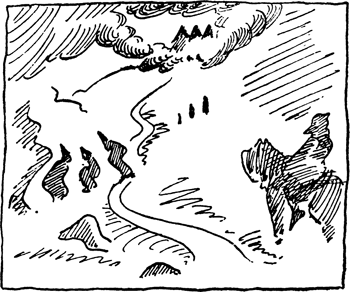
Figure 19
free water-colour sketch made only with a brush and in different tones of blue; it had turned into a landscape of jagged ice mountains, in which the dim shape of an ice demon had frozen sky and earth into an agonised tension of lifelessness. Actually I had painted over the ice demon as soon as he appeared, feeling quite unable to face him, and had then torn up the picture. Later in the day, however, I had begun another painting in blue which had finally emerged as the Skeleton under the Sea. After it was finished I recognised it as belonging to a fairy tale I had once written. In the fairy tale there had been no explanation why the skeleton was there, the story had only been concerned with attempts to bring it to life. But I thought now that the torn-up ice-demon picture did throw light on the origin of the skeleton; for it surely showed ideas of how an alien force from above could freeze up the flow of life, congealing and fixing the free movement of feeling into a pattern of outwardly correct behaviour and inner lifelessness, as a young rabbit is frozen at the approaching shadow of a hawk.
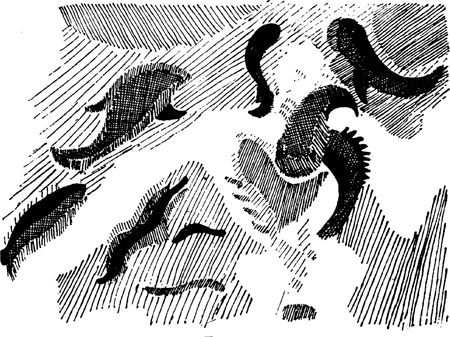
Figure 20
Incidentally, I noticed here how very wholesale the blind thoughts of the mind could be; they seemed to look on the controlling influence of imposed rules, authority, orderliness, as something utterly fixing, instead of as a support necessary in moderation when the free movement of feeling threatens to become an overwhelming sea. Thus authority appeared as an absolute and deadening tyranny which could only be dealt with by an absolute and complete destruction through committing it to the depths of the ocean. But if this absolute idea of order as something relentlessly imposed from above could be the basis of one’s unwitting thoughts, no wonder it might be difficult, in painting as well as in life, to combine free expression of mood and feeling with an ordered and well-planned design. If, in imagination, one could destroy the very symbol of order and control within oneself, then no wonder it might at times feel that one had no resource but to copy the ordered behaviour of others, whether in painting or in living.
Another drawing (Frontispiece) called ‘The Angry Parrot’ showed not only rebellion against the controlling authorities but also the feeling of urgent need for their protection, even for their help in controlling the anger they themselves aroused:
‘… the bird is angry and terrified – terrified of the waves that seem likely to engulf it, angry lest the precious egg be taken away. The egg is important, partly because it floats on the sea and so provides a resting place, also the parrot feels it is going to hatch into something very important though it is not sure what. And it is afraid that the Grey Woman is going to take the egg away, also that the black pincer-like thing coming down from the skies is going to attack it, perhaps at the Grey Woman’s suggestion.
‘The Grey Woman is very powerful, she is not harmed by the waves and can even calm the storm by her presence, for there is a gleam of sunlight on the water near her. She is looking rather pained at the parrot’s anger and greedy determination to hang on to its egg, and she has in her hand a bunch of sweet-smelling flowers, which shows she knows where the safety of the land is, whereas the parrot does not. But the flowers are like the bunches carried by judges in the old days to protect them from the smell and disease germs of the prisoners: and for all her mild looks she is there to judge and although she tries to hide those nasty purple spikes down her back they are there just the same. For all her saintly looks I think she is really greedy, or the parrot thinks so, anyway, it thinks she’s got designs on the precious egg.
‘As for the black thunder cloud shaped like claws, it’s probably God and the murky beam to the Grey Lady’s head suggests she is the Lord’s Anointed – anyway, she is definitely in league with the thunder cloud and could probably persuade the thunder-pincers not to grab the parrot – if she wanted to.
‘On the whole I think the parrot is in a difficult position; it needs the protection of the Grey Woman, and will have to please her if it is to get safely through the storm without being drowned: but it thinks she is an old hypocrite and not to be trusted too far. Lord knows what is going to happen to the egg.
‘The parrot certainly seems to be me. What then is the way out, how is it going to escape being drowned in those stormy seas of feeling? For if it gives in to what “they” want, the grabbing Thunder-god and the Grey Lady, if it lets them take its precious egg, it feels it will lose its identity altogether and never be a separate person at all. And yet if it does not give in they may destroy it as a punishment or go away altogether and leave it to drown.’
It was clear, of course, from the story of this last drawing, that it referred in part to the psycho-analytic situation, it represented the common fear that being analysed meant having to give up something that one was clinging to. But I felt sure it did not only refer to this, it had a bearing upon the general educational problem as well; for I suspected that if I only knew what the parrot was so afraid of losing I would also be able to see more of what current educational practice was leaving out.
What then really was this egg that the parrot felt could alone save it from drowning in the stormy seas of its own anger? At first I had thought it was just a symbol of childhood wilfulness, the childish belief in oneself as the centre of the universe and in one’s own right to have what one wants and when one wants it. I had thought that the parrot’s anger was based on the fact that every child’s first love is totally exclusive, its whole world is its mother, and its feelings when it first discovers it has to share her can be very tempestuous. I also thought that the parrot’s fear was partly because, being so utterly dependent, a child is therefore terrified of being separated from or earning the displeasure of those it loves so much and needs so much. I thought the picture also showed what happened later when the loved and commanding and feared parents, who formerly controlled the disruptive storms of rage, are no longer standing by, it showed what went on inside oneself, when the parents’ demands seemed to come from within, from a judging and demanding conscience. But here came in the angry parrot’s dilemma. For to do things or not to do them just because ‘they’ said one must or must not, or because ‘they’ would be pleased if one did or angry if one did not, even if ‘they’ seemed to be inside oneself, this was surely an evasion. It was an evasion of the responsibility of being a separate person who could not, without dishonesty, see permanently eye to eye with anyone else. Of course, such conformity was necessary at times, or social living would be impossible, but it was no solid rock on which to base one’s living, for it seemed a bartering of one’s birthright of the unique viewpoint. I had often enough found myself behaving according to these inner commands and then been shocked to notice that they were not standards which I myself agreed with at all; I had taken them over wholesale, oblivious of the fact that they were often in direct conflict with my own feelings about what was valuable in life. But although I had often thought over such matters I had not realised, until I looked at the free drawings, how violent the rebellion against these inner authorities might be; and I had not thought at all that such an inner fight might interfere with attempts at creative activity. I had not thought that one’s hidden rebellious feelings against order imposed from above could perhaps rush in, like a raging heath fire or blasting storm of cold fury, and fiercely attack the inner commanding authorities, like the fury of a wild creature defending her cubs. I had not fully realised that the restraint of one’s will imposed by authority could at times feel like a threat to one’s whole existence, an attempt to separate one from the very source of one’s creative relation to the world; and that to give in to this imposed restraint could at times feel like the deepest cowardice and betrayal of one’s whole identity.
But this meaning for the egg, as standing for the sense of one’s own separate identity, in so far as this is bound up with one’s own personal urges towards the world, seemed to be only a partial explanation, true as far as it went perhaps, but not going far enough. In fact I began to suspect that it was not just the over-riding of one’s will that was so hard to bear; it was something deeper than that, more to do with the danger of losing one’s whole belief in any goodness anywhere, it was this that the parrot was so frightened of and angry about.
I now found two drawings, one made immediately after the other, which showed not only a fury of rage against frustrating authority, but also a process of denying such rage (Figs. 21, 22).
The first had started from a scribbled shaded line that had turned itself into an ape-like creature; but it was not until several days after drawing it that I had noticed its implications and the violence of the emotions implied:
‘… the ape creature is terrified of something. I remember that when drawing it I wondered what he was so scared of, it seemed to be something outside the picture in the direction he is looking at. Now I see that he is turning his head away from his own hands, hands which are red with blood and aching to attack the two serpents. The serpents are chatting happily together, it is their garden, Adam and Eve, parents, and they can’t be bothered with the ape, in fact they have no idea how awful he feels. The tree is the Tree of Knowledge of Good and Evil, the ape is turning away because he cannot bear to look at them and face the jealousy and rage and fury they arouse: fury partly because he is shut out and doesn’t know what they are
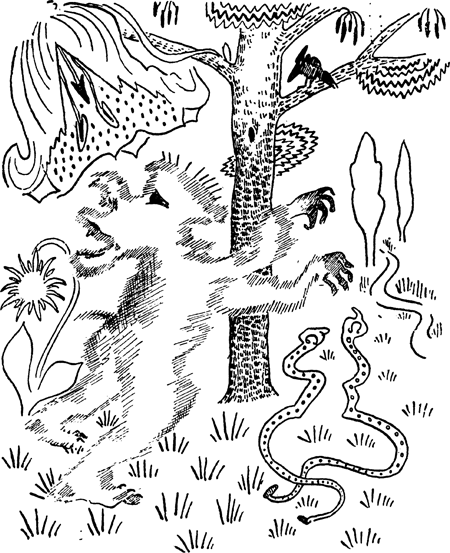
Figure 21
talking about, like a child whose parents have shut the door in its face, partly because they own the garden and can order him about.’
Immediately after making this drawing and before thinking at all what it might be about, I had turned to a fresh sheet and done another (Fig. 22). The following description of it had emerged:
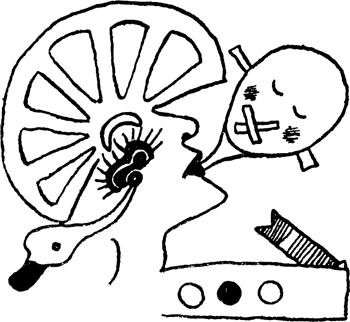
Figure 22
‘… that head with its ears stopped, eyes shut, lips sealed, blind and deaf and dumb, it’s surely a picture of defending oneself against something that is too awful to know. Yes, and the wheel-like thing looks like a Grecian helmet, a protection, protecting oneself from knowing. I think it’s shaped like a wheel because of the way thoughts go round and round in one’s head when there is something too painful to face. And why this hairy ear and the duck coming out? Oh, I see, of course, hairy ears like a donkey, escape by not knowing, being a nitwit, fool, donkey. And the duck, surely that’s a defence against psycho-analysis, the suggestion that its interpretations are all quackery, I won’t listen to them. And the red signal, that’s a danger sign, though the fact that it is “down” suggests that there are mixed feelings, the hint of a hope that the situation is not really so dangerous, only an imaginary danger.’
This second drawing coming immediately after the first did, I thought, confirm my guess about the meaning of the other angry drawing, of the parrot defending its egg. For the Angry Ape and its sequel seemed to be saying that what had to be so urgently defended against was knowing an experience of disillusion, a disillusion that if known about could seem to threaten all one’s belief in any goodness anywhere. Certainly there was in the Angry Ape drawing not only a depicted experience of rage against frustrating authority but also a recorded experience of disillusion; for the father and mother serpents are certainly not living up to the ideal expected by the ape child.
Having reached so far, was it not now possible to attempt some answer, in a more general way, to the question about where the monstrous rages came from? Was it not perhaps true to say that the Angry Ape drawing depicted a more or less inescapable aspect of the human situation, an inescapable result of the fact that men are not born knowing the difference between thoughts and things? For if the idea of perception being no primary phase of consciousness was true, then was not the parrot’s egg partly a symbol of the necessary illusion of no separateness between subject and object; an illusion which, if shattered too soon and too suddenly, could perhaps be felt as undermining the very foundations of one’s hope of eventually achieving a true objectivity?
There was also another drawing which showed, to a less dramatic degree, the attempt to get away from the knowledge of emotions of jealousy and hate, in fact, to escape the knowledge of disillusion. It was called ‘The Escaping Bear’ and its story was (Fig. 23):
‘Those three creatures that look like beetles are really eyes, “I’s”, they are involved in a stream of attraction and repulsion, two are being drawn towards the central figure by the beams of words, feeding on the beams, one is being driven away, both by a stream of words and beams from the eye. The three-faced figure with the paper crown is like the King and Queen and Jack in a pack of cards. The little bear on the right, coloured green, is trying to get away from all this attraction and repulsion of eyes, but finds that it bumps along behind him like a tin can tied to a cat’s tail – he’s got to “bear” it, whether he likes it or not. “That we may learn to bear the beams of love,” Blake said. But of hate, too, beams can burn as well as warm, can blind, destroy the eyes, the “I”.’
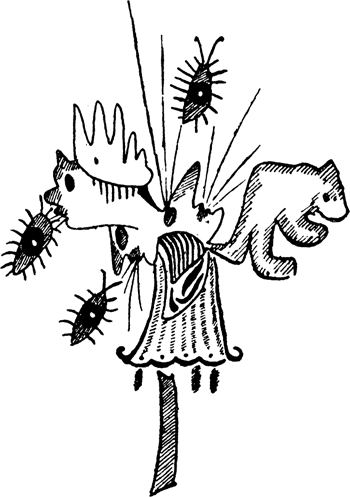
Figure 23
Of course there were also other aspects of the role of illusion to be considered, not only its role as a bridge leading to objectivity, not only the emotional disaster that could arise if the bridge were broken too soon and the change from innocence to experience not accomplished in the child’s own time. For instance, there were the advantages of disillusion to be considered. Undoubtedly the dispelling of an illusion is something that works both ways, it can not only be a source of rage and disappointment but also a source of relief; as when one wakes from a nightmare, or finds that one’s imaginary fears are imaginary.
There were also further aspects of the need for the controlling force, as well as rage against it to be studied. These were to be forced on my attention when considering the subject of rhythm in painting, together with those qualities of a work of art which are usually spoken of under the name of form as distinct from content. They were to raise the whole problem of one’s capacity to believe in any non-willed order, any force working for good that was not part of one’s conscious intention and plan; but meanwhile there were more monstrous creatures to be considered, not only angry but also hungry ones.