6
Monsters within and without
‘A Secret self I had enclosed within,
That was not bounded with my Clothes or Skin
….
It did encompass and possess rare Things.’
Thomas Traherne
One of the things that had been so dissatisfying about those deliberate drawings which were sheer copying of the object was that they had no life in them. Now I read:
‘The true amount of mental sympathy that the student can give to the subject he wants to draw creates a sense of life in the picture. This is very important. From this sense of life the picture begins to have a value of its own, an internal or spiritual value that the artist has added to it, quite separate from its interest as a mere copy of the subject.’
Jan Gordon: A Step Ladder to Painting, p. 68
But how did this mental sympathy really come about and what was its nature? Apparently in painters’ language it was spoken of as ‘action’:
‘In this sense of what we have called action lies much of the true vitality of the drawing. An artist’s drawing differs from that of an engineer because the artist’s must have a kind of subconscious spirit of life. Much of that strange life in a good drawing comes from the artist’s power to seize the action of what he is drawing….
‘A mere jug or a basin standing on a piece of paper has in it a definite amount of action. The jug is standing on the paper: it is exerting its energy downwards … The piece of paper also has action. It is lying flat.’
Gordon: A Step Ladder to Painting, pp. 64–67
But how did one come to perceive this kind of action in what one saw? How did one in fact give it this spiritual life of its own? One painter’s answer was:
‘Everyone has two bodies, the real body and the imaginative, whimsical, adventurous, astral self. The real body may go on with its humdrum existence while the astral body is prancing alongside, driving cars at a thousand miles an hour, strangling lions in the Strand. The astral body strolls casually in to lunch at the Savoy while the real body creeps more humbly into Lyons.
‘The ordinary man’s astral body is of little use, but the artist pulls his in, and sets him to work. At one moment he may have to be a jug, at another a bunch of carrots. When the artist is drawing a living thing, that astral body must become the living thing, it should act as the living thing is acting…
‘At first you may find this astral body a little rebellious, it would far sooner be an aviator flying the Atlantic than a bunch of carrots: it would rather pose as an unrecognised genius coming into his own than flatten itself out into a field for cows to chew. But by persistent drilling your astral self will come to heel and at last should get tremendously interested in this art job. It must end up as your most enthusiastic help.’
Gordon: A Step Ladder to Painting, pp. 206–207
But what was this other adventurous self? Certainly the idea of everyone having an imaginative body as well as a physical one seemed likely to be connected in some way with the transfiguration of the object in the light of one’s own dreams. But this thing that one could deliberately spread out, was it really the same stuff as one’s dreams? If so, why was it so essentially spatial and yet at the same time infinitely pliable and receptive? Certainly I had repeatedly found, only had been almost unable to believe my own observations, that my whole relationship with other people as well as objects, works of art, nature, music, could depend upon what I did with this imaginative body rather than with my concentrated intellectual mind. And the main thing about this capacity seemed that, although obviously an aspect of the mind, it did feel like a body, in that its essential quality was this sense of extension in space. It always had a more or less spatial shape, even when to do with music, in contrast with the more intellectual capacities of the mind concerned with reasoning and argument, which seemed somehow above or abstracted from existence in space.
Although not fully understanding just what this thing was that could be so spread out I tried deliberately using it by setting myself exercises in seeing ‘action’ in nature. Surprising things happened. For instance:
‘… that chair I am looking at, it seemed to be rearing its back, throwing forward its seat, straddling its legs, full of aggressive defiance. And that chest of drawers over there, it’s like a great sinister grinning mouth, like Mickey Mouse’s piano that danced about and gnashed its teeth.’
But this surely was not the kind of action the painters talked about, it was something much too primitive and childish and vehement, more like the animism of savages which sees spirits and magical influences in all the objects of nature.
When looking for an explanation of this experience the thought of the free drawings forced itself into my mind, together with an urge to study what they were actually about.
I had, of course, already recognised that they were about feelings or moods, that the blasted beeches and heath fire and Noah’s Dove drawings represented states of mind, they were not records of external facts but of internal ones. But up to now it had seemed that they were records more concerned with psycho-analysis than with painting. This was mainly because the majority of them had emerged at a time when I was undergoing the process of Freudian psycho-analysis myself. I had undertaken it partly with the intention of gaining added equipment for scientific work, and it had been during the early period of the analysis that I had often, in
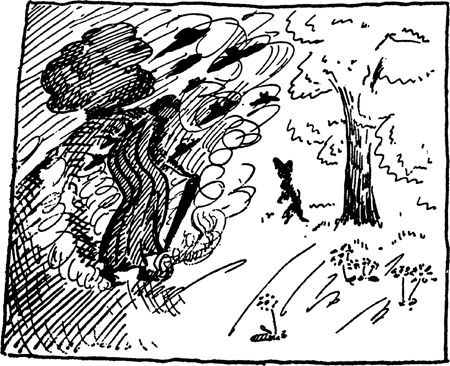
Figure 12
moments of relaxation in the evenings, settled down to draw by the free method. I had tried not to see any connection between these drawings and efforts to learn to paint, because psycho-analysis was part of work and painting was not, and it had seemed preferable to try to keep them separate. Clearly many of the stories of the drawings illustrated recognised aspects of psychoanalytic theory, some of which I had actually discussed in analysis and read about; also the drawings had usually been shown to the analyst. But although I had myself seen psycho-analytic meanings in some of them, from time to time, I had so far never studied the drawings as a whole, either in relation to the special problems of learning to paint, or in their relation to the question of how both one’s gods and one’s devils could take up their shrines in the external world.
With this idea in mind I remembered that there were many of the free drawings in which some sort of monster
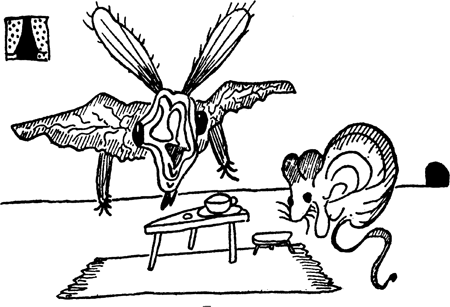
Figure 13
appeared, and I now sorted these out. The first noticeable thing about them was that there was usually a harmless and innocent creature, as well as a nasty one, and that I myself was identified with the innocent one; as if one might be trying to feel that this was what one’s real self was like. Also the harmless creature was usually threatened by some sort of danger from the unpleasant one. For instance, there was a drawing which had emerged once when, after a day of walking in the country and wondering about the difficulties of drawing from nature, I had begun idly scribbling in charcoal (Fig. 12). The following story had emerged when I looked at the drawing:
‘… the little shadowy animal on the right, a sort of Mickey Mouse, was walking in the summer woods, happy and revelling in the sunshine. Suddenly he sees smoke and greyness coming towards him, blasting the green things, a witch approaches, foul and bent with huge bats flying round her head, stinking things buzzing like blow flies round a corpse. Wherever her feet touch the earth they burn up the grass and flowers, blasting the whole summer day, leaving a trail of grey desolation behind her and a hot blood-red sky.’
There was also Figure 13:
‘… the good obedient little mouse has come out to eat his frugal supper. But in through the window has flown a frightful blood sucking creature, half mosquito, half bat, who is going to steal the mouse’s supper – and outside the window there are plenty more like him.’
and Figure 14:
‘… the young donkey, silly and innocent, was happily looking at its own reflection in the water, admiring itself and the beautiful waterlily. But from under the water-lily comes this serpent creature. I remember when painting it that I thought I was painting the ripples in the stream, but they turned out to be this creature. All the same, I think it is only mock sinister, not nearly as awful as the Blasting
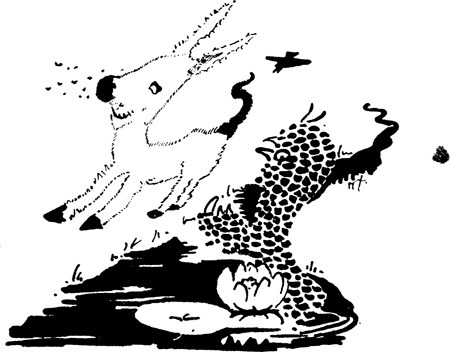
Figure 14
Witch, in fact it looks a bit of a fool, more like an angry hen than a devouring monster.’
It was still another drawing of this type (Fig. 15) which gave the first hint as to what might be happening here. This one had no ‘story’ and although after drawing it I had no ideas about the attacking creatures, the shark and amoeba and kite-like animal, the figures supporting the greedy-looking bottle were clearly cooks or nurses. And here I suddenly became aware of a reversal, for the bottle was demanding from the baby, not the baby from the bottle. This gave the hint that there might be a reversal in all this set of drawings and that the pictures might be illustrating a process which I knew intellectually to be characteristic of the blind part of one’s mind: the trick of trying to get away from the necessity to admit unpleasant things in oneself by putting them outside and feeling that it is others who are bad, not oneself. So the baby can feel threatened by greedy creatures around him who seem to wait to eat him up when in fact he is the greedy person who wants to do the eating.
There was yet another picture which brought home the truth that the attacking creatures must be really within myself (Fig. 16). It was called ‘Freedom’:
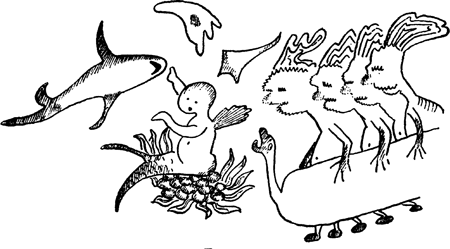
Figure 15
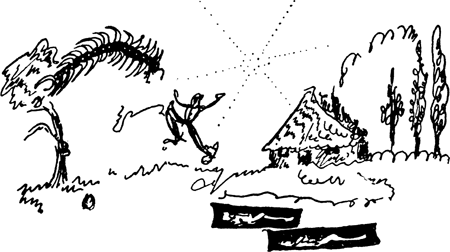
Figure 16
‘The dancing figure comes gaily out of his house on a spring morning thinking he has successfully buried external authority and can now be himself and enjoy himself in his own way. But he meets this monstrous centipede on the tree just as the Mickey Mouse creature met the Blasting Witch. Surely I have seen this centipede before, yes, it emerged as an image that time I used to seek for peace by concentrating on the source of life within myself, when I used to find it somehow in the centre of my spine – until this centipede appeared.’
This image of the centipede, when it originally appeared, had given me such a shock that I had turned away from it at once, thinking that such an idea must be near madness. But now, having learnt considerably more about how the mind makes use of images, I was able to see what was happening; my mind was trying to tell about the angry attacking impulses that are an essential part of oneself, but the existence of which I had persistently tried to deny. Obviously such an expression of hidden aggressive impulses in an indirect or symbolic way was part of the ABC of psycho-analysis and the analytic implication of the picture was clear enough. Not having been able to admit the angry tearing impulses against the parent figures, in their role of frustrating authority, having striven to believe oneself a ‘good’ child, the angry feelings are then felt to be coming at one from outside; thus the dancing figure is being threatened by the same tear-ing biting anger that he originally felt towards those who restricted his will, the same anger which made him want, in imagination, to bury his parents. But the point, for my present purpose, was that here surely was a pictorial dramatisa-tion of that very process that I had consciously observed happening when setting out to try to see ‘action’ in nature. When consciously observing the chair growing defiant and the piano beginning to gnash its teeth, I had surprised in the act, as it were, a process that usually goes on secretly and without our knowledge. Granted that it was a particularly childish form of devil that had found itself an external peg in the chair and the chest of drawers, I did not think it altered the fact that the process itself might be something to be taken into account in difficulties in learning to paint. Also even the fact of the childishness of the devils was something to be taken into account.
‘Lamb in Wolf’s Clothing’ (Fig. 17) also indicated the difficulty of accepting certain aspects of the self as one’s own, it seemed to show the need to pretend that the destructive greed and wolfishness, if it ever did manage to emerge, was something put on as a disguise, not part of one’s own inherent nature.
Now I thought I understood better, if there were so many imagined dangers growing from unadmitted angry and greedy feelings, why the imaginative body could often feel contracted to a tight knot inside, like a spider hiding deep in its hole. And no wonder it was difficult to put life or action into one’s drawings if the solidity of objects, which included their intrinsic identity and unseen insides, could become the lurking place of all the dark rebellious feelings within oneself. Once one began this game of endowing external objects with a spiritual life there was no knowing what might not happen, the spiritual life might turn out to be an infernal one. To see life and action in inanimate things was then a trick of the imagination which had better be firmly repressed, else the chairs and tables and jugs might suddenly get up and hit
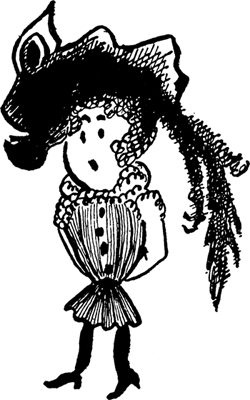
Figure 17
one over the head. So one might become mad, a fear hinted at in the bats flying round the head of the Blasting Witch. And the fact that these forms of life the imagination conjured up were not ‘real’ in the external sense would only increase the fears, for if I was seeing things that were not there, then certainly I must be mad: and when it was a question of trying to draw, not only objects, but living people, what then? To feel the real separate identity of another person, as compared with an orange or a jug, and express this in terms of paint, must raise even greater difficulties. And when it was not only a question of drawing other people, but the give and take of living with them, did not the same thing apply? To recognise the real spiritual identity of other people in everyday contact, in fact, to use one’s imagination about them, might seem equally fraught with dangers, it might seem much safer to mind one’s own business. Also one’s capacity to allow for the spiritual identity of others in daily life, one’s capacity to allow them to be themselves, must be linked up with one’s capacity to allow oneself to be oneself. It was all very well to be told to love one’s neighbour as oneself, but supposing in fact one did not love oneself at all but hated and feared it? Figure 18 seemed to show another way of attempting to deal with such hatred, not by putting it outwards, but by self-punishment, a sort of cancelling-out process:
‘…wasn’t it Salome who asked for the head of John the Baptist on a charger? Now the same thing has happened to her as a punishment for murdering the man of God.’
I now understood more about a certain passage in a book on painting, the implication of which I had been unable to grasp on first reading it:
‘The condition of vitality next involves the emphasis in each symbol of the living forces, the vital character, of the thing represented, in preference to mere surface qualities. This effect of vitality will be enhanced if the symbol states no more than the essential features, if it states them clearly, and if it states them swiftly, for the very swiftness of the execution will convey a sense of power and liveliness to the spectator. This vitality must also be accompanied with the tenderness and subtlety born of long and earnest insight into nature, or the symbol, though spirited, will be shallow….’
Holmes: Notes on the Science of Picture-Making,
pp. 304, 305
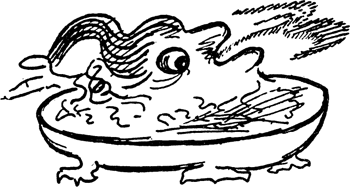
Figure 18
For now I understand something of the kind of denials in oneself that could prevent that subtle tenderness. In order to experience such a tenderness for nature outside, in all her forms, one had surely to have found some way of coming to terms with nature inside; or rather, with those parts of nature inside that one had repudiated as too unpleasant to be recognised as part of oneself. Otherwise the unadmit-ted opposites of the frugal mouse and the innocent donkey would be liable to make nature hated instead of loved, the peaceful summer morning could turn into a raging fire or a blasting blizzard.