3
Outline and the solid earth
‘… there they hoist us,
To cry to the sea that roar’d to us; to sigh
To the winds, whose pity, sighing back again,
Did us but loving wrong.’
Shakespeare
It was through the study of outline in painting that it became clearer what might be the nature of the spiritual dangers to be faced, if one was to see as the painter sees.
Up to now it was the outline that had seemed the easiest thing to manage. Apparently this is a common belief, for I read:
‘Most of the earliest forms of drawing known to us in history … are largely in the nature of outline drawings. This is a remarkable fact, considering the somewhat remote relation lines have to the complete phenomena of vision.’
Harold Speed: The Practice and Science
of Drawing, p. 50
The last remark in this passage was surprising, for I had always assumed in some vague way that outlines were ‘real’. I read on:
‘…a line seems a poor thing from the visual point of view: as the boundaries (of masses) are not always clearly defined, but are continually merging into the surrounding mass and losing themselves, to be caught up again later on and defined once more.’
After reading this I tried looking at the objects around me and found that it was true. When really looked at in relation to each other their outlines were not clear and compact, as I had always supposed them to be, they continually became lost in shadow. Two questions emerged here. First, how was it possible to have remained unaware of this fact for so long? Second, why was such a great mental effort necessary in order to see the edges of objects as they actually show themselves rather than as I had always thought of them? Then I read:
‘… the outline is the one fundamentally unrealistic non-imitative thing in this whole job of painting. Colours generally try to reproduce the effects of nature, tones and shadows also do their best. But outline the foundation of all drawing … is in truth no more than a bold artistic dodge….
‘Wild beasts such as the tiger or the zebra show how elusive the outline can become. A few black stripes on the tiger’s hide, and he no longer is
Tiger! Tiger! burning bright
In the forests of the night,
but merely a part of the sunlight and shadow of an Indian jungle. All his terror, malice and majesty have been swallowed up in a mere light effect. The outline puts him in his place.’
Gordon: A Step Ladder to Painting, p. 18
The italics are mine and this seemed the crux of the matter. For I noticed that the effort needed in order to see the edges of objects as they really look stirred a dim fear, a fear of what might happen if one let go one’s mental hold on the outline which kept everything separate and in its place; and it was similar to that fear of a wide focus of attention which I had noticed in earlier experiments.
After thinking about this I woke one morning and saw two jugs on the table; without any mental struggle I saw the edges in relation to each other, and how gaily they seemed almost to ripple now that they were freed from this grimly practical business of enclosing an object and keeping it in its place. This was surely what painters meant about the play of edges; certainly they did play and I tried a five-minute sketch of the jugs (Fig. 8). Now also it was easier to understand what painters meant by the phrase ‘freedom of line’ because here surely was a reason for its opposite; that is, the emotional need to imprison objects rigidly within themselves.
When trying to think about what might be the reason for this need to make objects keep themselves to themselves within a rigid boundary I remembered reading:
‘The outline is … the first and plainest statement of a tangible reality.’
Gordon: A Step Ladder to Painting, p. 19
Thus the outline represented the world of fact, of separate touchable solid objects; to cling to it was therefore surely to protect oneself against the other world, the world of imagination.
So I could only suppose that, in one part of the mind, there really could be a fear of losing all sense of separating boundaries; particularly the boundaries between the tangible realities of the external world and the imaginative realities of the inner world of feeling and idea; in fact a fear of being mad. This same fear was to appear again in connection with the imaginative perception of action in nature, the fear that letting go common sense appearances and letting in imagination meant letting in madness. I wondered, perhaps
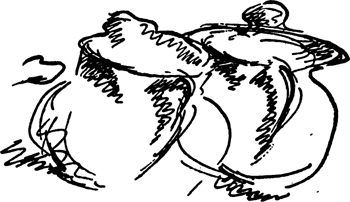
Figure 8
this was one reason why new experiments in painting can arouse such fierce opposition and anger. People must surely be afraid, without knowing it, that their hold upon reason and sanity is precarious, else they would not so resent being asked to look at visual experience in a new way, they would not be so afraid of not seeing the world as they have always seen it and in the general publicly agreed way of seeing it.
The extent to which one’s mind could be concerned with this question of boundaries was again apparent when I looked at some diary notes made on a summer holiday. It was the summer after most of the free drawings had appeared and the notes had been made in an attempt to come to grips with the problem of realism in painting. They had grown out of a determination to break away from the dull, realistic, impressionist type of amateur landscape painting, a determination to try to state pictorially something of the inner brooding quality of nature, rather than her accidental appearances. But I had no notion how or where to begin, I could not even decide what bit of nature to paint, much less how to paint it. So it had been in desperation that I had decided not to paint at all but to try to record in words, with perhaps brief pencil sketches, the faintest indications of what the eye seemed to like.
August 5th, 1939. I wanted to paint the approaching storm and thundery light, looking out from East Head over Thorney Isle. There was green water darkening towards the horizon and looming sky much darker than the sea. In the foreground, waves glistening white against the green, white sand close inshore, some terns, whiter than all against the darkening sea.
But since I could not manage to paint to that extent I tried drawing freely from the memory of it, in charcoal, and found I had made the thunder bird of the New Mexican Indians, spreading right across the sky, also a huge shadowy Indian drum and a snake rising up out of the sea (Fig. 9).
August 7th. I wanted to draw the tensions and sweep of ‘earth’ by the shore, not outline or edge so much as stretch and spread and heave of the sea-wall and low shore
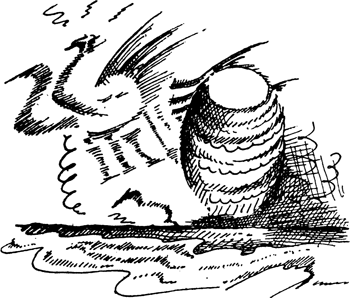
Figure 9
cliffs – yet seen in terms of line. What about colours, colours of earth? I did not notice them, except the crimson brown of the saltmarsh plants, but as I think of it now the colours grow and deepen in my thought, ochres and umbers and viridian put on thick. Earth, it’s dark, full of body, not the sunny pale surface of a water-colour. But why can’t I settle down to paint?
August 9th. Still I want to paint these earth colours, under a heavy sky, wet short grass, ragwort, green and yellow. I’ve tried making little water-colour notes of colour combinations but water-colour used like that seems to lack vitality, no glow in it. I want to make colours lit from within. On this cloudy day after rain wet grass glows its greenness from inside itself.
How the crisp froth of a wave gets narrower as it gets nearer the shore and the nearest one shows the yellow of sand through the water!
August 17th. Still this desire to paint ‘earth’ but I can find no special corner of it that will make a picture. So I have tried doing free drawings to see what this thought of earth means, I have done a series of four (Fig. 10a, b, c, d) but they are hardly more than scribbles, and I don’t know what they mean.
August 26th. I did find something to draw, a bit of the sea-wall. Now I have done about half a dozen line sketches of it, only about ten minutes each, it seems a very small bag for three weeks’ effort, but I have found something about what the eye likes: for the first one (Fig. 11a) is just a copy of the scene, quite realistic but not what my eye wants, the others seem to be gradually simmering out the essence of the form, the swerving stone groyne which
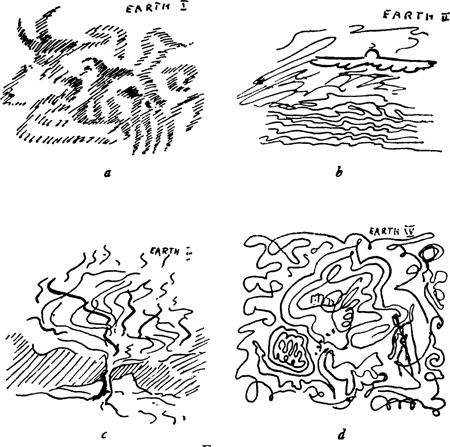
Figure 10
seems to become utterly different when the accidental details are forgotten (Fig. 11b).
August 27th. When I woke up this morning I suddenly thought that it’s the sea-gate in the wall that I have been drawing, where the seas broke in last winter and flooded the marshes, right up to and over the meadow. Now I see how those free drawings on the theme of earth led up to this: for two show chaos, or very nearly, and one shows a bird over a waste of waves, like Noah’s Dove who went out to seek for solid ground and also like the spirit brooding over the face of the waters, over the primary chaos. And one is a tree on a bare mountain, the beginnings of land
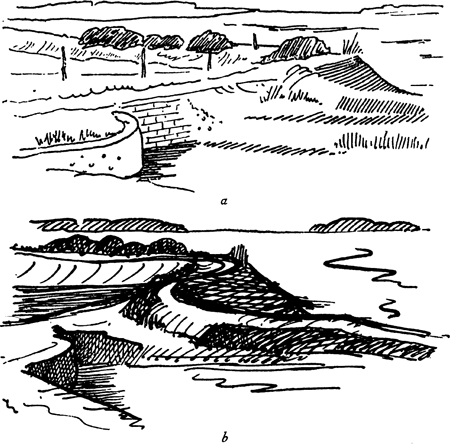
Figure 11
emerging from the flood. Yes, I am sure this is why I wanted especially to draw the sea-wall, a firmness to keep the flood of something in its place and prevent it from destroying the firm outline of the earth and the fertility of the pasture. And yet the thought of that inrush of the tide that broke the sea-wall is full of richness.
In spite of having been half aware that there might be internal reasons for choosing the broken sea-wall as subject, it was not obvious, to me at least, what was the significance of the other small bits of the external world that appeared in the notes. For instance, I did not see a connection between the approaching storm of Fig. 9 and the theme of the heath fire and the blasted beeches. Nor had I noticed that the drawing of the storm in Fig. 9 introduced phantastic elements in the sky, the thunder bird and huge Indian drum, while leaving the sea drawn in a representational way. Having failed so far to apply Blake’s remark ‘That which is above is within’ to these drawings, I had not yet arrived at the idea that the whole holiday could have been dominated by a single problem: the struggle to bring into relation the dream imaginings up above (inside) and the solid realities of the external world. For the same reason it had not been obvious what was the point of those free drawings on the theme of ‘Earth’ that had turned out to be hardly more than chaotic scribblings; for it had not as yet become apparent that the very problem so insistently trying to draw attention to itself was something to do with achieving a relation to the inevitable ‘otherness’ of what is outside one, to the reality of the solid earth. I did realise, however, that the Noah’s Dove drawing represented a state of mind I was familiar with; one in which, although the world around was quite clearly and precisely ‘there’, yet it remained utterly remote and meaningless, there was nothing in it to rest upon or clutch hold of.
It was, however, the exact opposite of the ideas symbolised by the Noah’s Dove drawings which eventually pointed the way to understanding something of what might be happening here.
They were experiences to do with the observation that at times, by the way in which one looked at a thing, it was possible to bring about an intense feeling for and belief in its living reality. Such a way of looking brought a complete transfiguration of the common sense expedient view where objects, both people and things, existed mainly in terms of their usefulness; it brought a change to a world of living essences existing in their own right and offering a source of delight simply through the fact of being themselves. In short, it was a transfiguration comparable in a small way to the transfiguration of falling in love; but, although such a vital experience, it was something that often for months together never happened. Because of this it could leave one vaguely preoccupied and continually searching for its return, discontented with the common sense world but also vaguely resentful that such moments could so interfere, by their contrast, with the common sense pleasures of living. And all the time one could have a lurking doubt whether this view of the world might not be somehow more real than the common sense one.
It was through attempts to study the use of colour that it became clearer what was the next direction in which to explore, both in order to understand more about the questions of outline and also of this divided allegiance between the two ways of looking.