2
Being separate and being together
‘The water is wide,
I cannot get o’er,
And neither have I wings to fly.
Give me a boat that will carry two,
And both shall row, my love and I.’
Folk Song
Instead of trying to puzzle out the meaning of the free drawings I went on trying to study the painter’s task from books. Up to now I had assumed that all the painter’s practical problems to do with representing distance, solidity, the grouping of objects, differences of light and shade and so on were matters for common sense, combined with careful study. But when I tried to begin such careful study there seemed some unknown force interfering. Of course I was already familiar with the idea that one’s common sense mind is not all there is, and that when it is difficult to do something that the common sense mind says is straightforward and should be done, then one must expect the imaginative mind to have quite other views on the matter. But I had not up to now thought of applying this to painting. When I did, it was clear that the imaginative mind could have strong private views of its own on the meanings of light, distance, darkness and so on. For instance, I began to find that it had some very definite ideas of its own about the subject of perspective and that these ideas were in fact being illustrated in some of the drawings.
In spite of having been taught, long ago at school, the rules of perspective, I had recently found that whenever a drawing showed more or less correct perspective, as in drawing a room for instance, the result seemed not worth the effort. But one day I had tried drawing an imaginary room (Fig. 5) and after a struggle, had managed to avoid showing the furniture in correct perspective. The drawing had been more satisfying than any earlier ones, though I had no notion why. Now it occurred to me that it all depended upon what aspects of objects one was most concerned with. The top of a table, for instance, could be considered as a supporting squareness on which to lay the breakfast, not as a flattened shape with side-lines fading off to a vanishing point, as it seems to the contemplative eye when one sits down to make a sketch of it. And so with chairs, the important thing about a chair seemed to be that it is below one, ready to support one’s weight; and that was how I wanted to draw it. Gardens introduced a similar question of view-point; I found I wanted to draw a garden looking down on it from above, so that one was, as it were, more nearly inside it and surrounded by it (Fig. 6). It was as if one’s mind could want to express the feelings that come from the sense of touch and muscular movement rather than from the sense of sight.
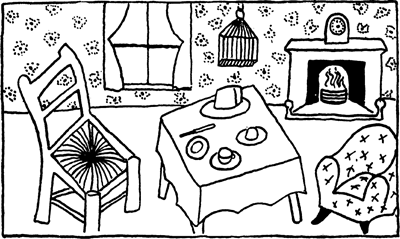
Figure 5
In fact it was almost as if one might not want to be concerned, in drawing, with those facts of detachment and separation that are introduced when an observing eye is perched upon a sketching stool, with all the attendant facts of a single viewpoint and fixed eye-level and horizontal lines that vanish. It seemed one might want some kind of relation to objects in which one was much more mixed up with them than that.
At first I thought that such an unwillingness to face
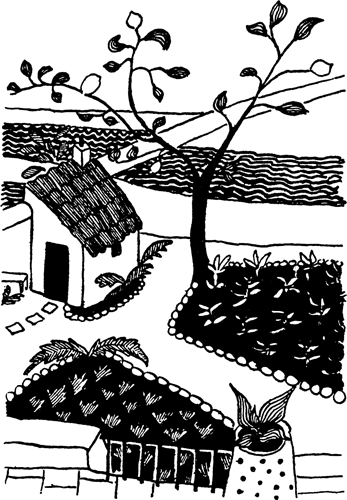
Figure 6
the visual facts of space and distance must be a cowardly attitude, a retreat from the responsibilities of being a separate person. But it did not feel entirely like a retreat, it felt more like a search, a going backwards perhaps, but a going back to look for something, something which could have real value for adult life if only it could be recovered. It almost seemed like a way of looking at the world which the current, ‘reasonable’, common sense way had perhaps repudiated, but a way which might have potentialities of its own at the appropriate time and place, a kind of uncommon sense that one needed.
Somewhere in the books it was stated that painting is concerned with the feelings conveyed by space. This was surprising at first, up to now I had taken space for granted and never reflected upon what it might mean in terms of feeling. But as soon as I did begin to think about it, it was clear that very intense feelings might be stirred. If one saw it as the primary reality to be manipulated for the satisfaction of all one’s basic needs, beginning with the babyhood problem of reaching for one’s mother’s arms, leading through all the separation from what one loves that the business of living brings, then it was not so surprising that it should be the main preoccupation of the painter. And when I began to feel about it as well as think about it then even the whole sensory foundation of the common sense world seemed to be threatened. For instance, I remembered a kind of half-waking spatial nightmare of being surrounded by an infinitude of space rushing away in every direction for ever and ever. In a similar way the term ‘vanishing point’ aroused vistas of desolation. So it became clear that if painting is concerned with the feelings conveyed by space then it must also be to do with problems of being a separate body in a world of other bodies which occupy different bits of space: in fact it must be deeply concerned with ideas of distance and separation and having and losing. What I did not yet see was that the free drawings which had been set aside were all the time silently showing what the feelings about those ideas could be.
There were many other aspects of the emotions conveyed by space to be considered. For instance, once you begin to think about distance and separation it is also necessary to think about different ways of being together, or in the jargon of the painting books, composition. On this subject I read:
‘Looking at any single object the spectator is easily able to decide; “Yes, that is a nice shape” (or ugly shape as the case may be). In selecting another object he can also decide; “This, too, has a nice shape.” But here comes the test of the artistic vision. In placing the two objects together in a group is he able to decide whether the group-shape is also nice?’
Jan Gordon: A Step Ladder to Painting, p. 45
My own experience certainly confirmed that this test of artistic vision was a crucial one. I found that to draw the line of one object with fully felt awareness of the line of a neighbouring one and of the patterns of space that they mutually created between them, seemed as potent an act as laying a wire across the terminals of a battery; and the resulting flash seemed to light a new world of possibilities. Presumably it was fear of these new possibilities which caused such a compelling narrow focus of attention in which it was only possible to attend to one thing at a time. One drawing cer-tainly illustrated the curious lengths this narrow focus could lead to (Fig. 7). It was not a free drawing but a deliberate attempt at imaginary composition and at first it was not at all clear why two of the houses were at right angles to the slope of the hillside; the drawing defied the elementary facts of gravity and yet I had felt a determined impulse to draw it like that. But now it seemed likely that it was a matter of narrow focus, the two end houses were thought of so much in isolation that each had its separate base-line of earth regardless of the fact that it was ‘together with’ other items in the picture.
The more I thought about the direction in which this study was leading the more one thing seemed likely: that original work in painting, if it was ever to get beyond the stage of happy flukes, would demand facing certain facts about oneself as a separate being, facts that could often perhaps be successfully by-passed in ordinary living. Thus it
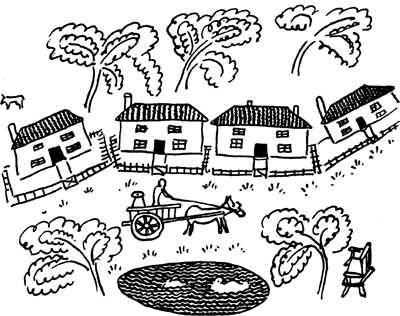
Figure 7
seemed that it was possible, in spite of having lived a life of independent work and travel and earning a living, to have evaded facing certain facts about the human situation, or only given a superficial acquiescence to them. Otherwise why was it so difficult to feel about, as well as think about, the separateness or togetherness of objects? As a matter of fact the painters themselves, some of them, seemed willing to admit that genuine vision as an artist needed a kind of courage that was willing to face all kinds of spiritual dangers. For I remembered Samuel Palmer’s account of a conversation with Blake, then sixty-seven years old and busy upon his Dante designs.
‘He said he began them with fear and trembling,
I said, “O! I have enough of fear and trembling.”
“Then,” said he, “you’ll do.” ’
A. Gilchrist: Life of Wm. Blake, p. 390
But what were these spiritual dangers? Certainly seeing with one’s own eyes, whether in painting or in living, seeing the truth of people and events and things needed an act of the imagination; for the truth was never presented whole to one’s senses at any particular moment, direct sensory experience was always fragmentary and had to be combined into a whole by the creative imagination. Even the perception of a chair or a carrot was an imaginative act, one had to create imaginatively, out of one’s past experience of walking round things or holding them in one’s hand, the unseen other side of the chair or the carrot. And how much more did one have to create the insides of things. And when the solid object was a living person, what great feats of imagination even the most unimaginative person achieves in recognising them, not only as solid bodies with physical things inside, bones and nerves and blood and so on, but also as having their past and their future inside, memories and hopes and ideas. The present-moment view of any object is always determined by the accident of where one is standing at the moment, as the view of a person’s face is, the accidental angle that the snapshot often catches with violently distorting results. But to know the truth of people you have to select and combine; to grasp the essence of them, whether in paint or thought, you have surely to combine all the partial glimpses into a relevant whole. This, however, since it requires imagination, brought me face to face with certain dangers inherent in the nature of imagination.