1
What the eye likes
‘O, down in the meadows the other day,
A-gath’ring flowers, both fine and gay,
A-gath’ring flowers, both red and blue,
I little thought what love could do.’
Folk Song
I had tried various obvious ways of learning how to paint, such as special painting lessons at school, evening classes in life drawing, sketching during holidays and visiting Art Galleries in the lunch hour and on Saturdays. But both the life drawings and the sketches were vaguely disappointing, they gave no sense of being new creations in their own right, they seemed to be only tolerably good imitations of something else; in fact, to be counterfeits.
Then I had begun to read books about the nature of the painter’s problems. All the years previously I had painted blindly and instinctively, it was only discontent with the results that was the spur to trying to discover something about the technical problems the painter was trying to solve.
At first the books on how to paint seemed likely to provide help. They talked about the need for a sense of pattern in the arrangement of lines and masses, of darks and lights, about colour contrasts and harmonies, matters I had never deliberately thought about before. But the result of trying to put this new-found knowledge into practice was that anything done according to the learnt rules still had a counterfeit quality.
One of the books, however, said that the aim of painting was that the eye should find out what it liked. This seemed a useful idea, for it coincided with something I had already discovered about living many years since; a new world had then revealed itself as the result of an attempt, by keeping a diary, to find out what had seemed most important in each day’s happenings. But as applied to drawing it was not so easy. One could see a tree that looked lovely, but in beginning to draw the sense of what the eye liked about it could disappear; indeed it often seemed not worth risking the attempt to draw, if with the first few lines the sense of the loveliness might so vanish away. But one thing was quite clear. There was no doubt that drawings which were a fairly accurate copy of an object could produce an almost despairing boredom; so I was forced to the conclusion that copies of appearances were not what my eye liked, even though what it did like was not at all clear.
In another book I read that the essential of a good drawing was that the lines should be a genuine expression of a mood. Here was no reference to the object one was drawing, so it seemed a hopeful approach, it offered a possible way of breaking through this barrier of appearances. But when it came to the point of actually expressing a mood in lines and shapes it was a different matter. For instance, the books said that upright lines expressed dignity and power, horizontal lines restfulness, an upward curve exuberance, a sharp angle quick movement, a blunt angle slow movement. However true this might be it did not seem to help the expression of my own mood, there seemed to be no connection between moods as lived and anything that appeared on paper.
It was a long time before it occurred to me that one of the difficulties here might be something to do with a very careful selection of the moods to be depicted, an attempt to find expression for quiet and ‘beautiful’ ones only. This did not become apparent until after making my first surprising discovery.
Just as having once found that writing down whatever came into one’s head, however apparently nonsensical, could reveal a meaning and pattern that one would never have guessed at, so I had now thought that drawing without any conscious intention to draw ‘something’ might also be interesting. The first attempts had not seemed to mean much and had no value as drawings. But one day, when filled with anger over a quarrel, I had turned to such free drawing in a desperate attempt to relieve the mood of furious frustration. Here is a note, made afterwards from memory, of what ideas had accompanied the actual process of drawing:
Fig. 1: ‘I’ll have a large sheet of paper this time and charcoal, yes, it makes a good thick line … now … that’s only a scribble, what’s the good of that? It looks like a snake, now it’s a serpent coiled round a tree, yes, like the serpent in the Garden of Eden, but I don’t want to draw that, oh, it’s turning into a head, goodness, what a horrid creature it is, a sort of Mrs. Punch, or the Duchess in Alice. How hateful she is with that hunched back and deformed hand and all that swank of jewelry.’
When the drawing was finished the original anger had all vanished. The anger had apparently gone into the drawing. So it seemed that here at least was an expression of a mood, even though it was not an original expression, but an
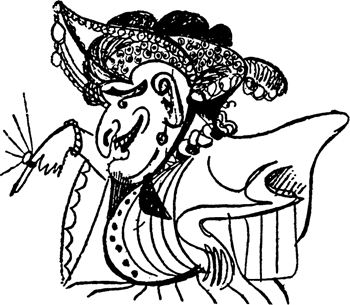
Figure 1
unconscious adaptation of the Duchess in Lewis Carroll’s famous book.*
This experience provided a first hint that some of the difficulties of achieving a genuine expression of mood might be due to the kind of mood seeking expression. One day, several years later, I saw a girl in an underground train, her toes turned in and a rapt, brooding expression which at once caught my attention. In herself she showed some of that inner intensity of living that always stirred the impulse to draw and I had read somewhere that one should always try to get at least something down on paper when such feelings occurred. On reaching home I had begun a sketch in charcoal, feeling that the mood to be expressed was a real aesthetic pleasure in beauty of form, to be embodied in a serious drawing of artistic worth. Instead, Figure 2 appeared.
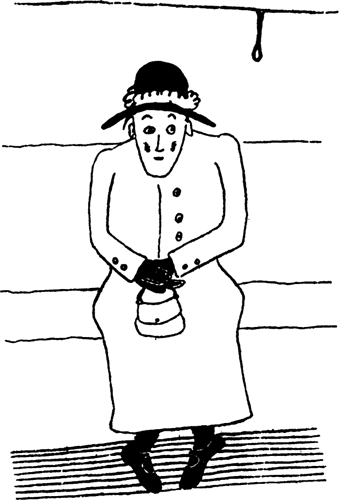
Figure 2
* Alice’s Adventures in Wonderland with John Tenniel’s illustrations had been one of the most familiar books of my childhood.
Thinking over all this it occurred to me that preconceived ideas about beauty in drawing might have a limiting effect on one’s freedom of expression, beauty might be like happiness, something which a too direct striving after destroys. But nearly all my drawings so far had been determined by a wish to represent beauty. I decided that the next time such a feeling occurred it would be worth trying some experiments. So, when sitting in a buttercup field one Sunday morning in June, watching the Downs emerging from the mist, I checked the impulse to make a water-colour sketch which was certain to be a failure. Instead, I concentrated on the mood of the scene, the peace and softness of the colouring, the gentle curves of the Downs, and began to scribble in charcoal, letting hand and eye do what they liked. Gradually a definite form had emerged and there, instead of the peaceful summer landscape, was a blazing heath fire, its roaring flames leaping from the earth in a funnel of fire, its black smoke blotting out the sky (Fig. 3). This was certainly surprising, in fact it was so surprising it was hard to believe that what had happened was not pure accident, perhaps due to the fact that random drawing in charcoal easily suggests
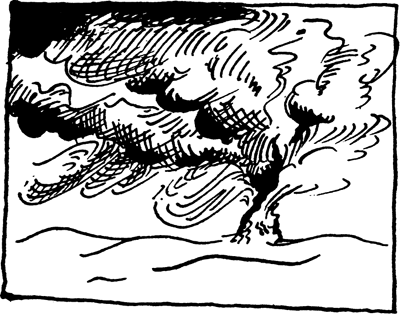
Figure 3
smoke. But the following week-end I was again urged to draw something beautiful, when sitting under beech trees on another perfect June morning and longing to be able to represent their calm stateliness. Once again I had tried the experiment of concentrating on the mood and letting my hand draw as it liked. After absent-mindedly covering the whole page with light and dark shadings I suddenly saw what it was I had drawn (Fig. 4). Instead of the over-arching beeches spreading protecting arms in the still summer air, there were two stunted bushes on a snowy crag, blasted by a raging storm.
This, coupled with the heath fire drawing, suggested that the problem of expression of mood, so cheerfully disposed of in the instructions, was not so simple as it sounded; for it seemed very odd that thoughts of fire and tempest could be, without one’s knowing it, so close beneath the surface in what appeared to be moment of greatest peace.
After this I found it was often possible to make drawings by the free method, even without the stimulus of strong conscious feeling about some external object. It was enough to sit down and begin to scribble and the scribble would
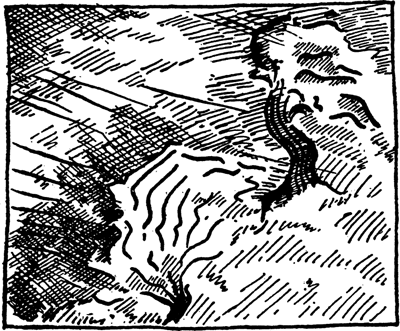
Figure 4
gradually become a drawing of something. It was usually something rather phantastic, but not always; sometimes it was a single object, sometimes a dramatic scene, sometimes a surrealist conglomeration of bits. Occasionally it would remain just a scribble.
Also, although the drawings were actually made in an absent-minded mood, as soon as one was finished there was usually a definite ‘story’ in my mind of what it was about. Most often these stories had been written down at once but even when not so noted I could remember their exact details years after, they seemed to be quite fixed and definite, having none of the elusive quality of dreams. But I could not at this stage bring myself to face the implications of the fact, though recognising it intellectually, that the heath fire and blasted beeches and girl in the train drawings all expressed the opposite of the moods and ideas intended.