CHAPTER 13
The Gospel of Stability
Relearning How to Move to Prevent Injury
The loftier the building, the deeper the foundation must be laid.
—Thomas à Kempis
By now it should be clear that it is important to stay in good physical condition as we age. But now consider another, related question: Why don’t more people actually pull this off?
A typical seventy-year-old will do less than half as much “moderate to vigorous” physical activity as she did at age forty—and after age seventy the decline accelerates. The fit people in their seventies and eighties are the exception, not the rule.
It is tempting to attribute this to aging itself, the aches and pains that accumulate in middle age and beyond, not to mention the steady loss of aerobic capacity and strength. Other factors such as weight gain and poor sleep can also leave one feeling wiped out. But I think the missing X factor that explains why so many people just stop moving is something else: injury. That is, older people tend to exercise less, or not at all, because they simply can’t. They have hurt themselves in some way, at some point in their lives, and they just never got back on the horse. So they continued to decline.
This was certainly true of Sophie, my friend Becky’s mother, but I too could have easily gone down that path. In my twenties, when I was in medical school and still training hard, lifting weights almost daily, I experienced a mysterious back injury that required two separate surgeries (one of which was botched), followed by a long and very difficult recovery. For several months I was almost unable to function, surviving on large amounts of painkillers. I couldn’t even brush my teeth without excruciating back pain, and I spent most of the day just lying on the floor. It got so bad that my mom had to fly out to Palo Alto and take care of me. The thing is, people think it’s terrible when someone in their twenties has to go through this (and it is), yet they almost expect it for someone Sophie’s age.
Sophie and I were not unique: this type of injury and chronic pain is shockingly widespread. According to the CDC, more than 27 percent of Americans over the age of forty-five report suffering from chronic pain, and about 10 to 12 percent say that pain has limited their activities on “most days or every day” during the previous six months. Most days or every day! Back pain, in particular, is a huge driver of opioid prescriptions and surgical procedures that are often of dubious value. It is a leading cause of disability around the world, and in the United States alone it drains off an estimated $635 billion-with-a-B per year in medical costs and lost productivity.
As I learned, all the aerobic fitness or strength in the world won’t help you if you get hurt and have to stop exercising for several months—or forever. Studies of college-age athletes who experience injury in their careers find that they report consistently lower quality of life at middle and older ages. Their injuries continue to affect them not only physically but psychologically as well, for decades into their lives. During my long ordeal, I came to appreciate how important our ability to function physically is to our overall well-being.
All of the above, the research and my own experience, support my first commandment of fitness: First, do thyself no harm.
How do we do this? I think stability is the key ingredient. But it also requires a change in our mindset. We have to break out of the mentality that we must crush all our workouts every single time we go to the gym—doing the most reps, with the heaviest weights, day after day. As I learned, pushing oneself so hard all the time, without adequate stability, almost inevitably leads to injury. If you are struggling to get through your workout, then you are likely resorting to your body’s own “cheats,” your ingrained but potentially dangerous movement patterns.
Instead, we need to change our approach so that we are focused on doing things right, cultivating safe, ideal movement patterns that allow our bodies to work as designed and reduce our risk of injury. Better to work smart than to work too hard. But as I would see for myself, relearning these movement patterns is no simple task.
Stability is often conflated with “core,” but there is much more to it than having strong abdominal muscles (which isn’t what “core” means anyway). In my view, stability is essential to any kind of movement, particularly if our goal is to be able to keep doing that movement for years or decades. It is the foundation on which our twin pillars of cardiovascular fitness and strength must rest. Without it, as we used to say in Canada, you are hosed. Maybe not immediately, but sooner or later you will likely experience an injury that limits your movement, kiboshes your daily activities as you age, and possibly knocks you out of the Centenarian Decathlon for good.
One thing that stability training has taught me is that most “acute” injuries, such as a torn ACL or a hamstring tear, are rarely sudden. While their onset may be rapid—instantaneous back or neck or knee pain—there was likely a chronic weakness or lack of stability at the foundation of the joint that was the true culprit. This is the real iceberg in the water. The “acute” injury is just the part you see, the manifestation of the underlying weakness. So if we are to complete the goals we have set in our own Centenarian Decathlon, we need to be able to anticipate and avoid any potential injuries that lie in our path, like icebergs at sea. This means understanding stability and incorporating it into our routine.
Stability is tricky to define precisely, but we intuitively know what it is. A technical definition might be: stability is the subconscious ability to harness, decelerate, or stop force. A stable person can react to internal or external stimuli to adjust position and muscular tension appropriately without a tremendous amount of conscious thought.
I like to explain stability using an analogy from my favorite sport, auto racing. A few years ago I drove to a racetrack in Southern California to spend a couple of days training with my coach. To warm up, I took a few “sedan laps” in my street car at the time, a modified BMW M3 coupe with a powerful 460+ HP engine. After months of creeping along on clogged Southern California freeways, it was hugely fun to dive into the corners and fly down the straightaways.
Then I switched to the track car we had rented, basically a stripped-down, race-worthy version of the popular BMW 325i. Although this vehicle’s engine produced only about one-third as much power (165 HP) as my street car, my lap times in it were several seconds faster, which is an eternity in auto racing. What made the difference? The track car’s 20 percent lighter weight played a part, but far more important were its tighter chassis and its stickier, race-grade tires. Together, these transmitted more of the engine’s force to the road, allowing this car to go much faster through the corners. Though my street car was quicker in the long straights, it was much slower overall because it could not corner as efficiently. The track car was faster because it had better stability.
Without stability, my street car’s more powerful engine was not much use. If I attempted to drive it through the curves as fast as I drove the track car, I’d end up spinning into the dirt. In the context of the gym, my street car is the guy with huge muscles who loads the bar with plates but who always seems to be getting injured (and can’t do much else besides lift weights in the gym). The track car is the unassuming-looking dude who can deadlift twice his body weight, hit a fast serve in tennis, and then go run up a mountain the next day. He doesn’t necessarily look strong. But because he has trained for stability as well as strength, his muscles can transmit much more force across his entire body, from his shoulders to his feet, while protecting his vulnerable back and knee joints. He is like a track-ready race car: strong, fast, stable—and healthy, because his superior stability allows him to do all these things while rarely, if ever, getting injured.
Obviously, my street car would be much more comfortable for a long road trip; no analogy is perfect. But this street car/race car comparison works because it forces us to consider stability in the dynamic setting. Unfortunately, the words stable and stability are too often lumped in with static terms like strong and in balance. A tree is more stable than a sapling. A Jenga tower cannot stand without stability. But in the exercise context, we’re not as interested in how rigid something is. Instead, we want to think about how efficiently and safely force can be transmitted through something.
The key word is safely. When stability is lacking, all that extra force has to go somewhere. If my street car’s powerful engine is transmitting only part of its power to the road through the tires, the remainder of that energy is leaking out, lost to friction and nonproductive motion, primarily. Parts of the car that should not be moving relative to each other are doing just that. As fun as it might be to drift a car around a corner, that lost energy is ravaging the tires and taking a toll on the suspension. Neither will last long. When this happens in our bodies, this force dissipation (as it’s called) leaks out via the path of least resistance—typically via joints like knees, elbows, and shoulders, and/or the spine, any or all of which will give out at some point. Joint injuries are almost always the result of this kind of energy leak.
In sum, stability lets us create the most force in the safest manner possible, connecting our body’s different muscle groups with much less risk of injury to our joints, our soft tissue, and especially our vulnerable spine. The goal is to be strong, fluid, flexible, and agile as you move through your world.
In action, stability can be magnificent to behold. Stability lets a skinny pitcher throw a blazing fastball. Stability allows Kai Lenny to surf towering waves at Jaws. But stability is also what enables a seventy-five-year-old woman to continue playing tennis injury-free. Stability is what keeps an eighty-year-old grandmother from falling when she steps off a curb that is unexpectedly high. Stability gives a ninety-five-year-old man the confidence to go walk his beloved dog in the park. It lets us keep doing what we love to do. And when you don’t have stability, bad things will inevitably happen—as they did to me, and to Sophie, and to millions of other formerly fit people.
My painful lower-back episode was only the beginning of my injury history. I completed one of my Catalina swims with a torn labrum that was almost certainly exacerbated by spending four hours a day training in the pool and ocean, and continuing to do so even after I started feeling pain.[*1] I still needed surgery to fix the problem more than fifteen years later. That was the price I paid for overdoing it in one specific sport. But it took me another couple of decades to really begin to understand why I had injured my back.
This knowledge came courtesy of Beth Lewis, a former professional dancer and powerlifter turned trainer and all-around movement genius who was then based in New York. (I’ve since talked her into moving to Austin.) We had barely even said hello before she ordered me to take off my shirt and squat. I obeyed, and she was not impressed. I was crestfallen. I had always thought of myself as someone who knew what he was doing in the gym. Now I was being told that I couldn’t even do a simple squat correctly.
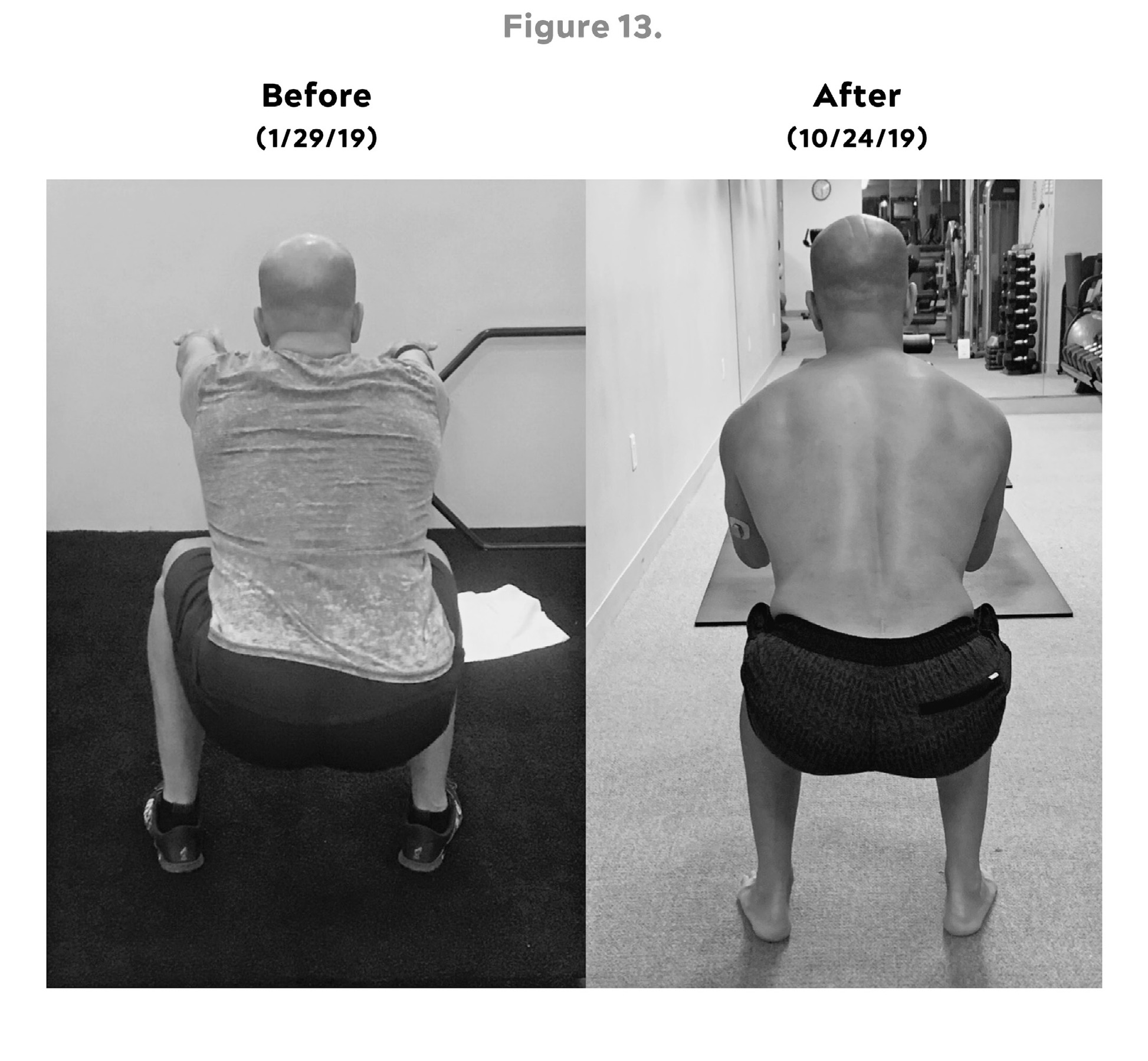
Her iPhone video told a sorry tale, as you can see from the “before” photo on the left (see figure 13): As I loaded my hips and sank down, I automatically shifted my entire body to the right. I look like I’m about to topple over. My problem, as these photos make painfully clear, was that I lacked stability. It even hurts to look at it now, because it reminds me of the thousands of atrocious, strain-inducing squats I’d committed in this awkward position.
I was not even aware that I was doing this, but I was likely compensating for various injuries and weaknesses that I had accumulated over the years. This is how it works, as I would learn: We try to cheat or work around our existing injuries and limitations and end up creating new problems. This rightward tilt may even explain my back injury when I was only in my twenties; even at that point, I had already been lifting heavy weights for years. Fixing the situation turned out to be a nine-month process, but it ultimately straightened me out, as you can see in the “after” photo on the right. It required retraining not only my body but my brain.
Both Beth and Michael Stromsness, a trainer with whom I’d worked in California and who had introduced me to Beth, were familiar with something I had never heard of called DNS. Short for dynamic neuromuscular stabilization, DNS sounds complicated, but it is based on the simplest, most natural movements we make: the way we moved when we were babies.
The theory behind DNS is that the sequence of movements that young children undergo on their way to learning how to walk is not random or accidental but part of a program of neuromuscular development that is essential to our ability to move correctly. As we go through this sequence of motions, our brain learns how to control our body and develop ideal patterns of movement.
DNS originated with a group of Czech neurologists who were working with young children with cerebral palsy in a hospital in Prague in the 1960s. They noticed that because of their illness, these kids did not go through the normal infant stages of rolling, crawling, and so forth. Thus they had movement problems throughout their lives. But when the children with cerebral palsy were put through a “training” program consisting of a certain sequence of movements, replicating the usual stages of learning to crawl, sit up, and eventually stand, their symptoms improved and they were better able to control their motions as they matured. The researchers realized that as we grow up, most healthy people actually go through an opposite process—we lose these natural, healthy, almost ingrained movement patterns.
Thus my youngest son, Ayrton, can execute a perfect ass-to-grass squat, dropping his little butt down practically to the ground, bending sharply at the knees yet remaining totally balanced and powerful. It’s just a perfect hip-hinge, and it blows my mind every time. He is an absolute master. Yet when I attempted the same movement, I ended up tilted over in the ridiculous half-canted position in the “before” photo, one hip pointed down at the ground, my shoulders askew, my feet rolled outward. My toddler can squat, but apparently I couldn’t.
And neither could my fourteen-year-old daughter, Olivia (before Beth got to work on her, too). Flexible as Gumby, skinny but whip-strong, she should be able to squat just as well as, if not better than, her youngest brother. But she couldn’t, because even at her young age she had already spent two-thirds of her life in school, mostly sitting in chairs. The ideal movement patterns that she learned as an infant and toddler were erased before she was able to develop the hip stability needed to squat properly. If she spends the next thirty, forty, or fifty years primarily sitting in chairs, as is likely, then she’ll be in the same boat as many of my patients, and myself as well: we have essentially forgotten how to move our bodies.
Most adults can’t squat correctly, even without any added weight. The only way many of us can come close to matching a toddler’s form is to lie on our backs, as Michael Stromsness demonstrated with me in one of our early sessions. Then it becomes much easier to raise our knees into a perfect squat position, with the correct degree of curvature throughout the spine from the base of the skull to the tailbone. This tells us that range of motion per se is not what’s stopping most adults from squatting well; it’s that when the average adult is under a load, even as little as their own bodyweight, the job of stabilizing his or her own torso becomes too much.
The point of DNS is to retrain our bodies—and our brains—in those patterns of perfect movement that we learned as little kids. As Michael Rintala, a leading American practitioner of DNS, puts it, “DNS beautifully integrates with all the good work you are already doing—it’s like a software upgrade for anything you are doing.”
My own software was in serious need of an upgrade.
The details of my own journey are too involved to lay out at length here, but in the rest of this chapter I will try to explain at least some of the basic principles that underlie stability training. These may seem a bit strange at first, and if you came to this chapter expecting a high-powered workout program, you may be disappointed. That is part of the point: in my practice, we don’t like to push much strength training, including many of the assessments I’ve discussed, such as dead hangs and weighted step-ups, until we have established some modicum of stability. We don’t think it’s worth the risk. Just as in engineering, it’s worth the extra time to build a solid foundation, even if it delays the project a few months.
A quick caveat: while strength training and aerobic conditioning are relatively straightforward, everyone has very different issues with regard to stability. Thus, it’s impossible to give a one-size-fits-all prescription for everyone. My goal in the rest of this chapter is to give you some basic concepts to think about and try out, to help you learn and understand how your own body interacts with the world—which, in the end, is what stability is really about. If you’d like to know more after you’ve read this chapter, I suggest visiting the websites for DNS (www.rehabps.com) and the Postural Restoration Institute (PRI) (www.posturalrestoration.com), the two leading exponents of what I’m talking about here. Stability is an integral part of my training program. Twice a week, I spend an hour doing dedicated stability training, based on the principles of DNS, PRI, and other practices, with ten to fifteen minutes per day on the other days.
Stability training begins at the most basic level, with the breath.
Breathing is about much more than simple gas exchange or even cardiorespiratory fitness. We exhale and inhale more than twenty thousand times per day, and the way in which we do so has tremendous influence on how we move our body, and even our mental state. How we breathe, as Beth puts it, is who we are.
The link between the body, the mind, and the breath is not new to anyone who has done more than a few Pilates or yoga classes or practiced meditation. In these practices, the breath is our anchor, our touchstone, our timekeeper. It both reflects our mental state and affects it. If our breathing is off, it can disrupt our mental equilibrium, creating anxiety and apprehension; but anxiety can also worsen any breathing issues we might have. This is because deep, steady breathing activates the calming parasympathetic nervous system, while rapid or ragged breathing triggers its opposite, the sympathetic nervous system, part of the fight-or-flight response.
Yet breathing is also important to stability and movement, and even to strength. Poor or disordered breathing can affect our motor control and make us susceptible to injury, studies have found. In one experiment, researchers found that combining a breathing challenge (reducing the amount of oxygen available to study subjects) with a weight challenge reduced the subjects’ ability to stabilize their spine. In real-world terms, this means that someone who is breathing hard (and poorly) while shoveling snow is putting themselves at increased risk of a back injury.
It’s extremely subtle, but the way in which someone breathes gives tremendous insight to how they move their body and, more importantly, how they stabilize their movements. We run our patients through a series of respiration and movement tests to get the full picture of their respiration strategy and how it relates to their strength and stability issues.
One simple test that we ask of everyone, early on, looks like this: lie on your back, with one hand on your belly and the other on your chest, and just breathe normally, without putting any effort or thought into it. Notice which hand is rising and falling—is it the one on your chest, or your belly, or both (or neither)? Some people tend to flare their ribs and expand the chest on the inhale, while the belly is flat or even goes down. This creates tightness in the upper body and midline, and if the ribs stay flared, it’s difficult to achieve a full exhalation. Others breathe primarily “into” the belly, which tilts the pelvis forward. Still others are compressed, meaning they have difficulty moving air in and out altogether, because they cannot expand the rib cage with each inhalation.
Beth identifies three types of breathing styles and associated phenotypes, which she jokingly calls “Mr. Stay Puft,” the “Sad Guy,” and the “Yogini”—each corresponding to a different set of stability strategies:
Mr. Stay Puft
HYPERINFLATED. This person is an upper-chest breather who tends to pull up into spinal extension for both respiration and stability. Their lumbar spine is in hyperextension, while their pelvis lives in anterior (forward) tilt, meaning their butt sticks out. They are always pulling up into themselves, trying to look like they are in charge. They have a limited sense of grounding in the feet, and limited ability to pronate to absorb shock (the feet turn outward, or supinate). All of the above makes them quite susceptible to lower back pain, as well as tightness in their calves and hips.
Sad Guy
COMPRESSED. Everything about them is sort of scrunched down and tight. Their head juts forward, and so do their shoulders, which kind of roll to the front because they are always pulling forward to try and take in more air. Their midback rolls in an overly flexed or hyperkyphotic posture, and they have limited neck and upper limb motion. Sometimes their lower legs externally rotate, and the feet overpronate. Gravity is weighing them down.
Yogini
UNCONTROLLED. These folks have extreme passive range of motion (i.e., flexibility)—and extremely limited ability to control it. They can often do a toe touch and put their palms flat on the floor, but because of their lack of control, these people are quite prone to joint injuries. They are always trying to find themselves in space, fidgeting and twitching; they compensate for their excessive flexibility by trying to stabilize primarily with their neck and jaw. It is very hard for them to put on lean mass (muscle). Sometimes they have very high anxiety, and possibly also a breathing pattern disorder.
Not everyone fits exactly into one of these three types, but many of us will recognize at least some of these traits in ourselves. There is some overlap as well; it’s possible to be a Sad Guy or Mr. Stay Puft and a Yogini at the same time, for example, because the Yogini type is really more about a lack of muscular control.
I was a hyperinflated Mr. Stay Puft, according to Beth: When I inhaled, my ribs would flare out and up, like a rooster thrusting out his chest. This got air into my lungs, but it also pulled my center of mass forward. To balance, my spine would curve into kyphosis, and my butt would stick out (Beth called it “duck butt”). This hyperextended my hamstrings, effectively disconnecting them from the rest of my body, so I was unable to access these muscles. For all those years, before I realized this, I was deadlifting using only my back and glutes, with virtually no help from my powerful hamstrings. In terms of breath training, I needed to think about getting air out, the exhale—while someone who tends more toward the Sad Guy type should work on getting air in, inhaling via the nose rather than the mouth.
The idea behind breath training is that proper breathing affects so many other physical parameters: rib position, neck extension, the shape of the spine, even the position of our feet on the ground. The way in which we breathe reflects how we interact with the world. “Making sure that your breath can be wide and three-dimensional and easy is vital for creating good, efficient, coordinated movement,” Beth says.
Beth likes to start with an exercise that builds awareness of the breath and strengthens the diaphragm, which not only is important to breathing but is an important stabilizer in the body. She has the patient lie on their back with legs up on a bench or chair, and asks them to inhale as quietly as possible, with the least amount of movement possible. An ideal inhalation expands the entire rib cage—front, sides, and back—while the belly expands at the same time, allowing the respiratory and pelvic diaphragm to descend. The telltale is that it is quiet. A noisy inhale looks and feels more dramatic, as the neck, chest, or belly will move first, and the diaphragm cannot descend freely, making it more difficult to get air in.
Now, exhale fully through pursed lips for maximum compression and air resistance, to strengthen the diaphragm. Blow all that air out, fully emptying yourself before your shoulders round or your face or jaw gets tense. Very soon, you will see how a full exhale prepares you for a good inhale, and vice versa. Repeat the process for five breaths and do two to three sets. Be sure to pause after each exhale for at least two counts to hold the isometric contraction—this is key, in DNS.
In DNS, you learn to think of the abdomen as a cylinder, surrounded by a wall of muscle, with the diaphragm on top and the pelvic floor below. When the cylinder is inflated, what you’re feeling is called intra-abdominal pressure, or IAP. It’s critical to true core activation and foundational to DNS training. Learning to fully pressurize the cylinder, by creating IAP, is important to safe movement because the cylinder effectively stabilizes the spine.
Here’s another quick exercise to help you understand how to create IAP: breathe all the way in, so you feel as if you are inflating the cylinder on all sides and pulling air all the way down into your pelvic floor, the bottom of the cylinder. You’re not actually “breathing” there, in the sense that air is actually entering your pelvis; you’re seeking maximal lung expansion, which in turn sort of pushes your diaphragm down. With every inhale, focus on expanding the cylinder around its whole diameter and not merely raising the belly. If you do this correctly, you will feel the entire circumference of your shorts expand evenly around your waist, even in the back, not just in the front. When you exhale, the diaphragm comes back up, and the ribs should rotate inward again as your waistband contracts.
This inhale develops tension, and as you exhale, pushing out air, you keep that muscular tension all around your cylinder wall. This intra-abdominal pressure is the basic foundation for everything that we do in stability training—a deadlift, squats, anything. It’s as if you have a plastic bottle: with the cap off, you can crush the bottle in one hand; with the cap on, there is too much pressure (i.e., stability) and the bottle can’t be crushed. I practice this 360-degree abdominal breathing every day, not only in the gym but also while I am at my desk.[*2]
Your “type” also indicates how you should work out, to some extent. The Stay Puft people tend to need more grounding through the feet and more work with weight in front of them so as to pull their shoulders and hips into a more neutral position. Beth typically has someone like me hold a weight in front of my body, a few inches in front of the sternum. This forces my center of mass back, more over my hips. Try it with a light dumbbell or even a milk carton, and you’ll see what I mean. It’s a subtle but noticeable change of position.
With the Sad Guys and Gals, Beth tends to work more on cross-body rotation, having them swing the arms across the body to open up the chest and shoulders. She is cautious about loading the back and shoulders, preferring to begin with body weight exercises and split-leg work, such as a walking lunge with a reach, either across the body or to the ceiling, on each step.
For the Yoginis, Beth recommends doing “closed-chain” exercises such as push-ups, using the floor or wall for support, as well as using exercise machines with a well-defined and limited range of motion, given their lack of joint control. Machines are important for these folks, and also for people who have not lifted much or at all, because machines keep their movements within safe boundaries. For the Yoginis, as well as for newbies in general, it’s important to become more aware of where they are in space, and where they are relative to their range of motion.
The larger point is that someone’s breathing style gives us insight into their broader stability strategy, the set of patterns that they have evolved over the years to help them get by in the physical world. All of us have these strategies, and 95 percent of the time, in the course of daily life, they work fine. But once you add different stressors, such as speed, weight, and novelty or unfamiliarity (e.g., stepping off a stair in the dark), then those strategies, those instinctive physical reactions, can create problems. And if our respiration is also taxed, those other problems will be magnified.
If the road to stability begins with the breath, it travels through the feet—the most fundamental point of contact between our bodies and the world. Our feet are literally the foundation for any movement we might make. Whether we’re lifting something heavy, walking or running (or rucking), climbing stairs, or standing waiting for a bus, we’re always channeling force through our feet. Unfortunately, too many of us have lost basic strength and awareness of our feet, thanks to too much time spent in shoes, especially big shoes with thick soles.
Going back to my race car analogy, our feet are like the tires, the only point of contact between the car and the road. The force of the engine, the stability and stiffness of the chassis, the skill of the driver—all of it is useless if the tires are not firmly gripping the track surface. I would argue that our feet are even more important to us than tires are to a car, as they also play a crucial role in dampening force before it reaches the knees, the hips, and the back (at least a car has suspension rods for that). Failing to pay attention to your feet, as most of us do, is like buying a McLaren Senna (my dream car) and then going to Walmart and getting the cheapest tires you can find. That’s what spending years in mushy shoes does to us.
Take another look at my “before” squat. Yes, my hips are obviously askew, but look more closely at my feet. Are they flat on the floor? No, they are not. As you can clearly see, they are rolled out on their outside edges—“supinated,” in physiologist-speak. They should be flat, grounded, stable, and strong, to support my weight. But instead they are rolled over and wobbly. No wonder my squat looks so bad.
To help reacquaint us with our feet, Beth Lewis likes to put me, and our patients, through a routine she calls “toe yoga.” Toe yoga (which I hate, by the way) is a series of exercises intended to improve the dexterity and intrinsic strength of our toes, as well as our ability to control them with our mind. Toe strength may not be something you think about when you go to the gym, but it should be: Our toes are crucial to walking, running, lifting, and, most importantly, decelerating or lowering. The big toe especially is necessary for the push-off in every stride. Lack of big-toe extension can cause gait dysfunction and can even be a limiting factor in getting up off the floor unassisted as we age. If toe strength is compromised, everything up the chain is more vulnerable—ankle, knee, hip, spine.
Toe yoga is a lot harder than it sounds, which is why I’ve posted a video demonstration of this and other exercises at www.peterattiamd.com/outlive/videos. First, Beth tells her students to think of their feet as having four corners, each of which needs to be rooted firmly on the ground at all times, like the legs of a chair. As you stand there, try to feel each “corner” of each foot pressing into the ground: the base of your big toe, the base of your pinky toe, the inside and outside of your heel. This is easy, and revelatory; when was the last time you felt that grounded?
Try to lift all ten toes off the ground and spread them as wide as you can. Now try to put just your big toe back on the floor, while keeping your other toes lifted. Trickier than you’d think, right? Now do the opposite: keep four toes on the floor and lift only your big toe. Then lift all five toes, and try to drop them one by one, starting with your big toe. (You get the idea.)[*3]
If you can do this at all, it likely takes a concerted mental effort, your brain telling that big toe to drop or rise—which is exactly the point. One of the goals of stability training is to regain mental control, conscious or not, over key muscles and body parts. Because our feet spend so much time crammed into shoes that may or may not fit properly, and likely have a lot of padding in their soles, many of us have lost touch with our feet, or have worked them into unhelpful contortions over time.
In my “before” squatting photo, as noted above, both of my feet are rolled out to the outside, or supinated, a common phenotype. Another common foot strategy is to “pronate” or fold the feet inward—a term you’re probably familiar with if you’ve ever bought running shoes. Beth compares pronation to driving a car with too little air in the tires, meaning you kind of slosh through your movements, unable to transfer force efficiently to the ground. Supination, on the other hand, is like having overinflated tires, so you skid and bounce around. Your feet are unable to absorb shock, and all that bouncing and jarring gets transferred straight to the ankles, hips, knees, and lower back. Both syndromes, pronation and supination, also expose us to risk of plantar fasciitis and knee injury, among other issues. We must be able to move in and out of both supination and pronation to locomote efficiently. Now when I squat, or do any standing lift, my first step is to ground my feet, to be aware of all four “corners,” and distribute weight equally. (Also important: I prefer to lift barefoot or in minimal shoes, with little to no cushioning in the soles because it allows me feel the full surface of my feet at all times.)
Feet are also crucial to balance, another important element of stability. One key test in our movement assessment is to have our patients stand with one foot in front of the other and try to balance. Now close your eyes and see how long you can hold the position. Ten seconds is a respectable time; in fact, the ability to balance on one leg at ages fifty and older has been correlated with future longevity, just like grip strength. (Pro tip: balancing becomes a lot easier if you first focus on grounding your feet, as described above.)
The structure we most want to protect—and a major focus of stability training in general—is the spine. We spend so much of our time in car seats, in desk chairs, at computers, and peering at our various devices that modern life sometimes seems like an all-out assault on the integrity of our spine.
The spine has three parts: lumbar (lower back), thoracic (midback), and cervical (neck) spine. Radiologists see so much degeneration in the cervical spine, brought on by years of hunching forward to look at phones, that they have a name for it: “tech neck.”
This is why it’s important to (a) put down the phone, and (b) try to develop some proprioceptive awareness around your spine, so that you really understand what extension (bending back) and flexion (bending forward) feel like, at the level of each single vertebra. The easiest way to start this process is to get on your hands and knees and go through an extremely slowed-down, controlled Cat/Cow sequence, similar to the basic yoga poses of the same names.[*4]
The difference is that you have to really, really slow down, moving so slowly and deliberately from one end of your spine to the other that you can feel each individual vertebra changing position, all the way from your tailbone up to your neck, until your spine is bent like a sway-backed cow. Then reverse the movement, tilting your pelvis forward and bending your spine one vertebra at a time until your back is arched again, like a really scared cat. (Note: Inhale on Cow, exhale on Cat.)
The point of this exercise is not how much extension or flexion you can reach in extreme Cat or Cow but rather how much segmental control you can achieve, going from one extreme to the other. You should learn to feel the position of each vertebra, which in turn helps you better distribute load and force throughout the spine. Now when I deadlift, this segmental control allows me to maintain a more neutral arc from my thoracic to lumbar spine, spreading the load evenly; before, my spine would have a sharp lordotic bend, meaning I was taking too much force on its hinge points. That’s what stability is about: safe and powerful transmission of force through muscles and bones, and not joints or spinal hinge points.
Next we come to the shoulders, which are both complex and evolutionarily interesting. The scapulae (shoulder blades) sit on top of the ribs and have a great ability to move around. The shoulder joint is controlled by a complex set of muscles that attach in various positions to the scapula and the upper portion of the humerus, the long bone in the upper arm (which is why we medical types call it the glenohumeral joint). If you compare this ball-and-socket joint to the far more stable and solid one in your hip, it becomes clear that evolution made a huge trade-off when our ancestors began to stand up: we gave up a lot of stability in that shoulder joint in exchange for a much greater range of motion and, in practical terms, the all-important ability to throw a spear. But because there are so many different muscular attachments in the shoulder (no fewer than seventeen), it is much more vulnerable than the hip as I learned in my boxing and swimming careers.
Beth taught me a simple exercise to help understand the importance of scapular positioning and control, a movement known as Scapular CARs, for controlled articular rotations: Stand with your feet shoulder-width apart and place a medium to light resistance band under your feet, one handle in each hand (a very light dumbbell also works). Keeping your arms at your sides, raise your shoulder blades, and then squeeze them back and together; this is retraction, which is where we want them to be when under load. Then drop them down your back. Finally, bring them forward to the starting point. We start out moving in squares like this, but the goal is to learn enough control that we can move our scapulae in smooth circles. A large part of what we’re working on in stability training is this kind of neuromuscular control, reestablishing the connection between our brain and key muscle groups and joints.
Almost everything we do in fitness, and in our daily lives, goes through our hands. If our feet are our contact with the ground, absorbing force, our hands are how we transmit force. They are our interface with the rest of our world. Grip strength—how hard you can squeeze—is only part of the equation. Our hands are quite amazing, actually, in that they are powerful enough to crush the juice out of a lemon yet dexterous enough to play a Beethoven sonata on the piano. Our grip can be firm yet feathery, transmitting force with finesse.
It’s all about how you distribute force. If you can transmit and modulate force through your hands, then you can push and pull efficiently. This force originates in the powerful muscles of the trunk and is transmitted down the chain, from rotator cuff to elbow to forearm to wrist. There is a strong correlation between having a weak rotator cuff (shoulder) and weak grip strength.
But it starts with finger strength—which, unfortunately, is another thing that we have sacrificed to comfort and convenience. Back when we carried things, we had to have strong hands to survive. No longer. Many of us don’t really even use our hands for much besides typing and swiping. This weakness means pushing and pulling movements bring a higher risk for elbow and shoulder injury.
Because we are not “training” grip in our daily lives, we must be deliberate in our workouts, focusing on initiating movement with the hands and utilizing all the fingers with our upper body movements. Adding carries to your training is a great way to train grip, but it is important always to be mindful of what your fingers are doing and how force is being transmitted through them.
One way that Beth likes to illustrate the importance of this is via a basic bicep curl with a (light) dumbbell. First, try the curl with your wrist bent slightly backward, just a bit out of line with your forearm. Now try the same bicep curl with your wrist straight. Which one felt stronger and more powerful? Which one felt like the fingers were more involved? It’s about building awareness of the importance of your fingers, as the last link in the chain.
One last way in which grip is important is in situations requiring reactivity—being able to grab (or let go of) a dog’s leash when needed, or gripping a railing to prevent a fall. Our grip and our feet are what connect us to the world, so that our muscles can do what they need to do. Even in a deadlift: one of the key things Beth taught me is that a deadlift is as much about feet and hands as hamstrings and glutes. We’re pushing the floor away as we lift with our fingers.
These moves and drills that I’ve described thus far represent only the very basic elements of stability work. They may seem simple, but they require a great deal of focus; in my practice, we don’t even allow our patients to work out with heavy loads until they work on these basic principles for at least six months.
One more note: Trainers can be useful for some purposes, such as basic instruction, accountability, and motivation, but we discourage patients from becoming overly reliant on trainers to tell them exactly what to do every single time they work out. I liken this to learning to swim in a wetsuit. Initially, a wetsuit can help give someone confidence because of the additional flotation it provides. But over the longer term, a wetsuit robs you of the need to figure out your balance in the water. Balance is the real challenge with swimming, because our center of mass is way off from our center of volume, causing our hips to sink. Good swimmers learn to overcome this imbalance with training. But if you never take off the wetsuit, you will never learn how to fix this problem.
Similarly, trainers can be helpful in teaching you the basics of different exercises, and to motivate you to get in the habit of working out. But if you never learn to do the exercises on your own, or never try different ways of doing them, you will never develop the proprioception needed to master your ideal movement patterns. You will rob yourself of the learning progression that is such an important part of stability training—the process of narrowing the gap between what you think you are doing and what you are actually doing.
Everything that we’ve covered in this last section serves two purposes: as a drill, and as an assessment. I would urge you to film yourself working out from time to time, to compare what you think you are doing to what you are actually doing with your body. I do this daily—my phone on the tripod is one of my most valuable pieces of equipment in the gym. I film my ten most important sets each day and watch the video between sets, to compare what I see to what I think I was doing. Over time, that gap has been narrowing.
It was really difficult, at first, to accept that I wasn’t going to be lifting heavy weights anymore, but Beth and Michael Stromsness were persuasive. I couldn’t even squat properly or perform a simple pull-up correctly, so doing anything more than that would put me at risk of (further) injury.
I fumed over this for a while. How could I live without weight training? It took several months of work, but eventually I had learned enough that I could deadlift again. Where in the past I’d done four hundred pounds or more, now Beth had me begin at just ninety-five pounds, which seemed like hardly any weight at all.
It helped to recall something that my driving coach, Thomas Merrill, often tells me. He is an incredible driver who in 2022 placed second in the one of the most prestigious motor races in the world, the 24 Hours of Le Mans; he knows what he’s talking about. One of his mantras is that in order to go faster, you need to go slower.
Here’s what he means: when you “overdrive” a car, as when you’re trying too hard to drive as fast as possible, you make mistakes. In driving, mistakes compound. When you spin in turn 5, it’s because you probably missed the apex in turn 2 and didn’t correct in turn 3. You need to slow down and get the car in the right spot, and it’ll take care of the rest.
Slow down, go fast. It’s the same, I think, with learning stability.
Hip-Hinging 101: How to Do a Step-Up
Rather than try to describe multiple exercises, I think it’s more instructive to provide a deeper explanation of one exercise. I’ve chosen a step-up, simply stepping up onto a box or a chair, for three reasons. First, it’s a hip-hinging movement, one of our core elements of strength training. Second, it’s a single-leg exercise that does not require much axial (spine) loading, even with weights in your hands, which means it’s very safe, even for beginners (you’ll start with just your body weight). Third, it’s one of the best exercises to target the eccentric phase of the movement as well as the concentric phase. I also like it because it demonstrates some of the key stability concepts we have been learning in this chapter.
First, find a box or a sturdy chair such that when your foot is on the step your thigh will be parallel to the floor. For most people this is about sixteen to twenty inches, but if that is too difficult start with twelve inches. Place one foot on the box, making sure that the big toe and pinky toe mounds and the entire heel are connected firmly to its surface (I like to do these barefoot). The back foot remains on the floor, roughly twelve inches behind the box, with roughly 40 percent of your weight on the back leg and 60 percent on the front leg. Keep your front hip flexed, spine tall, chest heavy (ribs down), arms relaxed by your sides, and eyes forward.
Now, slightly shift your head, ribs, and pelvis forward at the same time as you quietly but fully inhale through your nose, allowing the diaphragm to descend and creating intra-abdominal pressure. You should feel pressure in the center of the front foot, toward the heel, but keep your toes connected to the box. Glide your front femur back slightly, so that you feel a stretch in both the hamstring and the glute max; they should be very slightly loaded. This sensation is the essence of the hip-hinge. You want to lead with your glutes and hamstrings, not pelvis or ribs. All of your power will come from these muscles working together, and not your back. Keep your knee behind your toes, and your pelvis and ribs in alignment, and load your front foot evenly, not favoring either the toes/forefoot or heel.
With your front foot, push down on the box with intent and with minimal push-off assistance from the back foot. Lift yourself off the floor, exhaling as you initiate the movement, extend the hip, and stand up straight on top of the box. Your head and ribs should finish directly over the pelvis. Bring your rear leg through to finish beside and a little in front of the working leg. Everything should arrive at the same time, as you complete the exhale (feeling the compression in the ribs). Hold this position for a second or two.
On the way down, step the nonworking (now front) foot off the back of the box as your head, ribs, and shoulders shift slightly forward and the hip flexes to (once again) prepare the hamstring and glute to lower your weight. Load the front of the stationary foot, the toes actively flexed into the box. As you lower your body down and back through space, feel the weight shifting from the forefoot into the midfoot, and finally to the heel, in a smooth, coordinated fashion that is controlled by the hamstring (think: slowly rocking backward).
Keep the tempo as slow and even as possible; aim for three seconds from step-off to landing (difficult; two seconds is good). As the back foot lowers, your weight continues to shift back until you “land.” Avoid shifting more than 40 percent of your weight to the back foot, to reduce the temptation to use forward momentum to start the next rep. Repeat.
Do five to six reps on each side. Start with body weight only, but once you have the movement and sensation down, you can add weights, ideally a dumbbell or kettlebell in each hand. (Bonus points: Now you are training grip strength as well as hip-hinging.)
The loaded exercise is essentially the same in terms of sequence and position, with a few caveats:
-
Load is now a function of two things: weight and box height. Box height can be an issue if mobility (flexibility and loading tolerance) is a factor.
-
The weights must hang straight down from the shoulders. The brain will find any way to conserve energy and “cheat,” so avoid the subconscious urge to swing the weights forward or lift the shoulders to initiate the step-up (highly likely if the load is too heavy). The glute and hamstring should be doing all the work.
-
If the eccentric phase (step-down) cannot be controlled, the weight is too heavy. You never want to feel as if you are falling back. Try using less weight, or a shorter (two-second) step-down at first.
-
It is crucial to keep the ribs and head above or slightly ahead of the pelvis as you initiate the step-up. If you lead with the pelvis, you will be bending your back and also putting too much pressure on the knee.
You will find more video demonstrations on my website, at www.peterattiamd.com/outlive/videos.
The Power of Exercise: Barry
As a former athlete and lifelong exerciser, I already had a substantial fitness base built up, even if I wasn’t necessarily moving or lifting correctly. Many of my problems stemmed from lifting too much, cycling too much, or swimming too much. The vast majority of people have the opposite problem: They’re not doing enough. Or they haven’t done enough. Or they can’t do very much at all. For most people, this is the real challenge. They need a jump start. The good news is that these are the very people who can benefit the most. They have the most to gain.
This is also where we see the true power of exercise—its ability to transform people, to make them functionally younger. It’s quite incredible. I mentioned earlier how taking up weight training in her sixties changed my mom’s life. But there’s no better exemplar, I think, than the amazing, inspiring Barry.
Barry was another client of Beth’s (but not a patient of mine), an entrepreneur and executive who had spent his career building a successful business, putting in long hours at work and spending virtually no time on anything else, including his fitness. He took cycling trips occasionally, but that was about it.
I see that a lot among my own patients: they trade health for wealth. Then they reach a certain age and realize they are on a bad path. This was Barry: After spending basically fifty years sitting in a chair, he retired and it dawned on him that he was in terrible shape. Not only was his physical capacity very limited, but he was in almost constant pain. He was then closing in on eighty years old and looking at some painful years ahead—a bad Marginal Decade.
He began to wonder: Why had he worked so hard? In the state he was in, retirement no longer seemed very appealing.
At some point, he had a revelation: instead of retiring, he would give himself a new job. This “job,” as he saw it, was to rebuild his neglected body so he could get more enjoyment out of life. He began working with Beth and kept on going even as the pandemic made it impossible to train in person for a while. He was highly motivated. Beth has to remind many of her clients to stick with their workout schedule, but with Barry she had the opposite problem: he wanted to spend too much time in the gym. She had to make him take breaks and rest.
Barry’s goals are different from mine, obviously, but they went well beyond vaguely wanting to “get healthier.” He wanted to be able to do a pull-up—that was his stated fitness goal. What he really wanted was to feel strong, and to be able to move in the world with confidence again, without fear of falling, just as he had done as a younger man. But he was nowhere near that; if Beth had put him on a pull-up bar, he likely would have hurt himself. He could barely walk without pain. So he had to begin at a much more basic level, learning how to do simple movement patterns safely.
Beth started him off with some of the same introductory exercises I’d done: abdominal breathing, progressing into the slowed-down, segmental Cat/Cow. To lessen his risk of falling she had him focus on balance-related movements, beginning with his feet—learning to move and feel his toes again, after decades of having been shoved into shoes. He then progressed into one-leg walking and standing drills. Beth even had him dance, to help him relearn how to move his feet and how to react to visual cues to keep his balance.
They then progressed into building basic strength, beginning with walking lunges to fortify his lower body. His abdominals were still weak from surgery twenty years earlier—it’s not uncommon, I’ve observed, for these things to affect people decades after the fact. So they worked on his abdominal strength, beginning (as I did) with building intra-abdominal pressure. And gradually, they worked toward building his upper and midbody strength—and the scapular stability—he would need. Before long he could do better push-ups than most twenty-something gym bros.
Beth put him through drills designed to improve his ability to react and stay balanced. She had him use an agility ladder, similar to what NFL players and other field-sport athletes use to develop balance, quickness, and footwork. If you’re training to be an athlete of life, then you’re training to be an athlete, period.
Last, she had Barry work on jumping drills, which is definitely out of the comfort zone of most octogenarians. He was nervous, but eventually he got to the point where he could hop off a pair of yoga blocks and land in a squat—and stick it. The idea was to prepare him for the unexpected, so that if he did find himself stepping off an unexpected stair or curb, he could catch himself and not fall. Most people instinctively brace themselves, out of fear; they don’t trust their “brakes,” their eccentric strength, and that almost always makes their landing less safe. With stability, you have to be fluid and prepared to react, almost like a dancer.
Another important move that they worked on was simply to get Barry to be able to get up off the ground, using only one arm (or ideally, no arms). This is one of those things that we who are younger take for granted. Of course, we can get up off the ground—until, suddenly, we can’t. Children learn to do it without a second thought. But somewhere along the way, adults lose the ability to execute this basic move. Even if we have the requisite physical strength, we might lack neuromuscular control; the message from our brain just doesn’t reach our muscles. For someone who is eighty-one, like Barry (at this writing), this is a big deal; it could make the difference between continuing to live independently and having to think about going into a nursing home. So Beth taught him a choreographed sequence of movements that would allow him to stand up from a seated position, and he worked on them until he had mastered it.
The “Barry Get-Up” has become a key part of the fitness assessment that we do with all our patients, as well as one of the key events in the Centenarian Decathlon (it should be in yours, too). It’s an important move, whether you’re picking yourself up off the ground after a stumble or playing with grandchildren on the floor. (For a video demonstration of the Barry Get-Up, please visit www.peterattiamd.com/outlive/videos.) Everyone should be able to do it.
But I think it’s also a metaphor for what’s possible with exercise training (and, of course, stability). People like Barry help us to rewrite that narrative of decline that trapped my friend’s mom, Sophie, and so many other people. Exercise has the power to change us profoundly, even if we’re starting from zero, as Barry was. It gives us the ability to pick ourselves up off the ground—literally and figuratively—and become stronger and more capable. It’s not about slowing the decline, it’s about getting better, and better, and better.
As Barry puts it, “If you’re not pushing ahead, you’re going backwards.”