8.2 Principles of Cryptography
Although cryptography has a long history dating back at least as far as Julius Caesar, modern cryptographic techniques, including many of those used in the Internet, are based on advances made in the past 30 years. Kahn’s book, The Codebreakers [Kahn 1967], and Singh’s book, The Code Book: The Science of Secrecy from Ancient Egypt to Quantum Cryptography [Singh 1999], provide a fascinating look at the
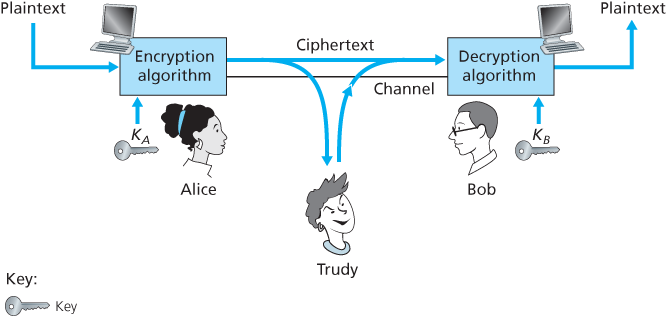
Figure 8.2 Cryptographic components
long history of cryptography. A complete discussion of cryptography itself requires a complete book [Kaufman 1995; Schneier 1995] and so we only touch on the essential aspects of cryptography, particularly as they are practiced on the Internet. We also note that while our focus in this section will be on the use of cryptography for confidentiality, we’ll see shortly that cryptographic techniques are inextricably woven into authentication, message integrity, nonrepudiation, and more.
Cryptographic techniques allow a sender to disguise data so that an intruder can gain no information from the intercepted data. The receiver, of course, must be able to recover the original data from the disguised data. Figure 8.2 illustrates some of the important terminology.
Suppose now that Alice wants to send a message to Bob. Alice’s message in its original form (for example, “Bob, I love you. Alice”) is known as plaintext, or cleartext. Alice encrypts her plaintext message using an encryption algorithm so that the encrypted message, known as ciphertext, looks unintelligible to any intruder. Interestingly, in many modern cryptographic systems, including those used in the Internet, the encryption technique itself is known—published, standardized, and available to everyone (for example, [RFC 1321; RFC 3447; RFC 2420; NIST 2001]), even a potential intruder! Clearly, if everyone knows the method for encoding data, then there must be some secret information that prevents an intruder from decrypting the transmitted data. This is where keys come in.
In Figure 8.2, Alice provides a key, KA, a string of numbers or characters, as input to the encryption algorithm. The encryption algorithm takes the key and the plaintext message, m, as input and produces ciphertext as output. The notation KA(m) refers to the ciphertext form (encrypted using the key KA) of the plaintext message, m. The actual encryption algorithm that uses key KA will be evident from the context. Similarly, Bob will provide a key, KB, to the decryption algorithm that takes the ciphertext and Bob’s key as input and produces the original plaintext as output. That is, if Bob receives an encrypted message KA(m), he decrypts it by computing
8.2.1 Symmetric Key Cryptography
All cryptographic algorithms involve substituting one thing for another, for example, taking a piece of plaintext and then computing and substituting the appropriate ciphertext to create the encrypted message. Before studying a modern key-based cryptographic system, let us first get our feet wet by studying a very old, very simple symmetric key algorithm attributed to Julius Caesar, known as the Caesar cipher (a cipher is a method for encrypting data).
For English text, the Caesar cipher would work by taking each letter in the plaintext message and substituting the letter that is k letters later (allowing wraparound; that is, having the letter z followed by the letter a) in the alphabet. For example if bob, i love you. Alice” becomes “ere, l oryh brx. dolfh” in ciphertext. While the ciphertext does indeed look like gibberish, it wouldn’t take long to break the code if you knew that the Caesar cipher was being used, as there are only 25 possible key values.
An improvement on the Caesar cipher is the monoalphabetic cipher, which also substitutes one letter of the alphabet with another letter of the alphabet. However, rather than substituting according to a regular pattern (for example, substitution with an offset of k for all letters), any letter can be substituted for any other letter, as long as each letter has a unique substitute letter, and vice versa. The substitution rule in Figure 8.3 shows one possible rule for encoding plaintext.
The plaintext message “bob, i love you. Alice” becomes “nkn, s gktc wky. Mgsbc.” Thus, as in the case of the Caesar cipher, this looks like gibberish. A monoalphabetic cipher would also appear to be better than the Caesar cipher in that there are 26! (on the order of 1026) possible pairings of letters rather than 25 possible pairings. A brute-force approach of trying all 1026 possible pairings

Figure 8.3 A monoalphabetic cipher
would require far too much work to be a feasible way of breaking the encryption algorithm and decoding the message. However, by statistical analysis of the plaintext language, for example, knowing that the letters e and t are the most frequently occurring letters in typical English text (accounting for 13 percent and 9 percent of letter occurrences), and knowing that particular two-and three-letter occurrences of letters appear quite often together (for example, “in,” “it,” “the,” “ion,” “ing,” and so forth) make it relatively easy to break this code. If the intruder has some knowledge about the possible contents of the message, then it is even easier to break the code. For example, if Trudy the intruder is Bob’s wife and suspects Bob of having an affair with Alice, then she might suspect that the names “bob” and “alice” appear in the text. If Trudy knew for certain that those two names appeared in the ciphertext and had a copy of the example ciphertext message above, then she could immediately determine seven of the 26 letter pairings, requiring 109 fewer possibilities to be checked by a brute-force method. Indeed, if Trudy suspected Bob of having an affair, she might well expect to find some other choice words in the message as well.
When considering how easy it might be for Trudy to break Bob and Alice’s encryption scheme, one can distinguish three different scenarios, depending on what information the intruder has.
Ciphertext-only attack. In some cases, the intruder may have access only to the intercepted ciphertext, with no certain information about the contents of the plaintext message. We have seen how statistical analysis can help in a ciphertext-only attack on an encryption scheme.
Known-plaintext attack. We saw above that if Trudy somehow knew for sure that “bob” and “alice” appeared in the ciphertext message, then she could have determined the (plaintext, ciphertext) pairings for the letters a, l, i, c, e, b, and o. Trudy might also have been fortunate enough to have recorded all of the ciphertext transmissions and then found Bob’s own decrypted version of one of the transmissions scribbled on a piece of paper. When an intruder knows some of the (plaintext, ciphertext) pairings, we refer to this as a known-plaintext attack on the encryption scheme.
Chosen-plaintext attack. In a chosen-plaintext attack, the intruder is able to choose the plaintext message and obtain its corresponding ciphertext form. For the simple encryption algorithms we’ve seen so far, if Trudy could get Alice to send the message, “
The quick brown fox jumps over the lazy dog,” she could completely break the encryption scheme. We’ll see shortly that for more sophisticated encryption techniques, a chosen-plaintext attack does not necessarily mean that the encryption technique can be broken.
Five hundred years ago, techniques improving on monoalphabetic encryption, known as polyalphabetic encryption, were invented. The idea behind polyalphabetic encryption is to use multiple monoalphabetic ciphers, with a specific

Figure 8.4 A polyalphabetic cipher using two Caesar ciphers
monoalphabetic cipher to encode a letter in a specific position in the plaintext message. Thus, the same letter, appearing in different positions in the plaintext message, might be encoded differently. An example of a polyalphabetic encryption scheme is shown in Figure 8.4. It has two Caesar ciphers (with bob, i love you.” is thus encrypted “ghu, n etox dhz.” Note that the first b in the plaintext message is encrypted using C1, while the second b is encrypted using C2. In this example, the encryption and decryption “key” is the knowledge of the two Caesar keys
Block Ciphers
Let us now move forward to modern times and examine how symmetric key encryption is done today. There are two broad classes of symmetric encryption techniques: stream ciphers and block ciphers. We’ll briefly examine stream ciphers in Section 8.7 when we investigate security for wireless LANs. In this section, we focus on block ciphers, which are used in many secure Internet protocols, including PGP (for secure e-mail), SSL (for securing TCP connections), and IPsec (for securing the network-layer transport).
In a block cipher, the message to be encrypted is processed in blocks of k bits. For example, if
Continuing with this 3-bit block example, note that the mapping in Table 8.1 is just one mapping of many possible mappings. How many possible mappings are
Table 8.1 A specific 3-bit block cipher
| input | output | input | output |
|---|---|---|---|
| 000 | 110 | 100 | 011 |
| 001 | 111 | 101 | 010 |
| 010 | 101 | 110 | 000 |
| 011 | 100 | 111 | 001 |
there? To answer this question, observe that a mapping is nothing more than a permutation of all the possible inputs. There are
The brute-force attack for this cipher is to try to decrypt ciphtertext by using all mappings. With only 40,320 mappings (when
Although full-table block ciphers, as just described, with moderate values of k can produce robust symmetric key encryption schemes, they are unfortunately difficult to implement. For
Instead, block ciphers typically use functions that simulate randomly permuted tables. An example (adapted from [Kaufman 1995]) of such a function for
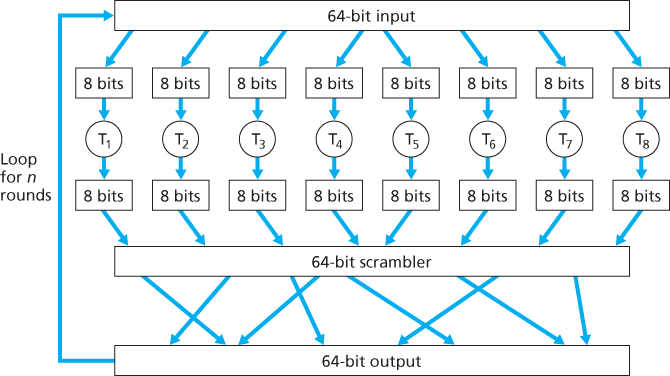
Figure 8.5 An example of a block cipher
Today there are a number of popular block ciphers, including DES (standing for Data Encryption Standard), 3DES, and AES (standing for Advanced Encryption Standard). Each of these standards uses functions, rather than predetermined tables, along the lines of Figure 8.5 (albeit more complicated and specific to each cipher). Each of these algorithms also uses a string of bits for a key. For example, DES uses 64-bit blocks with a 56-bit key. AES uses 128-bit blocks and can operate with keys that are 128, 192, and 256 bits long. An algorithm’s key determines the specific “mini-table” mappings and permutations within the algorithm’s internals. The brute-force attack for each of these ciphers is to cycle through all the keys, applying the decryption algorithm with each key. Observe that with a key length of n, there are 2n possible keys. NIST [NIST 2001] estimates that a machine that could crack 56-bit DES in one second (that is, try all 256 keys in one second) would take approximately 149 trillion years to crack a 128-bit AES key.
Cipher-Block Chaining
In computer networking applications, we typically need to encrypt long messages (or long streams of data). If we apply a block cipher as described by simply chopping up the message into k-bit blocks and independently encrypting each block, a subtle but important problem occurs. To see this, observe that two or more of the cleartext blocks can be identical. For example, the cleartext in two or more blocks could be “HTTP/1.1”. For these identical blocks, a block cipher would, of course, produce the same ciphertext. An attacker could potentially guess the cleartext when it sees identical ciphertext blocks and may even be able to decrypt the entire message by identifying identical ciphtertext blocks and using knowledge about the underlying protocol structure [Kaufman 1995].
To address this problem, we can mix some randomness into the ciphertext so that identical plaintext blocks produce different ciphertext blocks. To explain this idea, let m(i) denote the ith plaintext block, c(i) denote the ith ciphertext block, and
As an example, consider the 3-bit block cipher in Table 8.1. Suppose the plaintext is 010010010. If Alice encrypts this directly, without including the randomness, the resulting ciphertext becomes 101101101. If Trudy sniffs this ciphertext, because each of the three cipher blocks is the same, she can correctly surmise that each of the three plaintext blocks are the same. Now suppose instead Alice generates the random blocks
The astute reader will note that introducing randomness solves one problem but creates another: namely, Alice must transmit twice as many bits as before. Indeed, for each cipher bit, she must now also send a random bit, doubling the required bandwidth. In order to have our cake and eat it too, block ciphers typically use a technique called Cipher Block Chaining (CBC). The basic idea is to send only one random value along with the very first message, and then have the sender and receiver use the computed coded blocks in place of the subsequent random number. Specifically, CBC operates as follows:
Before encrypting the message (or the stream of data), the sender generates a random k-bit string, called the Initialization Vector (IV). Denote this initialization vector by c(0). The sender sends the IV to the receiver in cleartext.
For the first block, the sender calculates
For the ith block, the sender generates the ith ciphertext block from
Let’s now examine some of the consequences of this approach. First, the receiver will still be able to recover the original message. Indeed, when the receiver receives c(i), it decrypts it with KS to obtain
As an example, let’s now determine the ciphertext for the 3-bit block cipher in Table 8.1 with plaintext 010010010 and
CBC has an important consequence when designing secure network protocols: we’ll need to provide a mechanism within the protocol to distribute the IV from sender to receiver. We’ll see how this is done for several protocols later in this chapter.
8.2.2 Public Key Encryption
For more than 2,000 years (since the time of the Caesar cipher and up to the 1970s), encrypted communication required that the two communicating parties share a common secret—the symmetric key used for encryption and decryption. One difficulty with this approach is that the two parties must somehow agree on the shared key; but to do so requires (presumably secure) communication! Perhaps the parties could first meet and agree on the key in person (for example, two of Caesar’s centurions might meet at the Roman baths) and thereafter communicate with encryption. In a networked world, however, communicating parties may never meet and may never converse except over the network. Is it possible for two parties to communicate with encryption without having a shared secret key that is known in advance? In 1976, Diffie and Hellman [Diffie 1976] demonstrated an algorithm (known now as Diffie-Hellman Key Exchange) to do just that—a radically different and marvelously elegant approach toward secure communication that has led to the development of today’s public key cryptography systems. We’ll see shortly that public key cryptography systems also have several wonderful properties that make them useful not only
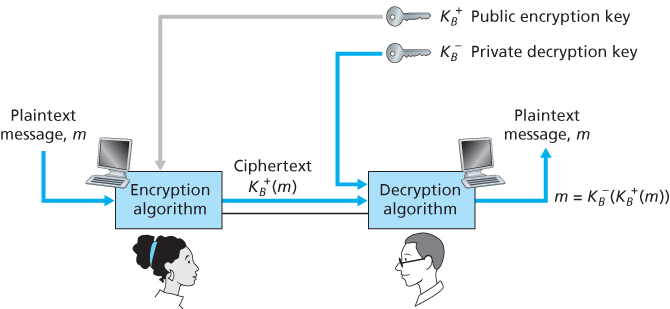
Figure 8.6 Public key cryptography
for encryption, but for authentication and digital signatures as well. Interestingly, it has recently come to light that ideas similar to those in [Diffie 1976] and [RSA 1978] had been independently developed in the early 1970s in a series of secret reports by researchers at the Communications-Electronics Security Group in the United Kingdom [Ellis 1987]. As is often the case, great ideas can spring up independently in many places; fortunately, public key advances took place not only in private, but also in the public view, as well.
The use of public key cryptography is conceptually quite simple. Suppose Alice wants to communicate with Bob. As shown in Figure 8.6, rather than Bob and Alice sharing a single secret key (as in the case of symmetric key systems), Bob (the recipient of Alice’s messages) instead has two keys—a public key that is available to everyone in the world (including Trudy the intruder) and a private key that is known only to Bob. We will use the notation
The use of public key cryptography is thus conceptually simple. But two immediate worries may spring to mind. A first concern is that although an intruder intercepting Alice’s encrypted message will see only gibberish, the intruder knows both the key (Bob’s public key, which is available for all the world to see) and the algorithm that Alice used for encryption. Trudy can thus mount a chosen-plaintext attack, using the known standardized encryption algorithm and Bob’s publicly available encryption key to encode any message she chooses! Trudy might well try, for example, to encode messages, or parts of messages, that she suspects that Alice might send. Clearly, if public key cryptography is to work, key selection and encryption/decryption must be done in such a way that it is impossible (or at least so hard as to be nearly impossible) for an intruder to either determine Bob’s private key or somehow otherwise decrypt or guess Alice’s message to Bob. A second concern is that since Bob’s encryption key is public, anyone can send an encrypted message to Bob, including Alice or someone claiming to be Alice. In the case of a single shared secret key, the fact that the sender knows the secret key implicitly identifies the sender to the receiver. In the case of public key cryptography, however, this is no longer the case since anyone can send an encrypted message to Bob using Bob’s publicly available key. A digital signature, a topic we will study in Section 8.3, is needed to bind a sender to a message.
RSA
While there may be many algorithms that address these concerns, the RSA algorithm (named after its founders, Ron Rivest, Adi Shamir, and Leonard Adleman) has become almost synonymous with public key cryptography. Let’s first see how RSA works and then examine why it works.
RSA makes extensive use of arithmetic operations using modulo-n arithmetic. So let’s briefly review modular arithmetic. Recall that x mod n simply means the remainder of x when divided by n; so, for example, 19 mod
It follows from the third fact that (a mod n)d
Now suppose that Alice wants to send to Bob an RSA-encrypted message, as shown in Figure 8.6. In our discussion of RSA, let’s always keep in mind that a message is nothing but a bit pattern, and every bit pattern can be uniquely represented by an integer number (along with the length of the bit pattern). For example, suppose a message is the bit pattern 1001; this message can be represented by the decimal integer 9. Thus, when encrypting a message with RSA, it is equivalent to encrypting the unique integer number that represents the message.
There are two interrelated components of RSA:
The choice of the public key and the private key
The encryption and decryption algorithm
To generate the public and private RSA keys, Bob performs the following steps:
Choose two large prime numbers, p and q. How large should p and q be? The larger the values, the more difficult it is to break RSA, but the longer it takes to perform the encoding and decoding. RSA Laboratories recommends that the product of p and q be on the order of 1,024 bits. For a discussion of how to find large prime numbers, see [Caldwell 2012].
Compute
Choose a number, e, less than n, that has no common factors (other than 1) with z. (In this case, e and z are said to be relatively prime.) The letter e is used since this value will be used in encryption.
Find a number, d, such that
The public key that Bob makes available to the world,
The encryption by Alice and the decryption by Bob are done as follows:
Suppose Alice wants to send Bob a bit pattern represented by the integer number m (with
The bit pattern corresponding to this ciphertext c is sent to Bob.
To decrypt the received ciphertext message, c, Bob computes
which requires the use of his private key (n, d).
Table 8.2 Alice’s RSA encryption, e = 5 n = 35
| Plaintext Letter | m: numeric representation | me | Ciphertext |
|---|---|---|---|
| l | 12 | 248832 | 17 |
| o | 15 | 759375 | 15 |
| v | 22 | 5153632 | 22 |
| e | 5 | 3125 | 10 |
As a simple example of RSA, suppose Bob chooses
Given that the “toy” example in Tables 8.2 and 8.3 has already produced some extremely large numbers, and given that we saw earlier that p and q should each be several hundred bits long, several practical issues regarding RSA come to mind. How does one choose large prime numbers? How does one then choose e and d? How does one perform exponentiation with large numbers? A discussion of these important issues is beyond the scope of this book; see [Kaufman 1995] and the references therein for details.
Table 8.3 Bob’s RSA decryption, d = 29 n = 35
| Ciphertext c | cd | m = cd mod n | Plaintext Letter |
|---|---|---|---|
| 17 | 4819685721067509150915091411825223071697 | 12 | l |
| 15 | 127834039403948858939111232757568359375 | 15 | o |
| 22 | 851643319086537701956194499721106030592 | 22 | v |
| 10 | 1000000000000000000000000000000 | 5 | e |
Session Keys
We note here that the exponentiation required by RSA is a rather time-consuming process. By contrast, DES is at least 100 times faster in software and between 1,000 and 10,000 times faster in hardware [RSA Fast 2012]. As a result, RSA is often used in practice in combination with symmetric key cryptography. For example, if Alice wants to send Bob a large amount of encrypted data, she could do the following. First Alice chooses a key that will be used to encode the data itself; this key is referred to as a session key, and is denoted by KS. Alice must inform Bob of the session key, since this is the shared symmetric key they will use with a symmetric key cipher (e.g., with DES or AES). Alice encrypts the session key using Bob’s public key, that is, computes
Why Does RSA Work?
RSA encryption/decryption appears rather magical. Why should it be that by applying the encryption algorithm and then the decryption algorithm, one recovers the original message? In order to understand why RSA works, again denote
Recall that, under RSA encryption, a message (uniquely represented by an integer), m, is exponentiated to the power e using modulo-n arithmetic, that is,
Decryption is performed by raising this value to the power d, again using modulo-n arithmetic. The result of an encryption step followed by a decryption step is thus (me mod n)d mod n. Let’s now see what we can say about this quantity. As mentioned earlier, one important property of modulo arithmetic is (a mod n)d mod
It therefore remains to show that
But remember that we have chosen e and d such that
which is exactly the result we are looking for! By first exponentiating to the power of e (that is, encrypting) and then exponentiating to the power of d (that is, decrypting), we obtain the original value, m. Even more wonderful is the fact that if we first exponentiate to the power of d and then exponentiate to the power of e—that is, we reverse the order of encryption and decryption, performing the decryption operation first and then applying the encryption operation—we also obtain the original value, m. This wonderful result follows immediately from the modular arithmetic:
The security of RSA relies on the fact that there are no known algorithms for quickly factoring a number, in this case the public value n, into the primes p and q. If one knew p and q, then given the public value e, one could easily compute the secret key, d. On the other hand, it is not known whether or not there exist fast algorithms for factoring a number, and in this sense, the security of RSA is not guaranteed.
Another popular public-key encryption algorithm is the Diffie-Hellman algorithm, which we will briefly explore in the homework problems. Diffie-Hellman is not as versatile as RSA in that it cannot be used to encrypt messages of arbitrary length; it can be used, however, to establish a symmetric session key, which is in turn used to encrypt messages.