7.5 Are Hypervisors Microkernels Done Right?
Both type 1 and type 2 hypervisors work with unmodified guest operating systems, but have to jump through hoops to get good performance. We have seen that paravirtualization takes a different approach by modifying the source code of the guest operating system instead. Rather than performing sensitive instructions, the paravirtualized guest executes hypercalls. In effect, the guest operating system is acting like a user program making system calls to the operating system (the hypervisor). When this route is taken, the hypervisor must define an interface consisting of a set of procedure calls that guest operating systems can use. This set of calls forms what is effectively an API (Application Programming Interface) even though it is an interface for use by guest operating systems, not application programs.
Going one step further, by removing all the sensitive instructions from the operating system and just having it make hypercalls to get system services like I/O, we have turned the hypervisor into a microkernel, like that of Fig. 1-26. The idea, explored in paravirtualization, is that emulating peculiar hardware instructions is an unpleasant and time-consuming task. It requires a call into the hypervisor and then emulating the exact semantics of a complicated instruction. It is far better just to have the guest operating system call the hypervisor (or microkernel) to do I/O, and so on.
Indeed, some researchers have argued that we should perhaps consider hypervisors as ‘‘microkernels done right’’ (Hand et al., 2005). The first thing to mention is that this is a highly controversial topic and some researchers have vocally opposed the notion, arguing that the difference between the two is not fundamental to begin with (Heiser et al., 2006). Others suggest that compared to microkernels, hypervisors may not even be that well suited for building secure systems, and advocate that they be extended with kernel functionality like message passing and memory sharing (Hohmuth et al., 2004). Finally, some researchers have made the argument that perhaps hypervisors are not even ‘‘operating systems research done right’’ (Roscoe et al., 2007). Since nobody said anything about operating system textbooks done right (or wrong)—yet—we think we do right by exploring the similarity between hypervisors and microkernels a bit more.
The main reason the first hypervisors emulated the complete machine was the lack of availability of source code for the guest operating system (e.g., for Windows) or the vast number of variants (e.g., for Linux). Perhaps in the future the hypervisor/microkernel API will be standardized, and subsequent operating systems will be designed to call it instead of using sensitive instructions. Doing so would make virtual machine technology easier to support and use.
The difference between true virtualization and paravirtualization is illustrated in Fig. 7-5. Here we have two virtual machines being supported on VT hardware. On the left is an unmodified version of Windows as the guest operating system. When a sensitive instruction is executed, the hardware causes a trap to the hypervisor, which then emulates it and returns. On the right is a version of Linux modified so that it no longer contains any sensitive instructions. Instead, when it needs to do I/O or change critical internal registers (such as the one pointing to the page tables), it makes a hypervisor call to get the work done, just like an application program making a system call in standard Linux.
Figure 7-5
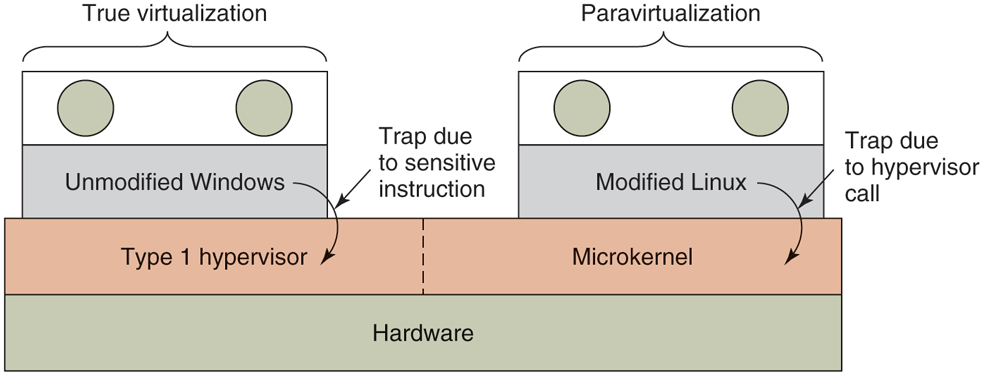
True virtualization and paravirtualization.
In Fig. 7-5, we have shown the hypervisor as being divided into two parts separated by a dashed line. In reality, only one program is running on the hardware. One part of it is responsible for interpreting trapped sensitive instructions, in this case, from Windows. The other part of it just carries out hypercalls. In the figure the latter part is labeled ‘‘microkernel.’’ If the hypervisor is intended to run only paravirtualized guest operating systems, there is no need for the emulation of sensitive instructions and we have a true microkernel, which just provides very basic services such as process dispatching and managing the MMU. The boundary between a type 1 hypervisor and a microkernel is vague already and will probably get even less clear as hypervisors begin acquiring more and more functionality and hypercalls, as seems likely. Again, this subject is controversial, but it is increasingly clear that the program running in kernel mode on the bare hardware should be small and reliable and consist of thousands, not millions, of lines of code.
Paravirtualizing the guest operating system raises a number of serious issues. First, if the sensitive (i.e., kernel-mode) instructions are replaced with calls to the hypervisor, how can the operating system run on the native hardware? After all, the hardware does not understand these hypercalls. And second, what if there are multiple hypervisors available in the marketplace, such as VMware, the open source Xen originally from the University of Cambridge, and Microsoft’s Hyper-V, all with somewhat different hypervisor APIs? How can the kernel be modified to run on all of them?
Amsden et al. (2006) have proposed a solution. In their model, the kernel is modified to call special procedures whenever it needs to do something sensitive. Together these procedures, called the VMI (Virtual Machine Interface), form a low-level layer that interfaces with the hardware or hypervisor. These procedures are designed to be generic and not tied to any specific hardware platform or to any particular hypervisor.
An example of this technique is given in Fig. 7-6 for a paravirtualized version of Linux they call VMI Linux (VMIL). When VMI Linux runs on the bare hardware, it has to be linked with a library that issues the actual (sensitive) instruction needed to do the work, as shown in Fig. 7-6(a). When running on a hypervisor, say VMware or Xen, the guest operating system is linked with different libraries that make the appropriate (and different) hypercalls to the underlying hypervisor. In this way, the core of the operating system remains portable yet is hypervisor friendly and still efficient.
Figure 7-6
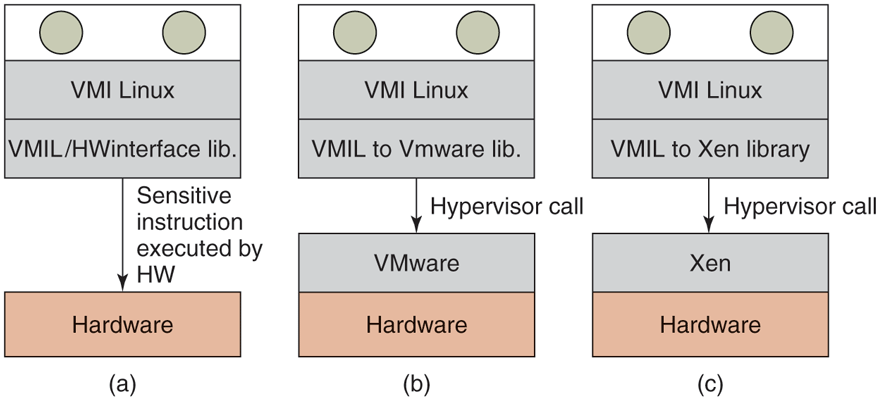
VMI Linux running on (a) the bare hardware, (b) VMware, and (c) Xen.
Other proposals for a virtual machine interface have also been made. Another popular one is called paravirt ops. The idea is conceptually similar to what we described above, but different in the details. Essentially, a group of several Linux vendors that included companies like IBM, VMware, Xen, and Red Hat advocated a hypervisor-agnostic interface for Linux. The interface, included in the mainline kernel from version 2.6.23 onward, allows the kernel to talk to whatever hypervisor is managing the physical hardware.