Long description
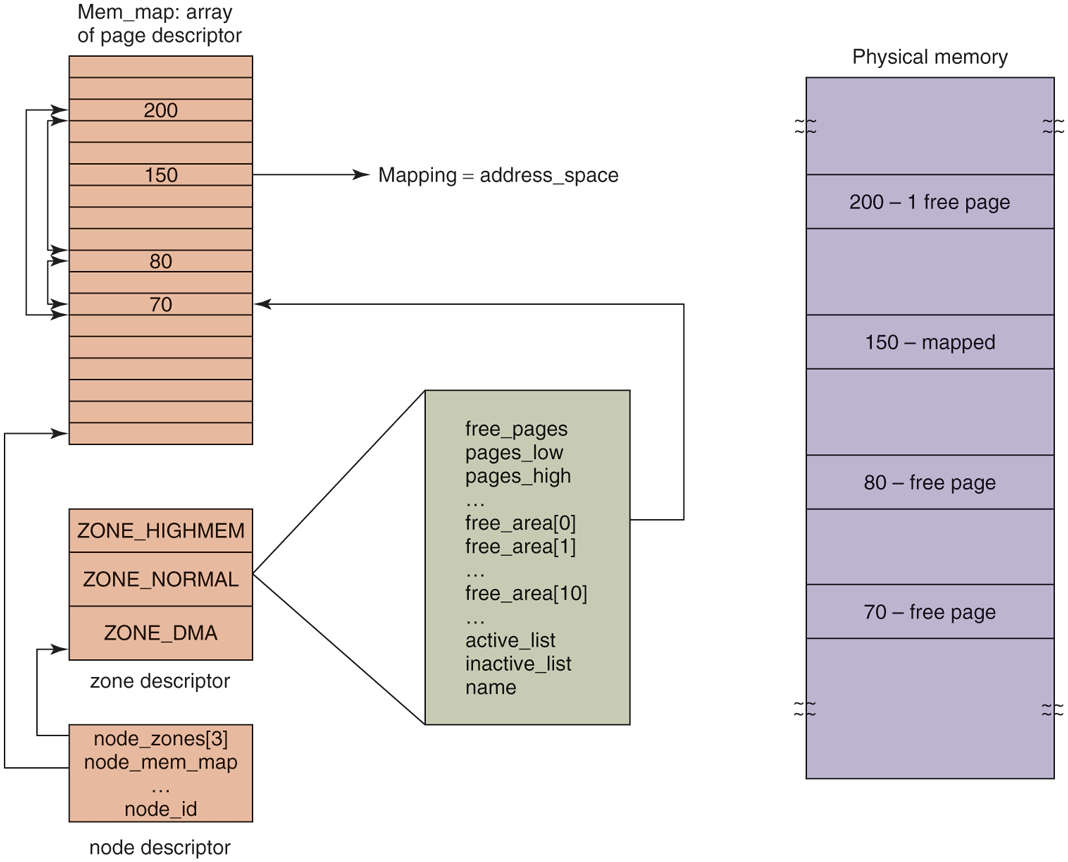
The figure shows a vertical block that is divided into 18 stacks labeled Mem underscore map: array of page descriptors. The third stack is labeled 200, the sixth stack is labeled 150, the tenth stack is labeled 80, the twelfth stack is labeled 70 and all other stacks are blank. A two-sided arrow is connected between stacks of 200 and 70, 80 and 70, 200 and 80. A rectangular block is labeled node descriptor and inside the block is labeled node underscore zones open square bracket 3 close square bracket
node underscore mem underscore map
…
node underscore id.
A one-sided arrow is pointing from the node descriptor block to the bottom of the vertical block. A rectangular block is labeled zone descriptor which is divided into three parts that are labeled ZONE HIGHMEM, ZONE NORMAL, and ZONE DMA. A one-sided arrow is pointing from the node descriptor block to the zone descriptor block. ZONE NORMAL is connected to a rectangular block that is labeled free underscore pages
pages underscore low
pages underscore high
…
free underscore area open square bracket 0 close square bracket
free underscore area open square bracket 1 close square bracket
…
free underscore area open square bracket 10 close square bracket
free underscore area open square bracket 10 close square bracket
active underscore list
inactive underscore list
name.
A one-sided arrow is pointing from this block to the stack that is labeled 70. A one-sided arrow is pointing from stack 150 to the right side and labeled Mapping equals address space. The right side of the figure shows a vertical rectangular block labeled Physical memory which is divided into nine parts. The first part is blank, the second part is labeled 200 – 1 free page, the third part is blank, the fourth part is labeled 150 – mapped, the fifth part is blank, the sixth part is labeled 80 – free page, the seventh part is blank, the eight-part is labeled 70 – free page, and the ninth part is blank.
Back