Now Let’s Nurture the Relationship!
What is a nurture email campaign?
Nurture emails are designed to be ongoing email campaigns that continue to “nurture” your relationship with a client.
Some people calls these drip campaigns because they slowly drip information to customers over a long period of time.
With a nurture campaign, you’ll be dripping information to customers about how you can solve their problems and offer them value.
STAY IN THE GAME
The reason a nurture campaign is important is because most customers don’t want to buy your product right away. Often, they have to hear about a product five or six times before they’re willing to make a purchase. Why? Because they trust the familiar and don’t trust the unfamiliar. And what makes something or somebody familiar? Hearing about them over and over from different outlets in different contexts.
So, imagine a customer hears about you from a friend. That’s touchpoint one. Then they hear about you again from another friend. That’s touchpoint two. Then they check out your website and because you used our framework, you invited them into a clear story and they have a much deeper understanding of how awesome your product is. That’s touchpoint three. Then they download your PDF and that takes care of touchpoint four. Then they start getting emails from you, which represents, let’s say, touchpoints five through seven. They discuss your product with a friend at work and that represents touchpoint eight. Then, that same weekend, they get another email from you, which represents touchpoint nine, and they realize they’ve been meaning to buy your product for a few weeks but just hasn’t made the time. They finally sit down at the kitchen counter and pulls out a debit card to make that purchase.
That’s how a relationship with customers tends to work. And because you’re sending them emails, you sped up those touchpoints and entered into a relationship of trust much more quickly.
In fact, without those emails, they may have never placed an order at all!
PEOPLE BUY WHEN THEY ARE READY, BUT ONLY IF YOU ARE STILL AROUND
The truth is people buy when they’re ready to purchase, not when you’re ready to sell. It goes without saying, you are most likely to close the deal if you are around when they’re ready to buy. Sending out a weekly email ensures that when they hit the buying window you, and not your competitor, are fresh in their minds.
Not only this, but by sending them a weekly email, you’re showing up in the most intimate device they own: their phone.
Customers are walking around all day, staring at their phones. If you can send them a weekly email that reminds them you are a guide who can help them solve a problem, offer them assistance and support, and provide them with an immense amount of value for free, they are more likely to stay subscribed as you’re communicating with them on the same device as their friends, family, and coworkers. Earning the right to be in that sacred space is critical. And it’s an honor.
If you aren’t leveraging the power of an email nurturing sequence, and your competitor is, they will beat you in the marketplace. It’s absolutely essential that you are emailing your list consistently with valuable content.
NURTURE EMAILS ARE A GREAT WAY TO PLAY THE LONG GAME
By creating a nurture campaign you’re committing to the long game.
Don’t be discouraged. You could send nurture emails to a customer once a week for seven years before they make a purchase.
Stay connected until they want to make a purchase.
You may ask for the sale a number of times before they’re ready, but if you’re providing enough value in your nurture emails, they will stay subscribed even if they aren’t interested in making a purchase right now.
Commitment in a relationship takes time. It’s true in romance, friendship, business relationships—and especially in the relationships we build with our customers.
WHAT ABOUT UNSUBSCRIBES?
The unsubscribe button is your friend. You don’t want to waste your customers’ time and you don’t want an email list full of people who don’t want to receive them.
Because your customers can unsubscribe from your emails at any point, you don’t have to feel guilty about bothering them. Everybody knows how to unsubscribe these days, so if they’re not unsubscribing, they like you. And you should feel great about that.
You don’t have to worry about them not opening your emails, either. There are plenty of companies whose nurture campaigns I subscribe to that I hardly open. But those emails are super powerful anyway. Why? Because once a week or more I am seeing the name of that company as I swipe and delete that email. It’s fantastic branding. Even though they are sending me a bunch of emails I am not reading, because those emails come from them, I am being reminded that they exist. So when I am ready to actually buy a pair of shoes or a power tool or a vacation with my wife, I have a company fresh in my mind to call.
WHAT SHOULD AN EMAIL ACCOMPLISH?
Many, if not most, people will not open your emails—but a good percentage of people will. That means we need to write some really great emails.
Later I’ll give you some formulas so that writing emails gets easier. And more fun. But for now here’s a high-level overview of what emails should accomplish:
• Solve a problem. Never miss an opportunity to tell people why you matter. And why do you matter? Because you solve a specific problem. Tell customers what that problem is and they will remember you forever.
• Offer value. What information, access, and tips can you offer your potential customers that help them get what they want?
• Remind them you have a solution. Don’t mention a problem if you aren’t going to position yourself as the one who resolves it. What products do you have that solve your customers’ problems?
• Send customers back to your website. They came once, downloaded your lead magnet, and showed interest. Now it’s time to bring them back with fresh eyes. Your website is the perfect elevator pitch: by bringing them back you get to make that pitch again.
Many of our clients feel timid about selling their products and services. They don’t want to come off like infomercial pitchmen, emotionally strong-arming customers out of their money.
One great characteristic of an email nurturing campaign is that it offers free value. Of course you always want to mention that you have more products, but this is hardly strong-arm selling.
A nurturing campaign does something even more powerful than selling your product. It positions you as the forever guide your customer has been looking for. Really, the goal of a nurturing campaign is to make sure the customer knows that, in the area of your expertise, you’re the first person they need to call.
This means all the information you give away should be your expert advice on what’s going wrong in your customers’ lives and how their lives can be made better.
If you sell athletic shoes, you can tell your customers why the shoes they used to wear don’t last, why people have back pain, and how the right pair of shoes can turn them into an athlete.
If they want to take a deeper dive, they can purchase your shoes.
If you sell a management consulting services you can talk about why common management assumptions are wrong, about mistakes managers make, or about the need to set up an actual execution plan.
If they want to take a deeper dive, they can purchase your consulting.
You want to keep giving your customer information on why the way they are living their lives without your product is not working, all the while positioning your product as the how that will fix their problem.
THE STRUCTURE OF A BASIC NURTURE SEQUENCE
There are many ways you can nurture customers. For the purposes of allowing you to create an initial, effective campaign, I am going to walk you through three types of nurture sequences that are easy to create and will work right away.
Kinds of Email Nurturing Campaigns
Weekly announcements. Every Monday morning we send out a nurture email with a preview of our podcast. Our podcast delivers content from experts that will help companies grow, which means every week our entire list receives some kind of beneficial content.
The real power of the email podcast announcement is that it gives me an excuse to send an email to my list, week after week. And each email explains how we’ve interviewed an expert to deliver even more value.
Honestly, it’s hard to know what is more valuable in terms of growing our business, the podcast or the email we send each week announcing each episode’s guest. Both are terrific touchpoints for our customers.
What could you email your customers about each week? A weekly product focus? A Monday morning management tip? An educational series that will turn them into a great guitar player?
Find a reason to email your customers so you remind them you exist.
Even though the point of a nurture email is not to sell product, you should still include a mention of your product at the end of each email. This mention is not a hard sell, just a small reminder that lets customers know what you do and what products you create that may solve their problems.
In our weekly podcast announcements, we take it a step further. While the purpose of the email is to let people know about our podcast, we include an ad at the bottom of the email reminding subscribers about our products.
Here’s a sample of one of those weekly emails:
Catchy Title:
Is the Financial System Ripping You Off?
Short Description of Content:
How much do financial markets actually impact your small business? More than you probably realize. And in this case, what you don’t know really can hurt you—and your employees. Today on the podcast, Josh Robbins will arm you with the information you need to make smart decisions about your financial advisors, investments, and 401k plans—without getting taken advantage of.
Call to Action:
Listen now
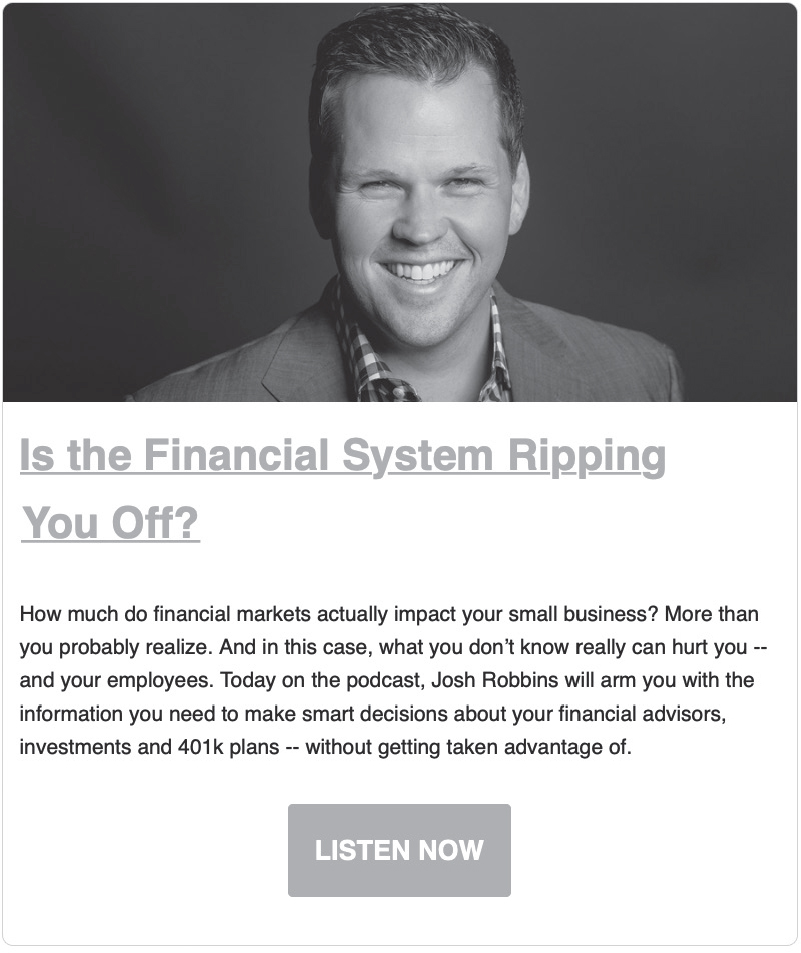
Short Ad:
Story Brand Live Marketing Workshop May 19–20
As more companies experience the power of the StoryBrand Framework, our marketing workshops get bigger and bigger. But this next one is a little different.
Our next workshop is happening May 19–21, at Clementine Hall in Nashville. Clementine Hall is a beautiful venue with a really intimate feel, and it’s probably the last time we’ll do a Live Marketing Workshop with this small of a group. Don’t miss it!
Second Call to Action:
Register now

Share weekly tips. Another kind of weekly email you can send would be a collection of tips that will make your customers’ lives better as it relates to your products and services.
You can offer something consistent every week, like a weekly cocktail or cooking recipe, or you can offer tips that help them organize their homes, their time, or their lives.
If you are having a hard time deciding what type of tips to send, survey your subscribers to see what kinds of content they want to receive. What do they need help with? What are the top three problems they encounter every week?
You can also look at your social media platforms and analyze which posts have the most interactions. Are there pictures or tips that your tribe is typically drawn to? Use those as launching points for creating new and helpful content.
If you are a store that sells cookware, your customer wants to be a great at-home chef, but they don’t know the first thing about seasonings. Take them to seasonings school! Every week, send them a description of a feature seasoning. Tell them where to use each seasoning, where it came from, and why it’s so wonderful to include in a dish. And for heaven’s sake, include recipes. (If anybody creates this nurturing campaign, by the way, sign me up!)
Here are a few kinds of weekly tip emails that have been powerful for our clients:
• Weight loss tips
• Cocktail recipes
• Fashion tips
• Leadership tips
• Motivational Monday tips
• Weekly activities to do with your kids
• New yoga poses
• Tips on social media marketing
• Dog-training tips
• Tips on personal safety
• Each-week-of-the-year gardening projects
• A parent-to-adolescent language translator
There is no end to the list of what you can offer your customers. Remember, you’re an expert and they want to know more. Step into your authority and teach them what you know!
The structure of these types of emails is fairly simple.
Think of the email as a blog post or short magazine article.
• Start with a clear title. This is not the time to be clever. The title can be catchy, but be very clear about what you’ve included inside the email. If I have to guess about the content, I’m not going to open the email.
• State the problem. Use a short description that addresses the customers’ problem and lets them know you are going to reveal a solution.
• Deliver the strategic tip or value. Simply let them know how to solve their problem. Break the problem down into steps if you can. Remember, even emails should be visual.
• Position yourself as the guide. You position yourself as the guide by expressing empathy and demonstrating authority or competency. Make sure you have a short statement about how or why you care that your customers are struggling and then let them know why you are qualified to help.
• Let them know you have a product to sell. Finally, make sure to mention your product or service. You will get a few orders when you do this, but that’s not the point. The point is to continue taking your potential customers through an exercise in memorization. You are teaching them to memorize what problems you solve and what products you sell.
Here is an example of a weekly tip email that works:
Clear Title:
Ten Tips for Losing Fifteen Pounds
We know that when it comes to losing that last fifteen pounds, the old rules no longer apply.
With the final fifteen, suddenly you’re in a whole new universe.
Our doctors and researchers have discovered a reason and it’s this: your set point has changed. What that means is that even though you’ve got fifteen pounds left to lose, your body thinks you are skinny!
But don’t worry. We’ve helped thousands of people drop the final fifteen and we can help you too.
The key is to stay active and get serious. You’re going to have to approach this like a baseball player approaches an opposing pitcher.
Get your strategy set, and you’ll find success.
So without further delay, here are our top ten tips to losing the last fifteen pounds.
Ten Tips to Lose The Last Fifteen Pounds
1. Let those who are around you know what you’re doing and find an accountability partner and/or group.
We believe that when you surround yourself with like-minded, motivated individuals, you drastically increase your chances of succeeding. (We see it happen daily!)
2. Remove all unhealthy temptations from your cupboards, refrigerator, and pantry.
Why have tempting foods in your house that don’t align with your goals? Temptation removed = setbacks removed!
3. Create a specific shopping list based on healthy 400–600 calorie meals.
Do not go into a grocery store blindly. Have a preplanned list and stick to the outside perimeter of the store where you will find whole, healthy food items. (P.S. Bonus tip: In addition to a list, give yourself a time limit so you’re not tempted to browse. If you’re a parent, your kids will love this game!)
4. Skip a few meals.
If your doctor approves, feel free to skip breakfast, lunch, or dinner every once in a while. More and more studies are revealing that your intestines think a little break is actually good for you. It teaches you to live without food, stabilizes your blood sugar, and ignites your body to start burning fat. Plan to skip three or four meals each week and enjoy the break your body has really been hungry for. Want to know more? Google “intermittent fasting” and do some research for yourself.
5. Drink more water! You need to drink at least half of your body weight in ounces every single day.
Find a water bottle that helps you track your ounces consumed per day. If you have a hard time remembering to drink water, set an alarm on your phone while you are working to develop this as a new habit.
6. Write down what you eat.
Keep a calorie journal. But don’t just keep a calorie journal to count calories, keep a journal to practice awareness. Most people forget nearly half of what they eat in a day. By writing down what you eat, you’ll start to see patterns and trends you can improve on. Plus, who wants to write down that bowl of ice cream at the end of the day?
7. Increase the amount of protein you are eating daily. Look for products that contain undenatured whey protein.
Your body doesn’t store protein as quickly as it stores carbs. Plus, protein is the building block of lean muscle, which actually helps you burn more calories. Increase the amount of protein that you eat, then, and you’ll be more likely to lose weight.
8. Stop your stress.
You’re not imagining it when stress and weight gain seem to go hand in hand. Stress raises the levels of cortisol in your body, which makes your body store fat at a higher rate.
9. Drink whey protein right before your head hits the pillow at night.
When your body breaks down protein while you sleep, it also helps the release of stubborn belly fat. (You really can add to your results while you rest!)
10. Get adequate, uninterrupted sleep every night. Include a healthy dose of natural melatonin.
Sleep is essential to any healthy lifestyle. Your body requires a full seven to eight hours of rest per night. Sleeping any less, even if you don’t “feel” tired, is stopping your body from performing at its best.
We know how hard it is to lose the final fifteen, but we also know it’s possible. And it’s not only possible, it’s can also be fun.
We’ve helped 1,245 people lose fifteen pounds right here in our gym. That’s because when you sign up for our biweekly workout class, we don’t even have you lift a finger without sitting down and learning a little about how your body burns fat.
If you’d like to attend one class for free, just call us today. We’d be glad to help.
When it comes to losing the final fifteen (or the first twenty!) we just might be the people you’ve been looking for.
Call us right now and we’ll book you in the next class.
Contact info: _____________________
Sincerely,
Jim Smith, Health and Wellness Gym
P.S. If you bring a friend, we’ll give both of you the first two workouts for free! Call us today.
The great thing about this email is it offers to solve a problem whether the customer pays the gym anything or not. But it also offers to hold the customer’s hand if they’d like to solve the problem together.
The chances of losing that final fifteen pounds would obviously increase dramatically with your help. Even if you think the information is obvious, your customer may be approaching their weight-loss journey for the first time, or need a reminder. This email would work to earn trust and increase customer engagement.
Another great thing about the content of this email is it could actually be turned into ten consecutive weekly emails. Take each tip and elaborate on it a little further and ten weeks’ worth of terrific content are ready to go. That’s ten touchpoints with a customer!
Share a weekly notification. Like you, I subscribe to many marketing emails from companies who have product I want to know about. While some of their emails may have helpful information, mostly I’m on their lists to see what new products they are developing or to be notified about special promotions.
If you have a brand that consistently makes or carries new products, your nurturing email can simply contain a catalog-style page revealing what’s new. You don’t have to overthink it.
That said, including the occasional email about how your products are made (always to solve a customer’s problem) or tips for best uses of your products will add to the overall depth of your offering. And they will also add some personality to the brand.
A recent shoe brand I consulted with wanted to know the fastest way to increase revenue. They’d spent a great deal of effort and money on branding and had sent their customers’ email after email talking about the mission of the company, but they’d failed to do the one thing that would grow their company the fastest: send emails with pictures of their shoes.
I recommended they split their list into four: women, men, teens, and parents of children and then send a weekly email featuring images of shoes that fit those specific demographics.
Another company I worked with in Fort Worth, Texas, grew their company by simply sending out pictures of trucks. They were (and are) the largest seller of used lifted trucks in the world. What weekly notifications did we decide to send out? Truck Tuesday: a weekly email showing images of trucks recently added to their inventory. What truck guy wouldn’t want to receive that email each week? I already have a truck and I still open every email.
The key to weekly notifications that feature products is to make sure you’re always letting customers know about something that is new and exciting.
In these types of nurturing campaigns, of course, you’ll want to include the “buy now” or “shop” direct calls to action next to the product.
Other types of weekly notifications emails that have been successful for our clients include:
• Calendar of events for the week
• Weekly specials for a restaurant
• New weekly inventory
• Plant of the week (for a nursery)
• New houses on the market in your neighborhood
• Stocks to watch
• Specials such as 10 percent off this week
• Weekly recipes
• Weekly how-to videos
One critical mistake we’ve seen a few companies make is to fill their nurture emails with information about them as a company. Hitting your list with weekly introductions to the different members of your staff doesn’t solve your customers’ problems, and they won’t be interested.
Also, keep the email titles clear and consistent so people know not to miss what they are looking for.
START SLOW AND ENJOY THE PROCESS
The nice thing about your nurture campaign is it’s all automated, and you don’t have to add to it every week. Simply start by crafting a few great emails, and when you start seeing customer engagement increase, you’ll be motivated to add a few more. Pretty soon you’ll have fifty-two emails that are delivering value and earning trust.
If you haven’t been sending consistent nurture emails and the idea of doing something every week feels overwhelming, don’t worry. Start slow. Repurpose content you have already created. And if you aren’t a writer, hire a writer to help you out. I like to think I’m a pretty good writer, but I hire copywriters all the time because I love seeing what they come up with, and I love sending out words from a fresh, fun new voice.
WHERE CAN I GET EMAIL IDEAS?
Once you realize how easy and fun it is to send emails, you’ll start seeing opportunities all the time.
Many of you came up with five or ten PDF ideas, but you’re only going to create one. What about using those other four or nine PDF titles and turning them into emails?
You can also ask customers what they would like to receive from you. Would a weekly recipe be helpful? A weekly workout motivation? Your customers may have some terrific ideas.
The bottom line is this: if you are not emailing your customers at least once each week, you’re missing out. And worse than missing out, you’re being forgotten.
You can grow your company the same way I convinced my wife to marry me. Just keep riding your bike by her house. Eventually, if you are helpful and nice and not scary, they just might marry you. Or, um, buy your product.