AN INTRODUCTION TO THE MARKETING MADE SIMPLE CHECKLIST
Many companies confuse branding with marketing, and this confusion is costing them millions.
Branding affects how a customer feels about your brand, while marketing communicates a specific offer.
Branding concerns itself with fonts and colors and design, while marketing puts the right words together to pique a customer’s interest and close the deal.
Most of us are so concerned with the way our brand looks and feels, we neglect to communicate what customers are actually looking for: a solution to their problem.
Imagine getting a job as an NFL football coach and spending 90 percent of your time choosing the new team logo, the new jersey designs, and the “branding” for game-day trinkets the team will hand out to fans? Meanwhile, your team hasn’t been drilled on the fundamentals of the game.
It doesn’t matter how pretty your jerseys are, your team is going to lose.
It’s easy for us to think of branding as more important than marketing. We watch the Super Bowl and get sentimental when the new Coca-Cola commercial comes on. We want people to feel just as great about our company. What we fail to realize is that Coca-Cola is a household brand name. Coke was invented in the nineteenth century and brilliantly marketed in the early twentieth century. Hundreds of millions of dollars have been spent telling the world what Coca-Cola is. And not only this, we’ve all tasted it and enjoyed it. Coke has extreme brand familiarity, which means they can afford do to more branding and less marketing.
Now imagine a company that has created an automotive product allowing you to only change the oil in your car once every year. That would be a pretty amazing product. Let’s say you can drive up to fifteen thousand miles between oil changes. Incredible. The problem is, nobody has heard of this company. A rookie mistake would be to “brand” the company rather than “market” the product.
A novice marketing director might want to use a tag line like “save time, save money,” which at first glance sounds great. But look again. To an outsider, it’s invisible language. Let’s say you’re driving down the street and see a random company logo on a billboard with giant words that say “save time, save money.” If you didn’t know what the product did or what problem the product solved, would that mean anything to you? No! People don’t pull their cars over to sit on their hood and study billboards. They pass by them at eighty miles per hour. That billboard needs to say “The oil you only have to change once a year!”
DON’T BE INVISIBLE
Most brands make what I call an invisible first impression. It’s not that they make a bad first impression—but it’s also not a good first impression. It’s just invisible.
A nutritional supplement company we worked with introduced me to their line of products by saying they give their customers more life and more fulfillment. That sounds great but the same could be said of a church, an executive coach, a gym, or a daycare! Those words go in one ear and out the other and come off as standard marketing speak. It’s an invisible first impression.
Consider all of the invisible first impressions you see as a consumer every day. How many billboards do you drive past that you pay no attention to? How many commercials run in the background of your TV or radio that you’re tuning out? Think about how much money was spent to put those forgettable ads into the world.
Anecdotally, I’d say more than 50 percent of all advertising makes this mistake. They create invisible ads that nobody reads or cares about.
MARKETING MADE SIMPLE WILL CAUSE PEOPLE TO MEMORIZE YOUR OFFER
The one final thing a sales funnel needs to do is help your customers to memorize your offer.
Good marketing is an exercise in memorization and successful brands know it.
Repeating the same language in the same way in your one-liner, landing page, emails, and direct sales letters helps you brand yourself into your customer’s mind.
We know that in only fifteen minutes, Geico can help us save up to 15 percent on car insurance. Why do we know this? Because their marketing led us through an exercise in memorization that caused us to memorize their offer.
After a customer has gone through your sales funnel, they will have memorized the talking points you want them to memorize. And when they’ve memorized your talking points, you will take up valuable real estate in their brains. They will know why you matter in their story, and they will be able to tell their friends why you matter in theirs too.
The key to going viral is to give people something very simple to think about and say regarding your products or services.
Before you create your sales funnel, come up with three or four things you want your customers to know about your brand.
If you understand the StoryBrand framework this is simple. Just use the words from your BrandScript to populate your sales funnel.
If you don’t understand the StoryBrand framework, consider answering these questions in your sales funnel:
What problem do you solve for customers?
What will your customer’s life look like if they buy your product?
What consequences does your product help customers avoid?
What does somebody need to do to buy your product? (“Click buy now?” “Call today?”)
The answers to these questions should be short, simple, and easy to understand. Remember, customers do not move into confusion.
If you are a dentist, you might say:
Could your smile be better?
You could be happy with your smile.
Schedule an appointment today.
I know that sounds simple, but we interact with thousands of brands who fail to tell their customers exactly what they offer and exactly how they can change their customers’ lives for the better.
In your marketing copy, don’t be cute, be clear. Simplify your message and repeat it over and over using the same language and customers will finally figure out where you fit in their lives.
THE MARKETING MADE SIMPLE CHECKLIST
Each sales funnel you create should break through the advertising clutter and speak directly to customers.
Your sales funnels are the foundation of your entire marketing effort. Again, once your sales funnels are created, your advertising campaigns should support those sales funnels, which then sell your product or service.
If you’re a visual learner or are looking for inspiration, start there.
There are many kinds of sales funnels. If done well, they all work. The Marketing Made Simple Checklist is a collection of best practices we’ve learned, having helped more than ten thousand businesses create marketing campaigns that work.
The practical tools we will help you build will guide customers through the three stages of relationships. We’ll help you create one-liners that pique a customer’s curiosity, wireframe websites and landing pages that further intrigue them about the problems you solve, lead generators that enlighten them as to why your products and services will work for them, email campaigns that establish trust with customers, and sales emails and calls to action that ask for a commitment without making you sound like a sleazy salesperson.
The five pieces of your sales funnel will be:
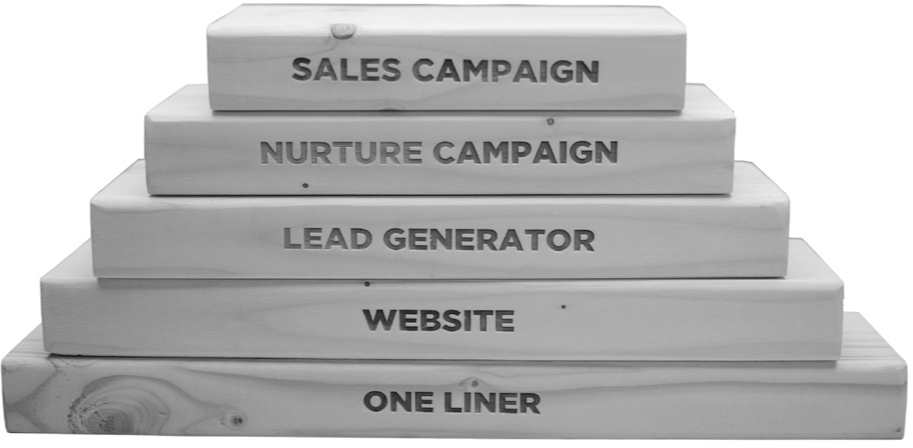
Curiosity |
Enlightenment |
Commitment |
One-Liner |
Lead generators |
Sales email campaigns |
Website |
Nuture email campaigns |
The next few chapters walk you step by step through how to create a marketing sales funnel. It is a checklist for you to walk through and make sure you have what you need and that you are doing it right.
You will start with building curiosity for your business through a one-liner and website wireframe. Then you will take your customer through the enlightenment phase by creating lead generators and nurture emails. Finally, you ask them to make a commitment with a sales email sequence. Each piece of collateral you create from the checklist will further engage your customer in a relationship with you and lead toward a sale.
So you know you are doing it right, each chapter contains an explanation of why you are creating the piece you are creating, a step-by-step guide to writing the material—and then we tell you how to implement it.
In the chapter on execution, we even give you a complete plan including a meeting schedule and agendas so that your team can create a series of sales funnels together.
EXECUTION IS KEY
We recently hired an independent research company to survey thousands of our customers to find out who sees greater success from clarifying their message and creating marketing that sells.
After all the surveys and all the data were compiled, you know what made the greatest difference? It wasn’t size, background, education, or business type. The companies that showed the greatest growth in profit, saw greater ease in the creation of marketing collateral, and saved more time and money in creating marketing collateral were the ones who actually followed the exact plan I am going to walk you through. The only thing that had a statistical impact on growth was how they implemented the framework.
Bottom line: when customers were asked what level of success they saw compared to how much they implemented the checklist, there was a striking correlation between the level of success as compared with implementation across all channels of marketing. This pattern was the same across every individual area of marketing as well as overall implementation. It also influenced every area of success. While simply implementing one part of the checklist still showed positive results, higher levels of implementation resulted in more positive results. The more thoroughly an organization implemented the Marketing Made Simple Checklist, the more confidence employees had in creating marketing messaging, and the more time and money was saved in creating marketing collateral.
Most importantly, the more a company executed the Marketing Made Simple Checklist, the more money they made.
In the graphs below you can see clearly, the more you implement the checklist throughout your marketing, the more growth your company will see, the more confident your team will become in creating marketing, and the more time you will save.
The data shows that the Marketing Made Simple Checklist works and it works for everybody.
You just have to execute.
If you want J. J. and I to take you through the Marketing Made Simple Checklist in video format, visit BusinessMadeSimple.com and register for our very inexpensive online platform. Use the code “Marketing” to get a buy-one-gift-one offer, allowing you and your entire team to use the platform for half the cost.
StoryBrand Messaging has directly contributed to our organization’s growth.
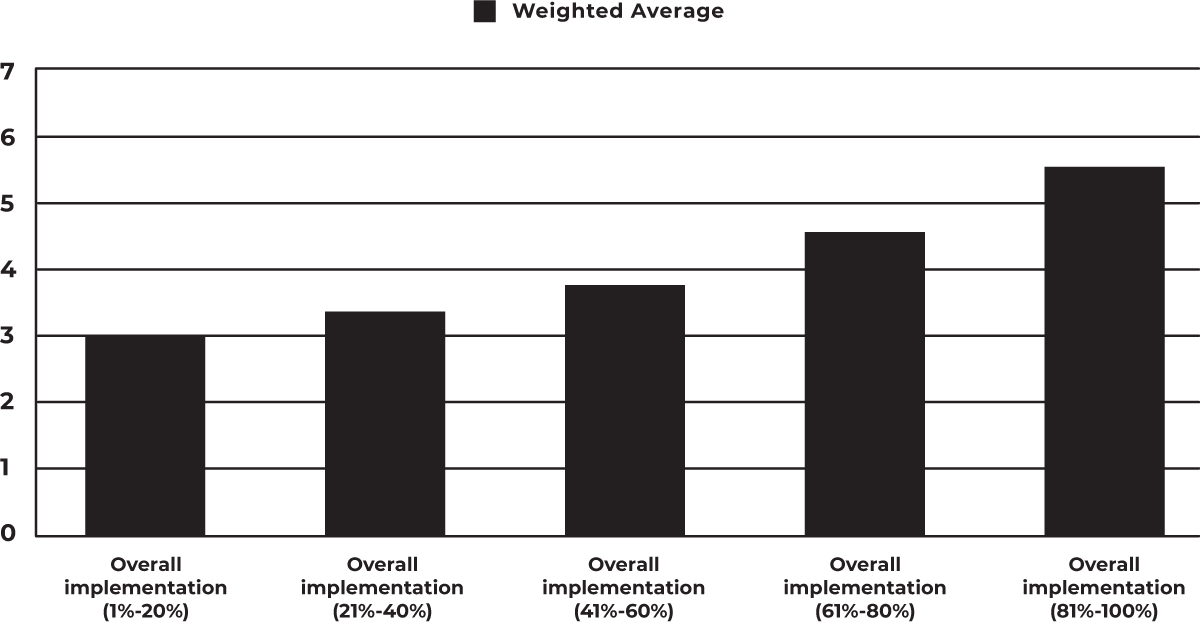
Graph of relationship between implementation and growth
Whether you’re going it alone with this book, hiring a guide, or learning from us on video, make a commitment today to follow through on this simple sales funnel and you will see results.
StoryBrand has made our team more confident.
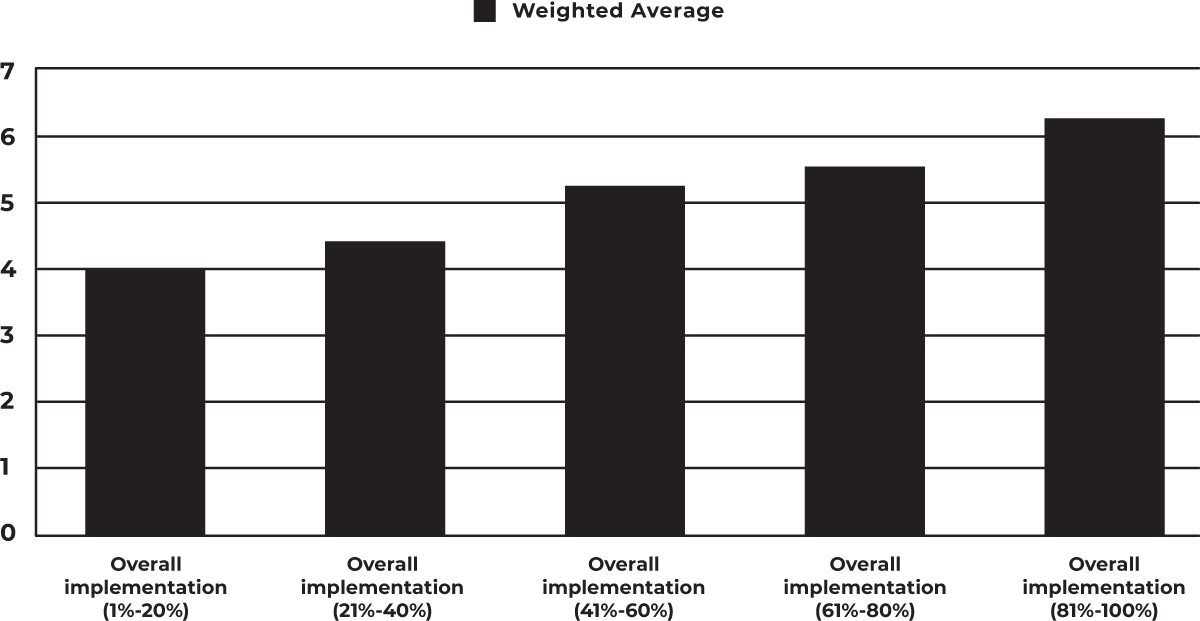
Graph of relationship between implementation and team confidence
StoryBrand has saved us time.
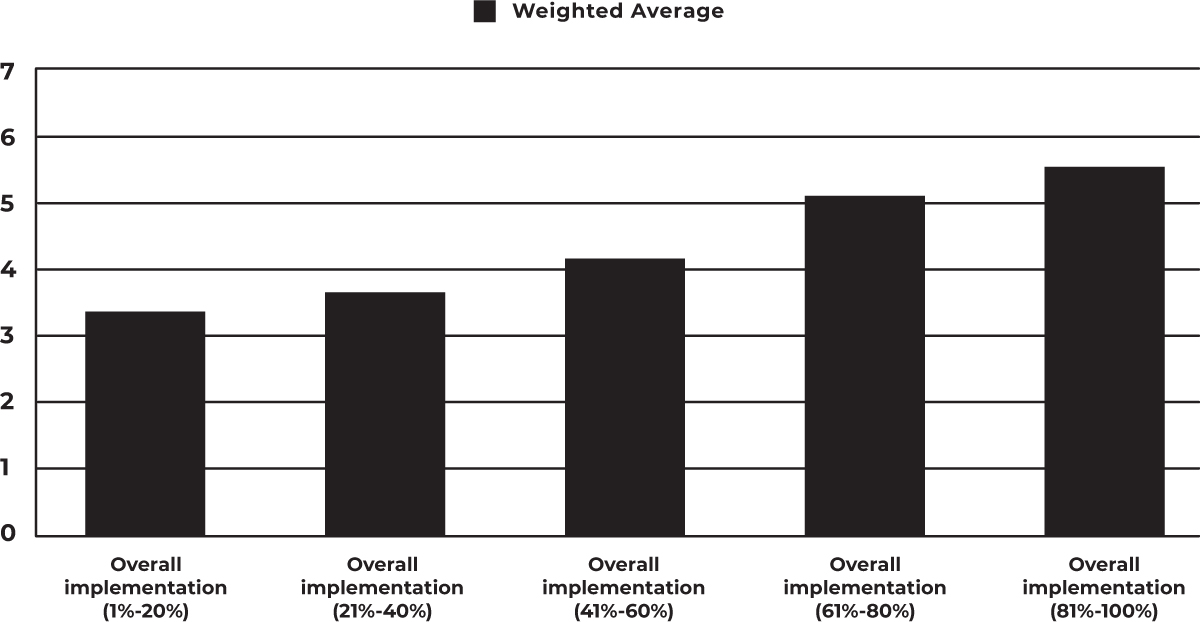
Graph of relationship between implementation and time saving