THE ACTUAL STAGES OF A RELATIONSHIP
Why People Have to Get Curious and Enlightened Before They Will Commit
Our five-step marketing plan will invite people into a trusted relationship with your brand. Not only will you sell more products, but customers will start thinking of you, your salespeople, and even your products as friends who are helping them on their journey.
Understanding the stages of a relationship is important because it helps us understand what our sales funnel has to accomplish.
We all want people to understand how our products can solve their problems so that they will make a purchase. But it turns out, simply asking people to buy our products doesn’t work. At least not right away.
Asking for a sale is a relational proposition. And relationships have rules.
Most of us ask people to buy our products the way a shy, young boy might ask a girl to go on a date. We clumsily walk up to her in the hallway, shake her hand with a strong grip the way our dad taught us, and ask her if she’d like to go to a movie with us and our mom, who just bought a new car. (I’m relating the story for a friend.)
Who knows whether that relationship will work out. Let’s hope so for the kid’s sake. Regardless, though, the kid would do a lot better if he understood how relationships really work. And the truth is relationships are built slowly.
Whether we are talking about a romantic relationship, a friendship, or even a relationship with a brand, all relationships move through three stages. And, these stages cannot be rushed.
The stages of a relationship are:
1. Curiosity
2. Enlightenment
3. Commitment
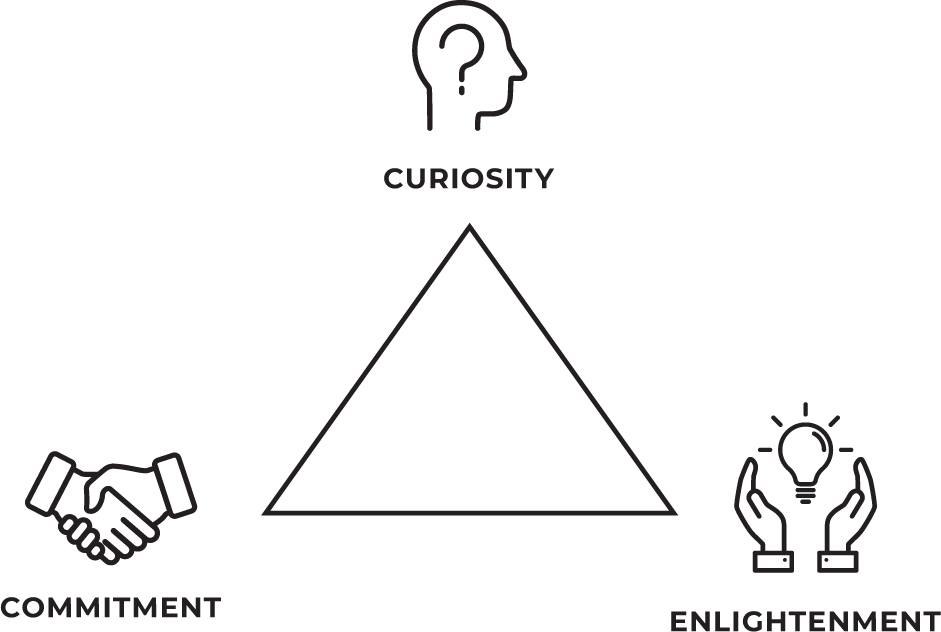
People do not want to be enlightened about you (get to know you more) unless they are curious about you (you have something that can help them survive), and until they are enlightened about how you can help them survive, they will never commit.
Every relationship you have ever been in has gone through these three stages. Even relationships you have with brands.
THE JOURNEY EVERY CUSTOMER TAKES
Recently I began exploring high-end audio equipment. Betsy and I live in Nashville and because so many people in this town are in the music industry, we often find ourselves hosting small get-togethers with artists who are working on an album.
After the fifth or sixth impromptu listening party, I realized the tiny Bluetooth speaker in our kitchen wasn’t good enough.
I spent a little time on Google and came across a small company named Oswalds Mill Audio that makes custom audio equipment. The pictures of the speakers and turntables were beautiful. The turntable itself weighed eighty pounds and the speakers looked like steel bullhorns pulled from an old football stadium. Everything was mounted on beautiful hardwood, and the guy in the picture playing the vinyl record was wearing a cool sweater, which is the sign of a guy who knows a lot about how a sound system works. Anyway, there was something different about this sound system and the way the product was talked about on the website that made me curious.
But how? And curious about what?
I’ll tell you whether I bought the sound system in a minute, but first, let’s explore what we need to do to help a customer be more interested in a brand.
Stage 1: Curiosity
Can this person, product, or service help me survive? The first stage of a relationship is curiosity. This is the stage where you meet somebody and you want to know more about them. At a party, this is the person you leave the party hoping for a second interaction with. Perhaps you went to the same school or perhaps they are a few years ahead of you in the same career.
Without knowing it, what’s making you curious about this person is one thing: you sense they can help you survive or thrive.
You might wonder how a person can help you survive just by having gone to the same school as you. The truth is, the filter that decides what helps us survive is incredibly nuanced and particular. Your filter is a ridiculously refined instrument.
That person who went to the same school as you solves the problem of you not feeling alone, that there is somebody who has a similar life journey as yours. We tend to collect people with similar life journeys for that very reason; they make us feel like we have a tribe.
Being alone, by the way, is a vulnerable state. Human beings move in families and tribes. We may go through seasons where we are alone but mostly we like being around other human beings.
When we meet somebody who is like us, we feel more safe, mainly because we understand the person better. Confusion about who somebody is makes us feel slightly threatened, so similarities break down those threats faster.
If the person we are talking to is a few years ahead of us in the same career, the way they can help us survive is more obvious. They can help us avoid pitfalls and may know some strategies so our career can advance a little faster.
None of this thinking is happening on a conscious level, of course, but it’s definitely happening.
A person, product, or brand that can help us survive or thrive activates a survival mechanism within us that piques our curiosity.
Curiosity Is a Snap Judgment
The curiosity stage of a relationship is mostly about snap judgments. Scanning our environment is like sorting through a stack of mail. We place anything we see as junk, or not relevant to our survival, in the recycle bin. Bills, letters from friends, catalogs we might be interested in, and such go into a pile to be sorted later. At the curiosity stage we are really only making two large piles: keep and discard.
This is how our customers’ brains work as they scan the three thousand pieces of marketing collateral they encounter each day. The overwhelming majority of material gets discarded, but the occasional message gets sorted to the keep pile.
I know this all sounds harshly utilitarian, but it’s quite normal and healthy. Each of us are trying to live a meaningful story, and not everybody or everything is useful to whatever story we’ve decided to live.
Human beings collect physical, emotional, and social resources that help them survive in the world. Just like the squirrels in my backyard collect nuts, we collect anything we might need to stay alive on this planet. And that’s not a bad thing. We are, after all, primates. And primates are terrific at survival.
A person with no curiosity filter would not survive in the world. In fact, people with no curiosity filter wouldn’t even make it out of their house in the morning. They’d just stand in the kitchen all day wondering about how the toaster works. Why? Because their curiosity filter wouldn’t tell them they don’t need to know how the toaster works and that if they don’t leave soon they will be late to work and if that keeps happening they will lose their job.
The point is this: if you don’t tell somebody how you can help them survive, they will set you aside—or worse, discard you.
When it comes to marketing, the header on your website, the subject line of your email, the opening statement of your proposal, the title of your lead generator, your entire elevator pitch, the first line of your keynote address, and a thousand other things need to succinctly express one of the ways you help people survive. If they don’t, people will not listen.
How Do You Get Past a Person’s Curiosity Filter?
So what made me curious about the expensive audio equipment? Several things, most of which were being communicated to my subconscious.
The main thing that made me curious was status. More than even a sound system that sounded good, the beautiful equipment was going to make my living room look and feel awesome. People were going to think more of me when they saw that equipment (or so my primate mind believed), and so the pictures on the website were doing a lot of the heavy lifting. Not only that, but the guy in the sweater was acting as a proxy for my aspirational identity. Who wouldn’t want to be ten years younger dressed in a cool sweater listening to an Al Green record while their spouse mixed them an old-fashioned in the background? Fantastic!
I know it all sounds irrational, but very little of what makes us curious is actually rational. People don’t buy products, vote for candidates, or join a movement because they are thinking rationally. If you look around, that’s pretty obvious.
Regardless, the point is this: to pique somebody’s curiosity, you must associate your products with something that will help them survive.
Your Customers Are Not Curious About You, They Are Curious About How You Can Solve Their Problem
Most businesses make the enormous mistake of telling their story to their customers, as though their customers are somehow interested. Customers are not interested in your story. They are, rather, interested in being invited into a story that has them surviving and winning in the end.
Instead of telling your story, the first stage of your marketing plan should pique a customer’s curiosity about how their own story could be made better.
Curiosity Isn’t Enough
Curiosity aside, I still wasn’t ready to buy the expensive sound system. The sound system was no impulse buy. I needed more information.
Without knowing it, I was moving into the second stage of relationships. I wanted the company to enlighten me about how, exactly, their product was going to increase my chances of survival.
Stage 2: Enlightenment
This is the process by which your customer begins to trust you. If curiosity is what gets us to pay attention to a brand, enlightenment invites us into a relationship.
I’m not talking about the “you’ll understand the meaning of the universe” kind of enlightenment: I’m talking about the kind of enlightenment that helps us understand how something works.
An enlightened person is somebody who understands and an unenlightened person is somebody who doesn’t. You are either enlightened about how the tectonic plates once moved, or you are not. And that goes for physics, gardening, neuroscience, or how to make snow cones. With the exception of how to actually eat snow cones, I, for example, am not enlightened about any of those things.
If you want customers to take the next step in a relationship with your brand, you need to enlighten them about how you can solve their problem and help them survive.
After piquing your customers’ curiosity on a website, in an email, or in some form of advertising or sales presentation, the next question they will likely ask is “but how?”
You sell a medicine that can cure a hangover. But how does it work?
You can improve education without raising taxes. But how?
You can safely rid their garden of pesky pests. But how?
The next phase of your marketing should enlighten them about how your products work to solve their problems.
Notice I didn’t say that you should enlighten your customers about how your product works. That’s hardly important. You should enlighten your customers about how your product works to solve their problem.
Never forget, we are not telling our story or even talking about our products. We are always inviting our customers on a journey in which their lives are made better through the use of our products.
Customers being invited on a journey want to know what tools we have to help them save the day and exactly how those tools will help them accomplish whatever task lays before them. If they are confused about how our products can help them win, they will walk away without making a purchase.
Customers Will Not Move Into a Fog
Being confused about something is a vulnerable state. If you drive a car in a country where traffic rules are different, your confusion could get you hurt. If you are confused about what kind of berries are poisonous and what kind are edible, you could get killed!
A human brain is designed to experience pleasure when it understands something and fear or resistance when it doesn’t. This is a basic survival mechanism and it’s one that very few companies take into account when they communicate with their customers.
When somebody is confused, in varying degrees, they feel exposed to danger. Therefore, people move away from situations in which they are confused and toward contexts in which they understand the situation and feel in control.
This principle is why politicians with repeatable, simple messaging statements usually win. It’s not because their plan will work or has even been thought through, it’s because voters feel a sense of understanding and associate that feeling of comfort and survival with that candidate.
The answer to confusion is always no.
When you enlighten your customers, you lift the fog and help them see clearly how your product can help them solve their problem.
If the header of your website, the first words of your proposal, or even the first thing you say in a keynote is meant to pique curiosity, the next idea you communicate should answer the “but how.”
Your Marketing Should Enlighten Customers
I built StoryBrand, the marketing division of BusinessMadeSimple, using a lead-generating PDF called “Five Things Your Website Should Include” because my potential customers wanted to know more. I convinced them their message wasn’t clear enough and then taught them how to clarify their message in a specific application. That lead generator was incredibly successful for me. It was a great “next step” in my customers’ relational journey with my brand.
There are many ways you can enlighten your customers, including long-form copy toward the bottom of your website in a lead generator, a live event, an email sequence, or even a video.
As I did further research on the speaker company, I found a video in which the founder explained how sound waves work. It turns out sound waves take up actual physical space. Some sound waves are an inch wide, and others are two or three inches wide. What this means is if you have speakers that aren’t the right dimensions to produce the physical sound waves, those waves become distorted.
The video enlightened me. No wonder the cheap Bluetooth speaker in our kitchen was so inferior. My speaker was squishing the precious sound waves!
After becoming enlightened, I realized why the sound coming from these new expensive speakers would deliver a terrific experience. And, of course, I wanted the experience all the more.
One thing the video could have done a little better would have been to connect the enlightenment about how their speakers work with my own survival. A simple line saying “so that’s why your friends aren’t super impressed with your current sound system and they will be really impressed when you install ours” would sell a lot more speakers. Why? Because now your big bullhorn speakers don’t just help me listen to music, they help me bond with and serve my tribe.
As you think about your marketing campaigns, are you piquing your customers’ curiosity and then enlightening them as to how you can solve their problems, help them survive, and improve their lives?
Later in this book we will give you step-by-step instructions on how to do this, but for now, know that even these first two steps are not enough. Now that we are in a trusted relationship with our customers, we have to ask them to commit.
Stage 3: Commitment
The point at which your customer is asked to make a risky decision. The two main reasons customers do not place orders are because:
1. The brand never asked them for the sale, or
2. The brand asked them for a sale too early.
The reason asking for a commitment too early in a relationship doesn’t work is because a commitment is risky, and taking risks works against our survival mechanisms.
Making our customers curious and then gradually enlightening them reduces the sense of risk and greatly increases the chance they will commit their hard-earned dollars on our products.
Timing Is Everything
The day I met my wife I knew I wanted to marry her. I did. Much later, of course. But the morning we met, it was all I could do to patiently wait and take small steps.
I was in and out of D.C. working on a government task force, and she worked at a bed and breakfast I was staying at. My only goal the morning we first met was to not spill coffee on my shirt as we sat at the breakfast table and talked. Luckily, I made it through that breakfast alive and could tell she was open to another conversation in the future.
But that’s when I screwed up. As we e-mailed back and forth over the next month, I never made my intentions known. Because I wasn’t asking her out, she assumed I only wanted to be friends and started dating somebody else. It would be nearly three more years before I had the chance to recover from my mistake.
What I should have said early on was that I enjoyed talking to her and whenever I happened to be in D.C. next, I’d love to take her on a date. If I’d have just said that, I might have gotten an earlier start on a great love story.
The reason I didn’t ask her out, though, was the same reason many of us don’t ask our customers to commit. We are a little scared of rejection and we don’t want to come off as pushy.
When the time is right, though, we have to make our intentions known or we will lose the relationship.
We often believe that being passive is a way of respecting our customer. We don’t ask for the sale because we don’t want them to be bothered. However, the last thing we want our customers saying is something along the lines of “I really like that brand, I consider them a friend, but I don’t buy anything from them. I do, however, make out with their competitor all the time.”
Blah.
Wise men say only fools rush in, but wise men also make a move eventually.
Move Slow, But Move
Having a “buy now” button on your website is not pushy. Customers always want to know where the relationship is going and you want to make sure to tell them that this relationship is a business relationship that is transactional in nature. They will respect you for being honest. Having a “buy now” or “schedule a call” button on your website makes sure they always understand the kind of relationship you are inviting them into.
Businesses that pretend to be their customers’ friend in order to create sales come off as users and stalkers. As a business leader, it’s our role to be trusted advisors to our customers. And customers absolutely love trusted advisors. We do not have to take the place of their parents or their spouses. That’s creepy.
Later in the book when we teach you to wireframe a website, we’ll show you how to always be asking for the sale without being pushy.
And being pushy is a problem.
When a sales relationship moves too quickly, the customer feels threatened. The reason people feel threatened is because making a purchase is always a decision to forgo valuable survival resources in exchange for resources they hope will increase their chances of survival even more. If they are wrong in that calculation, they are under greater threat than they were before they made the purchase.
That’s why so many people hate it when a car salesman rushes out of the building when we walk onto a lot to shop for a car. Nobody wants to be “tricked” into giving up their resources. They want to be invited into a journey in which they will discover a product that can help them survive, and preferably for a great value.
The same is true in social relationships. Commitment in a relationship takes time.
Why does commitment take time? Because commitment is the first stage in a relationship in which a person has to take a calculated risk. Commitment is when they put skin in the game.
Rushed Relationships Are Not Healthy
We all remember how relationships felt in junior high. We’d have a best friend one week and a new one the following week. We fell in love one month only to fall in love with somebody else a month later. As we grew older, the pace of those transitions slowed down and became healthier.
If an adult falls in love with somebody new every couple months, most people would think of that person as unhealthy and not want to risk being with them.
I say that because when we rush in to close a deal or make a sale too soon, the customer smells "unhealth."
Our sales funnels should invite people into a journey that never attempts to trick or coerce them to make a decision they will later regret. That’s one of the keys to staying in business for decades rather than months.
When we push customers to make a purchase, we end up with frustrated customers—or worse, unhealthy customers who don’t have good boundaries. The latter tend to light up our customer service lines and create more problems than the sale was worth.
It’s true you always want to be asking for the sale, but if the relationship is moving at the right pace asking for the sale, even when the customer isn’t ready, won’t break the deal. Always piquing their curiosity while enlightening them allows a customer to reject your offer while still asking to know more.
The key to marketing—and sales for that matter—is to invite the customer on a journey at the pace of a natural, healthy relationship.
To Create a Good Relationship You Must Keep in Touch
So what’s the correct pace? In my opinion, for most products a customer needs to experience about eight touchpoints before they are ready to place an order.
A “touch” in this context is an email, a visit to your website, a radio ad, a keynote that they hear, or any other piece of marketing collateral you send their way.
The sad news is, in order for your touchpoints to reach a customer eight times, you need to send out dozens of pieces of communication they may actually ignore. In other words, you may have to reach out to them fifty times just to get your customer to notice.
The less expensive the product, the more likely they are to impulse buy, which means fewer touches. But the more expensive the product, the more they will need to hear from you before they will take a risk.
The absolute best way to stay in a relationship with a customer is to email them. Depending on the kind of email campaign you are creating, you will continue piquing their curiosity, further enlighten them, and call them to action.
In the email section of this book, we will help you craft emails that do all three. Of specific importance to you, though, are the emails that close the deal.
Customers can be invited on a journey that builds a trusting relationship and invites them to buy your products all through email.
You should have an email campaign for every product you sell. Likely your salespeople should be interacting with clients at various stages of an email campaign.
A Sales Funnel Controls the Pace of the Relationship
In a relationship, you talk about things on a fourth or fifth date you might never talk about on a first date. Intimacy and trust take time.
The rest of this book will walk you through the creation of a sales funnel that will build trust with your customers in a way that is natural and safe.
As you create your sales funnel, you will be piquing your customers’ curiosity, enlightening them, and then asking them to commit. Different pieces of your sales funnel will accomplish these tasks and to some degree they overlap, but in the end your customer will enjoy interacting with your brand because you’ve respected their autonomy and space.
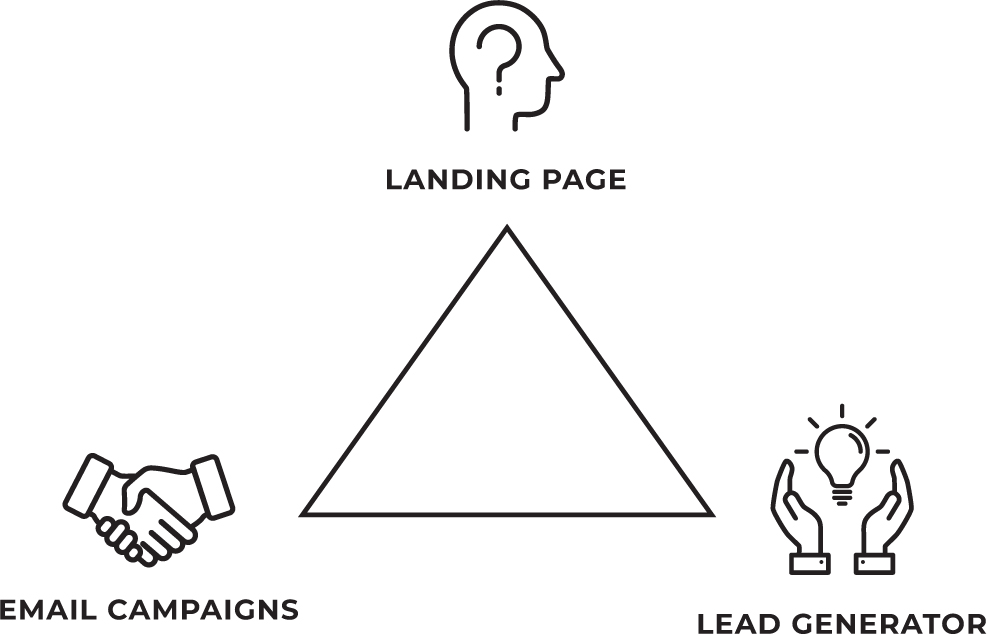
Assess the Strength of Your Marketing Campaign
Are you piquing your customers’ curiosity with your website, your signage, the first pages of your proposals, and through the talking points your salespeople employ?
Are you earning your customers’ trust by enlightening them about how you can solve their problems and help them survive?
Are you inviting your customers to place an order through a complimentary and direct ask?
Once you create your sales funnel, you’ll be inviting your customers into a trusted relationship that feels safe, consistent, and useful in their lives.
People fall in love with brands for the same reason they fall in love with each other. The brand helped them survive and got them a great return on their social, emotional, or financial investment.
What if a significant amount of trust building could be automated? What if, by the time you or one of your sales representatives sat down with a potential client, it felt like that client was already on the fourth or fifth date with your brand?
How much would your sales increase if by the time you interacted with a potential customer your customer’s curiosity had already been piqued and your brand had enlightened them on how you could solve their problem?
Customers can fall in love with your brand too. Just invite them into the stages of a relationship and do so at the right pace.
The Marketing Made Simple Checklist will show you the way.