Define Your Key Characteristics
Almost every story you love is about a character or a group of characters who want something and have to overcome obstacles to get what they want. What we really love about those stories, though, is not that the hero gets what they want, it’s that the hero transforms into a better version of themselves in order to get what they want.
Human beings love to watch other human beings transform into better versions of themselves. In fact, we are absolutely obsessed with people who transform. Whether we’re watching a television show about somebody who has gotten into amazing physical shape or a documentary about an orphan kid who grew up to become president, we are inspired and motivated by the idea that we, too, can transform.
Humans are active, fluid, ever-changing beings. We learn and grow and transform the more we engage in the story of life.
But how do human beings transform? Why do they transform? What causes transformation?
Human beings transform when they want something that requires them to become a better version of themselves in order to attain that something. Whether we want healthy intimacy and realize we need to see a counselor or we want to climb a mountain and so set out to physically transform into a person who is capable of such a feat, we change when we fully engage in something that sits beyond our current capability.
In fact, when you wrote down your Mission Statement, you not only invited yourself and others into a story, you invited yourself and others to transform into the sort of people who could accomplish that mission.
In fact, what top talent wants more than anything else is to work for a business that will help them transform into a high-value professional. If your Mission Statement is aspirational, they will see that opportunity in your business.
You and your team will have to develop certain characteristics in order to achieve your mission. In your package of Guiding Principles, these characteristics are called Key Characteristics.
You can think of your Key Characteristics as “core values” if you like, but to me, they are even better than core values. Core values are great, but often words like “integrity” are too elusive to live out. Besides, “integrity” is a core value of being human. If you don’t have integrity, you will likely end up in prison. Key Characteristics are more specific; they identify a specific set of skills or personality characteristics necessary to work for your company.
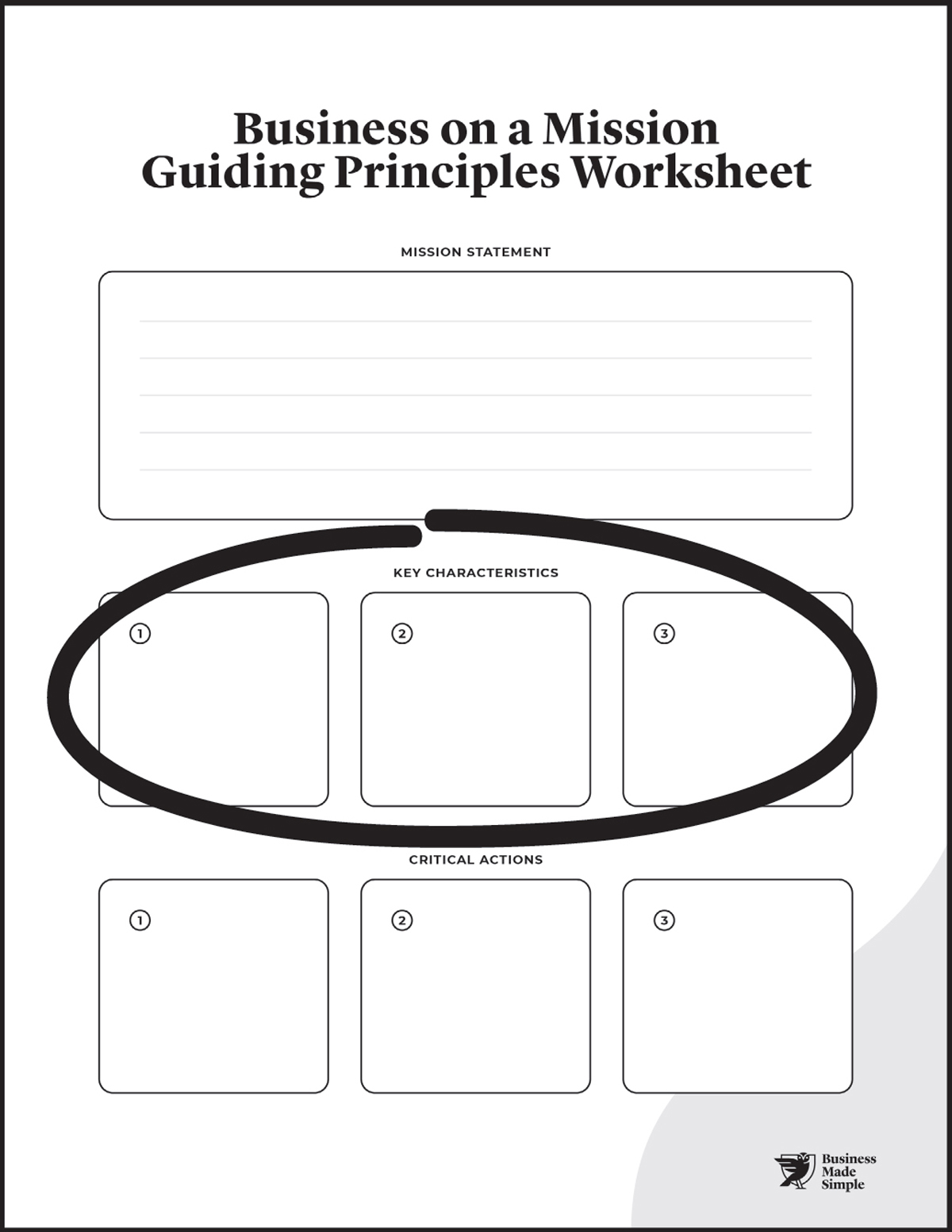
Access a digital, fillable version at SmallBusinessFlightPlan.com
For instance, if you are a software engineer, you may need team members who are obsessed with simplifying a user interface. If you are a pet store owner, you definitely want team members who love animals.
When you make your core values more specific by turning them into Key Characteristics, you better know what characteristics to develop in yourself and what characteristics to look for in new hires.
If you ask a potential hire if they have integrity, everybody will say, “Of course” The same thing will happen if you ask a pet store applicant if they love animals. But if you ask a potential new hire what they’ve done that demonstrates their love of animals, you’ll be much more likely to find out whether or not you’ve got the right candidate.
Here are three questions to ask when determining your Key Characteristics:
- What specific characteristics will each of us need in order to create (or sell) the products that solve our customers’ problems?
- What characteristics will we need to keep going when the challenges seem overwhelming?
- What characteristics will we need to create a safe, encouraging culture?
When you define the Key Characteristics you will need to embody in order to accomplish your mission, you determine who you will need to transform into and what kind of people you will need to hire.
How Many Key Characteristics Should We List?
In order to accomplish your mission, you and the members of your team will likely need to embody a number of character traits. In fact, different departments may need to embody different Key Characteristics.
For purposes of simplifying our Guiding Principles, though, we’re recommending you include only three Key Characteristics in your list. These three Key Characteristics should be specific enough to guide your hiring decisions but universal enough to be true for everybody in your organization.
Here’s a great example of some Key Characteristics for a local restaurant:
- We love people and enjoy serving them.
- We are obsessed with great-tasting food.
- We are calm under pressure.
Notice how specific these Key Characteristics are. The restaurant did not choose to say, “We are customer oriented.” They said, “We love people and enjoy serving them.” Because they defined exactly what sort of attitude to have when interacting with customers, their team members know how they are supposed to act. Anybody can be optimistic and still put people off, but if we are “positive when interacting with people,” we will hardly ever put people off.
Equally, if we are obsessed with great-tasting food, every member of the team is reminded to make sure the ingredients are fresh, that food is served in a timely manner, and that any plate that doesn’t look right goes back to the chef for review. Why? If we are obsessed with great-tasting food, we are always learning and growing and discovering new ways of making food taste better.
Finally, if the restaurant is going to grow, team members will need to stay calm under pressure. This is a big one. This invites team members to learn and grow and always become the sort of people who are calm under pressure. This Key Characteristic defines an aspirational identity. If the pressure gets intense, the leader can remind team members to remain calm under pressure—a characteristic that will no doubt become a defining attribute of the team. Not only this, but if they are developing the ability to be calm under pressure, they are finding better ways to organize the kitchen, expedite orders, and give individual attention to their guests even while the restaurant is buzzing around them.
Most importantly, though, these three characteristics contribute to the restaurant hitting its financial objectives. Think about it, if you walked into a restaurant with a staff that was incredibly positive, then they served food that tasted amazing, and they were never so overwhelmed that they failed to give you individual attention, wouldn’t you go back? Of course. That restaurant is going to grow, without question, because they defined the sort of people they would need to become in order to accomplish their mission and then actively began to transform into those kinds of people.
Here are some examples of the Key Characteristics different kinds of businesses could choose:
EXAMPLES:
Network Marketing Product Rep:
- Loves connecting with people,
- Believes their product can change lives, and
- Is always resilient.
Financial Advisor:
- Always puts the customers first,
- Can clearly explain complicated investments, and
- Enjoys helping families leave a legacy.
Consultant:
- Terrific at turning knowledge into practical frameworks,
- Loves networking with people, and
- Is obsessed with solving clients’ problems.
Now it’s time for you to define your Key Characteristics. What three characteristics will you and your teammates need to embody in order to accomplish your mission?
Brainstorm the Key Characteristics you and your team members will need to embody to accomplish the mission. When you decide on the top three, transfer them to your Small Business Flight Plan.
KEY CHARACTERISTICS:
[Your Notes]
Now that you know your three economic priorities along with what kind of people you need to become to reach your financial objectives, let’s talk about what actions we need to take in order to live the mission.