How Do We “Professionalize” Our Small Business?
Years ago, a friend gave me the best business advice I’ve ever received. His advice was so concise it rang in my head like a bell for the next five years.
Bill had scaled his father’s company into the billions and with that money bought and sold several more companies that succeeded as well. Bill knew what it took to run a business, and he knew what it took to grow one.
We were standing in my driveway after having talked for an hour or so. We’d talked about where my business was and where it could go. The future was limitless, yet I could tell there was something Bill didn’t want to say. He’d been nothing but encouraging in the years I’d known him, but this time it was obvious he had some constructive criticism. I asked point blank what he was thinking.
He stood silently for a moment, measuring his thoughts. “Don,” he finally said, lowering his head and taking off his glasses. “You need to professionalize your operation.”
“That’s your problem.” He continued. “Until you professionalize your operation, its potential is limited. The amount of money you make and your ability to have a positive impact on the world will be limited.”
I’d never heard the term “professionalize your operation” before, but it rang true. My business revolved too much around me, and nobody (including me) knew exactly what they were supposed to do to make it grow. We had a vision, for sure, but we’d not built the reliable, predictable systems that would allow us to execute that vision.
What Bill saw, and what I now know, is that even though we were succeeding as a company, we were climbing straight into the s-curve that haunts most small businesses.
Can You Avoid the Dreaded “S-Curve”?
Every successful business has come face-to-face with the “s-curve.” The s-curve follows a specific pattern—the business begins to grow, which is a great thing, and then a dreadful series of events that could make or break a company is put into action.
Imagine a business puttering quietly along—the first part of the s-curve. Then, their products begin to sell. Demand might even soar. It’s magic. The business begins to grow. Customers like the product and they start telling their friends. Everything is great, right? All the business owner’s problems seem to be behind them.
But, then, things take a turn.
The business owner is pulled out of their sweet spot, the sweet spot they were in when the company took off. They spend too much time trying to put out fires, and the business starts to decline because the owner is managing problems rather than continuing to create the magic that grew the company.
Then the problems get worse. They hire too many people because they anticipate growth. They order too many parts to make too many products. They extend their buyers’ terms to attract more business. They allot too much money to marketing that doesn’t work. They start seeing people around the office and aren’t sure exactly what they do. Customers feel the effects in product delays, frantic messaging, and bad customer service. Sales begin to decline. They temporarily lower their prices to cover bills and, as a result, devalue their product. Overhead increases while revenue decreases. The owner takes out a line of credit and starts to dip into it. The owner starts losing sleep. Their family suffers. Soon, the business has to shut down and the owner has to get a job to pay down the line of credit.
All this despite the fact that they had a product people wanted.
How in the world can something so tragic happen as a result of buyer demand?
After that conversation with Bill, I knew I was headed into the s-curve. My sweet spot was creating content and dreaming up great products, but for the previous year I’d been attending meeting after meeting trying to put out fires.
I did not want what has happened to so many small businesses to happen to me. In a way, Bill’s criticism was hopeful. It led me to discover there was something I could do to grow my small business the right way: If I “professionalized my operation,” the s-curve could be avoided.
I took Bill’s message to heart and accepted it as a challenge. And I’m glad I did. In professionalizing my business, my company was able to find its footing, and I was able to get back to doing what I do best: creating content. In fact, if I hadn’t professionalized my operation I’d not have been able to write the book you’re reading now.
In the seven years since that conversation, my small business has gone from about $3 million to nearly $20 million in revenue. During that time, we’ve maintained a significant profit margin. Even better: if I leave for a few weeks on vacation, the business performs as though I were still there.
How Can You Professionalize Your Small Business So That It Succeeds?
After talking to Bill, I looked around for ways to professionalize my small business, but the more I looked around, the more I realized nobody had created a playbook. There were plenty of books about leadership, marketing, and sales, but a simple, step-by-step plan to professionalize my small business so it ran reliably did not exist.
What follows is the playbook I needed back when Bill and I stood in my driveway. Yes, my team and I figured it out, but we did so by taking two steps forward and one step back—over and over again. I’ve included the steps forward in this book and have left the steps back in my “lessons learned” file. It turns out holding an optional yoga session to build community is not one of the foundational frameworks you need to professionalize your operation.
Perhaps “professionalizing your operation” is something you need to do too. Developing a series of systems and processes that allow your small business to run like a machine might be the step forward you’ve been looking for.
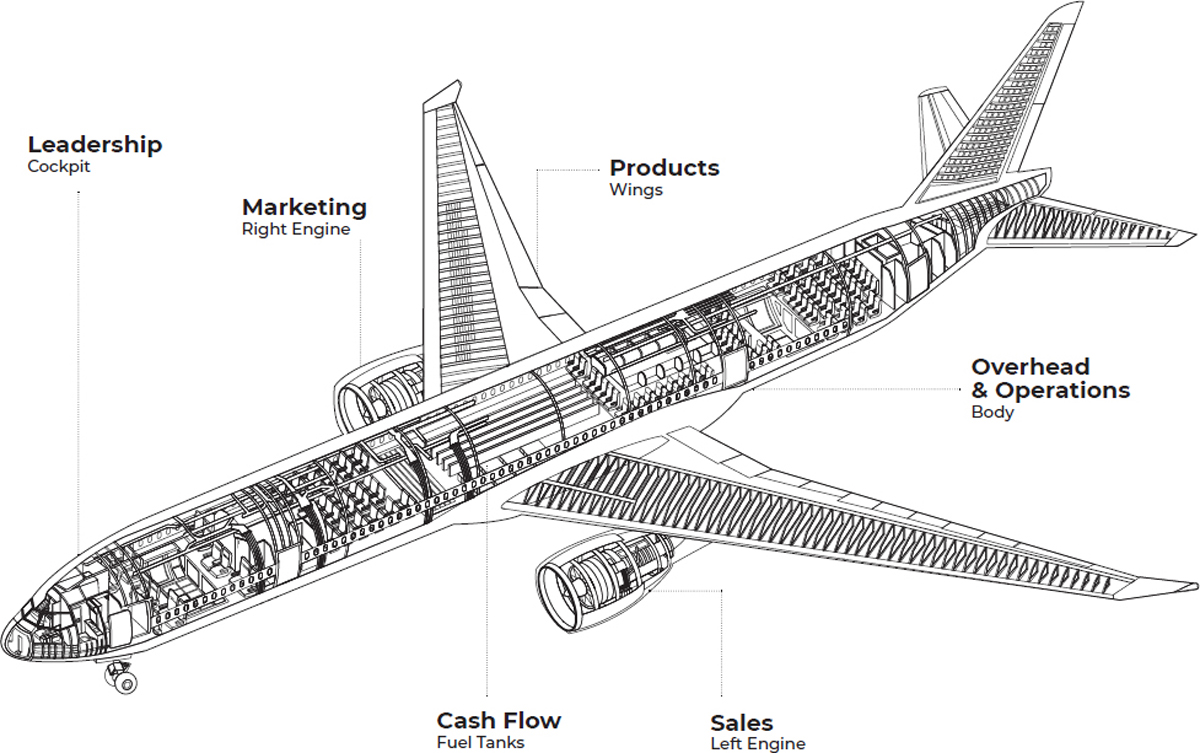
The six areas we addressed to professionalize our operation were:
- Leadership: We cast a vision for our company that included three economic priorities (chapter one) and made sure every role in the company supported those priorities.
- Marketing: We clarified our marketing message and invited our customers into a story (chapter two) in which their problems could be solved by purchasing our products.
- Sales: We installed a sales framework that made our customer the hero and learned to craft a million-dollar sales pitch that closed more sales and drove revenue (chapter three).
- Products: We optimized our product offering (chapter four) and focused on products that were in demand and profitable.
- Overhead and operations: We kept our overhead lean by running a management and productivity playbook that aligned the entire team by holding only five recurring meetings (chapter five). We made sure every team member had clear objectives and was coached and encouraged.
- Cash flow: We used five checking accounts to manage the money that came in and protected cash flow (chapter six) above everything else.
These six initiatives solved most of the problems that haunted my small business. When we fixed them, our business began to run like a predictable, reliable machine.
These days I spend the majority of my time creating content, meeting with clients, and being present with my family. I have about five meetings each week with various members of my team. In those meetings we share necessary information and make plans that cause the business to grow.
This is a different life than the one I was living before we implemented the six frameworks and playbooks. Before professionalizing my operation, I felt like my business was a machine and I was trapped inside it.
Of course, the transformation did not come easily. We spent hundreds of thousands of dollars on outside consultants and countless hours trying solutions that didn’t work. But, in the end, it was these six steps that led to both peace of mind and growth.
You Need a Practical, Realistic Plan You Can Install within Six Months
Regardless of the products or services you sell, you will sell more if you build a machine that properly produces, promotes, sells, and distributes those products. This book is not only designed to transform your business, it’s designed to transform you into a person who knows how to build a business that works. And once you know how to build a business, you can duplicate the process in as many businesses as you like.
Whether your business is business-to-consumer, business-to-business, digital, financial, industrial, content-focused, service-oriented, or anything else, every step you install from this playbook will make a positive difference in your bottom line.
If you do not take the six steps that will organize and grow your business, you will continue to struggle with the six reasons most small businesses fail. Those reasons are:
- A failure to identify and prioritize economic objectives
- A failure to market products with a clear message
- A failure to sell in such a way that makes the customer the hero
- The production of products that aren’t in demand or profitable
- Bloated overhead because of inefficient management and productivity
- A mismanagement of cash and cash flow
None of these problems has to take you down. If you implement the six steps I lay out in this book, none of them will.
Consider this book your manual for professionalizing your operation. These six steps can be installed in the order presented in this book, or in the order that will address your most pressing problems. If you want, you can install each of these steps in six months, or you may decide to take a year or longer. With each step you address, you will see results in your bottom line. You will find that Step One alone—rewriting your Mission Statement to include three economic priorities—will help you find the focus you need to grow revenue and improve morale. Step Two will cause even more growth, and so on.
You do not need to implement all six frameworks for your business to grow, but the more you implement, the stronger your business will become and the less you will feel trapped inside the machine you built.
With that, let’s look at a visual metaphor that will help you make sense of the six steps and also help you understand how a small business really works.
Build Your Business Like an Airplane or It Will Crash
In order to understand how to perfect our small business, we need a standard we can compare our business to so we can see which parts of our own business are engineered well and which parts need work.
You’ve likely met a person (or two) who is exceptional at business. You may have even thought these people have a gift. It’s true that some people come off as business savants because of their ability to know what’s wrong with a business after asking just a few questions. The truth is, though, they aren’t savants. What they have is a standard to which they are comparing the business in question. This standard is allowing them to perform a fast comparison that reveals weaknesses.
This chapter will reveal that standard. Once you understand it, you will see your business (and everybody else’s) clearly. I will then spend the rest of the book revealing how to fix each of the six critical parts of your businesses so it performs as close to the standard as possible.
The Airplane Is Our Standard
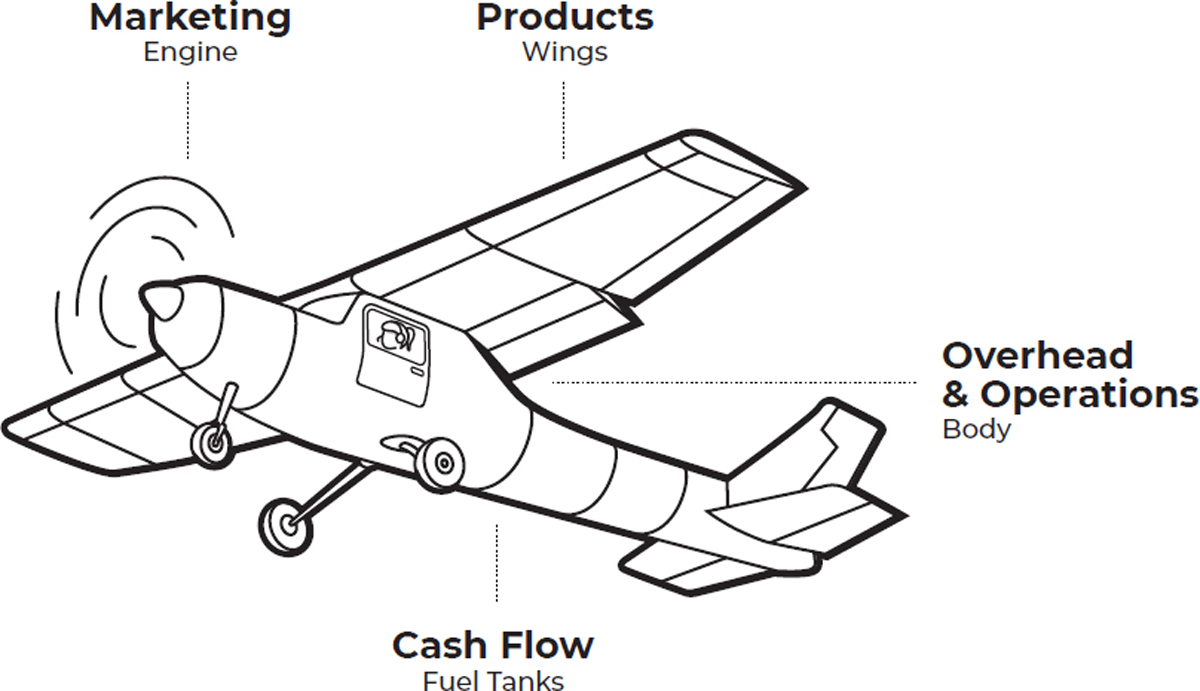
Back when my business was earning less than $250,000 in revenue per year, I had a model airplane on my bookshelf. One day, I was looking at the airplane and realized the way an airplane is engineered is similar to the way a business should be engineered. Like an airplane, a business has parts, and those parts connect to the whole to make it fly.
When it’s built correctly, an airplane is a safe, reliable, and useful machine that will successfully do its job of taking precious people and cargo to a set destination. When it is not built to the correct specifications, however, it becomes a dangerous machine that could produce catastrophic results.
The primary goal in engineering an airplane is to get it to a specific destination without crashing. In order to stay in the air, it has to move forward, fast, so it must have a source of propulsion. In order to get lift, it needs to have wings that are strong and light. In order to carry people and cargo, it has to have a body that is as lean as possible so it doesn’t add too much weight. Finally, the airplane must have enough fuel to reach its destination without running out and crashing.
A good commercial airplane has many parts, but six of them are absolutely crucial if it’s going to fly safely.
The Six Parts of Your Small Business
I picked up the airplane and turned it around in my hands. There are six critical parts to a business, just like there are six critical parts to an airplane.
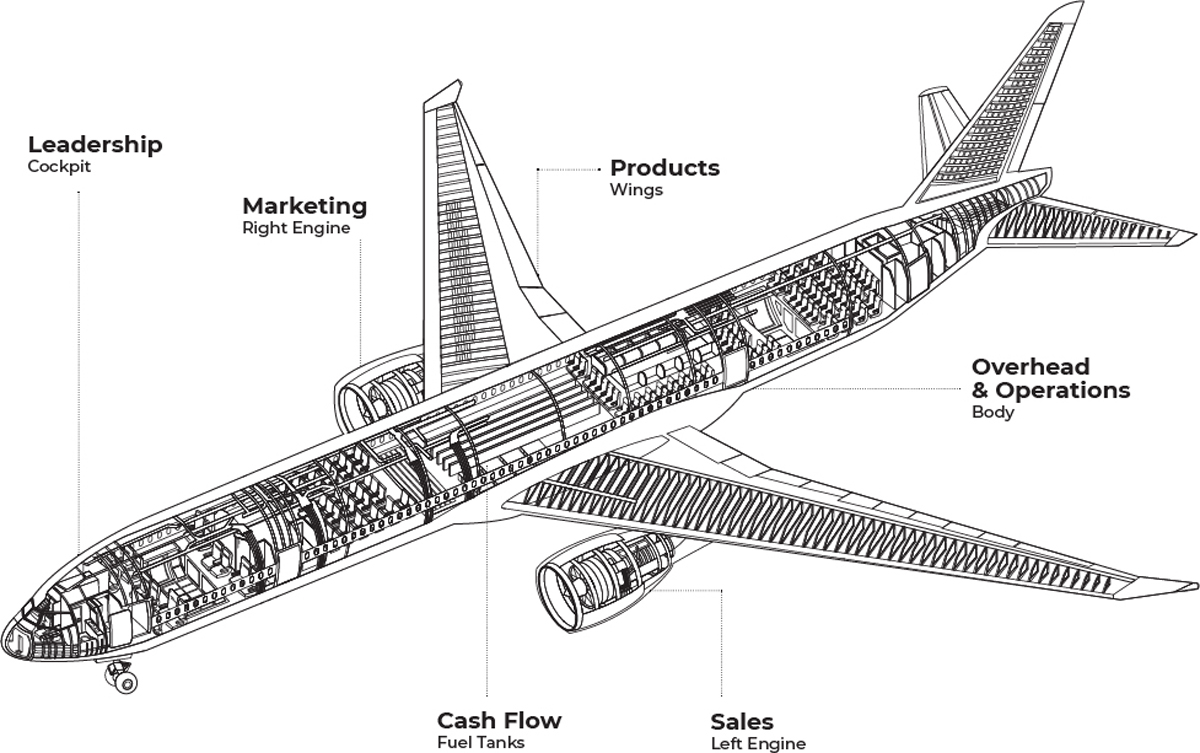
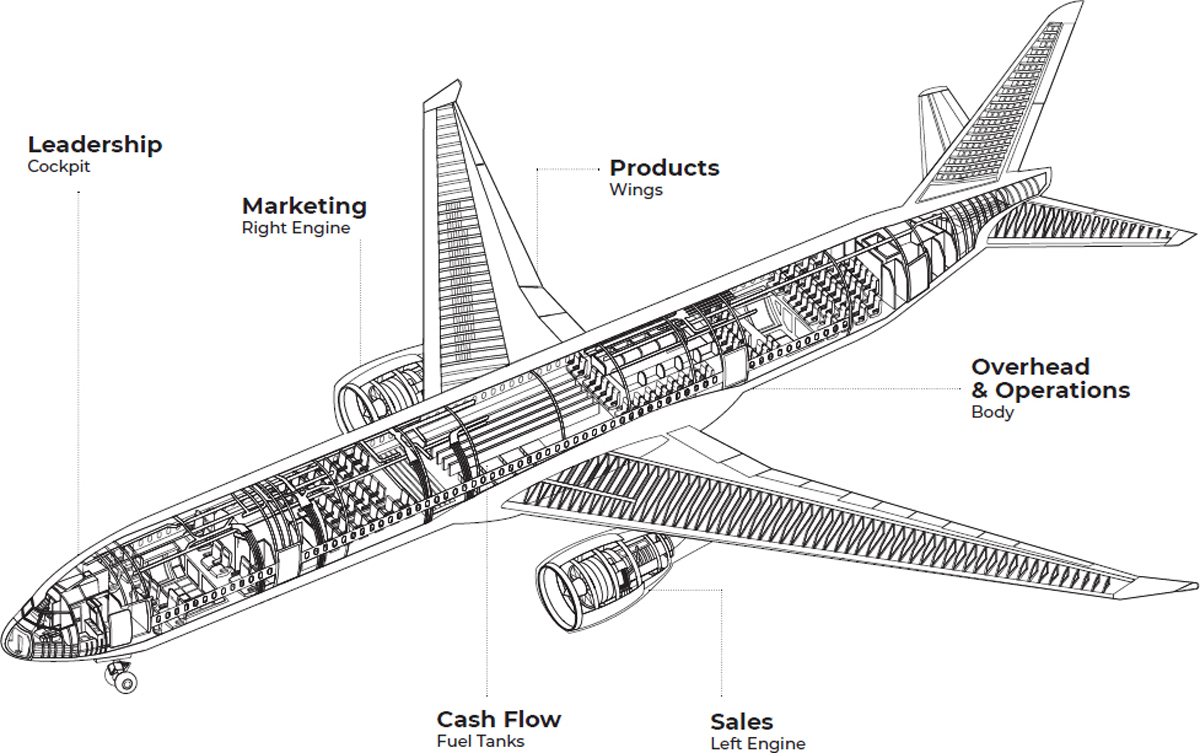
1. The cockpit of the airplane represents the leadership. Essentially, the leadership is in charge of getting the airplane to its destination. The pilot or pilots have to know where the plane is going and reverse engineer its safe arrival.
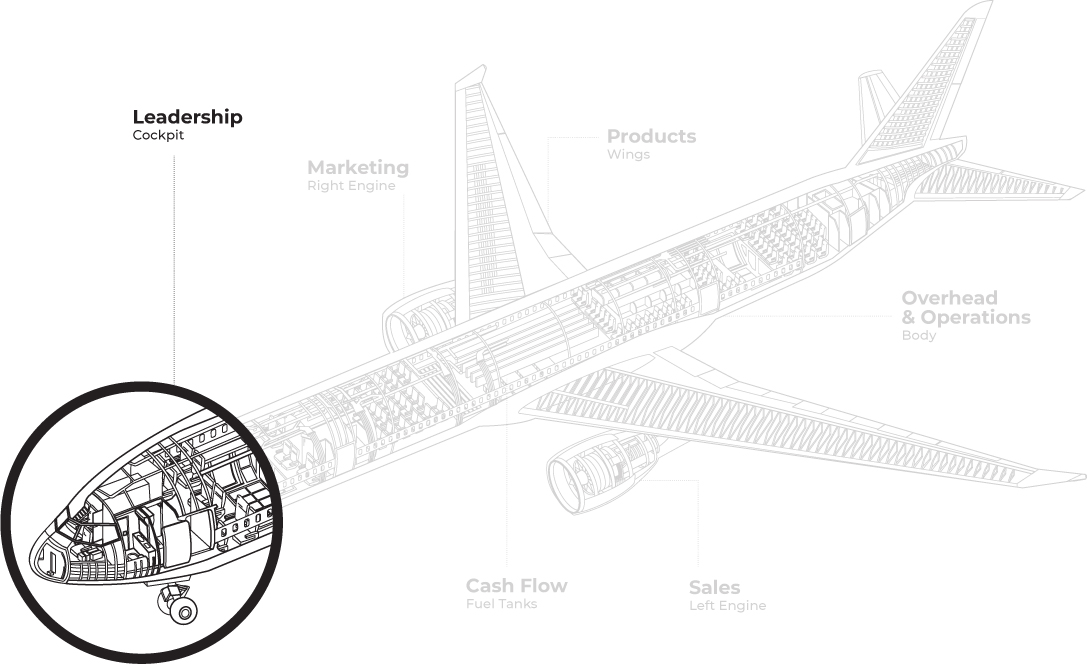
To grow a business, you’ll need to know how to unite a team around a clear economic mission.
2. The right engine represents the marketing effort, which directly contributes to the airplane’s thrust. When the marketing engine runs efficiently, the business sells more product and moves the business forward. This movement, in turn, contributes to lift.
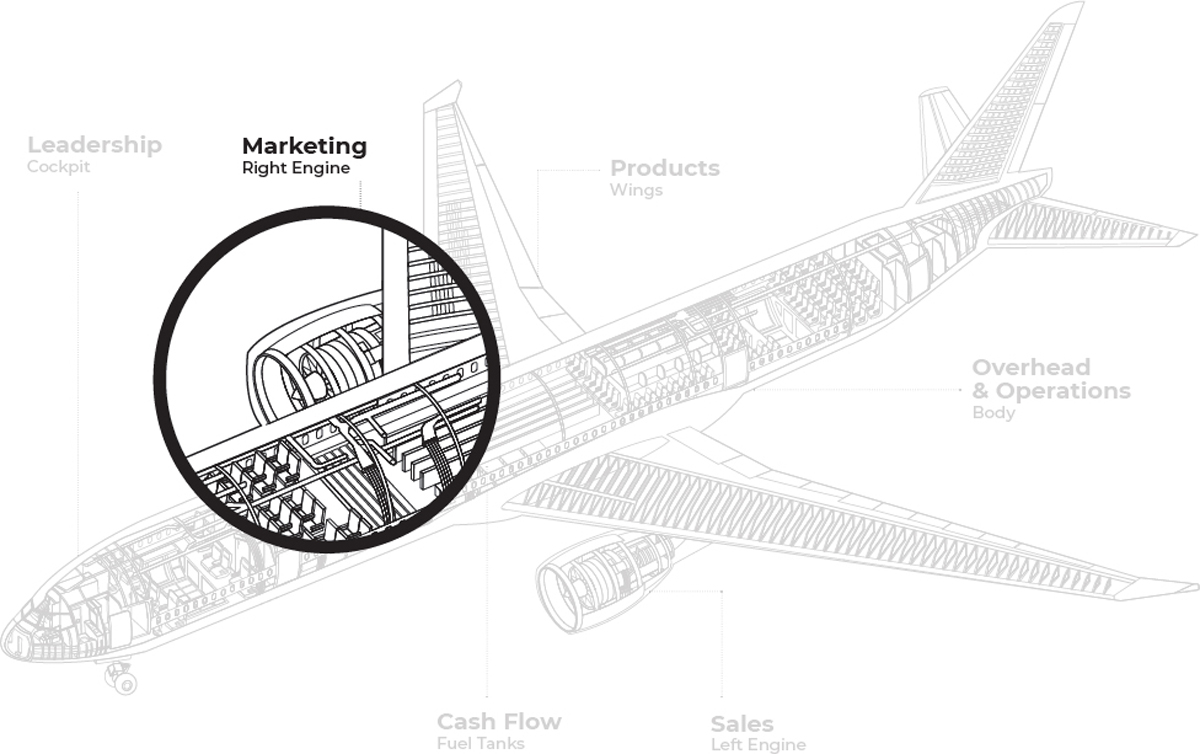
To grow a business, you will need to clarify your marketing message, so it produces a considerable amount of thrust.
3. The left engine represents sales, which increases the thrust of an airplane even more. Even if you don’t have a sales team, you are likely involved in countless sales conversations. Unfortunately, most of us hate to sell. Nevertheless, when we learn to craft a million dollar sales pitch and invite customers into a story in which our products or services solve their problems, sales go up and the thrust that moves the plane forward increases.
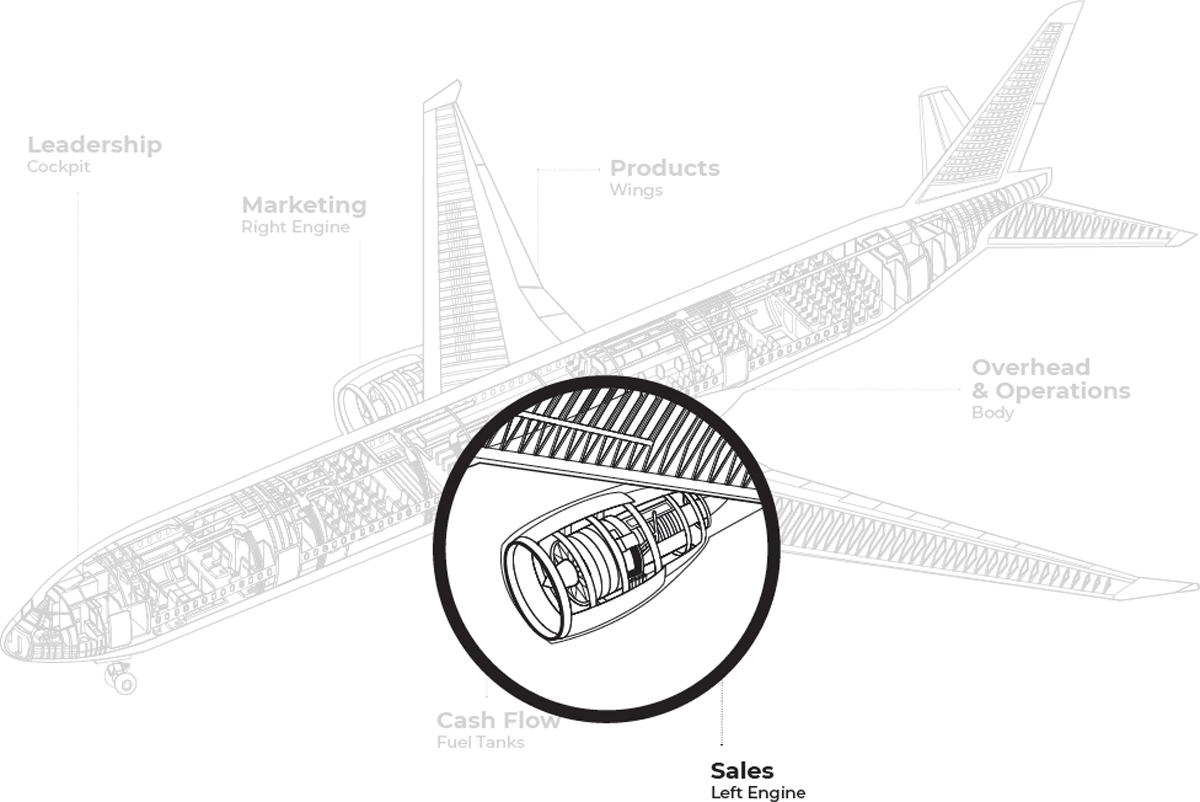
To grow a business, you will need to sell by making the customer the hero. Most people talk too much about themselves when they sell. Stop. Mastering sales conversations that invite customers into a story will increase the thrust of the airplane even more.
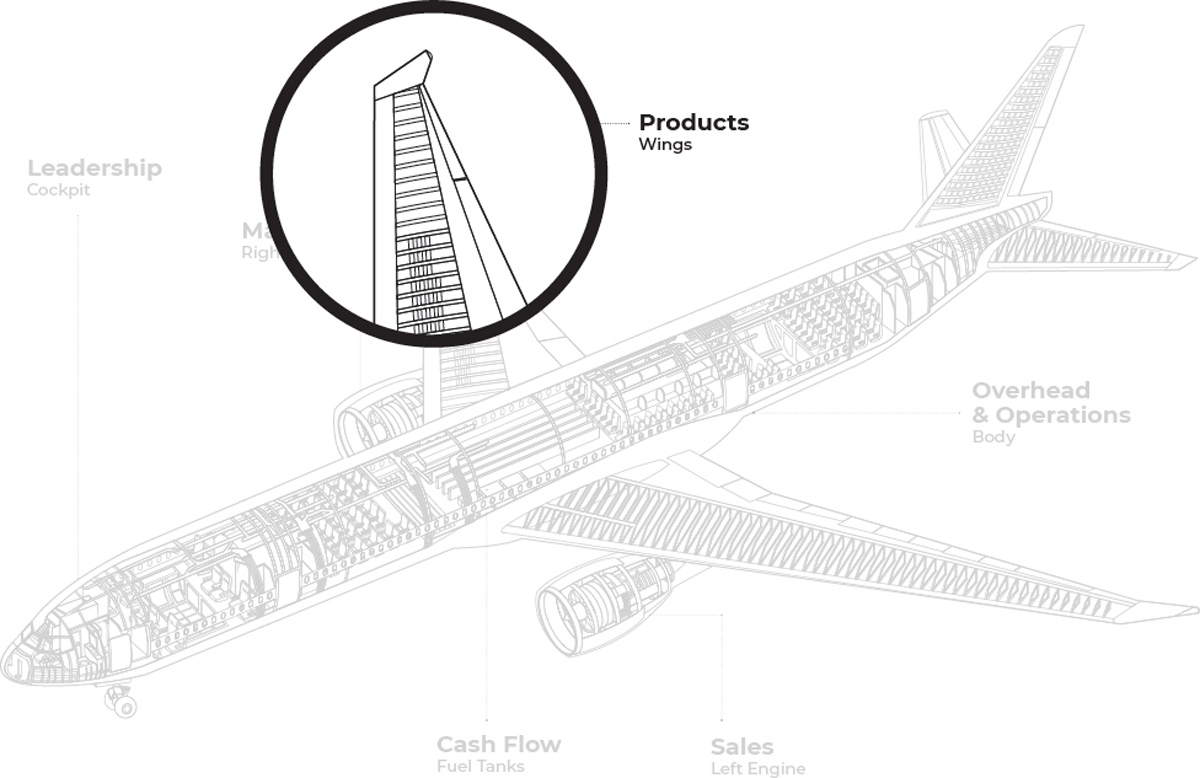
4. The wings of the airplane represent the products or services you sell. If the products or services you sell are in demand and profitable, they will give the business lift, and support the weight of the airplane. Thrust is provided through marketing and sales efforts, but the wings (profitable and in-demand products) make the airplane fly.
To grow a business, you need to know how to optimize your product offering so the airplane gets maximum lift.
5. The body of the airplane represents overhead and operations. If your overhead gets out of hand, the belly of the plane will grow too big, and the plane will crash. Your largest expense is almost always your payroll. Whether you are only paying yourself or a small staff, payroll will crash a business unless you and your team are running a management and productivity playbook.
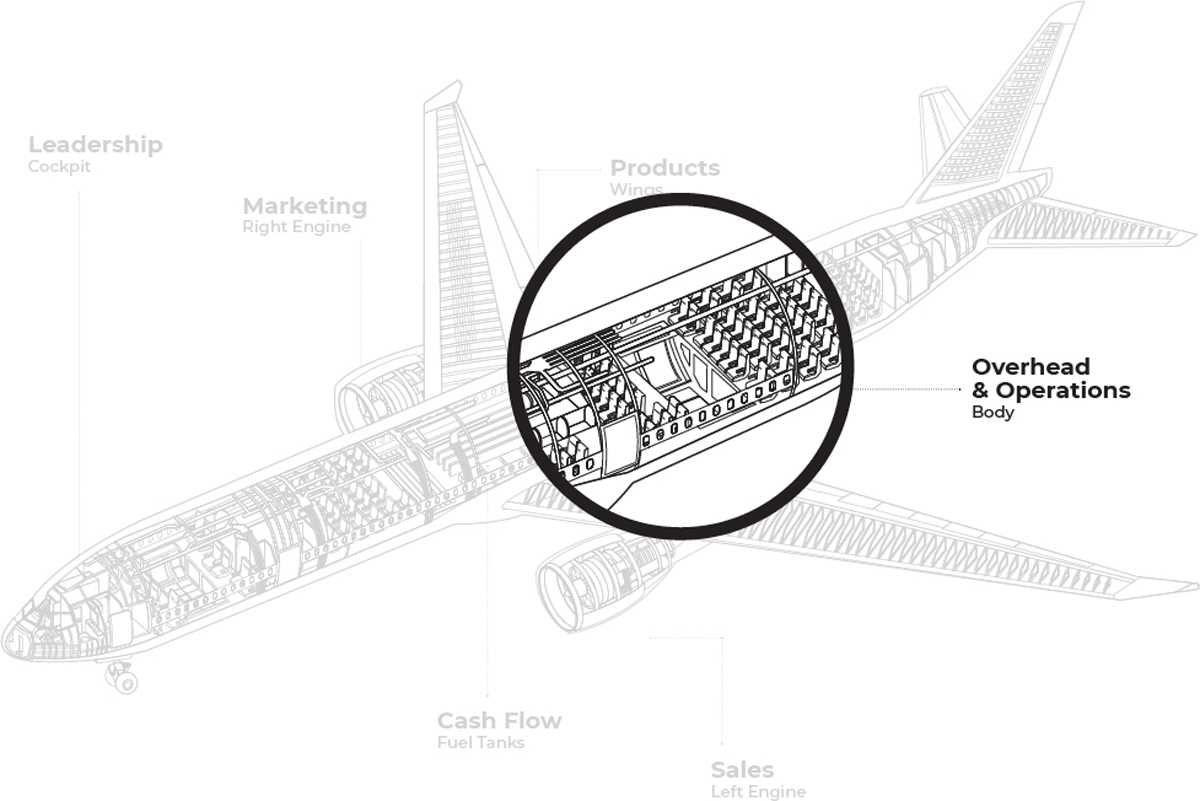
To grow a business, you’ll need to run a management and productivity playbook that ensures every team member is contributing to the overall economic priorities of the business itself.
6. The fuel tanks represent cash flow. With fuel, energy is transferred to all the moving parts of the airplane. Without fuel, the plane crashes no matter how well it is designed. The same is true of cash for a small business. Cash must be managed so that there is enough money to operate, plus plenty of extra in case the plane has to circle the airport a few times to prepare for an emergency landing.
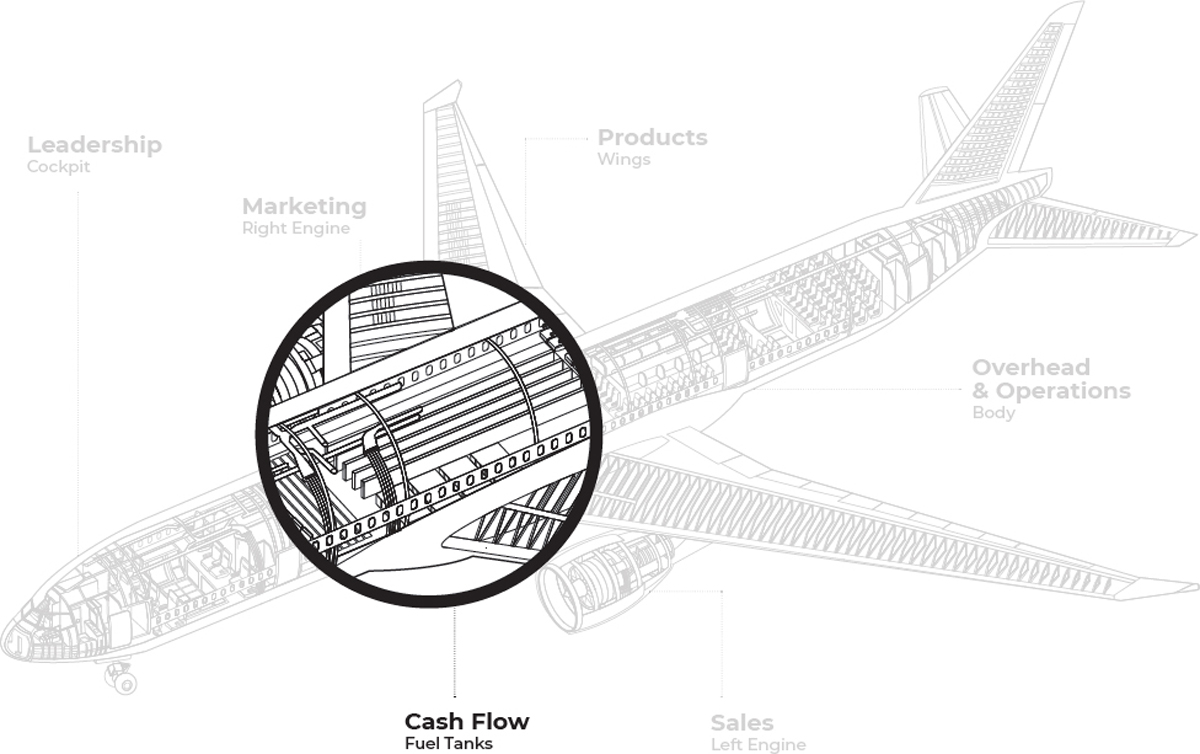
To grow a small business, you’ll need a method for managing money that is simple and easy to use.
The Airplane Creates a Decision-Making Filter That Gives You Peace of Mind
The simple metaphor of the airplane created a powerful decision-making filter that allowed me to grow my business intuitively. For instance, whenever we hired a new team member, I’d ask myself how we would offset their salary. Would this investment make the wings larger (helping create a new product or revenue stream) or increase thrust (increasing sales) or enlarge the body of the airplane (increasing overhead and making it heavier, contributing to a crash)?
Keeping this metaphor in mind has allowed me to make smarter decisions, which, it turns out, is the key to growing a business. Growing a small business is all about making one smart decision after another and knowing how to recover when things don’t work out the way you expected. Using the standard of the airplane, I was able to assess where my troubles were coming from and which of the six critical parts needed work in order to keep it flying.
In the years since I realized growing a business was a lot like building an airplane, I’ve taught this metaphor to thousands of other small-business owners. The results have been impressive. In fact, many small business owners just like you have doubled their revenue since implementing the frameworks. If you want your business to grow, all you need to do is work on the six parts of the airplane and connect them together so that it flies far and fast.
The steps included in this book will help you get your business off the ground and grow it to fifty or more employees or multiple millions in revenue. Once your business is off the ground, more frameworks and playbooks may be necessary to address more departments. Human resources comes into play the more team members you have, for example. Still, if you’re just getting started or attempting to grow your small business into the hundreds of thousands or multiple millions, these are the areas you need to address first.
Obey the Rule of Proportion as You Grow and Your Business Won’t Crash
In order to grow your business safely, you’ll want to grow its parts in proportion to each other.
When your business is really small, it’s just you in a cockpit with a single engine out front. You’re humming along through the clouds and life is great. That engine is likely a marketing engine, perhaps a simple sales funnel or some Facebook ads or, if you’re lucky, word of mouth. Your wings are likely small, but they’re enough to lift you off the ground. You’ve got a product you’re selling at the farmers market or on Etsy or perhaps a simple retail shop. Maybe you’re doing some consulting or offering financial services or selling real estate or a network marketing product. Regardless, you have a product or service people are buying and your single-propeller marketing engine is enough to move a few units and put cash in your pocket. Your fuel tanks are small, but because the plane is small, you’ve got plenty of fuel to circle the airport a few times in case there is an emergency.
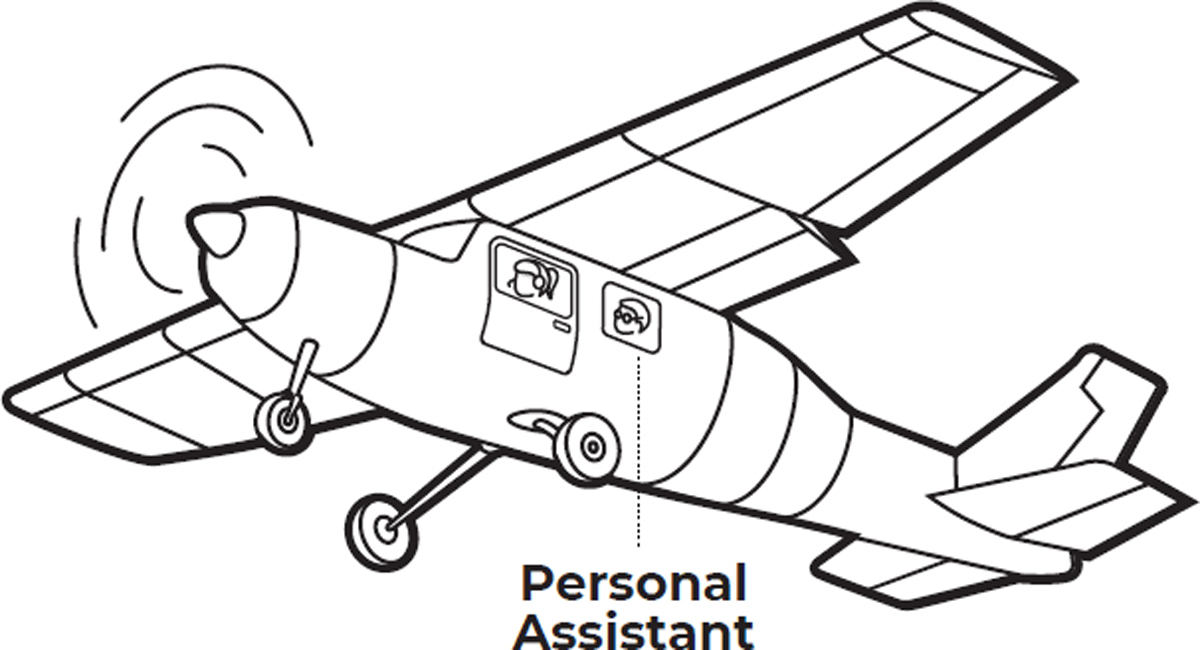
As your business grows, you are likely going to need help. Your first hire might be somebody to free up more of your time, so you hire a personal assistant. That hire contributes significantly to the overhead (makes the body of the airplane larger) and doesn’t directly contribute to the size of the wings or increase thrust to the engines. It’s a good thing to worry a little bit because the cost of the hire might put the safety of the plane at risk. However, when you consider the amount of time an assistant would allow you to contribute to the size of the wings or the thrust of the engine (perhaps as lead salesperson), you can more than justify the hire. The plane just got a little larger, but that doesn’t matter because the wings and engine(s) got larger too.
Congratulations. You just started growing your business. Let’s keep going.
Now that your overhead is a bit larger and your engine is humming a little louder, you’re going to increase the size of your fuel tanks. You’ll want six months of overhead sitting in a rainy-day account in case of an emergency. After saving six months of operating expenses, the airplane feels stable, so you start planning your next move.
Next, perhaps, you realize the marketing dollars you’re spending would be better spent in house, so you hire a full-time marketing person. This position isn’t cheap, but you can justify it because the new team member adds a second engine. Now there are three of you in the airplane: you, a personal assistant, and a marketing director. The plane’s a little larger, but it’s flying well.
After a year or so, you realize there are all sorts of special accounts interested in your products. If you had a salesperson, you could reach out to those accounts, so you hire a sales rep to create even more thrust. You pay them a small base salary and a healthy commission, so their position does not bloat the overhead. Commissions, after all, scale with success, which means the body of the airplane (overhead) only gets bigger when the actual thrust of the airplane increases.
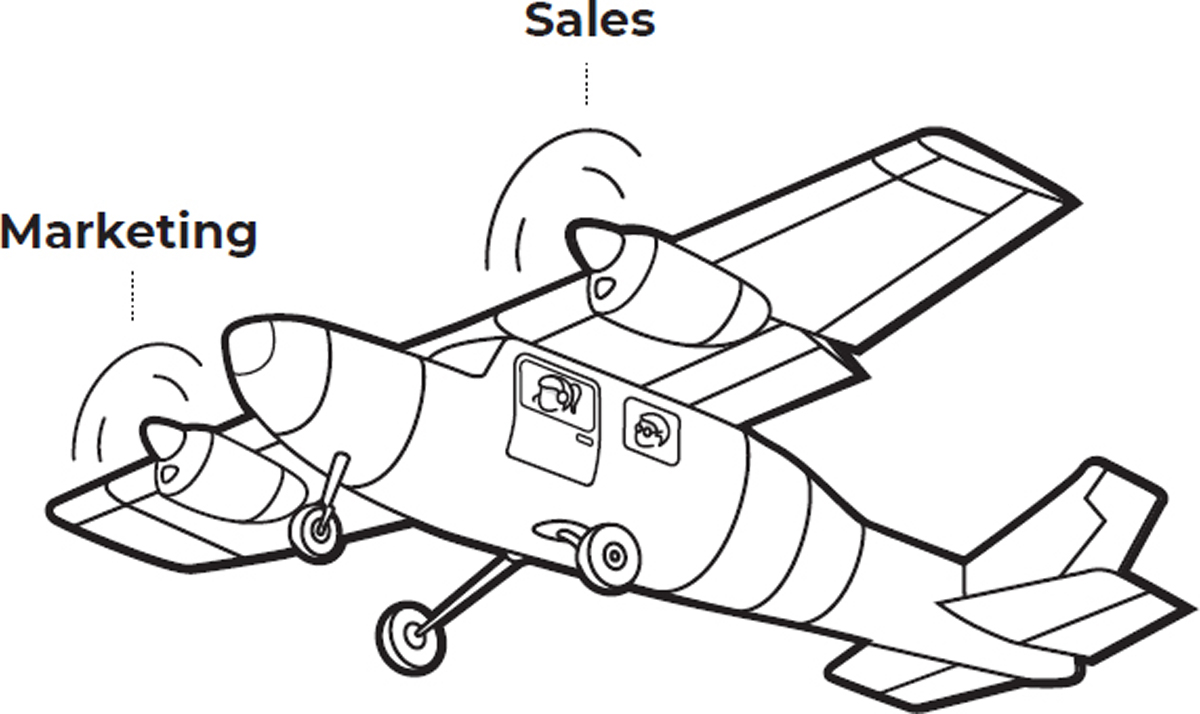
From here, you continue to alternate between hiring product creators, production team members, and marketing, sales, and administrative help. Since you hire team members proportionally and always keep an eye on overhead, your business grows with a limited amount of risk.
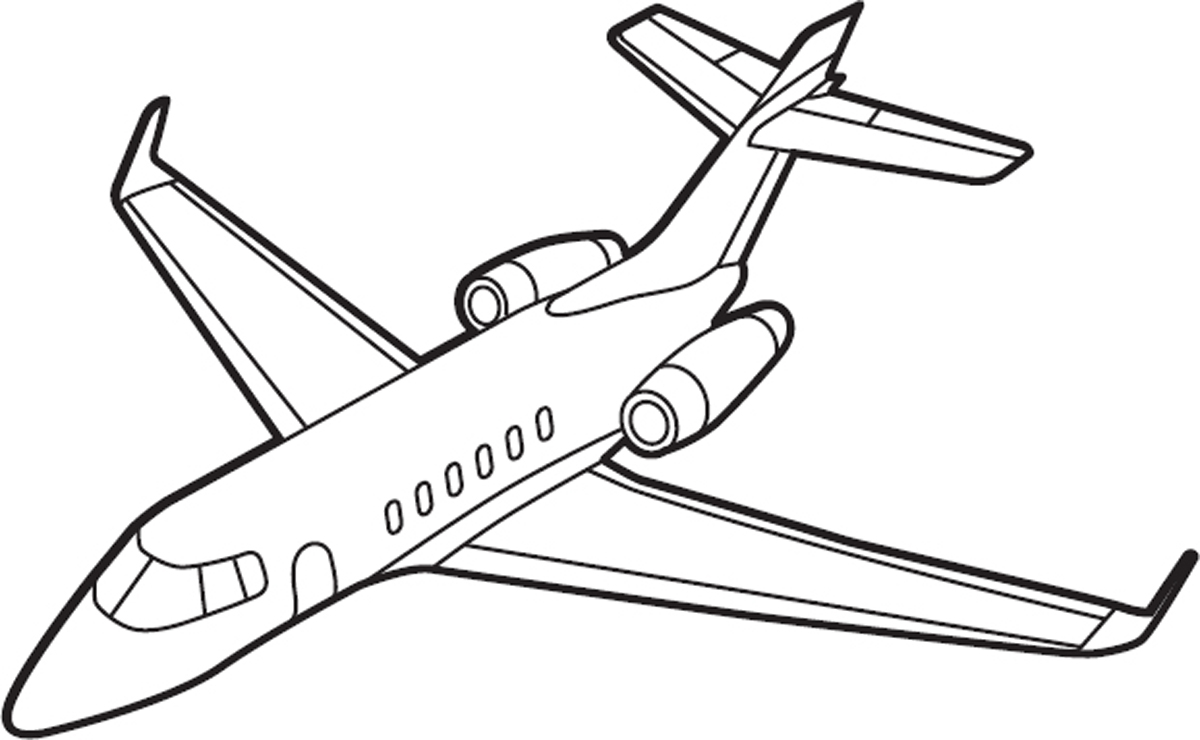
Not only this, but the business keeps growing from there. When you take the six steps, the steps themselves lead to growth while simultaneously helping you manage that growth.
Unfortunately, the moves I described above are mismanaged by most small-business owners. Sometimes, the business owner hires before the right and left engines can support the added weight. Other times, the business owner waits too long to hire, resulting in unhappy customers and lost potential.
The reason most small businesses fail is not because people don’t want the products they sell, it’s because they didn’t have a simple plan that made growing their small business intuitive. When we don’t have the visual metaphor of the airplane in mind, we are still building an airplane; we are just building it wrong. If you build an airplane the wrong way, it won’t fly. Or, worse, it will fly for a little while and then crash.
If you or someone you know has ever run a business that has failed, you can easily assess the postmortem using the analogy of the airplane. Remember, businesses usually fail for one of six reasons. Either the team failed to unify around economic objectives, the marketing message was not clear, the sales conversations didn’t optimize sales results, the products weren’t profitable or in demand, the overhead was bloated, or the business ran out of money.
You can easily avoid these six fatal flaws of small businesses. If you master the six steps that build your business like an airplane, your business will fly.
Beware of Looking Successful Without Being Successful
Sadly, many businesses, especially start-ups funded by outside sources like venture capital or private equity, can easily look successful without being successful. Beware. The leader of a start-up that is fully funded must still obey the rules of the airplane; otherwise, they will lose all their investors’ money.
Too many start-up leaders check their bank accounts, see millions of dollars, and start to spend the money without wisdom. They usually start by paying a firm to create a brand identity. Because a lot of branding firms are more interested in making you look good than making you money, the start-up leader ends up with a great looking brand that confuses rather than attracts customers. They double down on their investment by putting their pretty logo all over a bunch of unnecessary swag that, again, makes them look good but doesn’t sell products. Not only this, they get excited about their incredible funding and so they lease office space in an expensive part of town. They put their logo on the wall and invite friends over for happy-hour cocktails in which a ping-pong tournament breaks out and they all have more fun than they’ve had since college.
These kinds of decisions amount to an airplane with a massive body, tiny wings, weak engines, and a cockpit that more closely resembles a first-class cabin flowing with alcohol than a small room where serious pilots can study the numbers and fly the airplane.
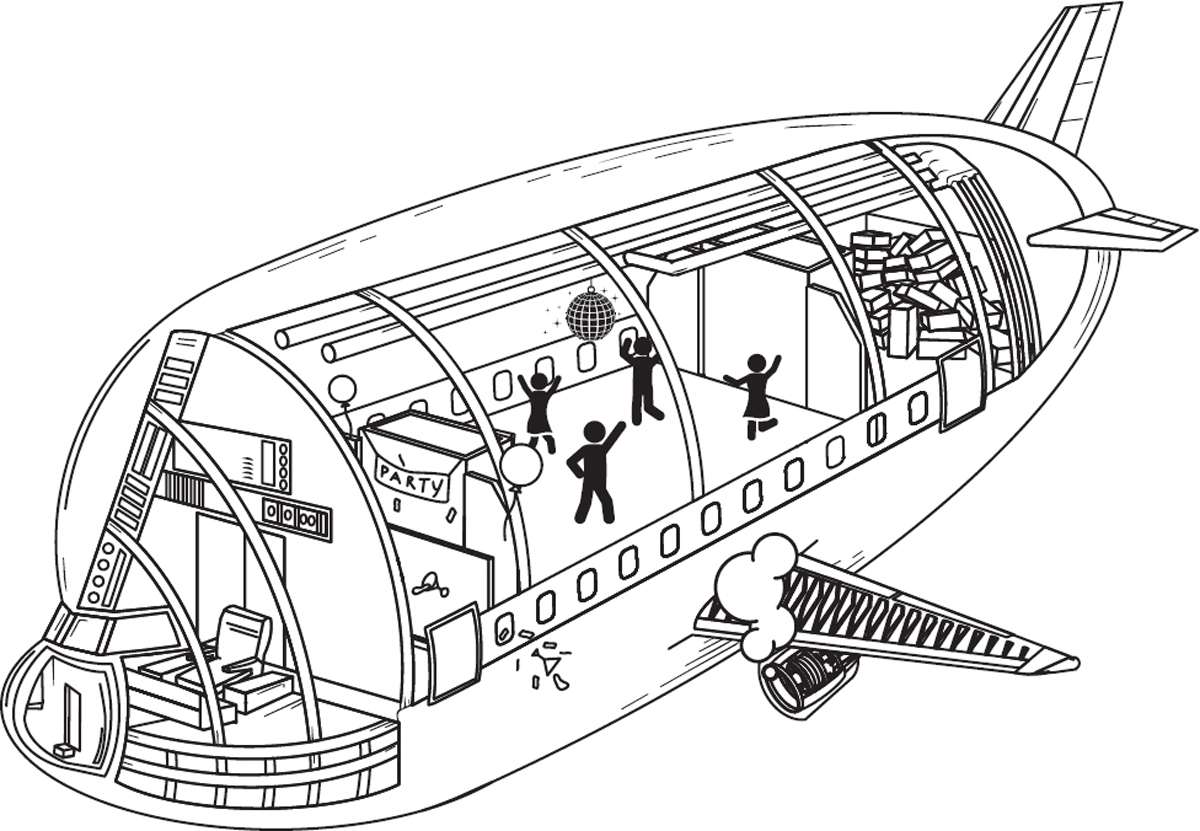
If you have started a small business and don’t have the luxury of deep pockets backing you up, you may actually be at an advantage. Why? Because you are more in touch with the rules of physics that determine the success or failure of your business. Venture capital and private equity are amazing tools but if leadership is not careful they can cause serious disorientation when flying the plane.
To Build Your Business, Create a Small-Business Flight Plan
If you engineer an airplane without paying attention to the laws of physics, people are going to get hurt.
To engineer and build an airplane correctly, the companies that build large commercial and government airplanes use careful checklists. Later, when pilots fly the airplane, they continue to use checklists, as do the maintenance crews on the ground. For this reason, air travel is one of the safest forms of transportation.
What has been missing since the beginning of small business are checklists, frameworks, and playbooks you can trust to grow a business.
Many business leaders fail to professionalize their operations because doing so feels cumbersome and exhausting. Some business owners have told me that installing an overall business playbook takes more work than serving their customers. This makes them frustrated because they didn’t sign up to build a business, they signed up to make or represent a product they love and sell those products to customers they care about. The business, in fact, seems to be the thing that gets in the way.
This shouldn’t be the case.
The six steps that help you build your business like an airplane are easy to understand and simple to implement.
Use this book as a manual of flight checks to make sure your business is engineered the best possible way for maximum revenue, profit, and customer satisfaction.
Each of the steps in this book works like a mini book in itself. Implement the steps you need at the pace you believe you need to take them. You can keep coming back to How to Grow Your Small Business for months or even years. In fact, you can hand this book to your leadership team, review the Small Business Flight Plan together, and transform your business as a group.
The point is this: if you’re spending too much time putting out fires and not enough time selling products and interacting with customers, you likely need to professionalize your operation.
To get the most from this book:
- Review the flight plan in the back pages. Your flight plan includes all the templates you need to implement the six steps.
- Read about each step and take them slowly. Each step will help you organize your small business and also generate growth.
- Continue using the six steps associated with the flight plan to operate your business safely and profitably.
Taking off into the clouds can be exhilarating if you know what you’re doing. Let’s take the first step.