Streamline Your Overhead and Operations with Management and Productivity Made Simple
Step Five Will Help You Solve These Problems:
- Too many people are wearing too many hats.
- Team members aren’t getting consistent feedback.
- Your culture feels like organized chaos.
- Your leaders need better management skills.
- You have too many meetings and they aren’t productive.
- Your team members aren’t nearly as focused as they could be.
• • •
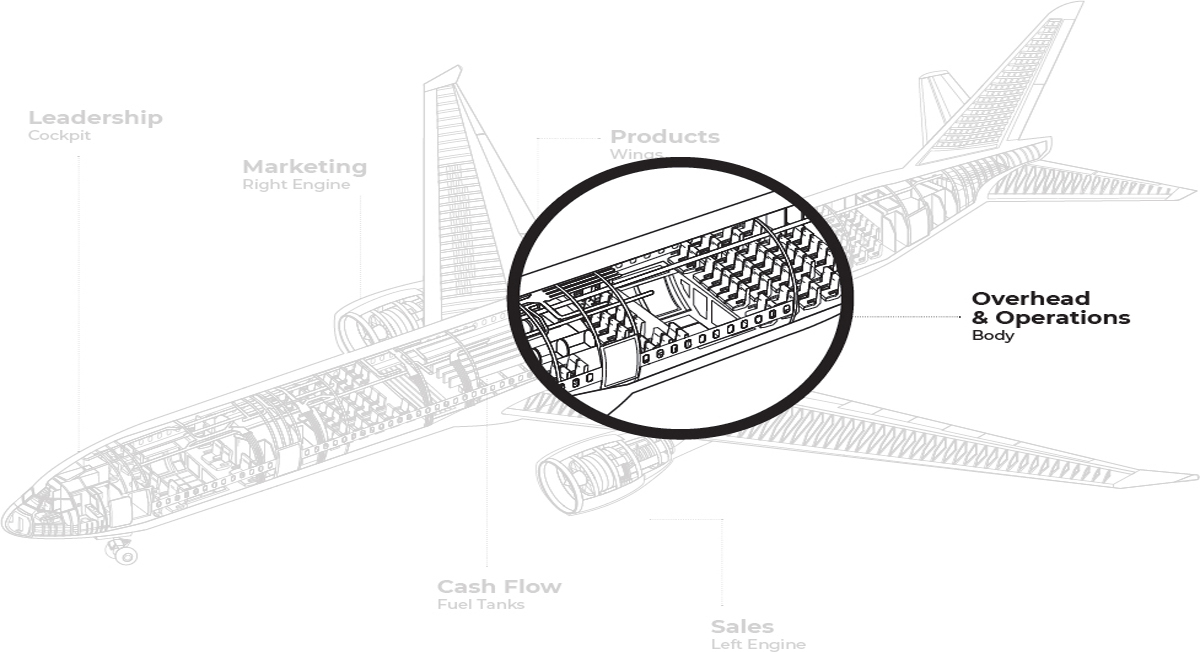
If the body of an airplane is too large to be supported by the wings and the engines, the plane will crash. That’s why when you board one of those smaller commuter planes you have to duck your head to get in the door. There’s a reason airplanes look like flying pencils. It’s because the shape, size, and weight of the body must be as lean and streamlined as possible to mitigate the plane’s need for power, lift, and fuel.
Our small businesses work the same way. The products we sell and the sales and marketing efforts that move those products should compensate (and, hopefully, overcompensate) for the overhead necessary to run our day-to-day operations.
If you want an airplane to fly, make the wings wide, the right and left engines powerful, and the body of the airplane streamlined and light. In other words, if you want your small business to make money, make the marketing and sales engines powerful, make the product profitable, and keep overhead down!
So the question is: How to we keep our overhead lean?
If you had to cut your overhead by 20 percent tomorrow, where would you start? Many of us would look over our credit card statements or start listing the monthly subscription services we never use. And those are perfectly great places to start, but saving money is only part of the equation. For most small businesses, those things aren’t where your overhead bloat is coming from. The reality is your largest expenses aren’t monthly subscriptions or that sales rep running around with the company credit card.
For most small businesses, out-of-control overhead comes from a single place: labor.
Creeping overhead can sink a business. Technology and rent can be expensive, too, but it’s labor that will crash a plane faster than anything else. The biggest expense has always been labor. Even if you’re a solo-preneur, you’re likely relying on freelancers and vendors to do the heavy lifting, and labor is likely causing the body of your airplane to expand faster than a balloon at a birthday party.
As I meet with small-business owners, I hear a similar story as it relates to overhead: The business was doing well so the owner hired a few people to help; then the cost of labor was more than they anticipated. Plus, managing the new people took them out of their sweet spot. Once the owner was out of their sweet spot, sales slowed a bit but the cost of labor remained the same and then, as the nose of the plane started to dip, everybody that had just been hired had to be let go.
If labor is the biggest expense affecting overhead, then how do we cut overhead? We might suppose that letting people go is the answer.
In fact, when turnaround teams go into big companies to stabilize a spiraling airplane, the very first thing they do is analyze labor and start laying people off. Downgrading office space and streamlining technology doesn’t happen for months because it’s labor, dreaded labor, that is usually the problem.
If you want to decrease the weight of your airplane and streamline the body, open the emergency doors and start throwing seats into the clouds. The fewer people in the body of the airplane, the better. Sadly, for many of us small-business owners, this means getting rid of your aunt who does the accounting, your best friend from high school who helps with your technology, and your nephew out back who cleans all those parts before they get transferred to welding.
Cutting payroll often means cutting off relationships with the people you love, being disowned by your family, and becoming that greedy capitalist who only cares about themselves and their money. I know it’s tough, but you have to do it and you have to do it fast. In the pursuit of greatness we have to be coldhearted, don’t we?
Not so fast.
If you can streamline your labor force with a management and productivity playbook that transforms all those seats in the body of the plane to high-functioning additions to the wings and engines, the rest of your airplane would grow in proportion so that it matched the body. What if, instead of letting everybody go, your entire labor force became a business-building group of focused professionals that contributed mightily to the bottom line? It means your business would start growing and your overhead would transform into an investment rather than a spend.
Yes, it’s important to review your credit card bills and cancel some of those monthly subscriptions, but, make no mistake, the number one thing you can do to streamline your overhead and get your pencil-thin airplane moving through the air so fast the paint rips off the fuselage is to install a Management and Productivity Playbook.
The playbook I will give you in this chapter won’t decrease your overhead right away. If your airplane is currently taking a nosedive, you may have to let some people go. I hate that but there are times laying people off is necessary to save the plane itself. If you’ve got a little time before you run out of money, though, we can streamline your workforce so work gets done in less time and the work itself is focused on the three economic priorities you defined in your Mission Statement. This, in turn, may save your business from crashing.
When your labor is focused on your three economic priorities, more money will flow into the business itself. This in turn allows the wings, engines, fuel tanks, and cockpit to catch up with your bloated overhead. The best way to decrease the size of the body of your airplane is not to decrease it at all, but to make the rest of the airplane larger while your payroll stays exactly the same (save for commissions for your sales reps and profit-based bonuses, which will hopefully increase).
Even if you aren’t having a problem with your overhead expenses, installing a management and productivity playbook is a good idea for many reasons. Optimizing your workflow will increase your profit, energize your team, and increase morale. Also, your customers will get more focused attention, and your products and services will increase in quality.
The Seemingly Unsolvable Problem
When I first started my small business, we didn’t need a management and productivity playbook. I only had one team member, and we’d simply touch base every morning to talk about what we were going to work on that day. The system was seamless and efficient. Then, we hired another team member. To be sure, a third team member added a layer of complexity but because we were all working out of the same tiny office, communication was terrific, and we were rarely confused about what we were supposed to be working on.
As the business grew, we added a couple freelance designers, then coders, and then copywriters and videographers. As you likely know, when a few of your team members (freelancers or otherwise) work remotely, it becomes more difficult to align the workflow. At one point I remember overhearing a phone conversation only to realize one of our contract workers had spent the previous week working on a project we’d canceled the previous month. That entire week’s work was lost. That’s the real way overhead gets out of hand—when you have team members doing work that does not support the economic priorities of the business. If that sort of thing gets out of control, the business will crash.
Sadly, most small businesses never realize the body of the airplane is getting too heavy. As leaders, we sit in the cockpit dialing up destinations and plotting our course while the folks in the rest of the plane wonder where this thing is going and why. Because they are good people, they work hard and even create work when they aren’t given clear objectives. If we aren’t careful we can easily end up flying a plane full of team members doing busy work.
To make sure everybody on the team was well managed, I promoted one of our leaders to Chief of Staff and that helped, but this individual had never been in that position before and without a formal system, the results were mixed. There always seemed to be a disconnect between the cockpit and body because the leaders in the cockpit were too busy plotting the course and filling the fuel tanks. Because we didn’t meet regularly with our team members and give them an actual playbook to run, our efforts to steady the plane didn’t work. We still had team members running around not quite sure what they were supposed to be working on.
Once we realized we couldn’t solve the problem ourselves, we hired an executive from a large company to help, but that was a mistake. Most large businesses solve problems like these by throwing enormous amounts of money at them. When you have a billion-dollar budget, that’s great, but it never works with a small business. Small businesses need to operate lean and don’t have time to form boards and run test groups and perfect hiring practices and so on and so forth. We small-business owners can’t afford the waste that a large corporation has built into the margins.
When hiring specialists didn’t work, we began to interview consultants from a number of management and productivity companies. To hire a consultant that could help us install lean management or some other productivity system ran as high as $100,000 per year. We didn’t have that kind of money to spare.
The solutions we researched were complex and, moreover, seemed designed for much larger organizations than ours. At that time, we employed about twelve people, along with a dozen or so contract workers. The management and productivity systems available to us were built for businesses whose employees numbered in the hundreds, if not thousands.
What we really needed was a management and productivity playbook for small business.
“Management and Productivity Made Simple” to the Rescue
It wasn’t until my friend, Doug Keim, stepped into the cockpit that we began to streamline our workflow. Doug is an old friend who came over from a larger corporation as a favor. I’d known him as a mentor for a few years and, even though he’d spent the majority of his career turning around multibillion-dollar companies, he took an interest in me and my small business. When he finished a three-year turnaround at a big company in Atlanta, I asked him if he’d be willing to spend a year with us to create a management and productivity playbook for small businesses. I explained to Doug that we’d need to create this playbook from scratch; it simply didn’t exist out there in the corporate world. “Most small businesses are making it up as they go along.” Doug understood and thought he might enjoy the challenge. Under his leadership, we designed a management and productivity system that we used in our own business.
We called the playbook The Management and Productivity Made Simple Playbook because it was simple to install, simple to use, and, more importantly, it worked.
It was amazing to watch Doug work. He spent all of his time in the body of the airplane, helping everybody clarify their objectives and overcome challenges. His personality worked more like a basketball coach than an executive. He’d huddle with the team, draw up plays, and then set them free on the court for a few minutes—allowing them to use their intuition within the boundaries of a set of objectives. When the team freewheeled a little too much, he’d call them back over, remind them of the objectives, ask if they had any feedback or wanted to evolve the plan a bit, make whatever changes he felt were positive, and then send them back out on the court.
Finally, my company began to grow. Not only did the company grow, but it grew during a season when it should have shrunk—if not gone under completely. When we brought Doug on, we were 75 percent dependent upon people getting on airplanes and attending our marketing and sales workshops. Only a few months after Doug joined the team and began to install our new Management and Productivity Playbook, the COVID pandemic shut down most of the world. We watched as the virus shut down an entire region of China and started hearing rumors the same thing would happen in America. That scenario seemed implausible to me, but friends started calling saying their brother, uncle, or niece worked at the State Department or were in the National Guard, and they were hearing cryptic rumors. I realized pretty quickly that regardless of what was true, the economic ecosystem was about to be disrupted.
My mind was split. Half of me believed our little airplane could miraculously stay in the air while the other half was trying to find a lake or pond we could use to water-land.
How did an in-person coaching company survive a global pandemic in which travel was brought to a halt? Management and Productivity Made Simple came to the rescue.
We’d already established our three main economic priorities. That move alone helped to streamline our workflow more than anything else we’d done in the history of the company. Using the new Management and Productivity Made Simple Playbook, we broke the twelve months following the shutdown into three-week sprints, each week supporting one of the economic priorities. We transitioned from in-person events to online workshops (something our clients had been asking us to do for years anyway) and revised our marketing messages to focus on a relevant value offer: surviving the pandemic. I confess the pandemic tightened our focus and added a sense of urgency. During our leadership meetings we summoned the focus and intensity of a team trying to win a national championship. We reminded ourselves of our three economic priorities, we defined and owned our different assignments, and we went back to work for at least one more day—if nothing else.
The results were surprising. When our small business should have crash-landed into a cattle pond in Kansas, we grew by more than 20 percent in revenue and nearly 30 percent in profit. We didn’t lay off a single team member and even added contractors to help with the workload. We tripled our rainy-day fund (think of this as adding a thousand pounds of fuel to the reserve fuel tank, all while in the air) and handed out bonuses at the end of the year. The playbook worked. Because the playbook worked so well, we still use it today, and I believe we will be using it twenty years from now—no matter how big we get.
The Management and Productivity Made Simple Playbook can be used by any small business to streamline their workflow, increase productivity (and revenue), and boost the morale that so often suffers when people aren’t properly coached and encouraged.
Install the Management and Productivity Made Simple Playbook
To use the Management and Productivity Made Simple Playbook, all you have to do is begin to hold five separate meetings. I know that sounds like a lot of meetings considering you’re probably attending too many meetings already, but these meetings are designed to replace most of the meetings that are currently bogging you down, some of the five meetings last as little as five minutes, and you, the leader of the business, will not have to attend all of them.
In fact, as the leader of my small business, the number of meetings (internal) I had to attend was cut in half when we created and started to implement the playbook. I have more, not less, free time because of it. Our meetings are fixed on a set schedule, so I was able to establish a repeating cadence that created a manageable work flow. Not only this, but during this same season, my wife and I added our first child. I truly believe without the Management and Productivity Made Simple Playbook I would not have been as present as I have been as a husband and father. I love my new schedule and believe we’ve set ourselves up for years of business growth. Not only this, but the playbook contributes positively to my personal and family health.
The Five Meetings
Later in this chapter I’ll give you an actual playbook as well as meeting templates that will streamline your operations. For now, though, here is a brief description of the five meetings we engage in as a team.
The All-Staff Meeting
Every Monday at 10:00 a.m. the entire staff gets together; some attend in person and some virtually. The purpose of this meeting is threefold:
- Maintain alignment and focus around the three economic priorities,
- Update the entire team about any department initiatives or successes, and
- Keep morale up by publicly honoring team members who are demonstrating exceptional work that helps your team make progress toward your three economic priorities.
The All-Staff Meeting is your longest meeting, from 45 minutes to an hour. The energy for this meeting should be high and helps you create a family-like atmosphere. A specific template should be filled out before the meeting. This template ensures the meeting is thoughtfully planned so it contributes to the economic priorities.
The Leadership Meeting
The Leadership Meeting takes place right after the All-Staff Meeting. This meeting consists of department heads and is designed to talk about the primary initiatives currently in motion as well as address any roadblocks that are holding back your economic objectives. This meeting usually lasts a half hour to an hour, depending on how many initiatives your team needs to cover that week.
The Leadership Meeting Template should be used to plan this meeting. The template will be filled out by you or the team member in charge of the meeting. Filling out the template makes sure each Leadership Meeting helps the overall company achieve the three current economic priorities.
The Department Stand-up
If your small business has more than five or six team members and those team members are divided into two or three departments, you may want to begin holding Department Stand-ups. If your team is smaller than two or three team members, an All-Staff Meeting or Leadership Meeting may be all you need. That said, you’ll want to hold that All-Staff Meeting more than once each week and likely three or four times each week. On Monday, hold a longer meeting but on the other days, keep it short and use the Department Stand-up Template to guide the meeting. As your team grows, though, you will want each department to hold Department Stand-ups each morning that there is no All-Staff Meeting.
Department Stand-up Meetings last for less than fifteen minutes and help ensure each department is working on an initiative or initiatives that support the three economic priorities of the business. It is during this meeting that department leaders set the objectives for the coming day and address any roadblocks team members may be experiencing regarding the previous day’s workflow. A Department Stand-up Template is filled out before the meeting.
The Personal Priority Speed Check
As your team continues to grow, each new team member is going to want to know how well they are doing their job. Ongoing coaching is critical to keep productivity and morale high.
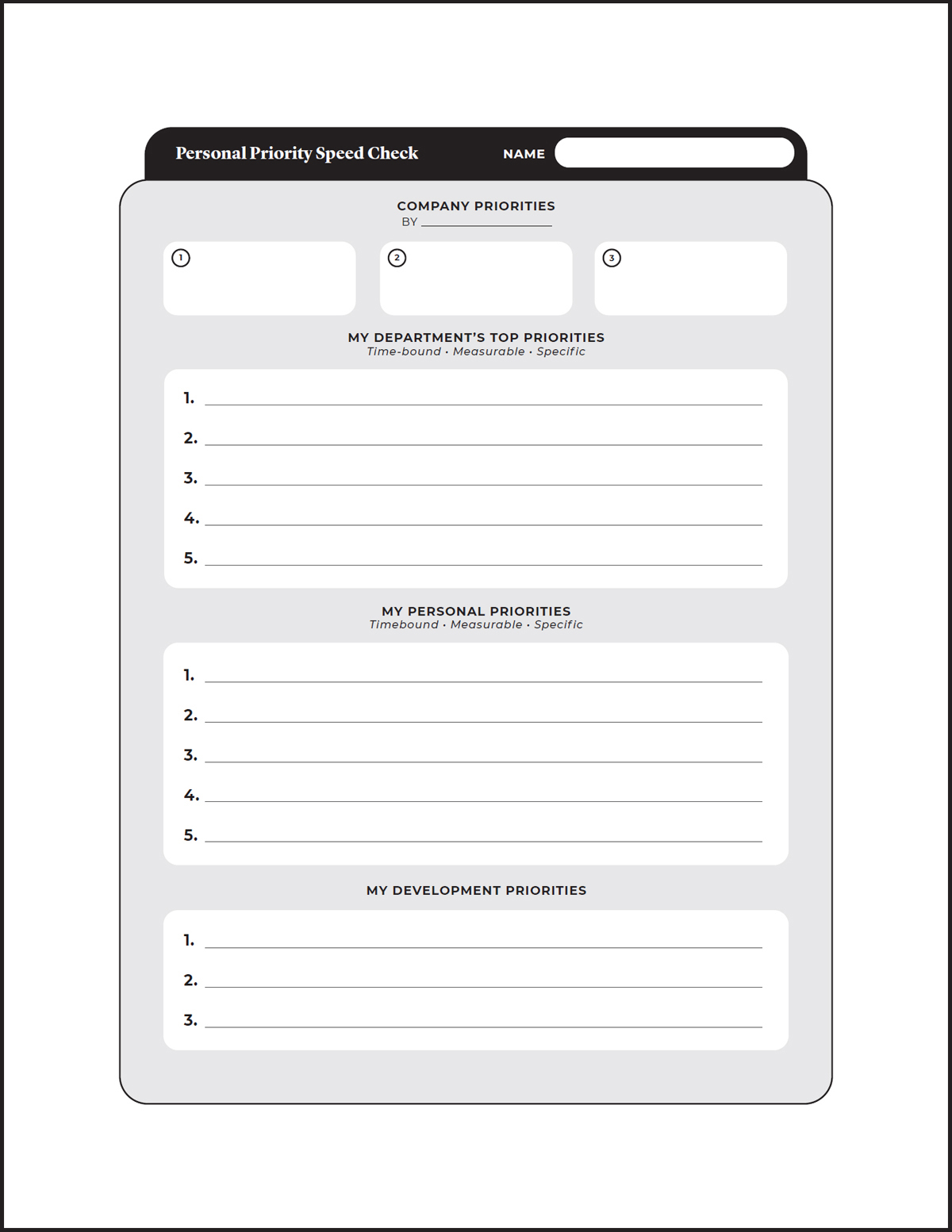
Once you have five or ten people on your team and the overall team is divided into separate departments, each director should meet one-on-one with their individual team members each week in a Personal Priority Speed Check. These meetings also last about fifteen minutes and are designed to zoom in on each person’s responsibilities within the context of their team. The Personal Priority Speed Check Template is filled out by the team member him/herself before the meeting. This template ensures the meeting has been thoughtfully planned so each team member feels supported as they contribute to the economic priorities of the overall business.
While this meeting may seem like too much to add to your workflow, remember two things: The meeting only lasts fifteen minutes per team member and your department leaders (not you) are holding these meetings.
Because your department heads are giving each team member the individual attention they need, your team members will feel supported and you will experience a surge in morale.
If you are a solo-preneur, of course, this meeting will not be necessary but it can be a great way to hold yourself accountable to your own economic and personal priorities. That said, if you do have a small staff, consider holding the Personal Priority Speed Check once each week (or at least once each month) with each individual team member. Use the Personal Priority Speed Check Template to guide the meeting and make sure your team member has filled it out before the meeting. You will be amazed how much time is saved, rather than wasted, by holding these meetings. Not only this, but your team will respect you all the more for giving them the individual attention they crave—even if it’s only fifteen minutes each week.
Quarterly Performance Reviews
So far, our meetings have revolved around generating focus and productivity. We haven’t however, addressed performance.
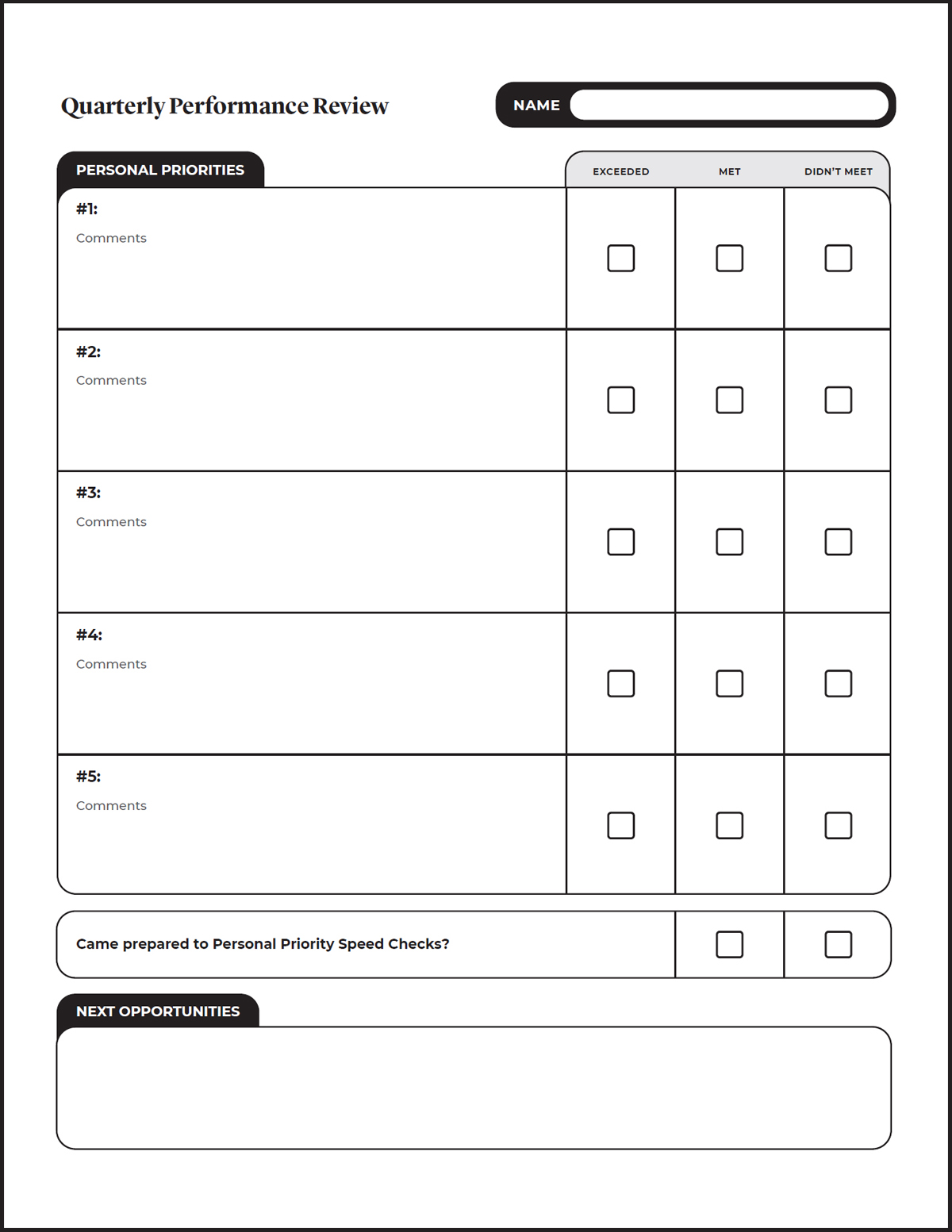
In the Quarterly Performance Review you will carefully assess each team member’s performance. You’ll ask questions like: Are they often late? Is the quality of their work subpar? How might management help them improve? These conversations are a mix between management and coaching in which each of your directors help their team members understand how to improve in their professional career. If you like, the fourth-quarter performance review can also be tied to a bonus and pay structure.
Your Quarterly Performance Reviews address the number one question most team members have: Am I doing a good job? These meetings are mostly positive but because they are a little longer and because the Quarterly Performance Review Template is filled out by both the team member and department head, an honest conversation is fostered and a natural, healthy environment for coaching and improvement is created.
As is suggested by the title, the Quarterly Performance Reviews take place once each quarter.
The Five Meetings That Will Transform Your Company and Streamline Your Overhead and Operations
These are the five meetings that will grow your small business. There are other meetings, of course, but, as you grow, if you implement the All-Staff, Leadership, Department Stand-up, Personal Priority Speed Check, and Quarterly Performance Review meetings, the flow of important information from person-to-person will not be blocked, and efficiency will increase.
When I talk about efficiency, I’m talking about the flow of energy to the wings and engines. Energy used to enlarge the wings or increase the thrust of the engines creates more income for the business and so can be considered an investment, whereas energy used within the body of the airplane (while often necessary for administrative tasks) should be considered a spend because it does not translate directly to revenue creation.
When team-member energy contributes to the wings and the engines, it does not count against the size and weight of the body; therefore, the Management and Productivity Made Simple Playbook is designed to move energy stuck in the body of the airplane out onto the wings and into the engines, thus decreasing the overhead-drag versus lift-thrust ratio.
This exact playbook may not work perfectly for you. Feel free to use the templates, though, to create a hybrid management and productivity playbook of your own. I assure you this playbook will work a lot better than many of the six-figure consulting systems firms will attempt to bring into your business.
Are These the Meetings That Replace Most Meetings?
You may look at these five meetings and feel resistance. How could you add anymore meetings to your existing schedule? I get it. Again, though, these meetings are designed to replace all those “can we get together?” meetings that are bogging down your schedule.
Not only this, but as the owner of the company or the person running the company, only three of these meetings are meetings you’ll attend personally: The All-Staff, Leadership, and (some of) the Quarterly Performance Reviews. The rest of the meetings are run by department directors.
The Management and Productivity Made Simple Playbook isn’t just designed to streamline leadership and management meetings; it’s designed to increase focus and decrease meetings for every single team member. Will you never have an out-of-the-playbook meeting because you’ve installed the Management and Productivity Made Simple Playbook? Sadly, no. You will continue to have outside meetings with customers, staff, leaders of other companies, and vendors, but you’ll be able to attend those meetings knowing your business is not losing focus because of your absence. That will make those outside meetings more pleasurable. In fact, you’ll find yourself being fully present in those outside meetings because things are running so smoothly at home.
Who Should Run the Management and Productivity Playbook?
Another concern you may have is that these five meetings will take an enormous amount of time to implement. If you felt that concern in your bones as you read about these meetings, you likely aren’t the person who should install the Management and Productivity Made Simple Playbook. Not everybody is wired to run a management and productivity playbook. In fact, if I had to install the playbook in my own company, we likely would never have implemented it at all, and my company would have suffered.
I assure you it’s not because this isn’t a good playbook. I think the playbook is exceptionally simple and effective. The reason I would never have installed it is because I am not an operator—I’m an artist/entrepreneur.
Of the three kinds of leaders you normally find at the top of a successful small business, there is the artist, the entrepreneur, and the operator.
The Artist
The artist obsesses over products and product creation. They care about how a product works, whether or not customers are happy with it, and how it is brought to market. The artist is often a visionary who “sees the future” as it relates to the business and how their products will affect their customers. Without the artist, the company will not change the world or create revolutionary products.
The Entrepreneur
The entrepreneur is always smelling around for revenue and growth opportunities. When they look at the world, they see an opportunity to expand. They often like to take existing ideas, bring them to market, and scale them up. If the company isn’t growing, they aren’t happy. Without the entrepreneur the company will fail to make money on the artist’s vision.
The Operator
The operator loves to organize chaos. They love to organize chaos because they do not like chaos. They want to break down the workflow into predictable systems and processes that can be duplicated so everybody knows what is expected of them, finishes their work, and is rightly compensated. Without an operator helping to run the machine, people get exhausted with the artist and entrepreneur and look for work elsewhere.
The person you are looking for who can install the Management and Productivity Made Simple Playbook will be an operator. If you hand this assignment to an artist, they will forget to show up at 75 percent of the meetings, and, when they do show up, they will likely pontificate wildly about how great the future will be, all the while listening to a Beatles album—probably backward, while asking their direct report whether they can “hear it.”
When Doug came on staff, I didn’t just ask if he could help us design a simple management and productivity playbook. I also asked him to install the playbook while training a direct report to manage that playbook once it was in full use. The person Doug trained is named Kyle Willis. After Doug left us to turn around another massive company, Kyle took over and has managed the system of meetings flawlessly. I can honestly say the Management and Productivity Made Simple Playbook, under Kyle’s leadership, has helped our business enter into its most productive season and, not only that, has given me the best relationship I’ve ever had with the business.
Before installing the playbook, I felt like my business was a machine I was trapped inside of. Today, my business is a community of thoughtful people working diligently to serve clients. It gives me energy to play the part of CEO, artist, and visionary inside this community.
Once you’ve identified your operator, they will use the following step-by-step guide to install it.
The Management and Productivity Made Simple Playbook: A Step-By-Step Plan
Step One: Assign an operator to install the playbook.
- If you are not going to run the playbook yourself, make sure the person who does is a true operator. They should love managing an existing playbook. They should be good with people but should also be truth tellers. Because so much of the playbook is about assessing performance, a team member who is too much of a people pleaser will frustrate the system. You are looking for a process-driven team member who is also an encouraging truth teller.
- Your operator could have the title of COO, President, or Vice President. They could even be a high-level executive assistant if your business is too small for an executive team. You don’t need to overthink this. There’s no reason to get bogged down in titles.
- Know that the person who handles the Management and Productivity Made Simple Playbook will be running your company. While you don’t need to think about titles (beware of title inflation), once you put this person in that seat, and if they work out well, you’ve likely found your go-to person who can set you free as an artist or entrepreneur. Your attendance at the Leadership Meeting will be your touchpoint with the company. You will no longer feel like you are trapped inside the machine.
Step Two: Launch the weekly All-Staff Meeting.
- Don’t worry about installing the entire playbook at once. For the first few months, all you need to do is hold the weekly All-Staff Meeting. The weekly staff meeting will remind everybody on your team of the mission and, specifically, the three economic priorities.
- If you do not know your three economic priorities, go back to Step One in the airplane framework: Business on a Mission. The main reason to have a weekly staff meeting is to review the economic priorities of the business and talk about how the entire team can move them forward.
- If you do not have a team but work with contractors, ask if they would be willing to attend the All-Staff Meeting. You can call the meeting whatever you want; if contract workers are critical to your success, ask them to attend. Depending on the state you live in (American audience) you may not be able to make attendance mandatory, but most contractors will want to attend the weekly meeting anyway because it will help them serve you with more efficiency.
- Once your staff meetings start feeling good and the business is aligned around the three economic priorities, move on to step three.
Step Three: Add a weekly Leadership Meeting.
- A weekly Leadership Meeting can take place directly after the All-Staff Meeting. This meeting is the least formal of all the meetings but it still has a template that will make sure it’s effective and doesn’t waste anybody’s time.
- If your business is small, your Leadership Meeting and your All-Staff Meeting may be combined. However, the agenda for both meetings should be different. Even though you will be holding the meetings back-to-back with the exact same people in attendance, do fill out both meeting templates.
- If your business has a leadership team that is not the same as the overall staff, the weekly Leadership Meeting will help your leaders talk about what each of their departments is working on and invite other leaders to help remove roadblocks.
- The weekly Leadership Meeting is designed to increase morale and a sense of community among the leaders of the team. Do not be surprised if some of your leaders feel isolated in their jobs. This meeting will help maintain team unity from the top down.
- Consider a quarterly breakfast or lunch for your leadership team. Even though you meet every week, one meeting a month or one meeting a quarter could be set aside as special. There’s nothing like sitting around a table and sharing a meal to create community.
- Once your leadership team feels like a good, healthy community, consider launching Department Stand-ups.
Step Four: Add Department Stand-ups.
- If your business is small, your All-Staff Meeting may suffice in channeling your focus around the three economic priorities. However, as you grow, you’ll find your team members begin dividing into departments. Sales, marketing, design, development, production, and customer service are all examples of departments inside of a small, growing business. If you do have departments, go ahead and launch Department Stand-ups. These meetings happen every weekday and are intentionally brief. They’re called Stand-ups because they are not supposed to be so long that people want to sit down. These meetings can take place in person or over conference calls.
- The Department Stand-up is led by your department directors. If you own the business or are running the business, you should not need to attend these Stand-ups. The template used to run the meeting will ensure the economic priorities still govern the mission.
- Use the Department Stand-up template for every Stand-up meeting. Using the template is critical to the success of the Management and Productivity Made Simple Playbook. If you do not use the template, the conversation during the Stand-up will wander in unproductive directions.
- Once your Department Stand-ups are up and running and going well, you can add step five of the Management and Productivity Made Simple Playbook.
Step Five: Add Personal Priority Speed Checks.
- As your small business grows, individuals will find themselves more removed from the owner or the person running the business. This means they are going to grow a bit insecure about their performance. This can be a problem. If team members are not sure what their job is and/or whether or not they are performing well, individual and team morale begins to decline. If morale declines, productivity declines with it, resulting in the body of your airplane becoming larger and heavier. Each team member needs feedback in order to do their job well and to feel good about the role they play in the business.
- One way to make sure team members are getting the feedback they need is to install a weekly Personal Priority Speed Check for every team member in the organization. The Personal Priority Speed Check Template should be filled out by the team member before the meeting and then reviewed by their department director during this check-in.
- The Personal Priority Speed Check should be led by each team member’s department head. The spirit of the meeting should be coach-like and encouraging. You will find that morale and productivity increase when you install the Personal Priority Speed Checks. Once your Personal Priority Speed Checks are up and running, you can implement step six of the playbook.
Step Six: Add Quarterly Performance Reviews.
- Quarterly Performance Reviews are terrific for any size business. Even though this is step six in the process for a business with a dozen or more team members, a smaller business may want to implement this step sooner. Your people need to know how they are doing in the eyes of their department leader in order to feel comfortable and safe at work.
- Use the Quarterly Performance Review Template to guide this meeting. The template should be filled out by both the team member and department head. Each template asks the person filling it out to assess the team member’s performance. This sets up an open conversation about how the department head and team member see their performance. There may be areas where the team member feels they are doing a better job than the department head or, there may be areas in which they team member is insecure about their performance while the department leader feels they have done a good job. Either way, every team member craves and deserves honest and encouraging feedback and the Quarterly Performance Review is where they are going to get what they want.
- Once your small business has more than ten team members, you will likely want to start thinking about performance reviews that are tied to compensation packages. As a team grows, team members will want more predictability and control over their compensation. You can likely “wing it” when it comes to compensation packages for a while, but be careful. Offering discretionary bonuses and discretionary pay raises can get you into trouble. Every raise and bonus sets a precedent and, with it, an expectation. Holding Fourth-Quarter Performance Reviews tied to compensation creates a consistent, stable environment for a team member to thrive within.
- The first three Quarterly Performance Reviews will help your team member understand what they should continue to do and what changes they might make to enjoy their full opportunity in terms of a raise and bonus. It’s important to know this is the controlling idea behind the entire conversation: What do I need to do to get my full bonus and full pay raise next year?
- When a team member feels in control of their financial future, they are more likely to love their job.
- Here is a simple breakdown of raises and bonuses that could be made available to each team member: A 1 percent to 3 percent raise can be given to each team member based on their performance. In addition, a 1 percent to 3 percent (of their salary) bonus can be tied to the overall revenue goals of the company. If the company hits its goal, up to 3 percent of their salary can be awarded to each team member, based on performance. If the overall business hits its stretch goal, up to 5 percent is made available to each team member. Every member on a perfect team on a perfect year would get a 5 percent bonus (of their salary) and a 5 percent raise. That may sound like a lot of money, but if you’re hitting your stretch goals as a business, you’ve got a high-functioning team deserving of financial acknowledgment.
- In order to run this playbook, your business will need revenue goals and stretch revenue goals. For instance, if your company makes one million dollars, team members have the opportunity to get up to 3 percent of their salary as a bonus. If the business hits their stretch goal of 1.3 million dollars, each team member could get up to 5 percent of their salary as a bonus. You can set the goals and stretch goals as you wish, and, naturally, the percentage each team member gets depends on their Quarterly Performance Reviews.
- The Quarterly Performance Review and compensation system is a simple, scalable way to handle compensation. It may not be necessary for most small businesses but as you grow, you’ll find the challenge of compensation and performance coming up more often. This simple system should satisfy all of your team members because it allows them to control their financial future, sets clear expectations, and is designed to be fair.
Your Management and Productivity Meetings Are Not the Only Meetings You Will Have
The five meetings included in the Management and Productivity Made Simple Playbook are not the only meetings you will have; they are merely the set meetings you will have within a weekly and annual routine. These meetings are designed to replace most other meetings; however, you may also need to hold a few more meetings. Some of those meetings may include but are not limited to:
Revenue Meetings
The controller, operator, or some other financial leader in your small business should hold a monthly revenue meeting in which they review last month’s numbers. After reviewing the numbers, two questions need to be addressed: Why and where did we do well? Why and where can we improve? You will find that this meeting gives you great insight into the overall health of the business and directly affects your strategy. If it’s possible, your operator should collect the data and lead the revenue meetings.
War Rooms
When a specific problem needs to be tackled, it’s often effective to gather the principal team members in a room for a few hours to formulate a strategy in a War Room. If you are relocating or selling off inventory or launching a new product, War Rooms may be necessary. War Rooms should be led by the leader who felt the meeting was necessary.
Leadership Off-Site Meetings
There are times when it makes sense for your leadership team to spend an entire day together to talk about the state of the overall business. These meetings will be led by whoever sits in the operator position and are mostly designed to help them understand how best to move the company forward. The agenda for the meeting will change depending on the context, but the basic idea behind a Leadership Off-Site Meeting is for the operator to align the team around particular challenges and opportunities. In essence, this meeting is a catch-all for all the needs the business is currently processing. Leadership Off-Site Meetings can last all day and happen when needed.
The Body of Your Airplane Will Become Leaner When You Install the Management and Productivity Made Simple Playbook
Again, the main culprit of overhead bloat comes from the cost of labor. When it comes to cutting labor costs, you have two choices: You can either lay off some of your team, or you can transform your existing team into a lean, revenue-generating force. If it’s possible, we highly recommend saving jobs and transforming each member of your team into revenue generators.
Of course, there are times when people need to be let go, but we hope these instances are rare and more related to fluctuations in the market than to the productivity of your team.
If you are hiring somebody to run your small business, their job description could be as simple as this: Install Step One and Step Five of the Small Business Flight Plan into our small business. If they do this well, and also hold a monthly revenue meeting, you have the equivalent of a terrific COO helping you grow your small business.
To install the Management and Productivity Made Simple Playbook, take the steps outlined in this chapter and use the meeting templates included in your Small Business Flight Plan.
Copies of the meeting templates are on the following pages. When you use the digital version at SmallBusinessFlightPlan.com, you and your team can archive all past meeting templates.
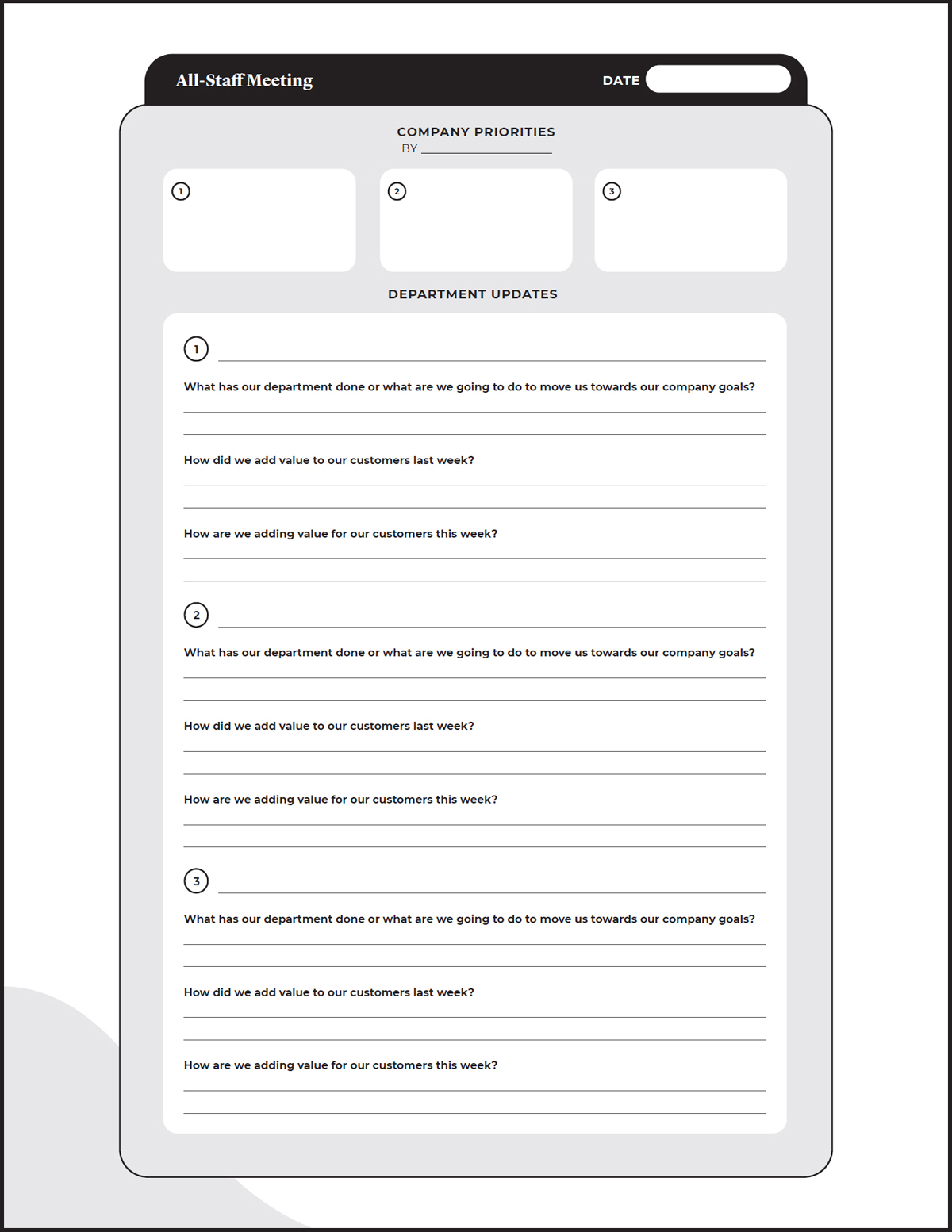
Access a digital, fillable version at SmallBusinessFlightPlan.com
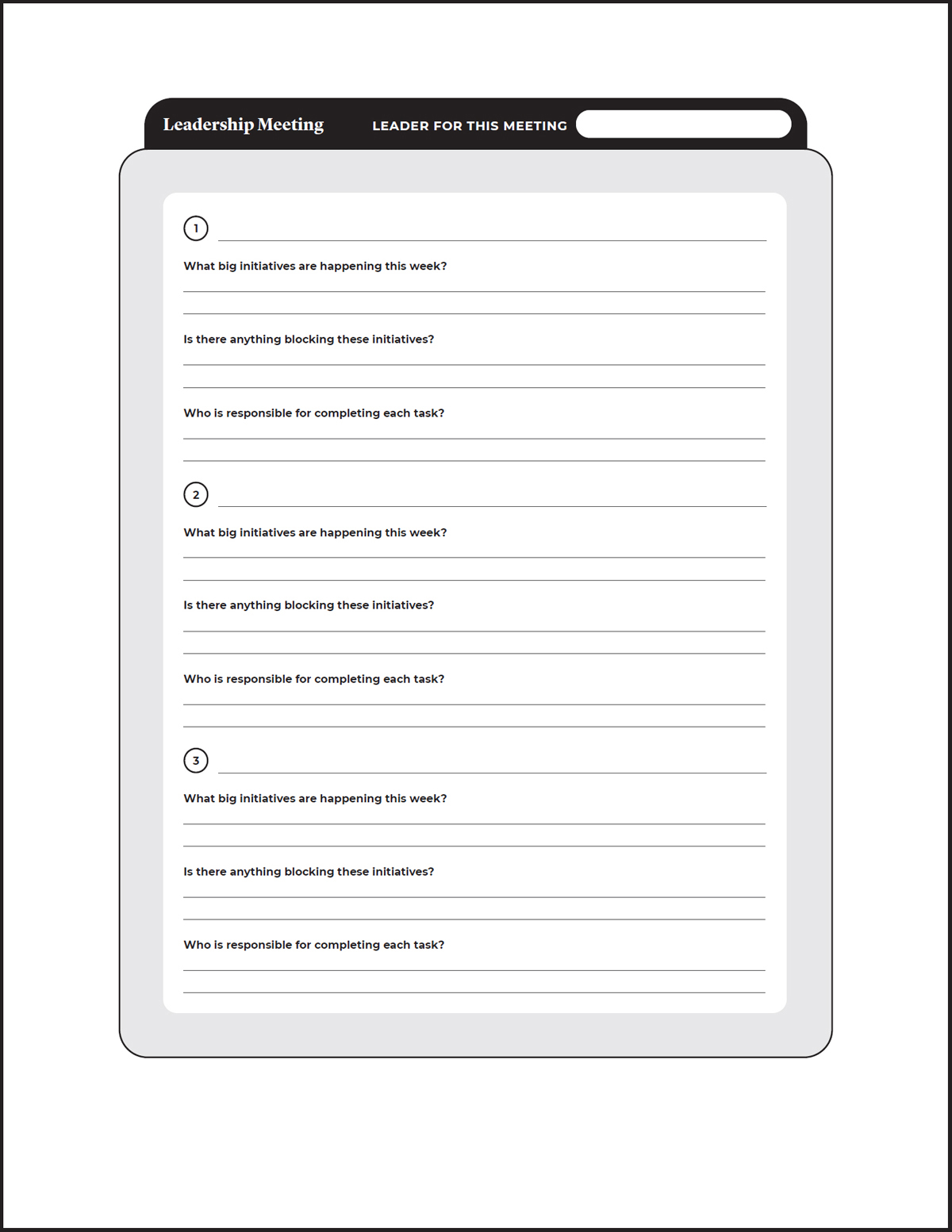
Access a digital, fillable version at SmallBusinessFlightPlan.com
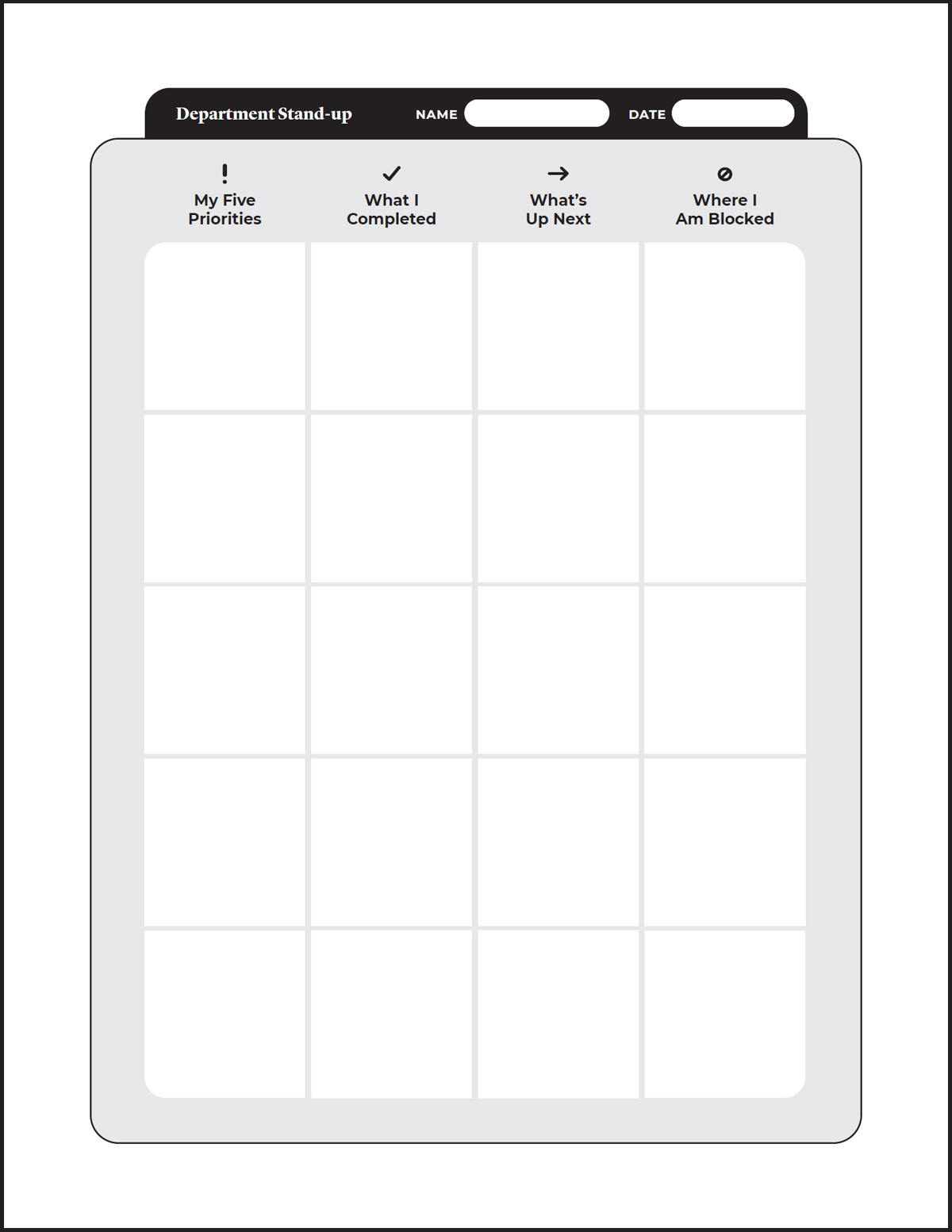
Access a digital, fillable version at SmallBusinessFlightPlan.com
Access a digital, fillable version at SmallBusinessFlightPlan.com
Access a digital, fillable version at SmallBusinessFlightPlan.com
Once you have taken the first five steps, you’ll find your small business is making a lot more money. So how do you manage that money? Let’s move on to the last of the six steps: Small Business Cash Flow Made Simple.