Optimize Your Product Offering with the Product Optimization Playbook
Step Four Will Help You Solve These Problems:
- You aren’t sure which of your products is really producing the most profit.
- You could use a new product that increases your profitability.
- Your product offering is getting boring to your customers.
- You have wasted many hours launching a product that didn’t sell.
- You need more cash and you need it fast.
- You do not have a process in place to upsell products to existing customers.
• • •
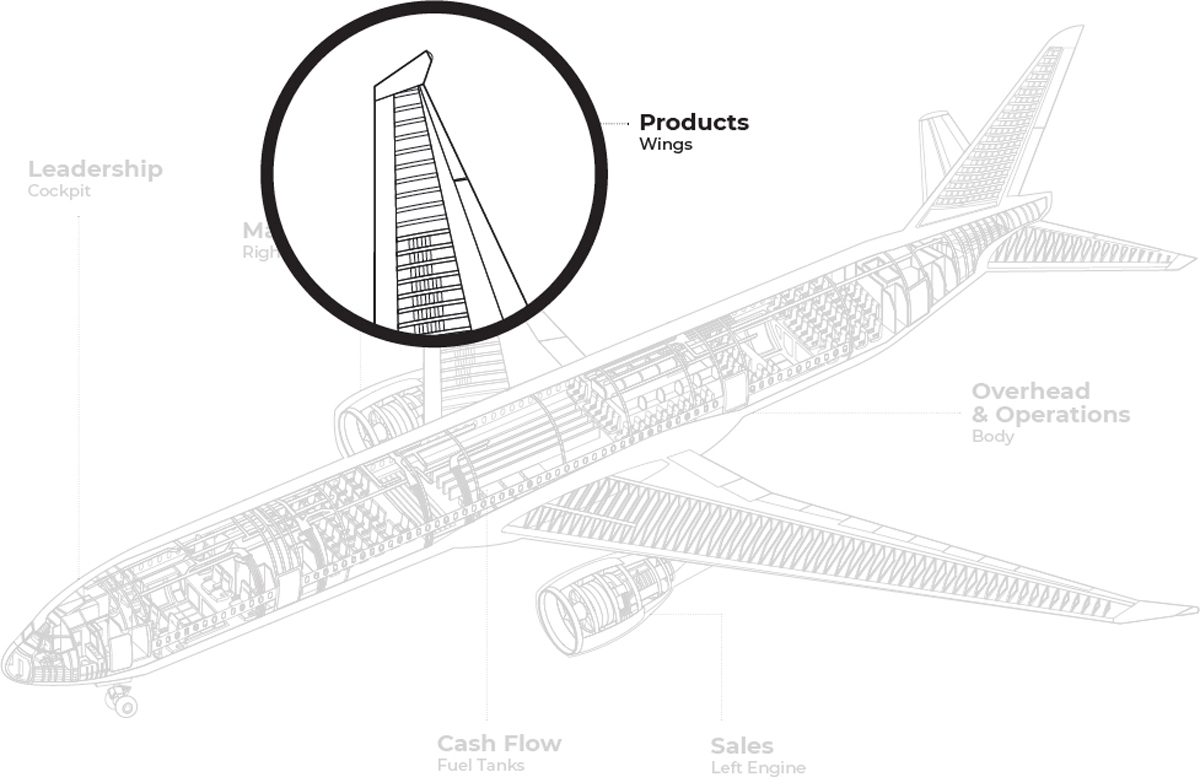
What gives your airplane lift? The wings. The right and left engines, as powerful as they may be, will not contribute to lift without a strong set of wings.
Your marketing and sales engines only work if they have product to sell. And what that product is, how it came to be, whether or not it is bundled with other products, and how profitable those products are all contribute to the success or failure of your small business.
The same is true of the products you sell through your small business. Your business gets off the ground only when your marketing and sales engines move product. The kinds of products we choose to create and sell, then, matter as much to the flight of our business as the wings matter to an airplane. If the products are not in demand and profitable, it will be as though the wings of our airplane are too small. Could an airplane like that work? For sure. But only if the marketing and sales engines are strong enough to overcome the lack of surface area that would otherwise create lift.
When you optimize your product offering for demand and profitability and prioritize products that create more lift, it’s as though you are enlarging and strengthening the wings of your aircraft, allowing it to take flight with greater ease.
If you had to increase your current revenue by 25 percent in six months, what would your first move be? Likely, you’d ramp up your marketing and sales engines. That makes sense. If the right and left engines gain more power, the plane will fly faster. What if, though, I removed those options? What if you had to increase your revenue by 25 percent and weren’t allowed to touch your marketing or sales engines? If that were the case, you’d only have one option, an option that most small-business owners forget they have: to optimize your product offering.
When we think about growing our business, we rarely think about optimizing our product offerings. This is a mistake. There are thousands, if not millions, of dollars to be made by optimizing the products you sell for greater demand and profitability.
On my podcast, I recently spoke with two women who own a dance studio in Salt Lake City. As we discussed increasing their revenue, they mentioned they wanted to franchise and build another location. What do you think I heard when they said that? I heard, “Let’s bloat the body of the airplane!” Sure, they could increase revenue that way, but another location would create a tremendous amount of additional overhead.
When I asked them what their top revenue-generating products were, they told me the first was beginner dance lessons for little kids, followed by break dancing (soon to be an Olympic sport, apparently), and a few other classes.
“How much do you charge to teach people how to break dance?” I asked.
“About $250 for six classes.”
“That’s six weeks’ worth of classes you have to teach, right?”
“Yes,” they said, “our instructor teaches six 90 minute classes.”
After they told me what the instructor got paid and how many people signed up for each class, I realized they weren’t making much profit. Still, the only way they figured they could scale was to open another location and duplicate their current model.
That’s the way most small-business owners think. It’s not a terrible way to think but it’s not the best way, either.
The real question we all want to ask when it comes to optimizing our product offering is this: How can I work just as hard as I’m working now and generate two, five, or even ten times the revenue?
Sound crazy? It isn’t crazy at all. All you have to do is figure out how to work just as hard as you’re working now and provide 2x, 5x, or 10x the value you offer to customers.
As we continued talking, I asked the owners if they were familiar with all the dance crazes happening on social media. You know what I’m talking about. Scroll through your social media feed and half the videos are of individuals, families, or even teams of people dancing.
“What if you did this?” I asked. “What if you charged a company $10,000 to teach their employees how to do a dance and then filmed that routine at their place of business? Would that be hard?” I asked.
“No,” they said. “That’s what we do. We teach people how to dance.”
“Yeah,” I continued, “but if you teach a little kid to dance, you get $250 over six weeks and you have to pay for the building. But if you teach a corporate team to dance, that is worth a lot more. Corporations are looking for team-building activities. Not only that, if you film the video at their place of work and they use it on social media, it’s great advertising. It’s a great recruiting tool too because everybody wants to work at a place with a fun culture.”
Think about what we just did. We figured out how our friends who run a dance studio could do the exact same work and charge fivefold or more. For a large company, this would be a cost-effective team-building exercise as well as good advertising and a good recruiting tool. Ten thousand dollars is a steal for that kind of value, and the dance studio just increased the value of their product dramatically without increasing the cost of the product itself at all.
Another guest on the podcast, a wedding planner out of Chicago, was challenged with growing her business without having to duplicate herself. She charged quite a bit for each wedding but because she was only one person, was limited in her ability to scale. During the interview, we optimized her product offering by creating a product called Plan Your Own Wedding. For $5K, she would walk you through a robust checklist by giving you access to step-by-step videos that helped couples plan everything from the event space to catering to flowers and even cocktail recipes. Not only this, but when customers signed up for the step-by-step process they got to meet, in a cohort, with her each week for 90 minutes to ask questions and address concerns. Suddenly our wedding planner went from planning one wedding at a time to planning 10 or 15. And all it cost her was 90 minutes each week. She could plan 10 weddings in a fraction of the time she could previously plan one, and if anybody wanted to upgrade to her personal services, they could pay for her previous service.
Another idea for enlarging the wings of your airplane is concierge service. I once had a doctor who charged me a monthly fee to be a “member” of his program. The idea was that he promised to have many fewer clients and take more time with each of them. I still had to pay a fee whenever I went to see him, but when I did we’d sit in his office for an hour or more and talk about diet and exercise and health trends and family history. I never once felt rushed. Was it expensive? It was but I cared enough about my health and longevity that the fee was worth it.
Is it possible to make the wings of your airplane stronger, lighter, and larger? For almost everybody reading this book, it is. You can charge a premium for more focused attention. You can bundle products together to create packages of products. You can take some of your expertise online and coach people in groups. You can charge a monthly fee for information you have access to. Even if you represent somebody else’s products and there’s nothing you can do to change that, you can offer a subscription service where folks get the product monthly.
So how do we optimize our product offering?
There are three exercises you can conduct to optimize your product offering. The first is to rate your products for profit. In this exercise you’re going to look at your current offering and get brutally honest about what’s bringing in money and what’s weighing your airplane down. This exercise will help you focus your marketing and sales energy for optimum profit.
The second exercise involves a product brainstorm in which you see if you can offer new products that will bring in more revenue and profit. This exercise will expand the surface area of your wings.
The third exercise involves using a product brief to decide what products you should create to grow your business. A product brief is a form you fill out every time you have a new product idea. This form will help you realize whether or not the new product is a good idea or whether you’d be wasting valuable time, costs, and energy trying to bring it into the world.
When you perform these three exercises, and continue to perform them on a regular basis, you will improve your airplane by making sure the wings are optimized for lift. These exercises, by the way, are the secret to many multibillion-dollar businesses. Entire research and development processes, boards, and committees are in constant motion to create new and better products allowing them to keep pace with the competition and serve the ever-changing needs of their customers. Even though you are a small business, you can implement similar processes to optimize your product offering for revenue and profit.
Step One: Rate Your Products for Profitability
In the day-to-day whirlwind of running a business, we often lose track of which products are making us money and which products are weighing down our airplane. Selling products that are not profitable is like strapping two-by-fours to the side of our airplane and expecting them to work like wings. Your airplane won’t get any lift. In fact, any product that is not profitable is creating serious drag on your airplane while simultaneously stressing your right and left engines. In order for your airplane’s wings to remain light and strong, your products should be profitable and in demand.
Sometimes a product can be sold at a loss because it brings in customers who may buy more profitable products, but these instances are the exception to the rule.
The first exercise we will conduct to both lighten and strengthen the wings of our airplane involves ranking our products in order of profitability, from most to least profitable. Conducting this exercise brings us face-to-face with the truth about which products are really paying the bills.
If you have a retail store that sells hundreds or thousands of products, this exercise may be too involved. That said, you can easily rank your fifty best-selling products, which you will likely find account for 50 percent to 80 percent of your revenue anyway.
The exercise of ranking your products for profitability is going to do two important things for you as a small-business owner: It’s going to show you where your money is really coming from, and it’s going to inform you about where to spend more of your marketing and sales effort.
When you rank your products by profitability, ask the following questions:
- How much do your raw materials cost?
- How much of your labor costs are directly related to the creation, marketing, and sales of this product?
- Does the product expire and, if so, how does expiring and unsold inventory affect the cost of your product?
Ultimately the number you are looking for is the difference between what you sell a product for and what it costs to produce, support, and sell that product. This is a little different from “cost of goods sold,” but the idea is the same.
It’s important to note this is not an official accounting exercise. You aren’t turning this form in to the government or even to your accountant (although it’s not a bad idea to have your accountant provide their input). This exercise is purely about gaining an awareness of how your company makes money.
Here’s the process you should go through to rate your products:
- List every product you sell on a whiteboard or piece of paper—if you’re a retailer that has thousands of products, try to list your top 50 or so.
- Use your gut instinct to list those products in rank order for profitability.
- Do due diligence to make sure your list is right—truly figure out how profitable your products actually are.
If it’s possible to do this exercise with your leadership team, feel free. Your team will have different perspectives on which products are profitable and which products are not.
Use the Product Profitability Audit in your Small Business Flight Plan to conduct exercise one.
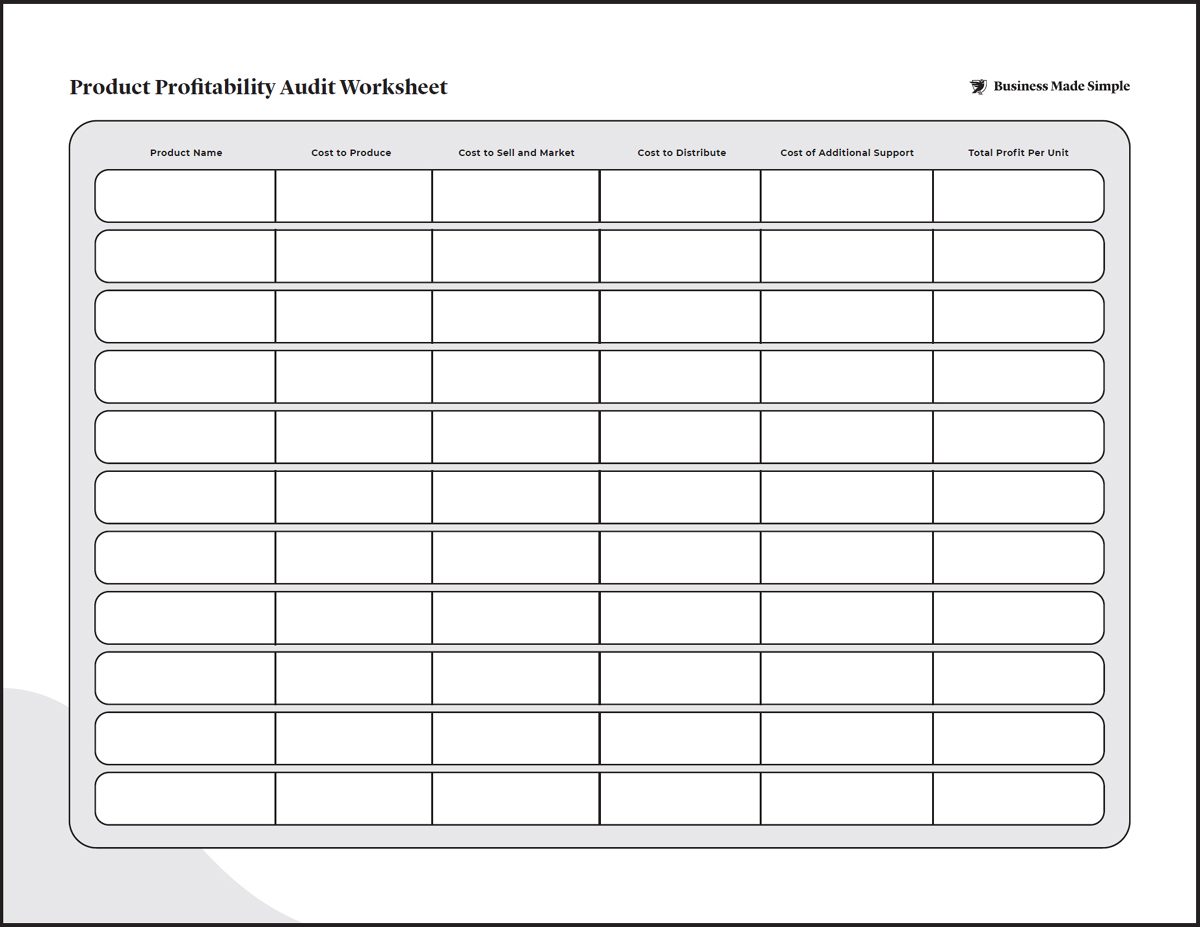
Access a digital, fillable version at SmallBusinessFlightPlan.com
After we know where our business really makes money and where it doesn’t, we need to ask ourselves some difficult questions:
- How much bandwidth is being used producing, marketing, and distributing products that are not very profitable?
- Can we stop selling some of those products?
- Are the marketing and sales efforts reflective of our profitability ranking?
- How can we allot more marketing and sales resources to increase sales on our highest-profit items?
Can You Sell More of What’s Already Working?
As small-business owners, we often make the mistake of believing our path to greater revenue must involve creating and selling new products. That logic makes sense. We launch one product, it starts to sell, we enjoy the positive cash flow, and we want to duplicate our efforts with another product. Repeat.
But that only makes sense if we’ve reached market saturation. The truth is, most small businesses haven’t saturated the market.
If we can sell more of the high-profit products we are already selling, let’s try that before doing all the work to create and launch a new product. In other words, let’s make the fire bigger by pouring gas on what’s already burning!
The money you need to grow your company may be sitting right in front of you. Is your pet store making great profit on a specific brand of dog food? Double your next order and turn it into an end-cap display, feature that bag of dog food in your next email, stack it high in the store window and have your retail team mention how great that particular brand of dog food is to every person who comes in to buy a chew toy.
If you are known for selling a specific product, it’s much easier to sell more of that product than become known for selling something else. Both are possible, of course, but selling more of what you’re already selling is easier.
Can You Let Go of Products That Are Not Bringing You a Profit?
Now that we’ve doubled down on what’s working, let’s consider letting go of the products that aren’t selling.
Sometimes, of course, this is difficult and maybe even unwise to do. You may not make much money off a pack of gum, but folks who come into the store to buy gum often buy a large soft drink, which is very profitable. Excluding those loss leaders or break-even leaders, though, there are certainly products you can ditch that are taking up too much mental and financial energy. What would happen if you cut those products and focused your marketing on what’s already working?
In storytelling, there is a famous phrase that applies just as strongly to business: Kill your darlings. This phrase has helped create many literary masterpieces and can help your business take off, too.
I can’t emphasize this enough: If you can cut products and streamline your product offering, do it today.
Step Two: Add New, Profitable Products to Your Product Offering
When you stop spending valuable marketing and sales resources on products that don’t bring in a profit and reassign those resources to products that do make you money, the wings of your airplane become larger and your airplane generates more lift. Optimizing the performance of your wings by ranking your products and assigning more sales and marketing resources to what’s already working is the first step. The second step is to create more products that are as profitable or more profitable than your highest performers.
When you’re dreaming up a new product, consider this question first: What can I bring to market that will provide the most value to my customer?
There are many categories of products where people will pay a premium, but here are the six categories of problems and product offerings most successful companies produce and categories you can explore to expand your product offering:
- Making Money: If the product you sell will help people make money, it’s worth money. If you sell a franchise, for instance, you’re selling a business that people can run and make a great living from. If you wholesale products that other people can sell, you’re helping people make money. Financial advice, coaching, and sales representation are all products that help other people make money. Marketing and advertising are great examples of investments people make in order to get a financial return. If you’re selling certification so people can better represent your brand, or training on how to invest or sell, you are able to charge a premium because, in the end, you’re a direct financial investment in which your customer will get a good return.
- Saving Money: If your product saves customers money, they will pay you a percentage of that savings. For instance, if you sell solar panels that will, over the years, save your customer thousands in energy bills, you can charge a percentage of that savings. If you are able to broker a deal and save your client money, you can charge a percentage of that savings.
- Reducing Frustrations: If your product is able to alleviate stress and anxiety, you have a great product to sell. People will pay for a sense of peace, calm, and resolution. The frustrations people experience most include a lack of time, a lack of organization, or a lack of knowledge. Services as simple as dog walking fit into this category along with more elevated services such as therapy or counseling.
- Gaining Status: If you have a luxury item or product that includes limited access, people will invest in your brand. Rolex sells a watch that is about the same quality as many other watches but people buy them as a way of acknowledging their success or achievement. A luxury car, a penthouse suite, even a special table at a restaurant are examples of premium products that carry with them an elevated sense of status.
- Creating Connection: If you are able to create a community of like-minded individuals, you have a terrific product opportunity for which there is a human longing. The desire for human connection with others experiencing similar challenges or ambitions is a valuable commodity.
- Offering Simplicity: When a customer has a problem, they don’t just want to solve the problem, they want to solve the problem as easily and simply as possible. If you have an all-in service that can solve your customer’s problem with one easy payment or perhaps a subscription method, you’ve got a great product. Most subscription services fit into this category. If you’re mowing my lawn or cleaning up my book, you’re simplifying my life. For that, I will pay a premium.
Three Proven Places to Create Profitable Revenue Starting Now
Now that we know six types of offerings that are always in demand, we must determine how we can package those offerings as products that deliver the most value and have the greatest positive effect on the bottom line of our business. Here are three great ideas:
1. Subscriptions: Whether you sell paper towels, financial advice, pet food, or even human food, turn your product offering into a daily, weekly, or monthly subscription. Allow your customers to choose how often they want to receive a forty-pound bag of dog food and start shipping it on a schedule. For them, this amounts to incredible convenience; for you, it amounts to a steady stream of profitable income.
2. Certifications: If you’re selling an expertise, consider duplicating yourself in the form of a certification. Yes, you can certify people on nearly any expertise that can be leveraged into a small (or large) business. Have you spent the last twenty years consulting with wannabe home gardeners? Leverage your expertise into a home gardening consultant certification.
3. Package deals: Often your customers don’t just come to you to buy a product, they come to you to solve a problem. For instance, if you own a store that sells greeting cards, paper products, and party supplies, consider packing a “Children’s Birthday Party Package” that includes banners, paper plates, hats, and so on. Customers who come in to buy some balloons and a banner will discover that their entire problem (How do I decorate for my child’s birthday party?) can be solved in one simple purchase. If you are going to create package deals, start with the top three problems customers seek you out to solve and create packages around those problems. For instance, the “New Puppy Package” is great for a pet store and the “Best Valentine’s Day Ever” travel package would be terrific for any travel agent. Get creative. Just remember, your customers aren’t seeking you out to buy a product, they’re seeking you out to solve a problem! Organize the solution to that problem into a package and watch your sales increase.
Step Three: Install a Product Brief
One of the great things about running a small business is you get to implement decisions quickly. A service can suddenly exist today that didn’t exist yesterday. Larger businesses are bogged down in committees and market testing, but not you.
Well, I’ve got not-so-good news for you. Or perhaps it’s good news. It depends on how you look at it. The news is this: Those product-creating processes exist for a reason. As you get larger, the freewheeling entrepreneurial spirit can slow you down because the more people there are in the business, the harder the business is to pivot. When a business is larger and the visionary leader starts making fast decisions, half the team has no idea the business went in a new direction and confusion and frustration abound.
The answer, even for small businesses, is to start using product briefs.
As a freewheeling visionary entrepreneur, the idea of installing product briefs into your business may sound about as beneficial as pouring pancake syrup into an engine. I get it. When our business started using product briefs, I was convinced the process would gum up the process and slow us down. Here’s the thing: The purpose of a product brief is to create doubt. Doubt, it turns out, is your friend. If you and your team’s ideas can make it through the gauntlet of questioning involved in a product brief, the idea is much more likely to evolve and ultimately positively affect the bottom line. Failing to fill out a product brief as a way of vetting your ideas, however, will ultimately slow your business down with bad products that hit the market with a thud.
Filling out a product brief launches a process in which you and your team spend a week or two doing due diligence before launching a product or service. During the product brief, you and/or your team analyze whether launching the new idea will interfere with existing revenue streams, confuse customers, be profitable and sustainable, or bloat your overhead (the body of the airplane)—causing more harm than good.
For you high-control folks who like to run-and-gun and install the wings of the airplane while it’s barreling down the runway, trust me: Slowing down to install a product brief is going to grow your business a little bit slower but a heck of a lot bigger.
Our run-and-gun ways might make us feel free, but the truth is we’re leaving a pile of frustration behind us as we go. When we decide to create a “new product” then pivot a week later and forget we even brought up the idea a month later, we run the risk of burning out our team. Not only this, but failing to slow down and analyze our plan and do due diligence about its potential amounts to amateur hour. If you ever want to sell your company, investors and buyers will smell the lack of professionalism about halfway through the second analysis meeting and realize the processes you have in place are entirely dependent on you and cannot be duplicated. This will devalue your business.
Performing a product brief process is necessary if you want to professionalize your operation.
I know a business owner who made his entire team so angry that they got together and collectively wrote him a letter saying he was too spontaneous and inconsistent to work for and spelled out a few processes that would make their jobs (serving him) easier. His response was to fire his entire staff. Some of his team members had served him faithfully for ten years. To this day, he refuses to speak to them. The result? He is surrounded by a new team of underpaid, submissive servants who will not give him honest feedback for fear of retaliation. As a result, he consistently makes a fool of himself with his public speculations about what he will offer. His business is limited. Even though his business has a hundred-million-dollar potential, it will never grow past three to four million dollars.
Those of us who need high levels of control hate product briefs. I know because I used to be a control freak myself. To be honest, I’d still be a control freak if I hadn’t discovered my team members are actually smarter than I am, are in closer relationships with many of my customers, and remember better than I do the mistakes we’ve made in the past. I do not submit to product briefs because I am a good boss and business owner (though I hope to be). I submit to product briefs because they are a foundational process for building a better, more profitable business.
The sort of feedback I get from product briefs looks something like this: If we implemented the proposed idea, we would not be consistent with our big announcement at the beginning of the year. We would confuse customers about who we are and what we do. Worse, we’d take necessary work hours away from the creation of our most profitable products in order to experiment with this new idea.
I have also seen a product brief greatly enhance an already good idea.
The point is this: The product brief gives me valuable feedback before I spend time and money (overhead) bringing that product to market.
Getting negative feedback doesn’t always mean an idea should be tabled. Often, pushback provides a valuable list of risks that should be mitigated before an initiative is launched.
Each new idea, whether it’s a product, a service, or a marketing plan is a brick in the wall of your business. If you run-and-gun, you will build your business much faster but many of the bricks will be half-baked and cracked. Yes, a product brief will slow down the day-to-day feel of the business but when you implement the brief, your business will grow stronger and be more dependable.
When engineers design an airplane, they test wing designs in wind tunnels before ever installing them on an airplane. Slight tweaks in the design can result in better fuel economy, greater lift, and less drag. Without the wind tunnel, the entire plane would have to be built in order to test the wings. This would drive up costs enormously if a guessed-on design actually had to be pulled back and redesigned, or worse, scrapped altogether.
Put your products through the wind tunnel of the product brief before launching those products.
Use Product Briefs for Any Important Initiative
Product briefs can be used for more than just products. At my company, we are just as likely to use a product brief for a new marketing initiative as we are for a new product. When I look back on all the failed marketing attempts I’ve thrown to my marketing team before we had product briefs, I wonder at how much time we wasted experimenting with ideas that could have been “tested” via the product brief worksheet.
If you want to create products that sell, marketing initiatives that work, and a company culture that is stable, install a product brief process today.
The Product Brief Worksheet
The Product Profitability Audit and the Product Brief Worksheet are both in your Small Business Flight Plan.
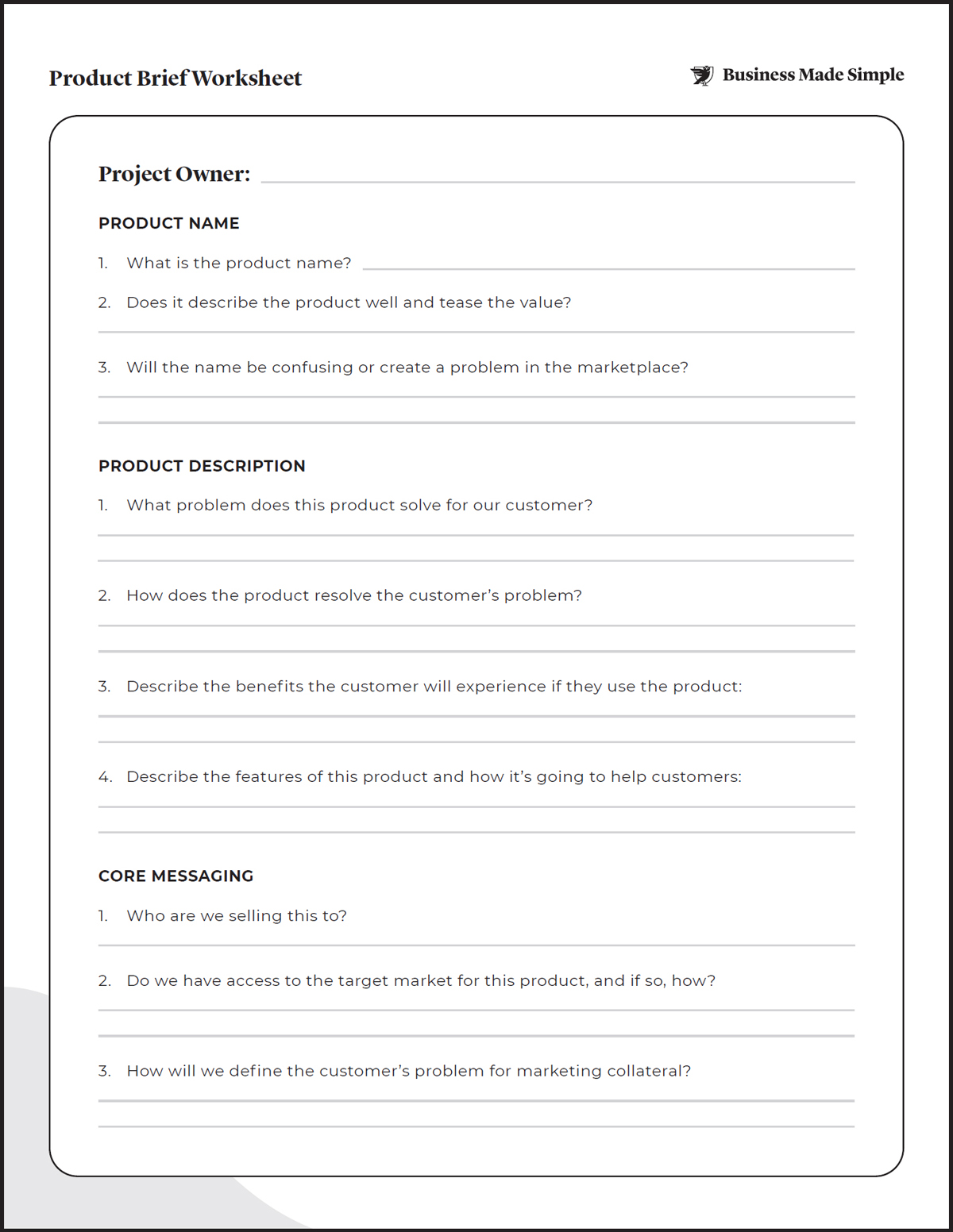
Access a digital, fillable version at SmallBusinessFlightPlan.com
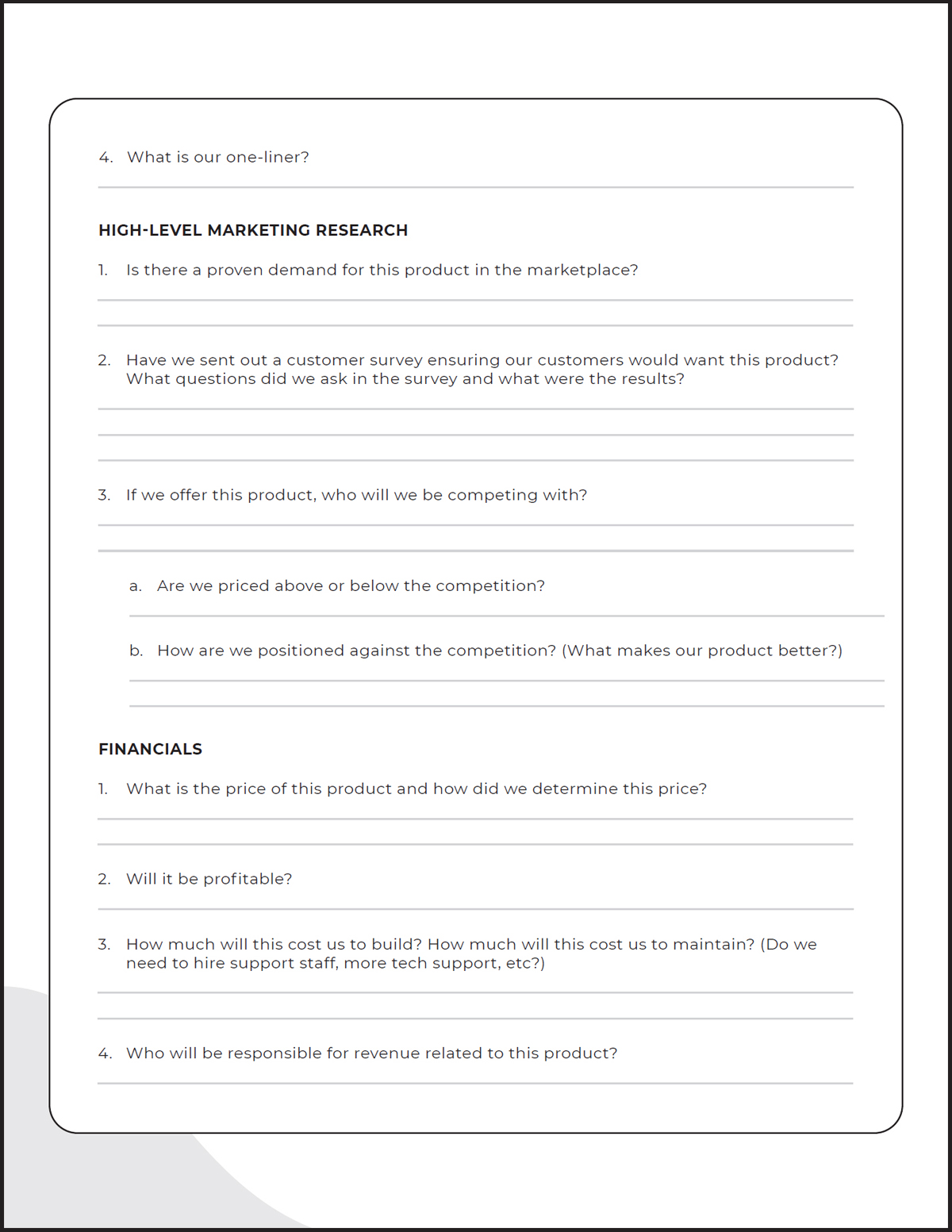
Access a digital, fillable version at SmallBusinessFlightPlan.com
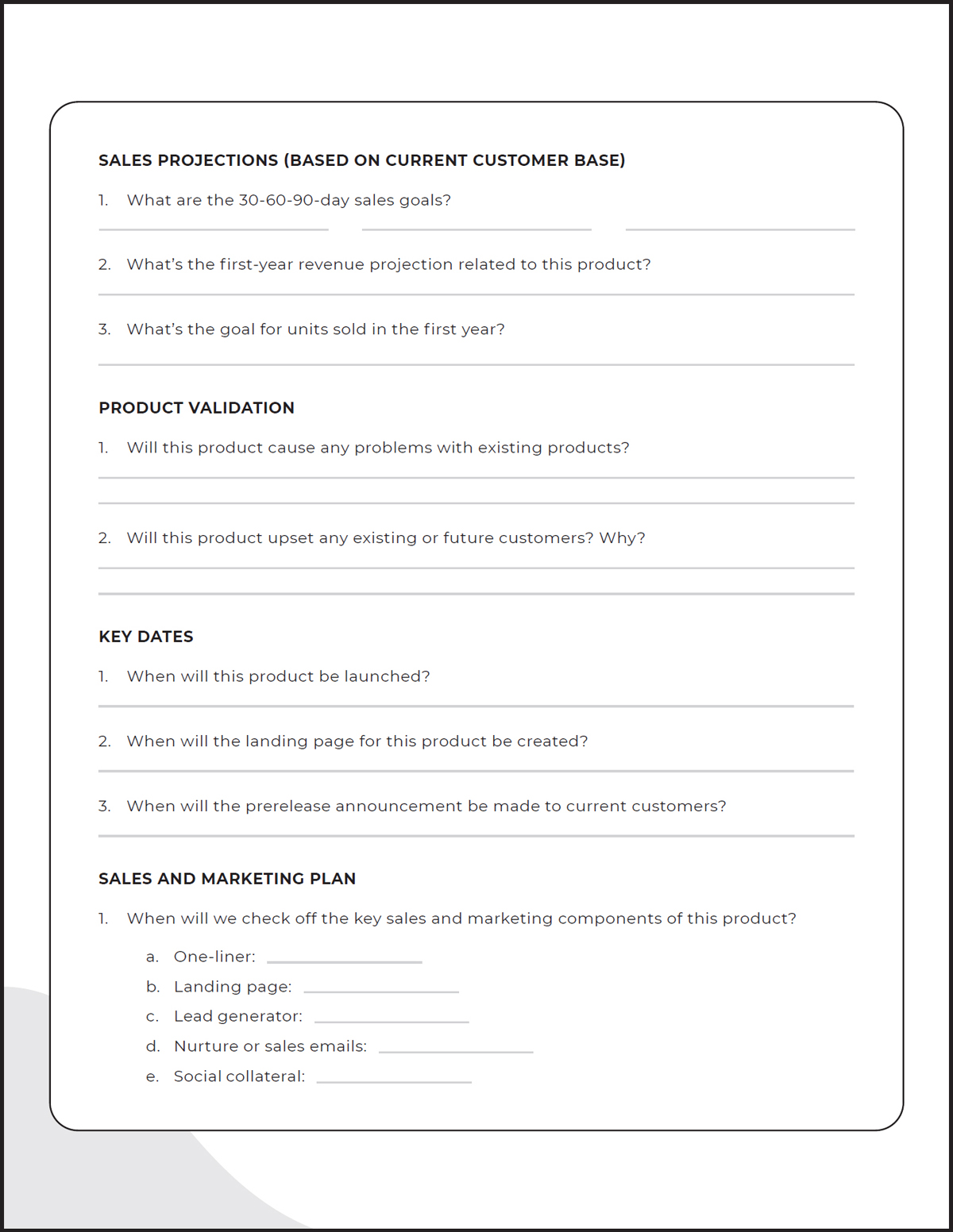
Access a digital, fillable version at SmallBusinessFlightPlan.com
Depending on the product or marketing initiative you are introducing, not every question in the Product Brief Worksheet will apply. Use the questions that do apply to spark thoughtful conversation about this important business decision and ignore the rest.
Your Products Determine Your Progress and Your Profit
Again, most business leaders don’t think about optimizing their product offering but launching the right new product can be a fast way of improving the bottom line.
If you do the following three things, the wings of your airplane will be optimized and your business will grow:
- Rank your products for profitability; consider letting go of products that are not profitable and/or in demand.
- Introduce new products to your customers that increase your revenue and profit.
- Install a product brief that ensures new products and initiatives are a success.
Once we’ve set our business on a mission, ramped up our marketing and sales engines, and created lift for our business by optimizing our product offering, it’s time to slim down the body of our airplane. The next step in growing your business involves using a management and productivity playbook. For those of you who struggle to align your team and who wonder if your team members actually know what they’re supposed to be doing, our Management and Productivity Made Simple Playbook is going to solve your problem.