Craft a Million-Dollar Sales Pitch
Step Three Will Help You Solve These Problems:
- You hate to sell but know you need to in order to grow your business.
- You don’t feel confident when you ask for the money.
- Your marketing and sales are not aligned.
- You do not know how to write a sales email that will immediately close sales.
- You keep making yourself the hero in sales conversations and it isn’t working.
- Potential customers do not immediately trust you.
- Your proposals get ignored.
- You are having trouble teaching your team members how to sell.
- You need more sales and you need them now.
• • •
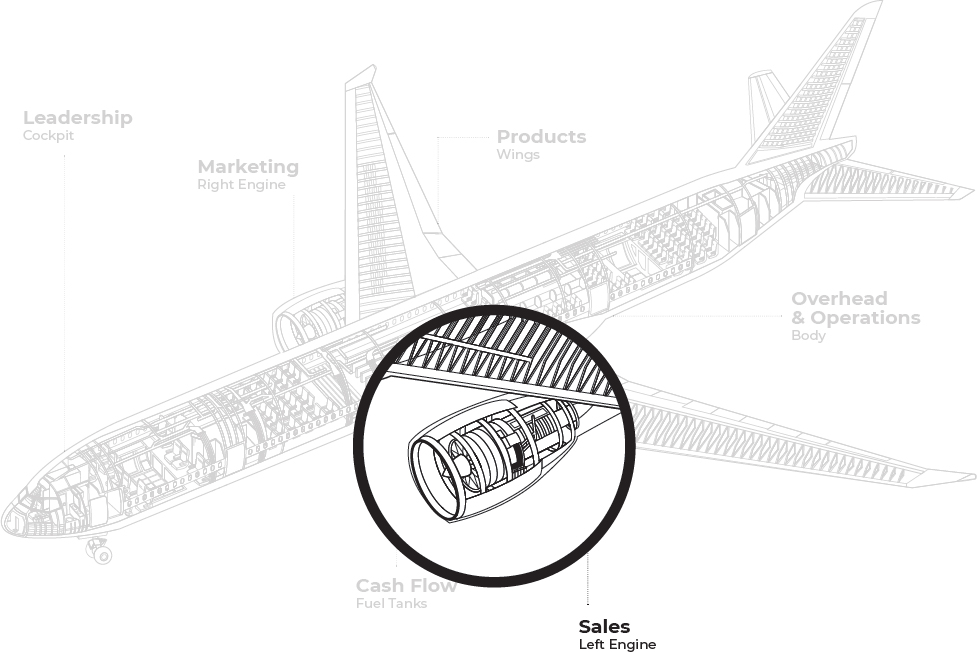
Now that our right engine is generating thrust, we can use the same storytelling framework to fire up the left engine of our airplane. When you add a sales component to your plane, you double the power that pushes you through the air.
For years, we’ve been asked by small-business owners to apply the StoryBrand Messaging Framework to sales. This is the first time we’ve introduced our sales framework to business owners and leaders like yourself.
Every small-business owner and every account executive or sales rep should know how to craft a million-dollar sales pitch. What do I mean by a million-dollar sales pitch? I mean a sales pitch you can use over and over to make a million dollars, no matter how big or small your business is. If you know how to craft a great sales pitch, you can bring millions in revenue into your small business.
If you have a sales team, you will want the entire team to understand Step Three because when they understand how to craft a million-dollar sales pitch, customers will have a more positive interaction with your brand and sales will increase.
In fact, at the end of this step I will challenge you to use the framework to write a sales letter that will more than pay for the money and time you’ve invested in this book.
Very few of us who run or own a small business think of ourselves as salespeople, but the truth is, we all have to sell. If we don’t tell others about our products in such a way they understand how we can solve their problems, our small businesses will crash.
If you don’t like to sell, don’t worry. The Customer Is the Hero Sales Framework will teach you to stop thinking about selling and instead craft a pitch that invites customers into a story.
If you hate to sell, I understand, but if this is true about you let’s take a moment to change the way we think of sales. Instead of trying to trick or manipulate people into buying our product, let’s simply explain how our product will solve their problems and allow the customer to decide whether or not they want to buy it.
The big rub when we encounter salespeople is that we feel they’re not being honest about something. The interaction can make us feel that the salesperson we are talking to just wants our money. The relationship feels transactional and inauthentic, which bothers us.
Several years ago, for example, my wife and I went down to a local car dealership to buy her a car. We were there for hours, going through their inventory, test-driving cars, and finally haggling about price. The process took so long I actually left and brought back dinner for the three of us: my wife, myself, and the sales guy. I was fine with that, though, because at the end of the process, the salesperson gave us $10,000 off on the car we wanted. He had to check with his manager five times and really crunch the numbers, but we got the deal done. I couldn’t have been happier until my wife and I got home and sat down on the couch to turn off our brains and watch television. No kidding, one of the first commercials that came on was from that car dealership. The commercial obnoxiously proclaimed that anybody who walked in the door would get $10,000 off a new car!
I felt used, manipulated, and foolish. My wife just giggled. “It was nice of you to buy him dinner,” she said, patting me on the knee.
So how do we keep from making people feel used or manipulated? Easy. Don’t use or manipulate people.
Instead of selling somebody something, let’s invite them into an honest story in which they are able to solve a problem by using the products we sell.
Whenever I’m in a sales conversation, I don’t give a second’s effort to trying to convince the customer to buy anything. Instead, all my energy is focused on a single question: Does this customer have a problem my product can solve? If they do, I tell them about my products. If they don’t, I don’t sell them anything.
In fact, there have been many times when a potential customer has wanted to buy my product, but I talked them out of it. I honestly didn’t believe my product would work for them, and as a small-business owner, I can’t afford to have a single customer dissatisfied with my product. Dissatisfied customers will crash your airplane fast. Take my word for it: Do anything you can to keep from selling products to people who don’t need them.
There’s a benefit to this commitment. When we stop thinking about trying to convince people they need something and instead try to find out if they have a problem our products can solve, both the sales conversation and the satisfaction of the customer after they buy the product (along with the word-of-mouth that spreads about you and your products) all go up. This amounts to a million-dollar sales pitch. And more.
The truth is it’s possible for people to explain what they offer, solve their customers’ problems, and grow their companies without coming off as sleazy.
In order to do that, though, here’s the big paradigm shift we need to understand: Instead of engaging in exhausting and manipulative sales conversations in which we try to convince people to buy something, let’s make the customer the hero and invite them into a story in which we help them solve a problem.
As you know, we’ve already done this with our marketing. The StoryBrand Framework helped you come up with fixed Soundbites you can use to populate marketing collateral. That part, though, is easy. You just come up with Soundbites, stick them on websites and in automated emails, and let them rest for years.
Sales, though, is dynamic. Sales conversations happen over lunch, in text message exchanges, and over Zoom calls. With The Customer Is the Hero Sales Framework, we are going to learn to actually think in story.
The greatest business leaders, political leaders, and religious leaders have all been exceptional salespeople. In fact, I firmly believe that Richard Branson, Mother Teresa, Oprah Winfrey, Mahatma Gandhi, Winston Churchill, and nearly any other leader you admire knows The Customer Is the Hero Sales Framework intuitively. And the more you use it, the more influence, impact, and sales success you can have. Were they trying to sell? No. They were trying to solve people’s problems.
So how do we do this effortlessly and naturally? We use a color-coded system that teaches us how to guide a conversation so it’s helpful to every customer we encounter.
The Customer Is the Hero: The Sales Framework for People Who Need to Sell
When we’re sitting across from a customer having a conversation or when we’re responding to an email inquiry, how do we “think in story?”
The key to all good sales conversations is understanding the story is not about us. We don’t need to spend a single second trying to convince people how great we are. Regardless of whether we’re having lunch with a potential client, checking in on the phone, or following up via email, we want to keep in mind that our customer is a hero in a story, and they are actively trying to solve a problem. If we have them and their story in mind each time we speak or communicate through email, we will best be able to guide them toward a purchase that will in turn solve their problem and resolve their story.
This means we should be much more interested in finding out if the person we are interacting with has a problem we can solve than we are in convincing them to buy a product they may not need.
When you “think in story” your conversations are much more interesting to potential customers, no matter the size of your business.
After learning to make the customer the hero, Steve Rusing, Senior VP of US Sales at Tempur Sealy International, the largest mattress company in the world, said that he and his team stopped “selling” their products to retail partners and, instead, met with them to inquire about the goals of their individual stores. Once they understood what their retail partners wanted to accomplish, they helped them position Tempur Sealy products to meet those goals.
Steve told me their retail partners had never had a mattress company ask them what their goals were or what they were trying to do with their stores. Sadly, mattress stores were more accustomed to mattress companies “using them” to accomplish their sales goals rather than working with the retailer to understand and accomplish their own goals. When Tempur Sealy found out what the hero wanted and came up with a campaign to help them reach their goals, everybody’s sales went up.
When business owners understand that the customer is the hero and treat them as such, they sell more product. And they do so without selling. All of this might sound complicated, but it isn’t. To think in story, all you need to do is think in color.
Here’s what I mean.
A long time ago a broadband business called and asked if I could consult with their sales team. They were struggling to close deals because they kept getting into the weeds describing all the technical capabilities of their products. Customers often looked at them blank-eyed, as though they’d been presented a complicated math riddle rather than a solution to their problem. To help make the customer the hero, they asked if I would review some of their sales collateral.
The first piece they wanted me to look at was a two-page proposal that, if accepted, would result in a sale worth millions. The proposal seemed good and clear but it was missing something. It was missing a story. The proposal clearly explained what would be included in the package of products they believed the customer needed, but the proposal read flat. It just wasn’t interesting.
I explained to the sales team how a sales pitch that invites a customer into a story works, that a story is almost always about a hero who overcomes a problem to experience a better life. We were meeting on Zoom, so I shared my screen and started using different highlight colors to deconstruct the proposal.
“Any text that describes the customer’s problem I’m going to highlight in red,” I said. “Any text that talks about the life they’re going to be able to experience if they buy your product, I’ll highlight in blue,” I continued. “The parts where you talk about your products, I’ll highlight in purple.”
“Got it,” they said. Then I started reading the document out loud, highlighting as I went. They were amazed when I was done. The document was covered in one color: purple.
All they’d done in the proposal was talk about themselves and their products without framing their products as the tools the customer could use to solve their problems and live happily ever after. This is the opposite of a million-dollar sales pitch.
Fixing the proposal so it honored the customer as the hero was easy. We simply wrote a few sentences at the beginning of the proposal that identified the customer’s problem (red) and then added a few sentences at the end of the proposal that identified what the customer’s life would look like if they said yes to the proposal (blue).
After we color-coded the proposal, we could clearly see that we’d invited the customer into a story. The proposal started out with some red, flowed into some purple, and ended up with a splash of blue. In other words: The proposal identified the customer’s problem, described their product as the solution to that problem, and painted a picture of the better life that was possible once the customer’s problem was resolved. Suddenly we had a million-dollar sales pitch.
The sales team closed the deal in large part because they made the customer the hero and invited them into a story.
That consulting conversation was so helpful, I created a color key that will allow any of us to have great sales conversations, write great emails, and create better proposals. It even teaches us to “think in story” when we’re in casual conversation.
Since that meeting with the broadband company, I’ve added a few more story elements and color-coded them so you will be able to see, at a glance, whether or not you are inviting the customer into a solid story. The color key is similar to the StoryBrand Marketing Framework but because the sales framework needs to be active and fluid, I simplified it.
The best way to think of The Customer Is the Hero Sales Framework is that it’s like chords on a guitar. Each color is a different chord you can use to create any number of songs you want. Once you know the chords, you can create art. As long as you’ve got a few colors represented in whatever document you are writing or conversation you are having, the customer will hear the music and clearly be able to identify the story you are inviting them into.
In fact, if you want to sell more of your products, take each one (or at least your top sellers) and create a sales letter using the color-coded The Customer Is the Hero Sales Framework. But don’t stop at just a sales letter. Use those same talking points in your sales conversations, presentations, and elevator pitch. The Customer Is the Hero Sales Framework will be your secret weapon to close more sales.
Any small-business leader who “thinks in story” will have the equivalent of a jet engine strapped to the left wing of their business. If your sales team can “think in story” your plane is going to move forward with a great deal more thrust. There is no question sales will increase.
The “The Customer Is the Hero” color key looks like this:
The customer’s problem: red
Your product positioned as the solution: purple
The three- or four-step plan: brown
The negative consequence you are saving the customer from: yellow
The positive result your customer will experience: blue
Your call to action: green
If you can include two or more colors in a customer interaction (an email, proposal, a conversation over lunch) then you’re inviting a customer into a story and they’re going to be much more likely to pay attention. If you can include three or four, all the better. If you can include all six then you have just crafted a million-dollar sales pitch without even thinking about selling.
The key is for all of this to become so natural you think in story intuitively.
What Does It Look Like to Invite a Customer into a Story?
Let’s say you’re at a cocktail party, and you meet two people who do the exact same job. They have the same type of small business that offers the same service with the same quality and the same price.
You’re talking with the first person and ask them what they do. They answer, “I’m an at-home chef. I come to your house and cook.”
You’d likely find this person interesting and begin asking how they got into a career in cooking. You might want to know where they went to school or what their favorite restaurants in town happen to be. You’d make casual conversation and probably enjoy the interaction, but you’d be unlikely to get their number and inquire about whether or not they could cook for you. In fact, it would never occur to you that an at-home chef might be exactly what you and your family need.
Later, while talking to the second person about what they do, you notice they answer differently. They say, “You know how most families don’t eat together anymore? And when they do, they don’t eat healthy. I’m an at-home chef. I come to your house and cook so you and your family can actually connect with each other over a great meal and when you’re done, you don’t have to worry about cleaning up.”
Now that’s a completely different way of answering the question! That’s a chef you might consider hiring because they invited you into a story.
What’s the story? The story is about you, the hero parent who hired an at-home chef so you could better connect with your family over dinner. And when you hear that story, you’re much more likely to want to actually live it. What do you need to do to live that story? You need to hire this person to be your at-home chef.
How Do You Use “The Customer Is the Hero” Color Key to Sell?
Let’s break down The Customer Is the Hero color key to analyze how this storytelling methodology works.
Identify the Customer’s Problem—Red
If you were only going to include one color in your conversation, you’d want to include the color red. Red text represents the problem your customer is having and will do more to engage a potential customer than any other color.
The problem is the “hook” in the story. Until our hero encounters a problem, we don’t pay much attention, which is why, when you’re watching a movie, the hero gets into trouble quickly. When a storyteller introduces the hero’s problem, a “story loop” opens up in the audience’s mind: Will the hero be able to solve this problem?
The same is true when we start talking about our customer’s problem in a sales conversation. When we identify their problem, a story loop opens in their mind and, of course, the only thing that will close the story loop (resolve the problem) is our product or service. In other words: They’re hooked.
When we mention the problem our customer has, our customer thinks: Do you have a solution? Will your solution work for me?
Why is the problem so important when we’re having a sales conversation?
Human beings are problem-solving machines. We are hardwired to engage challenges and overcome them. Even as I watch my ten-month-old daughter learn to lift a spoon and rub baby food on her head, I’m watching a lifelong problem-solver get started on her path to solve (and conquer) the million fun and exciting problems set before her.
In fact, human beings love to solve problems so ferociously that if they don’t have any problems, they will invent them. Ever been around somebody who likes to stir up drama? Why do they do that? They want a problem to talk about and have an opinion about and tinker with.
Again, as humans, we absolutely love to think about problems and then solve them.
For this reason, it’s only when we associate our product as a solution to our customer’s problem that they begin to think about making a purchase. Until your potential customer connects your product to their problem, they will not think much about your product at all. Therefore, the most important thing you can do in sales is talk about your customer’s problem. When you do, they lean in to learn more.
Let’s look at what our successful new chef friend said using the “The Customer Is the Hero” story-based color-code.
“You know how most families don’t eat together anymore and when they do, they don’t eat healthy . . .”
Bam! Right out of the gate, our chef opens a story loop. And he does more than that. He’s actually qualifying the customer. By saying, “You know how most families don’t eat together anymore . . .” he’s finding out if the person he’s talking to has the problem his product resolves. If they do, they’re already leaning in to hear the rest of the sentence; if they don’t, he can just enjoy a casual conversation and move on. In sales, your main objective is to find out whether the person you are talking to has the problem that your product solves. No strong-arming. No manipulation. No sleazy, coercive conversation.
The point is this: Start every sales conversation by identifying your customer’s problem.
Position Your Product as the Solution—Purple
A powerful thing happens when you position your product as the solution to a problem: The perceived value of your product skyrockets.
In life we attribute value to one thing and one thing only: solutions. A heart surgeon is the solution to a potentially fatal problem, so we value heart surgeons a great deal. A safe family car is a solution to any anxiety we might feel about carrying our kids around in a dangerous vehicle. A Rolex watch is the solution to a desire for status.
If we’re honest, we even see the people we love as solutions to a problem. My wife is a solution to my loneliness and my desire for romance, family, and adventure. I value her a great deal because she’s a wonderful solution to what could have easily been a big problem in my life. Even our children are solutions to our heart’s desire for meaning and our inherent need to sacrifice for and enjoy another.
The point is this: In a sales conversation, talk about your product as the solution to a problem and the people you’re talking to will place greater value on the product itself.
In fact, whenever I start to read a nonfiction book, my mind races to answer one question: What problem is this book going to help me solve? If I can’t answer that question within a few pages, my mind wanders, and the book inevitably ends up in the large pile of unread books on my nightstand.
It’s simple: We value people and things that solve problems.
Here’s another truth: The perceived value of a product increases or decreases based on the severity of the problem it resolves. The more serious the problem, the greater value we place on its solution. Clearly articulating how our product solves a problem is important to the perceived worth of that product.
Let’s look again at our chef’s answer to the question “What do you do?” to see how he includes his service as the solution to a problem:
“You know how most families don’t eat together anymore? And when they do, they don’t eat healthy. I’m an at-home chef. I come to your house and cook . . .”
When the chef opens with the problem his customer may have and then immediately positions his product as the solution, the listener determines that his service is valuable. He also opens and closes a story loop:
“What do we do if we don’t eat together anymore as a family? We hire this chef to come to our home and cook.”
In a way, when we opened our story loop by stating the problem and then offered to close it by positioning our product or service as the solution to the problem, we invited our customer into a story. Remember, a story is always about a hero who wants something and has to overcome conflict to get it. A story about how their family can overcome the challenge of not eating together anymore by hiring an at-home chef is a great story to invite a customer into if (and only if) our potential customer has the problem we have described.
If we simply take the first two steps in The Customer Is the Hero Sales Framework, we will close more sales. It’s true, if you just have a red sentence or two and a purple sentence or two in your sales email, proposal, presentation, or even as talking points in casual conversations, you will close more sales. Many more sales. But we’re not done. There is still another color we can add to further invite customers into a story.
Give Your Customer a Plan—Brown
At this point in the story you’re inviting customers into, they know you have a solution to their problem. Often, though, this isn’t enough information to cause them to place an order.
As we discussed while talking about the StoryBrand Marketing Framework, the reason your customer is unlikely to place an order is because placing an order requires them to take a risk. They could lose their money. They could feel like a fool. They could find out the product or service doesn’t fit their needs like they thought it would. In short, placing an order involves changing their lives in some way, and most people resist change.
Let’s look a little closer at the moment of pause and concern a customer experiences in the buying journey. When a customer realizes you have a solution to their problem, they have to make a decision about whether or not to buy that solution, so, at this point, they might experience a bit of cognitive dissonance. This cognitive dissonance is going to feel like confusion or perhaps concern, but they won’t know exactly why.
Imagine the customer journey as a hike through the woods. At this point in the journey, the trail they are on suddenly descends into a rushing river. By giving the customer a plan, you effectively build a bridge from the customer’s problem to your solution. Again, this bridge can be built by including a three-step plan the customer can follow to buy your product and solve their problem.
For example: If our chef friend included a three-step plan in the story he invites customers into, it might go something like this:
“You know how most families don’t eat together anymore? And when they do, they don’t eat healthy. I’m an at-home chef. I come to your house and cook.
“If you ever want to try it, the process is simple. We have a quick thirty-minute meeting in which I find out what your family likes to eat, what food allergies exist, and so on. Then I come to your house and make dinner. That costs about $100. Then, if you want to make that a regular thing, we figure out when you’d like to fit me in with your family’s schedule.”
Did you catch the chef’s three-step plan? First, he has an intake meeting. Second, he comes over and cooks a meal. Third, he enters into a retainer agreement.
When we offer a three-step plan, our customer is much more likely to cross the bridge from their problem to our solution.
When the chef gave his customer a step-by-step plan, he did two things:
First, he reduced the sense of risk. The customer would likely have been interested in the service based on what the chef had already explained, but the customer would likely not have moved forward because of too many unknowns. How often would the chef be there? Would it feel awkward for him to take over the kitchen? Would the chef be able to cook around the family’s food allergies? How much would all this cost, and what if the family didn’t like the food?
When the chef rolled out his simple plan, he mitigated the customer’s risk by reducing the process into a series of baby steps.
The second thing the chef did when he included the three-step plan was give the customer a clear picture of what the future would look like. Human beings don’t like change, even positive change, because change involves risk. What if, after hiring him, life got worse, not better? When the chef foreshadowed the customer’s future, he replaced fear with a hopeful vision of the future.
Think about it. Let’s say you’re selling mattresses. You know the customer you’re talking to has back issues, and you know their old mattress is making their back problems worse. Yet they won’t place an order. Why not? There are likely a few reasons. First, what if the mattress makes their back feel even worse? Second, what are they going to do with their old mattress? Third, what if the new mattress is great but softens quickly and loses its firmness? Maybe the new mattress isn’t worth it. Who knows? It’s an expensive risk to take.
If our mattress sales representative offers a three-step plan, though, they can alleviate all those fears. They simply need to say: First, we deliver the mattress to your house. Second, we take away your old mattress. Third, we stick by our product. If in ninety days you don’t like your mattress, we will take it back and apply your investment to any other mattress in the showroom.
The point is this: When you build a bridge from your customer’s problem to your solution, you alleviate risk, make the transition process clear, and increase the chances your customer will cross over and place an order.
Just remember this when it comes to spelling out the three- or four-step plan: Explain how easy the transition is from not using your product and having a problem, to using your product and solving said problem.
Don’t let your customer stand at the edge of the river fearfully watching the water flow by. Build a bridge by giving them a plan.
Now that we’ve started with the problem, positioned our product as the solution, and built a bridge from the customer’s problem to our solution, it’s time to create a sense of urgency.
Paint the Stakes and Create a Sense of Urgency—Yellow and Blue
There’s nothing better at the end of a movie than a happy ending. When the couple gets married or the bad guy is caught or the lawyer wins the case, we cheer. I can still remember standing on my seat as a kid as Daniel won the karate tournament in The Karate Kid. Why? Because I’d spent the previous hour biting my nails at the threat of Daniel being beaten up by the bully and humiliated in front of the girl he liked! In other words, the storytellers gave me a bunch of really good reasons to care.
The same factor that drives engagement in a movie can drive engagement in the story you are inviting customers into.
To increase engagement in a story, storytellers paint the stakes by constantly reminding the audience what could be won or lost if the hero does or does not accomplish the task at hand.
If you watch movies closely, you’ll notice the screenwriters will foreshadow a climactic scene. Sometimes this scene is called the “obligatory scene” because the storyteller is obligated to show it to us. My family and I were watching National Treasure 2 the other day. About fifteen minutes into the movie, Justin Bartha’s character turns to Nicolas Cage and says, “They’re going to try to steal the Declaration of Independence” to which Nicolas Cage says in a gritty tone, “And we’re going to stop them.”
There you go. A scene in which Nicolas Cage tries to stop the bad guys from stealing the Declaration of Independence is now the obligatory scene.
In fact, it’s often true that a screenwriter will write the obligatory scene and then go back and write the movie so that the obligatory scene is as emotionally fulfilling as possible. A good screenplay will often be reverse engineered with the ending in mind.
The same goes for sales: You’ll want to foreshadow an obligatory scene your customer can move toward.
For instance: If you’re a real estate agent and want to sell a house, simply find out what the homeowner hates most about their current home and foreshadow an obligatory scene that involves the resolution of that problem. Does your client hate the fact that the master bathroom only has one sink? Great. Remind them how it’s way too difficult for her and her husband to get ready in the morning with only one sink. Let her know you’re going to get her into a house that has a large, spacious bathroom and two sinks!
Did you see what the real estate agent did there? They foreshadowed a climactic scene in which the home buyer stood in a spacious bathroom with two sinks. That sort of vision casting gives the buyer a sense of urgency to close the story loop in their mind and buy the new, better house.
Remember, the obligatory scene is always, always the scene in which the primary problem in the story is resolved. So, if you listen well and understand the problem your customer is hoping to resolve and then foreshadow an obligatory scene in which their problem is resolved using your product or service, the energy in the story they are being invited into will run toward that obligatory resolution.
How Does Foreshadowing a Climactic Scene Increase Customer Engagement?
When you foreshadow a climactic or obligatory scene, you create something called cognitive dissonance, and cognitive dissonance is how stories generate narrative traction. Essentially, cognitive dissonance is a tension that builds and builds until it’s released by the resolution of the problem. Cognitive dissonance isn’t always uncomfortable—it can often be fun and entertaining. For crying out loud, will the team win the championship or not?!
For our real estate agent friend, foreshadowing the climactic scene creates a little cognitive dissonance that only a master bathroom with two sinks will resolve.
As the agent walks through each of the houses that she shows a client, she can foreshadow what the reality of living in this house would be like: Nancy would have plenty of room in the bathroom; Jim would have a fence around the backyard and would never have to wander the neighborhood in the middle of the night looking for the dog; the baby could be checked on without climbing any stairs. Perfect. That’s three climactic scenes the agent has foreshadowed, thus channeling the energy toward the resolution of three different problems in the customer’s story.
Every time the agent brings up a climactic scene, the customer feels two things. First, they feel listened to. Rather than talking endlessly about mortgage rates and cabinet space and the new water heater—three things the customer never mentioned—the agent has listened to and understood the story of her customers and is guiding them in the direction they want to go. Second, the customer feels a clear and actionable way to find closure in the story of finding a home.
Add Negative Stakes to Increase the Urgency Even More
Positive stakes aren’t the only tool you can use to increase urgency in a story. When you add negative stakes to the talking points of your sales conversations, sales go up even more.
Will Nancy have to continue to bump into her husband in their small master bath? Will Jim have to continue to roam the neighborhood looking for the dog all the time? What negative experiences will your customers have or continue to have if they do not buy your product?
When we paint a picture of the success our customer will experience, along with the frustrations our product or service will keep them from experiencing, customers are much more likely to place an order. Let’s add some positive and negative stakes to the dialogue our friend the chef is having at the cocktail party:
“You know how most families don’t eat together anymore? And when they do, they don’t eat healthy. I’m an at-home chef. I come to your house and cook.
“If you ever want to try it, the process is simple. We have a quick thirty-minute meeting in which I find out what your family likes to eat, what food allergies exist, and so on. Then I come to your house and make dinner. That costs about $100. Then, if you want to make that a regular thing, we figure out when you’d like to fit me in with your family’s schedule.
“There are only so many family dinners left before the kids go off on their own.
“My clients sit comfortably at dinner and actually engage with each other. Day after day, they get to know each other a little better and feel supported, listened to, and cared for. All because, at least for a couple days each week, they don’t have to cook!”
Do you see how adding positive and negative stakes creates a sense of urgency?
Adding stakes to your sales conversations makes the story you are inviting customers into more interesting.
Now let’s add the final talking point and start closing some sales.
Call Your Customer to Action—Green
The reason top salespeople got to be top salespeople is because they were good at asking for the order. Jerry Jones, owner of the Dallas Cowboys, once said there are three rules in business: The first is to always ask for the money and he couldn’t remember the other two.
If you get good at calling your customer to action, your small business is going to grow.
Still, most small-business owners hate asking for the money. It makes them feel sleazy and pushy. But let’s change the way we view that exchange. After all, what is really happening when we ask for the sale?
If you really knew what was happening in your customer’s mind after you invited them into a story, you’d ask for the sale every time. Here’s what I mean:
A few years ago my wife and I had a long wait in an overseas airport, so we decided to walk around and look in some of the shops in the terminal. This was a big airport with what amounted to a shopping mall in the middle. As I walked around the mall, I found myself perusing a jewelry counter that contained watches. For at least two years I’d been wanting to buy a nice watch. A few years earlier I’d scaled my company past a certain revenue mark. I’d told myself that when I did so, I’d get myself a little reward, something to wear on my wrist that I could pass down to my children when they got older. Two years had passed, though, and I hadn’t bought the watch. I’d bought more than a few nice watches for friends and team members, but it always seemed too luxurious to buy something like that for myself. My wife kept bothering me to buy the watch, but it never felt right.
The salesperson came up and asked if I wanted to try anything on. I told him I did and pointed at a nice, entry-level dress watch. When he asked why I was interested in that particular watch, I told him I’d scaled my company past my goal, and I’d been putting off getting myself a reward for a couple years. He smiled and said I certainly deserved it. I thanked him but ultimately took the watch off and told him I’d continue to think about it.
“You don’t want to buy this watch,” he said, forthrightly.
“Not today,” I reluctantly responded.
Then he did something I thought was really special, something for which I’m grateful.
“Don, would you like for me to box this watch up so you can take it home and keep it as a token of your accomplishment?” he asked with a smile, an expression on his face that said, Help me help you.
I paused for a moment to consider his question, then said, “Yes. That’s exactly what I want you to do.”
When I got back to my wife and showed her the watch, she was shocked.
“You actually did it!” she exclaimed. “It’s beautiful. What made you buy this one?”
I told her I didn’t know. At the time it was true; I really didn’t know what made me pull the trigger. Now I know I chose that watch because the salesperson gave me permission to do what I already wanted to do: He gave me permission to treat myself.
And you know what? I love that watch. I’ll give that watch to one of my kids or to a friend someday, and I’ll tell them about how hard it is to build a company but how, if you keep going and continue to offer value, your dreams can come true.
I can’t tell you how grateful I am that a salesman in the airport was professional and confident enough to call me to action. I really did want the watch. I had the money. I just needed a little help.
Sometimes Your Customer Just Wants You to Give Them Permission to Do What They Already Want to Do—Place an Order
Chances are you don’t consider yourself a professional salesperson, but if you run or own a small business, learning to call your customers to action can significantly increase your revenue.
The guy at the watch counter was not manipulating me. He knew I could afford the watch because I’d told him I’d grown my company, and he also knew I wanted the watch for a good reason. What he did when he called me to action was give me a little confidence that I was making a good decision. He was just letting me know I wouldn’t regret buying the watch, and he was right—I have no regrets at all.
Most small-business leaders fear being pushy or overbearing with their customers, so they don’t use clear calls to action in their sales conversations. Because of that, though, their sales interactions sound passive and weak, like this:
“It was great talking to you. If you ever need my help or want to talk more, let me know.”
This is what the customer hears when they encounter such a weak call to action:
“I don’t believe my product will solve your problem, but I want you to like me anyway. If you ever want to give me some charity in exchange for this product, which again, will probably not meet your needs, please do so because I have a mortgage to pay and kids to feed.”
This call to action lacks confidence.
When I talk about confidence, I’m not talking about being confident in yourself. I certainly hope you are confident in yourself as a person, but you don’t have to be confident in yourself as a person to be good at sales. In sales, you only have to be confident about one thing: that your product will solve your customer’s problem.
If you aren’t sure your product can solve your customer’s problem, stop now and improve your product. Keep working at it until it works better than anything else on the market (for that price), and soon you’ll have all the confidence you need to sell it.
People who represent quality don’t apologize for their offering. They know what their product or service is worth.
If you know your product or service will solve your customers’ problems, call them to action with confidence.
Make Your Calls to Action Clear
Another mistake small-business leaders make when it comes to calling their customers to action is they fail to make the call to action clear. Statements like: “Would you like to learn more?” or “Would you be interested in trying this out?” are actually not clear calls to action. Clear calls to action tell the customer exactly what they need to do to either buy the product or start the process of buying the product or service.
Statements such as: “Can I box this up for you?” or “We can be there on Thursday to install the machine. Do you want to buy it today?” are not statements the customer will be confused about. A good call to action does not give the customer a path to consider, it gives the customer a purchasing decision to accept or reject.
Again, our friend, the chef:
“You know how most families don’t eat together anymore? And when they do, they don’t eat healthy. I’m an at-home chef. I come to your house and cook.
“If you ever want to try it, the process is simple. We have a quick thirty-minute meeting in which I find out what your family likes to eat, what food allergies exist, and so on. Then I come to your house and make dinner. That costs about $100. Then, if you want to make that a regular thing, we figure out when you’d like to fit me in with your family’s schedule.
“There are only so many family dinners left before the kids go off on their own.
“My clients sit comfortably at dinner and actually engage with each other. Day after day, they get to know each other a little better and feel supported, listened to, and cared for. All because, at least for a couple days each week, they don’t have to cook!
“I have time next Thursday to meet about cooking for your family. Would you like to get together?”
Once our chef friend gives the customer a purchasing decision to accept or reject, the customer knows exactly what they need to do to solve their problem and can make a decision to step into the story or go a different way.
Rejection Isn’t the End of the World
Naturally, if you give customers something to accept or reject, you’re going to get more rejections than you used to get before you included a strong call to action. This is an unfortunate fact. Many people are not going to be ready to make a purchase no matter what you do, and this may lead to an uncomfortable exchange in which they reject your offer.
This is easy enough to resolve, though. If our chef is rejected, they simply need to say something like, “If you know anybody who could use a home chef, let me know. I’ve got room for two more families. Enough about me. What do you do?”
From this point on, you have made the story you invite people into perfectly clear and there’s no need to sell any further. The key to sales is clarity, not pushiness. By changing the subject and getting to know the person you are talking to a little bit, you ease all the discomfort of the rejection. The key to accepting rejection without making it feel awkward is for you, the person who is making the sale, to set the customer at ease for deciding not to move forward. When the person you’re talking to senses you are not the least bit uncomfortable having been rejected, they won’t be the least bit uncomfortable either. In fact, they will respect you more because, unlike most people, you are not afraid to ask for something you want. Rejection is part of life, and, honestly, it’s of no concern to most successful people. The customer isn’t rejecting you, after all—they’re just saying they don’t have the problem you are able to fix. Great. If they ever do have that problem, now they know who to call. And what’s more, if they have a friend who has that problem, they can refer them to you.
The good news about including a strong call to action in your talking points is that even though you are going to get rejected more than you did before, you are also going to make more sales than you ever have before. Because you made the call to action clear, more people are going to decide to buy your product and your left engine is going to create more thrust. In fact, you’ll find that when you make your call to action clear, your sales will increase dramatically.
One of the main differences between successful and unsuccessful small-business owners selling a good product is that successful business owners make their calls to action as clear as possible.
Memorize Your Call to Action
Clear calls to action aren’t going to come naturally. We all get a little timid when it’s time to ask for the sale.
After you learn the color-coded The Customer Is the Hero Sales Framework, you will start to invite customers into a story intuitively. But there’s only one part of the framework in which I’d recommend memorizing a “line” you can use over and over: the call to action.
It’s scary to ask people to make a purchase. However, if you memorize your call to action and say it as a predetermined line, you’ll find it works, and the more it works, the more natural it will feel to say it.
My guess is the guy at the jewelry store in the airport had said, “Would you like for me to box this up so you can take it with you on the plane” to thousands of people, many of whom, like me, answered with a “yes.” And once again, I am grateful he had that line prepared because I like that watch and I’m glad I own it.
The call to action you memorize could go something like this:
“My team can mow your lawn this Saturday and handle your landscaping every week from here on out. Want my team to show up at your place on Saturday? I can just leave an invoice in your mailbox.”
Any landscaper who uses that line every time they invite customers into a story is going to ramp up their left engine and grow their business. Fast.
If you have a product you believe in, have confidence in that product and call your customers to action.
When you learn to make the customer the hero using the six colors I’ve introduced you to in this chapter, you can easily craft million-dollar sales pitches intuitively, and without thinking about selling. With this “sales pitch” our chef could easily book millions in cooking and catering business over the span of a few short years and, if they branched out to other cities and hired more chefs to be on their team, millions and millions more. The framework isn’t about coercion and it’s hardly even about sales; it’s about clarity. Again, when customers understand how your product can solve their problem, they place orders.
Ramp Up Your Left Engine by Making the Customer the Hero
Years ago when my business was much smaller, I debated hiring a full-time sales representative. We’d grown our business through our sales funnel and were having no problem finding and serving customers. Hiring a sales representative, thus, seemed like an unnecessary risk.
After thinking about it, though, I realized that sales representatives are usually paid a small base salary and earn the rest of their income through commissions. If you’re building an airplane, this is great because it means your overhead (in this case, salary expenditure) increases minimally and only expands if the salesperson sells enough to generate commissions. So I decided to hire a sales representative.
That proved to be one of the best decisions I ever made. My new sales representative made the customer the hero and closed the same amount of sales my marketing funnel was able to create and close, which nearly doubled our revenue.
These days we have a small sales team that continues to account for over 50 percent of our sales. Both our right and left engines are ripping through the sky and, not only this, but because we are getting constant feedback from our sales team about what our clients want, we’ve been able to create new products that add to the strength and size of the wings.
If you have a product customers love and are considering hiring a sales representative, I’d advise you to do so. Just make sure they know how to make the customer the hero, and the left engine of your airplane should help you fly farther and faster.
Not quite ready to hire a sales rep? I understand. But here’s a little challenge that will help you more fully believe in The Customer Is the Hero Sales Framework: Use the framework to write a sales letter that generates thousands of dollars in business.
You’ve got a sample of the framework in your Small Business Flight Plan (and there’s a free digital version at OnlineSalesScript.com) that will allow you to create the perfect talking points you can use in a sales email. Is there a sale you’ve had trouble closing? Is there a product you can write a sales letter about and send that letter to your email list?
I challenge you to sit down and use the framework to write a sales letter, close a few sales, and put thousands of dollars in your operating account. When you do, you will realize how simple it is to ramp up your right engine and get your business growing again.
With that, let’s take a look at what these right and left engines are actually selling. Let’s optimize your product offering so your airplane gets even greater (and easier) lift. Let’s look at the wings of your airplane.
If you are struggling to craft good sales pitches, our design team created a digital tool at SmallBusinessFlightPlan.com that will color code your sales pitch for you. I use it all the time to help clients craft great sales pitches. Feel free to play with it yourself. It’s super helpful.