Become a Business on a Mission
Step One Will Help You Solve These Problems:
- You often feel like you are winging it.
- You do not have a compelling vision.
- As the leader, you are making up priorities as you go.
- Your team does not remember your mission statement.
- You are only “guessing” when it comes to the kind of people you hire.
- Everybody is busy but the business isn’t growing.
- Your team doesn’t really understand why your mission matters.
- You are “diving for dollars” but have no long-term plan or direction.

• • •
The primary job of the leader and the leadership team is to clearly define a destination and then reverse engineer a plan to get there. The second job of a leader or leadership team is to keep reminding team members about the destination and constantly make corrections to ensure a successful arrival.
When it comes to flying an airplane, much of what’s needed for a successful flight hinges on the flight plan. Without a clearly defined destination, the pilot and crew cannot execute the tasks required to achieve their objective.
On commercial flights, pilots know exactly where the plane is supposed to be every minute of the flight. The predetermined coordinates may change a bit in the air, but it’s the specific flight path that provides a filter for all decision-making during the flight.
The same should be true when it comes to leading a small business.
Most small businesses have goals, but those goals aren’t spelled out clearly enough to help each team member understand the mission and their role within that mission. The problem is that the mission is too elusive and the rest of their Guiding Principles are forgettable. If our goal is to “Earn trust by satisfying customers,” we are inviting team members into an elusive story that they cannot translate into action. However, if our goal is to “triple the number of coaching clients in the next twenty-four months,” and their Critical Actions are to ask every customer if they know about the coaching program, the team better understands what to do. Why? Because the mission has been made specific and their Critical Actions are defined.
I’ll explain more about how the three components of your Guiding Principles will inspire action in a moment. Sadly, an elusive mission is common with most small businesses. Many team members (and owners, for that matter) in the small-business environment aren’t sure what they’re supposed to be doing or, for that matter, where the business itself is trying to go.
Whether you’re a solo-preneur or run a small business, the Mission Statement and Guiding Principle framework I’ll share with you in Step One will clarify your company’s objectives so you can become a business on a mission.
By completing Step One, Become a Business on a Mission, you will be creating a Guiding Principles package that includes three elements:
- A Mission Statement that includes three economic priorities
- Key Characteristics necessary for every team member
- Critical Actions you can take every day that will unify your team and define your culture
When you are done with Step One, your Mission Statement and Guiding Principles will fit on a single sheet of paper you can review at important meetings. You will find that sheet of paper in your Small Business Flight Plan and can access a digital, fillable version at SmallBusinessFlightPlan.com. Once you know where you want your business to go, engineering its successful arrival will become more intuitive.
If you are going through this process alone, give yourself several days to finish Step One. Each element of your Guiding Principles package will require a bit of thought, so take your time. If you’re creating your Guiding Principles as a team, give yourselves eight to ten hours to complete the assignments. You can do this by scheduling several two-hour meetings or giving an entire day to the process. In fact, many teams schedule an offsite event or retreat to complete their Guiding Principles.
This chapter will introduce you to the three parts of your Business on a Mission Guiding Principles package and walk you through the process step-by-step.
The Mission Statement and Guiding Principles Worksheet you will use to execute Step One looks like this:
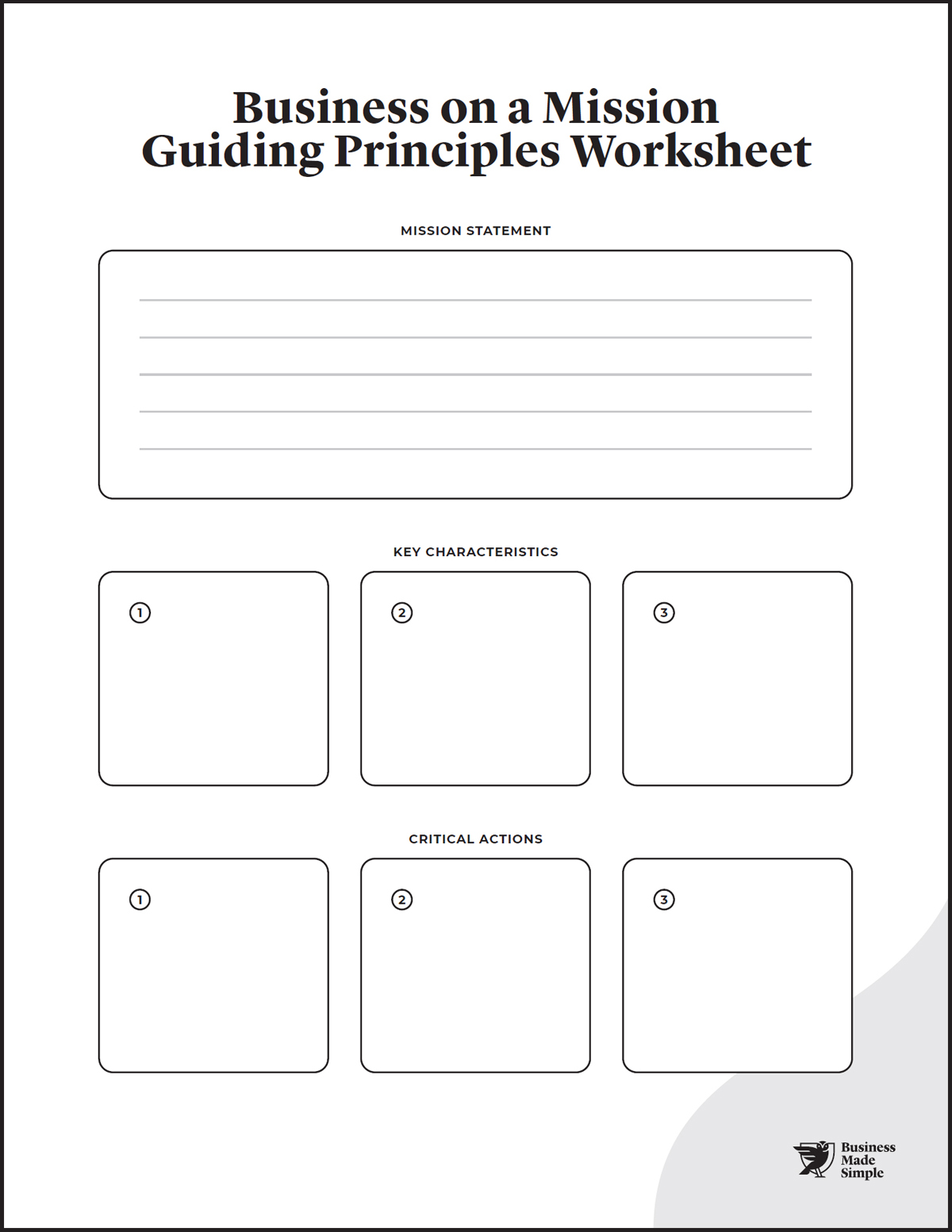
Access a digital, fillable version at SmallBusinessFlightPlan.com
Use the rest of this chapter to understand the three parts of the Business on a Mission Guiding Principles Worksheet. Once you’ve filled out this worksheet in your Small Business Flight Plan at the back of this book, your business will be aligned around three economic priorities, you will know what sort of people you should have with you on the plane, and you will establish three Critical Actions that further ensure your success.
Business on a Mission, Part One: Your Mission Statement
There are three reasons most Mission Statements fail:
- They do not include specific economic objectives.
- They do not include a deadline.
- They do not answer the question “why?”
When you include these three elements in your Mission Statement, you effectively invite yourself and your team into an important story.
Why invite yourself and your team into a story? Every human being wants to play an important role in an important story. When you use our formula for an effective Mission Statement, you give your team more than just a mission—you give them a part to play in a story that is bigger than themselves. This, in turn, is going to improve morale, productivity, recruitment, and retainment. Everybody wants to work for a business on a mission.
Let’s Face It, Most Mission Statements Are Forgettable and So They Are Forgotten
The sort of Mission Statements that get created by most businesses are anything but helpful.
Untold numbers of corporate Mission Statements read something like this: We exist to increase stakeholder value by serving customers with integrity and excellence whereas by which we blah blah blah, and so on.
A Mission Statement like this is missing one critical element: A mission.
Your company will live or die based on how clearly you articulate an engaging mission.
If you were assigning a mission to soldiers, wouldn’t you feel the need to be clear? Saying “at some point, we are going to serve the common good by ridding the social landscape of dangerous insurgents so everyone can be free” is not clear enough to inspire the specific actions necessary to achieve an objective. However, saying “our mission is to clear and secure the dictator’s compound from four sides and also from the air in order to save the hostages and take control of the area” is specific enough to inspire the right team to create the right plan and execute a series of actions to achieve the stated objective.
Equally, the director of a symphony will do no good to direct her orchestra to “play with excellence.” The performance will be nonsense unless she directs her players to play Holst’s The Planets, specifically, with excellence.
A Mission Statement that is specific inspires action; a Mission Statement that is vague causes confusion.
What if a confusing mission is holding your team back? Once each year you stand on a podium, lift your arms, and say something elusive like “do excellence,” after which each and every member of your team starts playing different songs with excellence.
To Inspire Your Team, Open a Story Loop
If we want our teams to unite around a mission, we have to open a story loop in their minds that can only be closed if we accomplish that mission. Another problem with vague Mission Statements is that they fail to open a story loop. When you tell a story, the listener pays close attention to find out if, in fact, the hero will disarm the bomb or the man will marry the woman. Until the story is resolved, they feel (and enjoy) a slight uneasiness that causes them to pay attention until their sense of peace is restored. This discomfort is a mild form of cognitive dissonance.
A story, then, works like a puzzle. The mind sees disarray and wants to put things together in the right order, and when it does, we experience a sense of relief.
The desire to close a story loop is called narrative traction. Narrative traction is the point at which we get interested in a story. Here’s why this matters for our businesses: When our Mission Statement creates narrative traction, team alignment and productivity increase because we and our team get to work to close the story loop.
When a general tells their troops that they are going to secure the dictator’s compound from all four sides as well as from the air, the imaginations in the ranks get to work, reverse engineering a plan that will allow them to secure the compound and close the story loop in their minds, relieving them of cognitive dissonance. When we are vague, though, a “plan” is never actualized because our team can’t imagine how the story we are suggesting might end. This is why statements such as “we exist to serve customers with care and excellence” fail to inspire action. A statement like that is the equivalent of giving soldiers the mission to “be good and fight for good.” Be good how? Fight who? To what end?
Be Specific
If you were to write a movie script that opens the story loop of a gentleman looking for something vague such as “excellence in all his doings,” the audience will have trouble knowing what that means and a story loop will fail to open. However, if the hero of your story wants to “break the world record for the 100-yard dash,” a story loop in the mind of the audience is opened and the story achieves narrative traction. Will our hero break the record? Let’s stay engaged until we find out.
What would change if you created a Mission Statement that opened a clear enough story loop that you and your team felt a collective narrative traction that drove action?
When you install Step One, Become a Business on a Mission, you are going to do exactly that.
What we need to create a Mission Statement that drives narrative traction are three economic objectives, a deadline, and a clear reason the mission is important.
The Business on a Mission formula includes the coordinates for a very specific destination, a deadline, and a reason “why.”
The Three Components of a Remarkably Effective Mission Statement
The first thing we will need to build a Mission Statement that actually works is to identify key sales metrics that will ensure your business succeeds.
Your mission statement should include three economic objectives. If everybody can understand exactly where the business is going, and that destination can be measured against a quantifiable metric, you’ve stated the mission clearly. When I say “measured against a quantifiable metric,” I mean the objectives are best understood if they are expressed numerically.
If people feel confused after they read your Mission Statement or, worse, if team members have all sorts of questions (they won’t actually ask for fear of looking stupid), your Mission Statement isn’t clear and won’t invite your team to move forward.
By stating numeric objectives such as “we will double our rate of customer retention” or “we will increase our revenue by 35 percent and increase our profit margin by 12 percent” or, better, “we will sell X number of Y products,” we define a metric by which we know whether we did or did not accomplish our mission. This kind of measurable specificity is necessary to open a story loop that people must take action to close.
I’ll explain more about what your three economic priorities should be soon; for now, let’s look at the second element necessary to create narrative traction.
Second, it should include a deadline. When you give somebody an important assignment, you must also give them a deadline. You’d never hire a contractor to build a house without agreeing on a budget and a timeline, right? The assignment is too important. Isn’t the mission of your business an important assignment? Of course it is.
Perhaps one of the reasons most Mission Statements don’t include a deadline is because leaders believe a Mission Statement should last forever. That’s one of the worst ideas when it comes to creating a Mission Statement. Can you imagine a sports team stating the mission to win the championship at some point in the next, say, one thousand years? That’s a worthless mission because the mission doesn’t have an actual deadline that creates a sense of urgency.
You can edit your Mission Statement every few years (and you should) because missions are meant to end. No mission that is open ended is going to inspire action.
A second reason people don’t include a deadline in their mission is because they don’t want to deal with the discomfort of having to achieve (or not achieve) their mission. The more elusive your Mission Statement is, the harder it will be to know if you’ve failed to achieve it.
Obviously, such a Mission Statement defeats the purpose. A good Mission Statement sets realistic goals and realistic deadlines rather than elusive goals and open-ended timelines you can hide behind.
The third thing your Mission Statement should include is a “reason” why the mission is important. Your mission needs a “why” or a “because” in order to invite you and your team’s full heart into the mission itself.
People are not motivated by money alone, nor by winning and success. In fact, sometimes numeric and financial goals (while easy to measure) make people uncomfortable. You must make sure the story of achieving your mission is larger than the economic factors that allow your team to measure their progress.
Human beings are complex creatures. We want to do important work. We want to know our lives are making a difference. While it might be true that we could all make more money doing selfish things, almost everybody reading this book wants to build a business that serves customers and makes personal sacrifices to do so.
So how do we include a “because” in our Mission Statement? We make sure to mention what happens in the overall story of our customer when they encounter our products and services.
For instance, if you own a real estate office and want to sell one hundred homes this year, your Mission Statement might end with the phrase: “. . . because every person deserves to walk into a home they love.”
This statement then serves as the reason your work is important. A real estate agent gets up every day because it brightens the lives of their clients when they find a home they love. Helping people find a home is important work. When the real estate agent includes the “why” in their Mission Statement, this inspires them and their office to do more great work and to do it well.
If you own a dental practice, you might say something like “because when people love their smile, they love themselves and their lives all the more.”
Including a “because” at the end of your Mission Statement will help everybody involved understand why the mission is important.
The Three Elements That Create a Storyline
One of the biggest problems all businesses face is the challenge of engagement. How do we get our talent to fully engage in the work? And how do we attract and retain top talent?
Again, the best way to engage yourself and your workforce is to create narrative traction around your mission. Narrative traction happens when your Mission Statement posits such an engaging question that you can’t wait to find out what happens. Will we surpass our competitor? Will we launch the new revenue stream? Will we double our sales of product X?
Your new Mission Statement defines that story and invites everybody to participate.
A Mission Statement Formula That Works
The best formula for a Mission Statement that includes all three elements necessary to create narrative traction goes like this:
We will accomplish X by Y because of Z.
When you use this formula to create your Mission Statement, you effectively enter economic coordinates for your business, you include a realistic deadline that increases a sense of urgency, and you define a reason the work is important. These three elements will also effectively invite you and your team into a story that will inspire action.
Now that we have a formula for creating a Mission Statement that works, let’s create one for you, step-by-step.
Mission Statement Part One: Define Three Financial Priorities
Once we break away from all the fluffy language we love to use in Mission Statements and generate specific coordinates that can be used to make decisions, everybody on board the plane will know where we are going and can reverse engineer their job to make sure it supports those objectives.
But what kind of objectives should we prioritize?
In order to build a business that is dependable, the objectives we prioritize must be economic. If the business does not create profitable revenue, the business will stall and crash. If the business crashes, the mission will not be accomplished, customers’ problems will not be solved, and the entire team will lose their jobs.
This catastrophe must be avoided.
Very few Mission Statements include economic objectives. I believe this is a mistake. The business exists to generate profit while creating value for customers. This should not be a hidden agenda.
Often, I meet team members within small businesses who believe that if you take care of customers, the money will take care of itself. Sadly, this is not true. Both the customers’ needs and your bottom line must be watched at all times. The laws of commerce, just like the laws of physics, don’t change. If a flight crew is extremely good to their customers but the plane runs out of gas, the story ends in tragedy all the same.
You don’t have to live for the dollar, but you do need dollars to stay alive. Establishing financial priorities in our Mission Statement sets clear goals for the safe flight of our airplane. Always remember you and your team are dependent on the success of this business. It must not crash.
Keep your business grounded in economic realities at all times. Not every team member wants to be in business to make money. Some team members would rather give products away and only be paid in gratitude. Unfortunately, that’s a great way to crash a plane. These employees see the world this way because the business they work for does not belong to them. It’s not their plane, it’s your plane; and if they crash your plane, they can go work on somebody else’s plane and crash that one too. Ironically, team members who are “not motivated by money” still expect a paycheck.
Let’s make sure the “we don’t care about money” mentality doesn’t take over our small business. The truth is that caring about customers and caring about the bottom line are not mutually exclusive. Again, keep your business grounded in economic realities at all times.
You and Your Team Should Talk Openly about the Economic Priorities
The main reason to include three economic priorities in your Mission Statement is to normalize conversations around finances. If you and your team normalize conversations about money, you and your entire team will make more money. I promise.
In conversations with your leadership, you should consistently ask and answer questions like these:
- How much money are we making?
- How profitable is the business we are bringing in?
- What was our financial goal this month or this quarter?
- Did we reach that goal? Why or why not?
- How can the company improve? Should we change the economic priorities in our Mission Statement?
- How are the economic objectives not listed in our Mission Statement doing?
Why Should You Only Include Three Economic Priorities?
Your small business may have several economic objectives. You may want to sell a specific number of units, maintain a certain profit margin, or increase sales by X. In fact, you should have dozens of economic objectives. The reason we limit our Mission Statement to include only three economic objectives, though, is because the human brain has trouble prioritizing more than three objectives at a time. The adage is true: if you prioritize everything, you prioritize nothing.
Regardless, for most businesses, there are typically as few as three economic factors that will likely determine their success. There may be more, and you will certainly tend to those, but as it relates to your Mission Statement, you should prioritize only three.
If you have a retail store and sell hundreds of products, you can batch your economic priorities into categories. For instance, a priority such as “we will sell thirty-five bags of dog food each day” speaks to an economic priority that will drive overall growth. You may sell twenty different brands of dog food, but because you’ve batched sales into a category, your team can engineer the accomplishment of that objective. If you’re behind on your goal, your team can create an end cap where you display the dog food or perhaps send out an email to customers who own dogs and inform them of their options.
What you’ll find is that by clearly stating the mission of increasing up to three financial priorities, you and your team open a financial story loop that must be tended to in order to close. In other words, including financial priorities in your Mission Statement focuses your mission on the economic realities that will keep your business safe and allow you to grow.
Along with sales objectives, it’s also okay to include lead measures that lead to sales. A lead measure is something like “X number of applications” or “X number of email addresses that will download our lead generator and enter into our sales funnel.” While these are not direct financial objectives, they do lead to sales, so they’re nearly as good as financial objectives. For instance, webinars, open houses, and keynote presentations all lead to sales if they are designed to lead to sales.
Where do we put the financial priorities in our Mission Statement? Right up front:
The first part of your Mission Statement will read: We will accomplish X. That “X” represents your three economic priorities.
For instance: We will sell one hundred units of X, three hundred units of Y, and fifty units of Z.
Or: We will help forty-two clients sell their houses, fifty-three clients buy new houses, and hold eighteen open houses.
It’s that simple. All you have to do is identify three financial objectives that will move the business forward and include them in your Mission Statement.
To get the most out of your Mission Statement, your three economic priorities should:
- Be specific and measurable,
- Drive company revenue, and
- Drive company profit.
Will it drive revenue and profit to increase subscriptions by 20 percent? If so, that’s a measurable statistic you can include in your Mission Statement.
Let’s say you run a restaurant and want to be known for your incredible desserts. Great. Instead of saying “We will be known for our desserts,” you will say “We will average forty-seven desserts per dinner segment each night.” An economic objective like this will cause you and your team to start initiating efforts to hit your goal. If you’re averaging only twenty desserts, your team can start asking each table if they’d like desert, or perhaps print up a separate dessert menu and bring it to each table just as they are wrapping up dinner. Again, if you include economic priorities in your Mission Statement, you and your team will start creating ways to hit those goals. If your Mission Statement is elusive, it will not spark the kind of creativity necessary to grow a business.
Why Should the Three Economic Priorities Be Measurable?
It’s important the three financial priorities in your Mission Statement be measurable because it must be obvious whether or not you have accomplished your mission. If you exist to make customers happy, that’s great, but that’s also wildly anecdotal. “Happy customers” is a difficult objective to measure. Instead of saying you want “happy customers,” say you want “250 return customers within the next twenty-four months.” Stating the economic priority in such a way that it can be measured allows you to engineer and execute a plan to accomplish that mission. If you fail, no problem: Identify why you missed the mark, adjust your plan, extend your deadline, and keep going.
Define three critical economic priorities for your business, and you’ll have more money for payroll, benefits, and your growing business profit account that you can later use to make outside investments and grow your personal wealth.
What are the three critical economic priorities you want to include in your Mission Statement?
EXAMPLES:
A brewery: We will increase our distribution of beer to seventy-five more restaurants, four more grocery store chains, and twenty-seven bars by . . .
A magazine: We will increase our subscriber base to 22,000, our advertisers by 40 percent, and raise the average customer advertising investment to $22K by . . .
A consulting firm: We will serve thirty new clients, sell five new retainer packages, and receive 98 percent client satisfaction survey results during the period of . . .
Brainstorm Your Three Economic Priorities
Write part one of your Mission Statement with the following simple phrase:
WE WILL ACCOMPLISH:
[Your Notes]
Once you complete your mission statement you can transfer your statement to the Small Business Flight Plan.
Feel Free to Change Your Mission Statement in Real Time
Most large companies would be unable to change their Mission Statement in real time, but you do not run a large company. There’s no reason you can’t change your mission statement every couple of years.
Your Mission Statement is not a legal document; it is designed to create narrative traction and inspire action so you and your team don’t lose the plot along the way. If your three economic priorities are not generating clarity and focus, change the statement. Simply gather your team and talk about what needs to change. In fact, we changed our three critical priorities several times before we dialed in the objectives that now drive our growth. Add to that our deadline is rarely further out than eighteen months, so our mission statement is edited and adjusted at least every eighteen months.
When should you change your Mission Statement? Simple. Change your Mission Statement under two circumstances: First, when you have accomplished all or part of your mission, and second, when you realize your Mission Statement isn’t inspiring action. Continue to edit your Mission Statement until it inspires a mission, then let it ride.
Now that the team knows the economic priorities that serve as your destination and can help you create a flight plan, let’s talk about increasing the urgency of your mission.
Mission Statement Part Two: Include a Deadline for Your Financial Priorities in Your Mission Statement
When storytellers and screenwriters want to make a story more interesting, they include a deadline. It’s one thing that our hero wants to marry the woman he loves, but it’s even better if the woman is getting married to his jerk of a brother in less than a week! When a story includes a deadline, it gets a lot more interesting.
In fact, one of the most popular television series of all time was based on a twenty-four-hour countdown clock slowly ticking down. Millions watched as Kiefer Sutherland attempted to stop the bad guys before the clock hit zero.
A ticking clock is an incredible device to increase you and your team’s intensity as it relates to hitting those three financial objectives.
After you determine your three financial objectives, include the date those objectives must be accomplished by as the next part of your Mission Statement.
When you include a deadline, your Mission Statement will read something like this:
We will accomplish [your notes], [your notes], and [your notes] by [your notes].
Each of your three economic objectives should share the same deadline. The idea is to choose a date in which you can accomplish everything in your Mission Statement and then dream your Mission Statement up again to continue to inspire growth.
It’s rare to see a deadline in a Mission Statement, which is yet another reason most Mission Statements are ineffective.
Deadlines help people understand that a project is urgent. The product must be on the shelves within twelve months. The debt must be paid off within three years. The new hire needs to be onboarded within ninety days.
All of this begs the question: What do we do when we reach the deadline? That’s a great question. The answer is you either learn from the failure to accomplish the mission or celebrate the accomplishment of the mission. Then you edit your Mission Statement to make it relevant again.
How Much Time Should We Give Ourselves to Accomplish Our Mission?
It’s not a bad idea to change the economic objectives along with the deadline every one or two years. If the deadline in your Mission Statement extends beyond two years, you’re going to lose that sense of urgency.
Human beings tend to view their future lives as though those lives belong to somebody else. Humans may think about the future, but they live in the now and tend to concern themselves with how they feel today and, perhaps tomorrow, but not much further out than that.
A deadline that extends one to two years will not extend so far into the future that it loses its sense of importance.
EXAMPLES:
A brewery: We will increase our distribution of beer to seventy-five more restaurants, four more grocery store chains, and twenty-seven bars by the end of the fiscal year.
A magazine: We will increase our subscriber base to 22,000, our advertisers by 40 percent, and the average customer advertising investment to $22K within two years.
A consulting firm: We will serve thirty new clients, sell five new retainer packages, and receive 98 percent client satisfaction survey results by December 31.
Take some time either alone or with your team and decide upon a deadline to accomplish your three economic objectives. When you have decided upon a deadline, add it to your mission statement.
After you define up to three financial objectives and set a deadline, you will want to finish your Mission Statement by reminding yourself and your team why hitting these objectives matters. Let’s answer the question “why?”
Mission Statement Part Three: Explain Why the Mission Matters
The Mission Statement “We will mow lawns for more than 300 families by the end of the year” is a good start, but to finish it off with a bang, add the why: “because everybody deserves to come home to a lawn they love.”
This simple “because” addition gives you and your team a great reason to drive your mission forward and reminds you why you are in businesses in the first place. In fact, the “because” part of our Mission Statement is the actual mission. Without the “because,” all you have is a goal and goals in and of themselves will not inspire your business into expansion and growth. A mission is much more important than a goal. A mission happens when we accept the challenge to improve the lives of our customers.
Here are two things your Mission Statement can include to turn your goals into a mission:
- A vision of a better world: Tell us, specifically, how the world will be better if you accomplish the mission. What will people see? What will they feel?
- A counterattack against an injustice: Tell us about the suffering people will no longer have to experience if you accomplish your mission. What broken thing will be restored?
When you include a because, your mission matters, and you and your team will be energized around that cause.
EXAMPLES:
A brewery: We will increase our distribution of beer to seventy-five more restaurants, four more grocery store chains, and twenty-seven bars by the end of the fiscal year because everybody deserves access to their new favorite beer.
A magazine: We will increase our subscriber base to 22,000, our advertisers by 40 percent, and the average customer advertising investment to $22K within two years because good journalism can save the country.
A consulting firm: We will serve thirty new clients, sell five new retainer packages, and receive 98 percent client satisfaction survey results by December 31 because everybody deserves the help they need to grow a business.
What’s your because? What’s the “why” of your mission? Close your Mission Statement with a good reason to take action and you and your team will do just that.
Put All Three Parts Together for the Perfect Mission Statement
Again, the Mission Statement should define up to three financial priorities, set a deadline, and describe the reason the mission matters. If you do this in your Mission Statement, your entire team will know what vision they are supposed to be advancing and why their work matters.
It may take some time for you to perfect your Mission Statement. Feel free to write it and edit it. Simply ask for grace from your team as, together, you change the priorities, the deadline, and the reason why until the Mission Statement creates narrative traction.
The point of the Mission Statement was never to check a box and have some meaningless words on a page. The point of the Mission Statement is to invite you and your team into a story that everybody finds engaging.
All storytellers workshop their plot lines to make them more interesting. Feel free to do the same with your Mission Statement.
When you finally have your Mission Statement nailed down, it’s time to embed that mission into your own mind and the minds of everybody who will be working to accomplish the mission.
Once You Write Your Mission Statement, What Do You Do with It?
Another mistake leaders make with their Mission Statement is they write it, read it a couple times, and then file it away. At best, the Mission Statement is buried in small text on their website or perhaps in an HR brochure they hand to new employees.
If you and your team members can’t remember the Mission Statement, you and your team members can’t remember the mission.
Once you write your Mission Statement, you’ll want to launch a communication campaign that helps you and your team take action on that statement. And we all know what it takes to remember something: repetition.
Here are four ways to help your team remember the mission:
- Open your All-Staff Meetings by reading through the Mission Statement.
- On a monthly or quarterly basis, acknowledge a team member for advancing the mission and tell their story as a way of highlighting the team member and the mission.
- Ask potential hires to read the Mission Statement and write down why that mission is important to them.
- Have the Mission Statement written on the wall of your place of business and make a production (and celebration) out of changing it as the mission shifts.
Again, the idea is to see your Mission Statement as the plot line of a story and to remind your team of that story every chance you get.
Once you write your Mission Statement, you are one-third of the way toward creating the Guiding Principles that will serve as the foundation of your company.
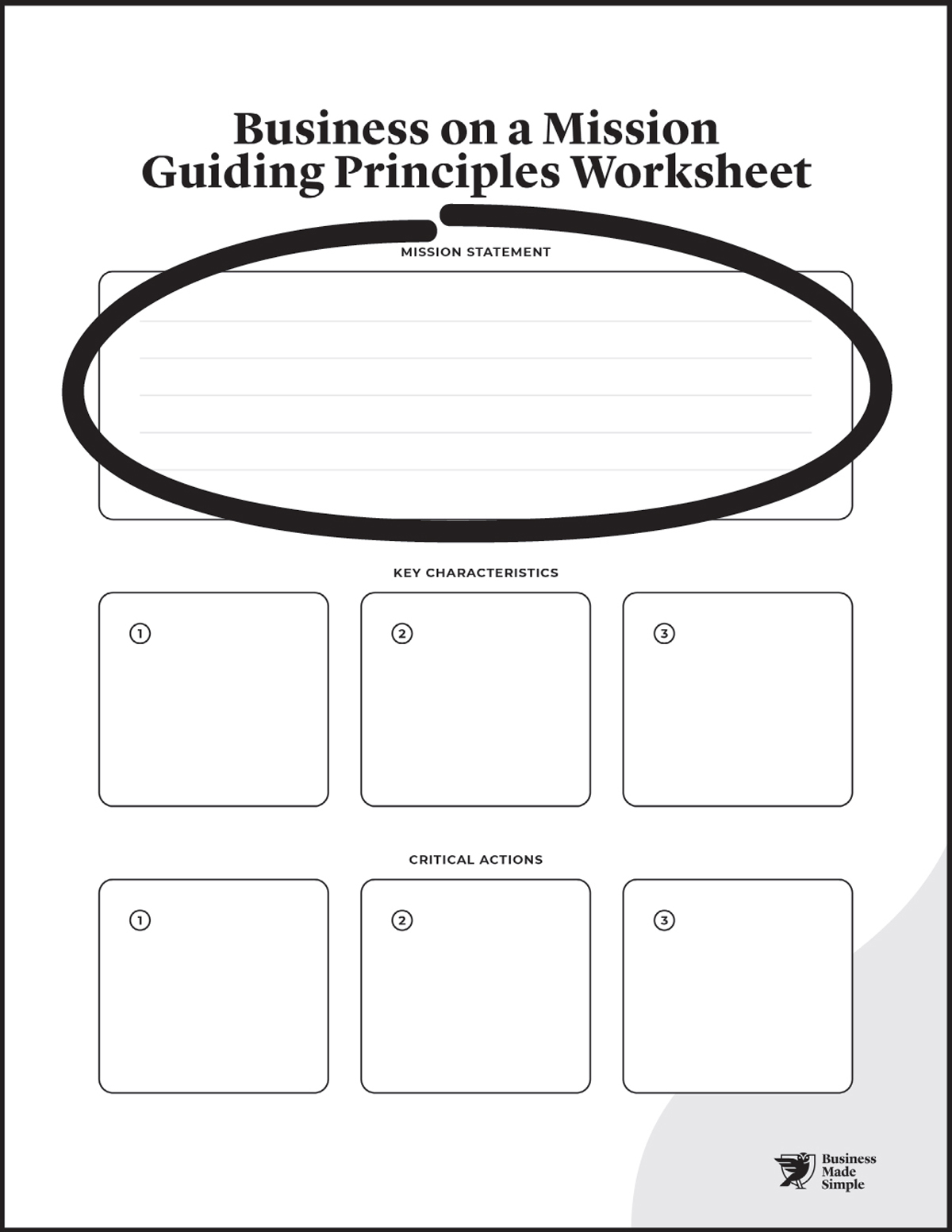
Access a digital, fillable version at SmallBusinessFlightPlan.com
Next, let’s define the sort of people you are going to need to recruit (and become) in order to accomplish your mission. Let’s define your Key Characteristics.
Once you complete your mission statement, transfer it to the Guiding Principles Worksheet in your Small Business Flight Plan.