StoryBrand Principle Five: Customers do not take action unless they are challenged to take action.

At this point in our customers’ story, they are excited. We’ve defined a desire, identified their challenges, empathized with their feelings, established our competency in helping them, and given them a plan. But they need us to do one more thing: they need us to call them to action.
ASK THEM TO PLACE AN ORDER
In stories, characters never take action on their own. They have to be challenged to take action. Tom Cruise’s character would never have journeyed to pick up his brother in the movie Rain Man unless he’d received a call explaining his father had died. Romeo wouldn’t have climbed into the Capulet courtyard unless he’d fallen sick with love for Juliet. Elle Woods wouldn’t have applied to Harvard unless she’d been dumped by her boyfriend. Liam Neeson’s character wouldn’t have chased the bad guys to Europe unless his daughter had been kidnapped.
The reason characters have to be challenged to take action is because everybody sitting in the dark theater knows human beings do not make major life decisions unless something challenges them to do so.
If I wrote a story about a guy who wanted to climb Everest and then one day looked at himself in the mirror and decided to do it, I’d lose the audience. That’s not how people work. Bodies at rest tend to stay at rest, and so do customers. Heroes need to be challenged by outside forces.
Have you ever wondered why late-night infomercial hosts keep screaming, “Call now! Don’t delay!” over and over as though they’re trying to wake people up from a zombie trance? They do that because they’re trying to wake people up from a zombie trance!
Your customers are bombarded with more than three thousand commercial messages per day, and unless we are bold in our calls to action, we will be ignored. If our calls to action are soft, they will not be noticed.
The Power of the “Buy Now” Button
I have a friend who has bought and sold nearly one hundred companies. He knows a lot about scaling a company up, and as he evaluates a company, he makes sure the people, products, and procedures are all healthy. But the key ingredient he looks for in a company is whether the company is challenging their customers to place orders. My friend knows the fastest way to grow a company is to make the calls to action clear and then repeat them over and over. He’s made millions simply buying companies, creating stronger calls to action, and then selling the company after their revenue increases.
One of the biggest hindrances to business success is that we think customers can read our minds. It’s obvious to us that we want them to place an order (why else would we be talking to them about our products?), so we assume it’s obvious to them too. It isn’t.
There should be a “Buy Now” button in the top right corner of your website, and it shouldn’t be cluttered with a bunch of other buttons. The same call to action should be repeated above the fold and in the center of your website, and again and again as people scroll down the page.
Companies that don’t make their calls to action clear remind me of my dating days before I met my wife. Instead of clearly asking a girl out, I’d say something like, “Coffee is nice, isn’t it? Do you like coffee?”
What in the world is a woman supposed to do with a question like that? That’s just not how you make a baby.
As I got older I realized the power of clarity. In fact, the way my wife and I got together was probably the clearest I’ve communicated about anything. I’d known Betsy from a distance for a while, but when I finally got up the courage to ask her out, I discovered she had a boyfriend. Still, I’d been passive long enough. I’d been hoping she’d notice how much I liked her even as I completely ignored her. It was time for a strong call to action. The next time I saw her, I told her how I really felt and that I’d like to call her in thirty days to ask her out. I said she’d need to ditch the other guy to keep things from being awkward.
Amazingly, thirty days later, she’d broken up with the other guy and we started dating. About a year later we got married. We’re currently working on a baby that we’re probably going to name “Buy Now” to remind everybody how important it is to have a clear call to action.
The moral of the story is people don’t have ESP. They can’t read our minds and they don’t know what we want, even if it seems obvious. We have to clearly invite customers to take a journey with us or they won’t.
When I was a kid there was a guy on late-night television who used to saw mattresses in half with a chainsaw. He’d scream at the camera that he’d gone crazy and was slashing prices on all kinds of furniture. I think a lot of us are afraid to ask for the sale because we don’t want to look like that guy.
It’s true we don’t want to constantly beat our customers over the head with direct calls to action. Of the thousands of clients we’ve worked with, though, we’ve yet to encounter anybody who oversells. Most people think they’re overselling when, in truth, their calls to action fall softer than a whisper.
Do You Believe in Your Product?
The reality is when we try to sell passively, we communicate a lack of belief in our product. When we don’t ask clearly for the sale, the customer senses weakness. They sense we’re asking for charity rather than to change their lives. Customers aren’t looking for brands that are filled with doubt and want affirmation; they’re looking for brands that have solutions to their problems.
If we can change our customer’s story for the better, why shouldn’t we be bold about inviting them to do business with us? The guide in a movie must be direct with the hero about what they want the hero to do, otherwise the plot gets muddled and the audience starts to daydream.
Two Kinds of Calls to Action
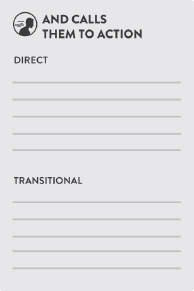
At StoryBrand we recommend two kinds of calls to action: direct calls to action and transitional calls to action. They work like two phases of a relationship.
Let’s say we ask a customer to buy but they don’t. Who knows why, but they don’t. There’s no reason to end the relationship just because they aren’t ready. I believe in honoring people who aren’t ready, and I’m a fan of no-pressure sales. Still, I want to deepen the relationship so that whenever they need what I sell, they will remember me. The way I deepen that relationship is through transitional calls to action.
Direct calls to action include requests like “buy now,” “schedule an appointment,” or “call today.” A direct call to action is something that leads to a sale, or at least is the first step down a path that leads to a sale.
Transitional calls to action, however, contain less risk and usually offer a customer something for free. Transitional calls to action can be used to “on-ramp” potential customers to an eventual purchase. Inviting people to watch a webinar or download a PDF are good examples of transitional calls to action.
To further the relational metaphor, a transitional call to action is like saying, “Can I take you out on a date?” to your customer, and a direct call to action is like saying, “Will you marry me?”
In our marketing collateral, we always want to have a direct call to action and a transitional call to action. The metaphorical conversation with our customers goes like this:
Us: Will you marry me?
Customer: No.
Us: Will you go out with me again?
Customer: Yes.
Us: Will you marry me now?
Customer: No.
Us: Will you go out with me again?
Customer: Sure, you’re interesting and the information you provide is helpful.
Us: Will you marry me?
Customer: Okay, I’ll marry you now.
As a brand, it’s our job to pursue our customers. We want to get to know them and for them to get to know us, but we are the ones who need to take the initiative.
THOSE WHO ASK AGAIN AND AGAIN SHALL FINALLY RECEIVE
Years ago, I was preparing a keynote presentation for a global shampoo brand and my graphic designer was too busy with other projects to help. Not wanting to wait, I decided to outsource the presentation to a design house. I went looking online for a shop that dealt specifically with presentations and found two local houses that could help.
The first website I visited was beautifully designed—a looping video loaded beneath text that explained the design house’s values and priorities. After about twenty seconds admiring the look of their site, though, I started searching for information about how to do business with them. I couldn’t find anything. They featured samples of previous projects, a few testimonials, and a phone number I could call but no direct, clear call to action. So I decided to check out their competitor’s site.
The other company’s site wasn’t nearly as beautiful, but it dared to be clear. “If you’re worried about a presentation, we can help you hit a grand slam.” The truth is I was worried, and they spoke to my internal fear. They also painted a picture of a climactic scene: to hit a grand slam. Then they asked me out: they offered a PDF called “5 Things Great Presenters Get Right,” and I was quite curious. I downloaded the PDF and read it in a few minutes. Their transitional call to action earned my trust and positioned them as the guide in my story. They had authority, it seemed. Then, on their website, they had a “schedule an appointment” button, and because they’d wined and dined me, I did. I never went back to the initial designer’s website (which, remember, was much better looking), and before long I was gladly writing a check for several thousand dollars to the company that had clearly challenged me to take action.
Direct Calls to Action
It bears repeating: there should be one obvious button to press on your website, and it should be the direct call to action. When I say, “one obvious button,” I don’t mean “only one button,” but rather one that stands out. Make the button a different color, larger, a bolder text, whatever you need to do. Then repeat that same button over and over so people see it as they scroll down the page.
Our customers should always know we want to marry them. Even if they’re not ready, we should keep saying it. You just never know when they’re going to want to make a commitment, and when they do, you want to be on one knee, holding flowers, smiling for the picture.
Examples of direct calls to action are
• Order now
• Call today
• Schedule an appointment
• Register today
• Buy now
Direct calls to action can be included at the end of every e-mail blast, on signage, in our radio ads, and even in our television commercials. Consider including direct calls to action in every team member’s e-mail signature, and if you really want to get the point across, on all your business cards. The idea is to make it very clear what we’d like customers to do: to make a purchase so we can help them solve their problem.
Transitional Calls to Action
Direct calls to action are simple and obvious (though ridiculously underused), but transitional calls to action can be equally as powerful to grow your business. In fact, StoryBrand grew into a multimillion-dollar company in only its second year based solely on the use of a transitional call to action. Recognizing that most of our clients were using the StoryBrand Framework to fix their websites, we released a free PDF called “5 Things Your Website Should Include,” and thousands of people downloaded it. At the back of the PDF we placed an ad for our StoryBrand Marketing Workshop. In the next twelve months, we doubled revenue without spending a dollar on marketing.
A good transitional call to action can do three powerful things for your brand:
1. Stake a claim to your territory. If you want to be known as the leader in a certain territory, stake a claim to that territory before the competition beats you to it. Creating a PDF, a video series, or anything else that positions you as the expert is a great way to establish authority.
2. Create reciprocity. I’ve never worried about giving away too much free information. In fact, the more generous a brand is, the more reciprocity they create. All relationships are give-and-take, and the more you give to your customers, the more likely they will be to give something back in the future. Give freely.
3. Position yourself as the guide. When you help your customers solve a problem, even for free, you position yourself as the guide. The next time they encounter a problem in that area of their lives, they will look to you for help.
Transitional calls to action come in all shapes and sizes. Here are a few ideas to create transitional calls to action of your own:
• Free information: Create a white paper or free PDF educating customers about your field of expertise. This will position you as a guide in your customer’s story and create reciprocity. Educational videos, podcasts, webinars, and even live events are great transitional calls to action that on-ramp customers toward a purchase.
• Testimonials: Creating a video or PDF including testimonials from happy clients creates a story map in the minds of potential customers. When they see others experience a successful ending to their story, they will want that same ending for themselves.
• Samples: If you can give away free samples of your product, do it. Offering a customer the ability to test-drive a car, taste your seasoning, sample your music, or read a few pages of your book are great ways to introduce potential customers to your products.
• Free trial: Offering a limited-time free trial works as a risk-removal policy that helps to on-ramp your customers. Once they try your product, they may not be able to live without it.
Connecting the Dots
Earlier this year StoryBrand worked with a health clinic that specialized in health screening, drug testing, treating minor sicknesses, and giving shots. The primary traffic the clinic received was through businesses who needed their employees to complete drug tests. Still, the clinic was stagnant in growth. Customers were coming in to get one product but weren’t aware of anything else the clinic offered.
Upon visiting the clinic, one of our StoryBrand Guides noticed they needed to create clear direct and transitional calls to action.
Patients would come into the shop, sign and date an entry form, then sit in the lobby reading magazines or watching television while they waited for a nurse. As one of our StoryBrand Certified Guides consulted with the clinic, she told the owner to remove the television and magazines. Instead of magazines, she encouraged them to create a transitional call to action called “The Healthy Body Checklist,” allowing patients to self-assess their health. The checklist included questions like, “Do you feel tired at about two in the afternoon every day?” and “Are you satisfied with your current weight?” After patients finished their drug or blood tests, we suggested that nurses review the checklist with each patient and let them know about solutions that were also available at the clinic. The receptionist could then enter the customer’s data into their e-mail marketing system and, based on how a patient was tagged, an automated campaign would go into effect. If the customer seemed like they needed more vitamin B, they’d get a series of e-mails explaining the benefits of a monthly vitamin B shot, along with clear calls to action directing the patient to make another appointment.
Is there a transitional call to action you can create that will grow your business? Are your direct calls to action clear and repeated often? If not, your customers likely don’t know what you want them to do. Remember, people are drawn to clarity and away from confusion. Having clear calls to action means customers aren’t confused about the actions they need to take to do business with you.
WHAT ARE THE STAKES?
Once customers decide to buy our products, how can we increase the perceived value of those products and deepen the positive experience they have with our brand? How can we make the story we’ve invited them into so enticing that they can’t wait to turn the page?
To do this, we must define the stakes. What’s at stake in the customer’s story if they do or do not choose to do business with us? If we’ve not defined the stakes, we’ve not made the story interesting.
In the next two modules, I’ll teach you how to deepen your customers’ experience with your brand by defining exactly what’s at stake.
Before we move forward, though, continue clarifying your business by brainstorming potential calls to action you can include in your StoryBrand BrandScript.
CLARIFY YOUR MESSAGE SO YOUR CUSTOMERS LISTEN
• Go to mystorybrand.com and either create a StoryBrand BrandScript or log in to your existing BrandScript.
• Decide what direct call to action you want to make obvious on all your marketing material.
• Brainstorm any transitional calls to action you can create that will stake a claim to your territory, create reciprocity with your customers, and position your brand as a guide.
• Fill out the “Call to Action” section of your StoryBrand BrandScript.