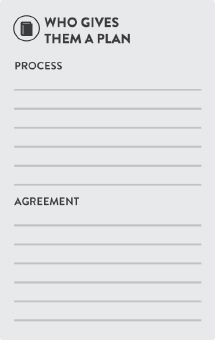
StoryBrand Principle Four: Customers trust a guide who has a plan.

At this point in our customer’s journey, we’ve identified something they want, which got the story started. Then we defined their problems, which created intrigue as to whether we can help them overcome their challenges. Then we introduced ourselves as the guide by expressing empathy and demonstrating authority, which established trust. And yet, even with all this, the customer isn’t going to place an order. There’s something missing.
If we’ve positioned ourselves as the guide, our customers are already in a relationship with us. But making a purchase isn’t a characteristic of a casual relationship; it’s a characteristic of a commitment. When a customer places an order, they’re essentially saying, “I believe you can help me solve my problem, and I believe it so much I’m willing to put skin in the game. I’m willing to part with my hard-earned dollars.”
Commitments are risky for our customers because as soon as they make a commitment, they can lose something. Most customers are not going to take this risk yet.
When a customer is deciding whether to buy something, we should picture them standing on the edge of a rushing creek. It’s true they want what’s on the other side, but as they stand there, they hear a waterfall downstream. What happens if they fall into the creek? What would life look like if they went over those falls? These are the kinds of questions our customers subconsciously ponder as they hover their little arrow over the “Buy Now” button. What if it doesn’t work? What if I’m a fool for buying this?
In order to ease our customers’ concerns, we need to place large stones in that creek. When we identify the stones our customers can step on to get across the creek, we remove much of the risk and increase their comfort level about doing business with us. It’s as though we’re saying, “First, step here. See, it’s easy. Then step here, then here, and then you’ll be on the other side, and your problem will be resolved.”
In the StoryBrand Framework, we refer to these “stones” as a plan.
In the movie Moneyball, Peter Brand (the guide) gives Billy Beane a plan he can employ to turn his baseball team around. In a series of steps, Billy will begin using an algorithm to choose players, rather than relying on anecdotal evidence from his antiquated coaching staff. He’s going to begin to trust the numbers and run the team the way a hedge-fund manager might run his hedge fund.
In nearly every movie you can think of, the guide gives the hero a plan. The plan is the bridge the hero must cross in order to arrive at the climactic scene. Rocky has to train using nontraditional methods, Tommy Boy has to embark on a national sales trip, and Juliet must drink the potion the apothecary gives her in order to trick her family into thinking she’s died and to be free to be with Romeo.
The plan tightens the focus of the movie and gives the hero a “path of hope” she can walk that might lead to the resolution of her troubles.
THE PLAN CREATES CLARITY
Plans can take many shapes and forms, but all effective plans do one of two things: they either clarify how somebody can do business with us, or they remove the sense of risk somebody might have if they’re considering investing in our products or services.
Remember the mantra “If you confuse, you lose”? Not having a plan is a guaranteed way to confuse your customers.
After potential customers listen to us give a keynote or visit our webpage or read an e-mail blast we’ve sent, they’re all wondering the same thing: What do you want me to do now? If we don’t guide them, they experience a little bit of confusion, and because they can hear that waterfall downstream, they use that confusion as an excuse not to do business with us.
The fact that we want them to place an order is not enough information to motivate them. If we’re selling a storage system a customer can install in their garage, they hover over that “Buy Now” button subconsciously wondering whether it will work for them, how hard it will be to install, and whether it will sit unopened in the garage in boxes like the last thing they bought. But when we spell out how easy this whole thing is and let them know they can get started in three easy steps, they are more likely to place an order.
We must tell them to . . .
1. Measure your space.
2. Order the items that fit.
3. Install it in minutes using basic tools.
Even though these steps may seem obvious, they aren’t obvious to our customers. Placing stones in the creek greatly increases the chance they will cross the creek.
THE PROCESS PLAN
At StoryBrand we’ve identified two plans you can use to effectively encourage customers to do business with you. The first kind of plan, and the one we recommend every one of our clients employ, is a process plan.
A process plan can describe the steps a customer needs to take to buy our product, or the steps the customer needs to take to use our product after they buy it, or a mixture of both.
For instance, if you’re selling an expensive product, you might break down the steps like this:
1. Schedule an appointment.
2. Allow us to create a customized plan.
3. Let’s execute the plan together.
Whether we’re selling a financial product, a medical procedure, a university education, or any other complicated solution, a process plan takes the confusion out of our customer’s journey and guides them in the next steps.
So far I’ve mostly talked about stones we can place in the creek that lead our customers to make a purchase, but another kind of process plan would be the post-purchase process plan. A post-purchase process plan is best used when our customers might have problems imagining how they would use our product after they buy it. For instance, with a complicated piece of software, we might want to spell out the steps or even the phases a customer would take after they make the purchase:
1. Download the software.
2. Integrate your database into our system.
3. Revolutionize your customer interaction.
The post-purchase process plan does the same thing a prepurchase process plan does, in the sense that it alleviates confusion. When a customer is looking at the wide span between themselves and the integration of a complicated product, they’re less likely to make a purchase. But when they read your plan, they think to themselves, Oh, I can do that. That’s not hard, and they click “Buy Now.”
A process plan can also combine the pre- and post-purchase steps. For instance:
1. Test-drive a car.
2. Purchase the car.
3. Enjoy free maintenance for life.
Again, the key to the success of any plan is to alleviate confusion for our customers. What steps do they need to take to do business with you? Spell out those steps, and it’ll be as though you’ve paved a sidewalk through a field. More people will cross the field.
We get frequent questions about how many steps a process plan should have. The answer varies, of course, but we recommend at least three and no more than six. If doing business with you requires more than six steps, break down those steps into phases and describe the phases. In reality, you might guide your customer through twenty or thirty steps, but studies show when you bombard customers with information, buying decreases.
Remember, the whole point of creating a plan is to alleviate customers’ confusion. Having more than four steps may actually add to, rather than reduce, confusion. The key is to simplify their journey so they are more likely to do business with you.
THE AGREEMENT PLAN
If process plans are about alleviating confusion, agreement plans are about alleviating fears.
An agreement plan is best understood as a list of agreements you make with your customers to help them overcome their fear of doing business with you.
Earlier I talked about CarMax and how they resolve the customer’s agitation of having to deal with a used-car salesman. One of the tools they use to communicate that customers don’t have to encounter this internal fear is an agreement plan. CarMax’s four-point agreement includes the promise that customers will never have to haggle. Afraid you’ll be stuck with a lemon? CarMax refuses to sell a car that doesn’t meet their standards, and they put every car through a renewal process to be sure it earns their quality certification seal.1
Today, CarMax sells more cars than its next three competitors combined. In 2015, Automotive News named CarMax the undisputed used-car champion.2 As I mentioned in chapter 5, CarMax rarely advertises the solution to their customers’ external problems, that is, the need for a used car. Instead, they focus on their customers’ internal problem, the fear of interacting with a used-car dealer, and they alleviate this fear with an agreement plan.
An agreement plan can also work to increase the perceived value of a service you promise to provide. For instance, Newt Gingrich’s “Contract with America” is an example of an agreement plan. Newt was a relatively unknown congressman from Georgia who led a takeover in both houses of Congress by making an agreement with voters. Newt simply took age-old conservative talking points, turned them into a list, and said, “If you vote for us, we’ll do all these things.” More than three hundred conservative legislators signed on, and Newt became an overnight presidential hopeful.
Another benefit of an agreement plan is that it can work to clarify shared values between our customers and us. Whole Foods’s list of values has attracted millions to their stores and, in ways, works as an agreement with their customers to source their food in a way that is socially and environmentally responsible.
Unlike a process plan, an agreement plan often works in the background. Agreement plans do not have to be featured on the home page of your website (though they could be), but as customers get to know you, they’ll sense a deeper level to your service and may realize why when they finally encounter your agreement plan.
The best way to arrive at an agreement plan is to list all the things your customer might be concerned about as it relates to your product or service and then counter that list with agreements that will alleviate their fears.
If it’s short enough (we’re fans of brevity, obviously), you can feature your agreement plan on the wall of your business or even on your packaging or shopping bags.
WHAT’S THE PLAN CALLED?
Once you create your process or agreement plan (or both), consider giving them a title that will increase the perceived value of your product or service. For instance, your process plan might be called the “easy installation plan” or the “world’s best night’s sleep plan.” Your agreement plan might be titled the “customer satisfaction agreement” or even “our quality guarantee.” Titling your plan will frame it in the customer’s mind and increases the perceived value of all that your brand offers.
Now that you’ve given your customer a plan, they will be much more likely to do business with you. You’ve lifted the fog, made things clear, set stones in the creek, and they are ready to continue the journey.
And yet before they’ll make a commitment, they will need one more thing from you. They will need you to call them to action. I’ll teach you the right and wrong ways to call customers to do business in the next chapter.
First, though, spend some time defining the plan or plans you want to implement to ease your customers’ fears and concerns so they will engage your brand.
CLARIFY YOUR MESSAGE SO CUSTOMERS LISTEN
• Go to mystorybrand.com and either create a StoryBrand BrandScript or log in to your existing BrandScript.
• Either alone or with a team, brainstorm the simple steps a customer would need to take to do business with you (either a pre- or post-purchase process plan or a combination of both).
• What fears do your customers have related to your industry? What agreements could you make with them that would alleviate those fears? Feel free to use the notes feature of your BrandScript, where there is more room, to document your agreement plan. Use the plan section, then, to document the title of your plan.
• Do you share unique values with your customers? Can those values be spelled out in an agreement plan?
• Write the steps (and name) of your process plan on your StoryBrand BrandScript. If you’re creating an agreement plan, simply use the notes section of your BrandScript to capture the agreement you’ll be making with your customers.