StoryBrand Principle Three: Customers aren’t looking for another hero; they’re looking for a guide.

Shakespeare was right—a person’s life is made up of many acts. As a book writer, though, I prefer to see these acts as chapters. If you look back on your life, you’ll likely see them too. There is the chapter when you grew up poor and the chapter when you began to understand the importance of relationships. There is the chapter when you realized you were good at math or sports, and there was the chapter when you left home to start out on your own.
No two lives are the same, and yet we share common chapters. Every human being is on a transformational journey.
It’s easy to recognize these chapters by their events, or what writer and story scholar James Scott Bell calls “doorways of no return.”1 This might have been our parents’ divorce, our first crush, a rejection from somebody we loved, or having absolutely nailed the moonwalk when the crowd gathered around us at the junior high dance.
In stories, events mark the beginnings and endings of our chapters. But if we look closer, we will see something else or, more accurately, somebody else.
The events that define our chapters are often instigated or interpreted by mystical characters that help us along the way. In a story there are many names for these characters, but I choose to call them guides.
In his book The Seven Basic Plots, Christopher Booker describes the introduction of the guide into the story this way:
A hero or heroine falls under a dark spell which eventually traps them in some wintry state, akin to a living death: physical or spiritual imprisonment, sleep, sickness or some other form of enchantment. For a long time they languish in this frozen condition. Then a miraculous act of redemption takes place, focused on a particular figure who helps to liberate the hero or heroine from imprisonment. From the depths of darkness they are brought up into glorious light.2
EVERY HERO IS LOOKING FOR A GUIDE
When I talk about a guide, I’m talking about our mother and father when they sat us down to talk about integrity, or a football coach who helped us understand the importance of working hard and believing we could accomplish more than we ever thought possible. Guides might include the authors of poems we’ve read, leaders who moved the world into new territory, therapists who helped us make sense of our problems, and yes, even brands that offered us encouragement and tools to help us overcome a challenge.
If a hero solves her own problem in a story, the audience will tune out. Why? Because we intuitively know if she could solve her own problem, she wouldn’t have gotten into trouble in the first place. Storytellers use the guide character to encourage the hero and equip them to win the day.
You’ve seen the guide in nearly every story you’ve read, listened to, or watched: Frodo has Gandalf, Katniss has Haymitch, and Luke Skywalker has Yoda. Hamlet was “guided” by his father’s ghost, and Romeo was taught the ways of love by Juliet.
Just like in stories, human beings wake up every morning self-identifying as a hero. They are troubled by internal, external, and philosophical conflicts, and they know they can’t solve these problems on their own.
The fatal mistake some brands make, especially young brands who believe they need to prove themselves, is they position themselves as the hero in the story instead of the guide. As I’ve already mentioned, a brand that positions itself as the hero is destined to lose.
The Fatal Mistake
The fatal ramifications of positioning our brand as the hero could be huge. Consider the failure of the music streaming service Tidal. Never heard of it? There’s a good reason. Rapper Jay Z founded the company with a personal investment of a whopping $56 million with a mission to “get everyone to respect music again.”3 Instead of being owned by music studios or tech companies, Tidal would be owned by musicians, allowing them to cut out the middleman and take their products directly to the market. As a result, the artists would pocket more of the profits.
Sounds like a great plan. But Jay Z failed to consider the mistake of positioning himself and other artists as the heroes. Were artists going to buy music from each other? No. He needed to position the customer, not the artist, as the hero.
In the months leading up to the launch of Tidal, Jay Z recruited sixteen well-known musicians who agreed to release exclusive content on his platform in exchange for a percentage of equity. In their multimillion-dollar rollout, the artists stood shoulder to shoulder at a press conference to explain their mission. Predictably, this is where everything fell apart.
If only Jay Z, in other ways a virtual genius, had understood the age-old rules of story, he might have avoided walking into a field of land mines.
“Water is free,” Jay Z quipped. “Music is $6 but no one wants to pay for music.” He continued, somewhat confusingly, “You should drink free water from the tap—it’s a beautiful thing. And if you want to hear the most beautiful song, then support the artist.”4
Social media, especially Twitter, eviscerated Jay Z and Tidal. Thousands reminded him to check with the people who paid his bills to discover water wasn’t actually free. Overnight, an artist who built his career speaking for the people sounded entitled. The public became nauseated listening to a row of famous, multimillionaire musicians guilt-trip them into paying more for their music. The crucial mistake: Jay Z failed to answer the one question lingering in the subconscious of every hero customer: How are you helping me win the day? Tidal existed to help the artists win the day, not customers. And so it failed.
Always position your customer as the hero and your brand as the guide. Always. If you don’t, you will die.
The Story Is Not About Us
The larger point here is simple: the day we stop losing sleep over the success of our business and start losing sleep over the success of our customers is the day our business will start growing again.
If we are tempted to position our brand as the hero because heroes are strong and capable and the center of attention, we should take a step back. In stories, the hero is never the strongest character. Heroes are often ill-equipped and filled with self-doubt. They don’t know if they have what it takes. They are often reluctant, being thrown into the story rather than willingly engaging the plot. The guide, however, has already “been there and done that” and has conquered the hero’s challenge in their own backstory.
The guide, not the hero, is the one with the most authority. Still, the story is rarely about the guide. The guide simply plays a role. The story must always be focused on the hero, and if a storyteller (or business leader) forgets this, the audience will get confused about who the story is really about and they will lose interest. This is true in business, in politics, and even in your own family. People are looking for a guide to help them, not another hero.
Those who realize the epic story of life is not about them but actually about the people around them somehow win in the end. It’s counterintuitive, but it’s true. In fact, leaders who think the story of life is all about them may achieve temporary successes but are usually remembered in history’s narrative as a villain.
THE TWO CHARACTERISTICS OF A GUIDE
We have seen hundreds if not thousands of businesses experience an increase in customer engagement once they started positioning themselves as the guide. After filtering their message through the StoryBrand Framework, business leaders realize their websites, e-mail blasts, digital ads, television commercials, and even their elevator pitches have been facing the wrong direction. Simply turning our focus to the customer and offering them a heroic role in a meaningful story is enough to radically change the way we talk about, and even do, business.
So what do we have to do to be recognized as the guide in our customers’ lives?
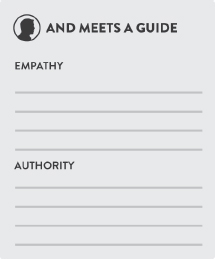
The two things a brand must communicate to position themselves as the guide are
Empathy
Authority
When Luke Skywalker meets Yoda, he encounters the perfect guide. Yoda is the endearing character who understands Luke’s dilemma and empathetically coaches him to use the Force. This empathy would go nowhere, of course, were it not for Yoda’s authority as a Jedi himself. Yoda understands Luke’s dilemma and has mastered the skills Luke must develop if he is going to win the day.
The guide must have this precise one-two punch of empathy and authority in order to move the hero and the story along. These are the characteristics the hero is looking for, and when she senses them, she knows she’s found her guide.
Express Empathy
When Bill Clinton delivered his now-famous line “I feel your pain” in 1992, he did more than just clinch a victory over George H. W. Bush; he positioned himself as the guide in the American voters’ story. A guide expresses an understanding of the pain and frustration of their hero. In fact, many pundits believe Clinton locked up the election during a town hall debate in which Bush gave a rambling answer to a young woman when she asked what the national debt meant to the average American. Clinton countered Bush’s linear, cerebral answer by asking the woman if she knew anybody who’d lost their job. He asked whether it pained her that she had friends out of work, and when the woman said yes, he went on to explain how the national debt is tied to the well-being of every American, even her and her friends.5 That’s empathy.
When we empathize with our customers’ dilemma, we create a bond of trust. People trust those who understand them, and they trust brands that understand them too.
Oprah Winfrey, an undeniably successful guide to millions, once explained the three things every human being wants most are to be seen, heard, and understood. This is the essence of empathy.
Empathetic statements start with words like, “We understand how it feels to . . .” or “Nobody should have to experience . . .” or “Like you, we are frustrated by . . .” or, in the case of one Toyota commercial inviting Toyota owners to engage their local Toyota service center, simply, “We care about your Toyota.”
Expressing empathy isn’t difficult. Once we’ve identified our customers’ internal problems, we simply need to let them know we understand and would like to help them find a resolution. Scan your marketing material and make sure you’ve told your customers that you care. Customers won’t know you care until you tell them.
ARE YOU LIKE ME?
Empathy is more than just sentimental slogans, though. Real empathy means letting customers know we see them as we see ourselves. Customers look for brands they have something in common with. Remember, the human brain likes to conserve calories, and so when a customer realizes they have a lot in common with a brand, they fill in all the unknown nuances with trust. Essentially, the customer batches their thinking, meaning they’re thinking in “chunks” rather than details. Commonality, whether taste in music or shared values, is a powerful marketing tool.
A recent Discover Card television campaign tapped into the power of empathy by featuring people who call customer service and end up talking to an exact replica of themselves. The message? Discover Card will take care of you the same way you would take care of yourself.
Demonstrate Authority
Nobody likes a know-it-all and nobody wants to be preached at. Brands that lord their expertise over the masses turn people off. For this reason, many marketing experts say we shouldn’t express authority at all, that what people want is a brand that puts their arm around their customer’s shoulder and walks alongside them as an equal. But this isn’t completely true.
Imagine walking into a nutritionist’s office for the first time, determined to get into the best shape of your life.
“I’d like to lose thirty pounds,” you tell her. “It’s been a struggle for a long time, but I’m ready.”
What would you do if the nutritionist looked back at you and said, “Me too!”
It wouldn’t take you long to realize you’d chosen the wrong nutritionist.
When I talk about authority, I’m really talking about competence. When looking for a guide, a hero trusts somebody who knows what they’re doing. The guide doesn’t have to be perfect, but the guide needs to have serious experience helping other heroes win the day.
So how do we express our authority without bragging about ourselves so much that we step into the role of hero?
As customers view our websites, commercials, or e-mails, they simply want to check off a box in the back of their minds that gives them confidence in our ability to help them.
There are four easy ways to add just the right amount of authority to our marketing.
1. Testimonials: Let others do the talking for you. If you have satisfied customers, place a few testimonials on your website. Testimonials give potential customers the gift of going second. They know others have worked with you and attained success. Avoid stacking ten to twenty testimonials; otherwise you run the risk of positioning yourself as the hero. Three is a great number to start with and will serve the need most customers have to make sure you know what you are doing. Also, avoid rambling testimonials that heap endless praise on your brand. It won’t take long for a customer to trust you, so keep a testimonial brief.
2. Statistics: How many satisfied customers have you helped? How much money have you helped them save? By what percentage have their businesses grown since they started working with you? A simple statement like the e-mail marketing platform Infusionsoft’s “125,000 users trust [our] award-winning automation software”6 is all your potential customer needs. Moreover, this scratches the itch of the left-brained consumer who loves numbers, statistics, and facts.
3. Awards: If you’ve won a few awards for your work, feel free to include small logos or indications of those awards at the bottom of your page. Again, there’s no need to make a big deal about it, but awards go a long way in earning your customer’s trust, even if they’ve never heard of the award.
4. Logos: If you provide a business-to-business product or service, place logos of known businesses you’ve worked with in your marketing collateral. Customers want to know you’ve helped other businesses overcome their same challenges. When they recognize another business you’ve worked with, it provides social proof you have the ability to help them win the day.
Take a minute to scan your marketing material and ask yourself whether you’ve demonstrated competency. Remember, you don’t have to brag about yourself. Testimonials, logos, awards, and statistics will allow customers to check the “trust” box in the back of their minds. The questions they’re asking themselves are, “Does this brand know what they’re doing? Is investing my time and money going to be worth it? Can they really help me solve my problem?”
HOW TO MAKE A GREAT FIRST IMPRESSION
When people meet your brand, it’s as though they are meeting a person. They’re wondering if the two of you will get along, whether you can help them live a better life, whether they want to associate their identity with your brand, and ultimately whether they can trust you.
Harvard Business professor Amy Cuddy has spent more than fifteen years studying how business leaders can make a positive first impression. Cuddy distilled her research into two questions people subconsciously ask when meeting someone new: “Can I trust this person?” and “Can I respect this person?” In her book Presence, Cuddy explains human beings value trust so highly, it’s only after trust is established that a person begins to consider getting to know us further.7
When we express empathy, we help our customers answer Cuddy’s first question, “Can I trust this person?”
Demonstrating competence helps our customers answer the second question, “Can I respect this person?”
The same two characteristics that help us make a great first impression with people at a cocktail party also work to help our brand make a great first impression with potential customers.
Once we express empathy and demonstrate authority, we can position our brand as the guide our customer has been looking for. This will make a significant difference in the way they remember us, understand us, and ultimately, engage with our products and services.
That said, even though our customers like us and trust us, it doesn’t mean they’re going to place an order. There is still a yawning chasm between a customer’s affection and their decision to invest their hard-earned money in what we’re offering. What are they looking for next? We’ll talk about it in the next chapter.
For now, though, brainstorm how you can position yourself as the guide in your customer’s life by expressing empathy and demonstrating authority.
CLARIFY YOUR MESSAGE SO CUSTOMERS LISTEN
• Go to mystorybrand.com and either create a BrandScript or log in to your existing BrandScript.
• Either alone or with a team, brainstorm empathetic statements you can make so your customers know you care about their internal problem.
• Brainstorm the many ways you can demonstrate competence and authority by exploring potential testimonials, statistics that demonstrate competence, awards you’ve won, or logos from other businesses you’ve helped succeed.
• Once you finish your brainstorming session, make the two StoryBrand BrandScript decisions that will allow you to fill out module 3.