StoryBrand Principle Two: Companies tend to sell solutions to external problems, but customers buy solutions to internal problems.

Now that you’ve entered into your customers’ story, how do you increase their interest in your brand? You borrow another play from the storyteller’s playbook; you start talking about the problems your customers face.
Identifying our customers’ problems deepens their interest in the story we are telling. Every story is about somebody who is trying to solve a problem, so when we identify our customers’ problems, they recognize us as a brand that understands them.
The problem is the “hook” of a story, and if we don’t identify our customers’ problems, the story we are telling will fall flat. As soon as the conflict in a story is resolved, audiences stop paying attention. As the novelist James Scott Bell says, “Readers want to fret.”1 It’s true in story and it’s true in branding.
If Jason Bourne were to get a call thirty minutes into the first Bourne Identity movie and a gentle, calming voice began to explain who Jason really was, why he’d suffered amnesia, and that the government was offering him a pension along with a house on the coast, then no one would keep watching. The reason to pay attention would be gone.
It bears repeating. The more we talk about the problems our customers experience, the more interest they will have in our brand.
HOW TO TALK ABOUT YOUR CUSTOMERS’ PROBLEMS
In the second module of the StoryBrand Framework, we’re going to look at three elements of conflict that will increase customer interest, ratchet up engagement, and give a greater depth of meaning to the story our brand is telling.
First, though, let’s start with the root of where all this conflict is coming from. I’m talking about one of the most dynamic, interesting characters in any story: the villain.
Every Story Needs a Villain
The villain is the number-one device storytellers use to give conflict a clear point of focus.
Screenwriters and novelists know the stronger, more evil, more dastardly the villain, the more sympathy we will have for the hero and the more the audience will want them to win in the end. This translates into audience engagement.
How sympathetic would Batman be without the Joker? Luke Skywalker without Darth Vader? Harry Potter without Voldemort? Superman without Kryptonite? (Let’s be honest, Lex Luthor isn’t that interesting of a bad guy.)
If we want our customers’ ears to perk up when we talk about our products and services, we should position those products and services as weapons they can use to defeat a villain. And the villain should be dastardly.
The villain doesn’t have to be a person, but without question it should have personified characteristics. If we’re selling time-management software, for instance, we might vilify the idea of distractions. Could we offer our product as a weapon customers could use to stop distractions in their tracks? Sounds kind of dramatic, right? And yet distractions are what’s deluding our customers’ potential, wrecking their families, stealing their sanity, and costing them enormous amounts of time and money. Distractions, then, make for great little villains.
Now that I’ve pointed out the technique of vilifying our customers’ challenges, you’ll see it in television commercials all the time. Who knew that those dust bunnies collecting along the baseboards of our houses move around in animated, criminal gangs wearing leather jackets, coordinating their devilish efforts to ruin our floors? Ah, that is until they meet their match: the new mop from ACME Mop Company.
Advertisers personify the problems their customers face in order to capture their imagination and give their frustrations a focal point. Fuzzy hairballs with squeaky voices living in your drains, making nests, and clogging up the pipes? Yellow globs of living, breathing, talking plaque vacationing between your teeth? These are all personified versions of conflict. They’re all villains.
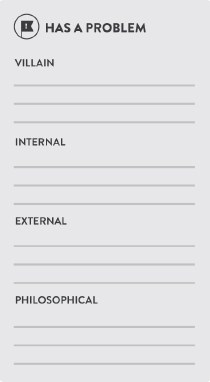
Here are four characteristics that make for a good villain on your StoryBrand BrandScript:
1. The villain should be a root source. Frustration, for example, is not a villain; frustration is what a villain makes us feel. High taxes, rather, are a good example of a villain.
2. The villain should be relatable. When people hear us talk about the villain, they should immediately recognize it as something they disdain.
3. The villain should be singular. One villain is enough. A story with too many villains falls apart for lack of clarity.
4. The villain should be real. Never go down the path of being a fearmonger. There are plenty of actual villains out there to fight. Let’s go after them on behalf of our customers.
Is there a villain in your customers’ story? Of course there is. What is the chief source of conflict that your products and services defeat? Talk about this villain. The more you talk about the villain, the more people will want a tool to help them defeat the villain.
Later, when you’re creating your BrandScript, I’ll ask you to brainstorm what kind of villain your customer faces. For now, though, let’s look closely at the kinds of conflict this villain causes. Once we understand our customers’ problems, we’ll have a better idea how to talk to them in such a way that they engage.
The Three Levels of Conflict
A villain is the antagonist because the villain causes the hero serious problems. That’s obvious. But what’s less obvious is that in a story, there are three levels of problems that work together to capture a reader’s or a moviegoer’s imagination.
The three levels of problems heroes (and customers) face are
External Problems
Internal Problems
Philosophical Problems
In a story, a villain initiates an external problem that causes the character to experience an internal frustration that is, quite simply, philosophically wrong. These are also the three levels of problems a customer hopes to solve when they buy a product.
I know that sounds complicated, but let’s take a closer look at each level of conflict so we know exactly which of our customers’ frustrations to talk about as we clarify our message.
EXTERNAL PROBLEMS
In literature, a villain’s job is to wreak havoc on the hero, to place barriers between them and their desperate desire for stability. But ill intentions aren’t enough. Something, that is, some thing (or things) must represent this barrier. Enter the “external problem.”
In stories, the external problem is often a physical, tangible problem the hero must overcome in order to save the day. The problem might manifest itself as a ticking time bomb or a runaway bus, or maybe even a combination of the two: a bomb on a bus that will go off if Keanu Reeves doesn’t keep the speed above fifty miles per hour!
The external problem works like a prized chess piece set between the hero and the villain, and each is trying to control the piece so they can win the game.
For Billy Beane in the movie Moneyball, the external problem is the need to win baseball games. For Matthew Broderick in the movie WarGames, it’s a piece of rogue software that has taken over the American government’s computer system and attempts to wage war against the Soviets.
But what does the existence of an external problem in a story have to do with branding? Well, most of us are in the business of solving external problems. We provide insurance or clothes or soccer balls. If we own a restaurant, the external problem we solve is hunger. The external problem a plumber fixes might be a leaky pipe, just like a pest-control guy might solve the external problem of termites in the attic.
Brainstorming what external problems you solve will be the easiest part of creating your StoryBrand BrandScript. It’s usually pretty obvious. But you’d be wrong to think the reason people call you, walk through your door, or visit your website is limited to the resolution of an external problem. Something else is going on.
INTERNAL PROBLEMS
By limiting our marketing messages to only external problems, we neglect a principle that is costing us thousands and potentially millions of dollars. That principle is this: Companies tend to sell solutions to external problems, but people buy solutions to internal problems.
The purpose of an external problem in a story is to manifest an internal problem. If I wrote a movie about a guy who simply needed to disarm a bomb, audiences would lose interest. What storytellers and screenwriters do, then, is create a backstory of frustration in the hero’s life.
In the movie Moneyball, for instance, Billy Beane failed in his playing career and so was filled with self-doubt about whether he could redeem himself as a general manager. In Star Wars, Luke Skywalker was told by his uncle that he was too young to join the resistance, so he doubted his ability until the very end.
In almost every story the hero struggles with the same question: Do I have what it takes? This question can make them feel frustrated, incompetent, and confused. The sense of self-doubt is what makes a movie about baseball relatable to a soccer mom and a romantic comedy relatable to a truck-driving husband.
What stories teach us is that people’s internal desire to resolve a frustration is a greater motivator than their desire to solve an external problem.
This is where most brands make a critical mistake. By assuming our customers only want to resolve external problems, we fail to engage the deeper story they’re actually living. The truth is, the external problems we solve are causing frustrations in their lives and, just like in a story, it’s those frustrations that are motivating them to call you.
After their near collapse, Apple didn’t find their footing until Steve Jobs understood that people felt intimidated (internal problem) by computers and wanted a simpler interface with technology. In one of the most powerful advertising campaigns in history, Apple showed a simple, hip, fun character who just wanted to take photos and listen to music and write books next to a not-so-hip tech nerd who wanted to talk about the inner workings of his operating system. The campaign positioned Apple Computers as the company to go to if you wanted to enjoy life and express yourself but felt intimidated by all the tech talk. What was the internal problem Apple identified? It was the sense of intimidation most people felt about computers. Apple started selling more than computers; they started selling a resolution to the problem of customer intimidation. Understanding their customers’ internal problem is one of the reasons Apple achieved such growth and created passionate brand evangelists.
The only reason our customers buy from us is because the external problem we solve is frustrating them in some way. If we can identify that frustration, put it into words, and offer to resolve it along with the original external problem, something special happens. We bond with our customers because we’ve positioned ourselves more deeply into their narrative.
For example, if we own a house-painting business, our customer’s external problem might be an unsightly home. The internal problem, however, may involve a sense of embarrassment about having the ugliest home on the street. Knowing this, our marketing could offer “Paint That Will Make Your Neighbors Jealous.”
What Frustrations Do Our Products Resolve?
Recently, the rental-car company National got my business by understanding my internal frustration. I used to rent from a company that got on my nerves. Normally when I get off a plane I don’t feel like making small talk. The staff at the company I used to rent cars from had a policy of chitchatting with their customers. They even used a script. First they asked whether I was in town for business or pleasure, then they asked about the weather where I came from. On and on it went. I heard this script so many times I started having fun beating them to their own talking points. I’d often jump ahead on their script and ask the clerk, “Are you going to be able to have a little downtime while you’re in town?” They’d just stare blankly at me because I’d hijacked their line.
One day, though, I was watching television and a commercial came on for National. It showed a guy walking through the rental office without talking to anybody. The character talked about how he hated having to make conversation with salespeople and how he loved walking straight to his car. I immediately changed rental car companies and have been happy ever since.
Speaking of car companies, CarMax is a chain of used car dealerships that aims most of their marketing collateral at the internal problem a customer experiences when looking for a used car, namely having to interact with a used-car salesman.
If you’ve ever walked onto a used-car lot, you know the feeling. It’s as though you’re about to tangle with a professional wrestler.
Knowing their customers don’t want to haggle over prices or risk buying a lemon, CarMax’s business strategy is aimed at you not having to feel lied to, cheated, or worked over in your car-buying experience. To do this, they have an agreement plan with their customers that ensures the price on the car is the price you’ll pay and lets you know their salespeople aren’t compensated on commission. They also highlight their quality certification and inspection process that ensures every car they sell is reliable.2
The external problem CarMax resolves is the need for a car, of course, but they hardly advertise about cars at all. They focus on their customers’ internal problems and, in doing so, entered one of the least-trusted industries in America and created a $15 billion franchise.3
Likewise, Starbucks exploded by not just offering customers a cup of coffee but by giving them a comfortable, sophisticated environment in which to relax. Customers felt good about themselves when they walked into a Starbucks. Starbucks was delivering more value than just coffee; they were delivering a sense of sophistication and enthusiasm about life. They were also offering a place for people to meet in which they could experience affiliation and belonging. Starbucks changed American culture from hanging out in diners and bars to hanging out in a local, Italian-style coffee shop.
In understanding how their customers wanted to feel, Starbucks took a product that Americans were used to paying fifty cents for (or drinking for almost free at home or at work) and were able to charge three or four dollars per cup. Starbucks customers are willing to pay more for their coffee because they sense greater value with each cup.
Framing our products as a resolution to both external and internal problems increases the perceived value (and I would argue, actual value) of those products.
Later, I’ll guide you through a brainstorming exercise helping you identify some of your customers’ internal problems, but before that, let’s look at a third kind of problem our customers experience. This third level of problem can take a story over the top, have audiences standing on their seats, and is one of the main reasons a film will win Best Picture at the Academy Awards. And it has the same kind of power when it comes to helping us turn disinterested customers into brand fanatics.
PHILOSOPHICAL PROBLEMS
The philosophical problem in a story is about something even larger than the story itself. It’s about the question why. Why does this story matter in the overall epic of humanity?
Why is it important that Tommy Boy save his dad’s company? I’ll tell you why, because the people trying to take Tommy Boy down are lying thieves. This is a comedic story about honesty, family, integrity, and hard work versus deception, greed, and trickery.
Why is it important that Hamlet avenge his father’s death? Because his uncle is getting away with murder.
Why is it important that Bridget Jones find love? Because the beauty and worth of every person deserves to be recognized and cherished by another.
A philosophical problem can best be talked about using terms like ought and shouldn’t. “Bad people shouldn’t be allowed to win” or “People ought to be treated fairly.”
In the movie The King’s Speech, the external problem is King George’s stutter. This external problem manifests the internal frustration and self-doubt the king struggles with. He simply doesn’t believe he has what it takes to lead his country. Philosophically, though, the stakes are much greater. Because the king must unify his people against the Nazis, the story takes on the philosophical problem of good versus evil.
In Jerry Maguire, the philosophical question revolves around whether people are worth more than the money they can bring in. Romeo and Juliet asks whether romantic love is more important than family squabbles and tribal unrest.
What’s the Deeper Meaning?
People want to be involved in a story that is larger than themselves. Brands that give customers a voice in a larger narrative add value to their products by giving their customers a deeper sense of meaning.
After creating their BrandScript, a global consulting firm we worked with began to talk about how everybody deserved to work for a great manager. A pet-store owner who came to us hung a sign in her window that said, “Pets deserve to eat healthy food too.” A fun-loving travel agent came to us and adopted the seasonal line “Because this summer should be remembered forever.”
Before music went digital, Tower Records promoted their chain of record stores using the tagline “No music, no life.” Not only did the tagline help them sell more than a billion dollars in records each year, but they sold thousands of bumper stickers and T-shirts featuring the tagline to fans who wanted to associate with the philosophical belief that music mattered.
Is there a deeper story your brand contributes to? Can your products be positioned as tools your customers can use to fight back against something that ought not be? If so, let’s include some philosophical stakes in our messaging.
The Perfect Brand Promise
If we really want to satisfy our customers, we can offer much more than products or services; we can offer to resolve an external, internal, and philosophical problem whenever they engage our business.
Storytellers use this formula to endear audiences all the time. When Luke shoots the photon torpedo through the little hole in the Death Star, he actually resolves the external problem of destroying the Death Star, the internal problem that had him wondering whether he had what it took to be a Jedi, and the philosophical problem of good versus evil, all with the press of a button.
When these three levels of problems are resolved in one shot, the audience experiences a sense of pleasure and relief, causing them to love the story. This scene is often called the “climactic” or “obligatory” scene, and it is arguably the most important scene in the movie because every other scene builds toward it in some way.
The resolution of the hero’s external, internal, and philosophical problem is the reason we cried when Woody and Buzz were reunited with Andy in Toy Story, and it’s why we felt so deeply when Private Ryan was rescued by Captain John Miller.
This formula works because human beings experience three levels of problems in their everyday lives. They aren’t just looking for a resolution to one level of problem; they’re hoping for a resolution to all three.
If we really want our business to grow, we should position our products as the resolution to an external, internal, and philosophical problem and frame the “Buy Now” button as the action a customer must take to create closure in their story.
Let’s look at how some successful brands we all know about have positioned the purchasing of their products as the resolution to external, internal, and philosophical problems:
TESLA MOTOR CARS:
Villain: Gas guzzling, inferior technology
External: I need a car.
Internal: I want to be an early adopter of new technology.
Philosophical: My choice of car ought to help save the environment.
NESPRESSO HOME COFFEE MACHINES:
Villain: Coffee machines that make bad coffee
External: I want better-tasting coffee at home.
Internal: I want my home coffee machine to make me feel sophisticated.
Philosophical: I shouldn’t have to be a barista to make a gourmet coffee at home.
EDWARD JONES FINANCIAL PLANNING:
Villain: Financial firms that don’t listen to their customers
External: I need investment help.
Internal: I’m confused about how to do this (especially with all the tech-driven resources out there).
Philosophical: If I’m going to invest my money, I deserve an advisor who will thoughtfully explain things in person.
WHAT CHALLENGES ARE YOU HELPING YOUR CUSTOMER OVERCOME?
The idea of identifying a villain that is causing an internal, external, and philosophical problem may seem daunting, but it will come to you if you commit to working it out in a brainstorming session. But be careful. A large problem most of our clients face is they want to include three villains and seven external problems and four internal problems, and so on. But, as I’ve already mentioned, stories are best when they are simple and clear. We are going to have to make choices.
Is there a single villain your brand stands against? And what external problem is that villain causing? How is that external problem making your customers feel? And why is it unjust for people to have to suffer at the hands of this villain?
These are the four questions we want to answer in the problem section of our StoryBrand BrandScript, and when we do, the story our brand is telling will take shape because our hero, the customer who wants something, is being challenged. Will they win? Will their problems be resolved?
Perhaps. The thing is, they will have to engage your brand to find out.
CLARIFY YOUR MESSAGE SO CUSTOMERS LISTEN
• Go to mystorybrand.com and either create a BrandScript or log in to your existing BrandScript.
• Either alone or with a team, brainstorm all of the literal and metaphorical villains your brand takes a stand against.
• Brainstorm the external problems your brand resolves. Is there one that seems to represent the widest swath of products?
• Brainstorm the internal problem (frustration or doubt) your customers are feeling as it relates to your brand. Is there one that stands out as a universal experience for your customers?
• Is your brand part of a larger, more important story? Is there a philosophical wrong your brand stands against?
• Once you finish your brainstorming session, make the four StoryBrand BrandScript decisions that will allow you to fill out part 2.