StoryBrand Principle One: The customer is the hero, not your brand.

A story doesn’t really pick up until the hero needs to disarm a bomb, win someone’s heart, defeat a villain, or fight for their emotional or physical survival. A story starts with a hero who wants something. And then the question becomes: Will the hero get what she wants?
Before knowing what the hero wants, the audience has little interest in her fate. This is why screenwriters have to define the character’s ambition within the first nine or so minutes of a film getting started. Will the underdog get the promotion? Will the runner finish the marathon? Will the team win the championship? These are the questions that keep an audience engaged for two hours.
As a brand it’s important to define something your customer wants, because as soon as we define something our customer wants, we posit a story question in the mind of the customer: Can this brand really help me get what I want?
Recently a high-end resort hired us to help them clarify their message. Like many companies, they were experiencing an identity crisis. Their marketing collateral featured images of their restaurant, front desk, and staff. It all looked nice, but unless they were trying to sell their buildings, they weren’t exactly inviting customers into a story.
What their customers wanted most, actually, was a luxurious, restful experience. After StoryBranding their resort, they changed the text on their website from long stories about themselves (which positioned them as the hero) to images of a warm bath, plush towels and robes, someone getting a massage in the spa, and a looping clip of a back-porch rocking chair against the backdrop of trees blowing in the wind along a golf course.
They replaced the text on their main page with short and powerful copy: “Find the luxury and rest you’ve been looking for.” That became the mantra for the entire staff. This phrase was posted on their office walls, and to this day you can stop any team member from the sous chef to the groundskeeper and they will tell you their customers are looking for two things: luxury and rest. Defining exactly what their customer wanted brought clarity and camaraderie to the staff. Each member of the staff then understood his or her role in the story they were inviting their customers to engage in.
One university we worked with defined their customer’s desire as “a hassle-free MBA you can complete after work.” A landscaping company humorously defined their customer’s ambition as “a yard that looks better than your neighbor’s.” A caterer we worked with in Los Angeles defined his customer’s desire as “a mobile fine-dining experience in the environment of your choice.”
When we identify something our customer wants and communicate it simply, the story we are inviting them into is given definition and direction.
Here are some more examples from companies we’ve worked with:
Financial Advisor: “A Plan for Your Retirement”
College Alumni Association: “Leave a Meaningful Legacy”
Fine-Dining Restaurant: “A Meal Everybody Will Remember”
Real Estate Agent: “The Home You’ve Dreamed About”
Bookstore: “A Story to Get Lost In”
Breakfast Bars: “A Healthy Start to Your Day”
When you define something your customer wants, the customer is invited to alter their story in your direction. If they see your brand as a trustworthy and reliable guide, they will likely engage.
OPEN A STORY GAP
In story terms, identifying a potential desire for your customer opens what’s sometimes called a story gap. The idea is that you place a gap between a character and what they want. Moviegoers pay attention when there’s a story gap because they wonder if and how that gap is going to be closed.
Jason Bourne is a spy who has amnesia, and we wonder if he’ll find anyone to help him. When he meets a young woman named Marie, that gap closes, only for another to open. Bourne and Marie have to flee the country. When they escape, that gap closes for yet another one to open. The cycle goes on and on, maintaining a taut grip on the audience’s attention up until the finale.
To understand the power of a story gap is to understand what compels a human brain toward a desire. Even classical music follows this formula. Many classical sonatas can be broken into three sections: exposition, development, and recapitulation. The final section, recapitulation, is simply an altered version of the exposition that brings a sense of resolve. If that doesn’t make sense, try singing “Twinkle, Twinkle, Little Star” without singing the final note on the word are. It will bother you to no end.
We also see this at work in poetry. When our ears hear Lord Byron’s first line “She walks in beauty, like the night,” a story gap has been opened. We are waiting to hear a word that rhymes with night and closes the open gap in our minds. Once we hear “Of cloudless climes and starry skies,” our minds find a bit of resolution. Until the next line, that is.
The opening and closing of a story gap is a magnetic force that drives much of human behavior. Arousal is the opening of a story gap and sexual fulfillment brings its closing. Hunger is the opening of a story gap and a meal ushers its closing. There is little action in life that can’t be explained by the opening and closing of various story gaps.
When we fail to define something our customer wants, we fail to open a story gap. When we don’t open a story gap in our customers’ mind, they have no motivation to engage us, because there is no question that demands resolution. Defining something our customer wants and featuring it in our marketing materials will open a story gap.
PARE DOWN THE CUSTOMER’S AMBITION TO A SINGLE FOCUS
A critical mistake many organizations make in defining something their customers want is they don’t pare down that desire to a single focus. I’ve had countless conversations with frustrated business leaders who push back at this point and say, “Wait, we provide about twenty-seven things our customers want. Can’t we mention all of them?”
The answer is no, at least not yet. Until we’ve defined a specific desire and become known for helping people achieve it, we shouldn’t add too many conflicting story gaps to our StoryBrand BrandScript.
This can be frustrating if your products and services fulfill many desires. The reality of a diverse brand, though, brings the same challenge many amateur screenwriters succumb to: they clutter the story by diluting their hero’s desire with too many ambitions.
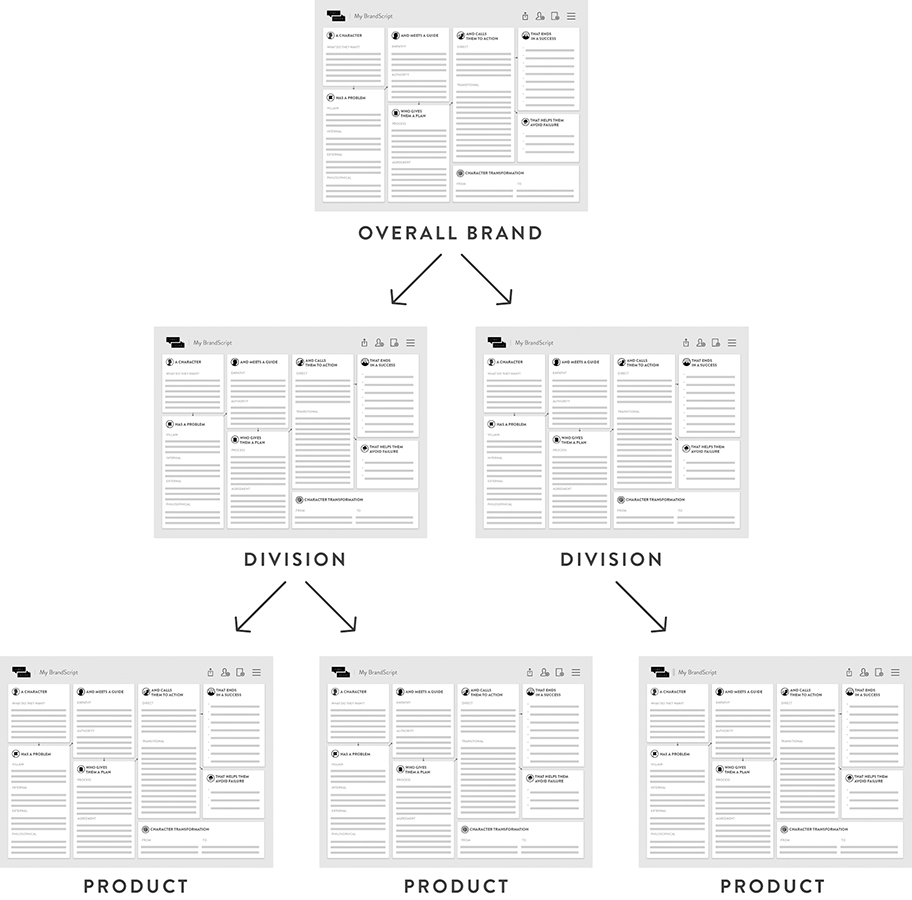
As you create a BrandScript for your overall brand, focus on one simple desire and then, as you create campaigns for each division and maybe even each product, you can identify more things your customer wants in the subplots of your overall brand.
On the following page you’ll find a grid of what a diverse brand might look like using the tool of various StoryBrand BrandScripts:
At the highest level, the most important challenge for business leaders is to define something simple and relevant their customers want and to become known for delivering on that promise. Everything else is a subplot that, after having delivered on the customer’s basic desire, will only serve to delight and surprise them all the more.
CHOOSE A DESIRE RELEVANT TO THEIR SURVIVAL
Once a brand defines what their customer wants, they are often guilty of making the second mistake—what they’ve defined isn’t related to the customer’s sense of survival. In their desire to cast a wide net, they define a blob of a desire that is so vague, potential customers can’t figure out why they need it in the first place.
A leadership expert recently asked for feedback on his brand. As I reviewed his marketing material, I noticed he was making a critical mistake: in defining what his customer wanted, he was vague.
The idea behind his brand is that he imparts knowledge to potential leaders. He saw himself as a storehouse of leadership resources and wanted to be the go-to guy for achieving excellence. In fact, his tagline was “Inhale knowledge, exhale success.”
Seems clear enough, but is it? What does exhaling success even mean? He was making potential customers burn too many mental calories to figure out how he was going to help them survive and thrive.
I recommended he make an edit to his message. Instead of saying, “Inhale knowledge, exhale success,” simply say, “Helping you become everyone’s favorite leader.”
Becoming everyone’s favorite leader means the customer would be more respected and better connected to a tribe, they’d have greater social and career opportunities, and much more. Exhaling success sounded nice, but thriving as the leader of a tribe is directly connected to survival. People will always choose a story that helps them survive and thrive.
Fortunately, he liked the idea, mostly because that’s what he was already doing. Defining something the customer wants and connecting it with the customer’s desire for survival opened an enticing story gap.
What Does Survival Mean?
When I say survival, I’m talking about that primitive desire we all have to be safe, healthy, happy, and strong. Survival simply means we have the economic and social resources to eat, drink, reproduce, and fend off foes.
So what kinds of desires fit under this definition? Well, too many to count, but consider these examples:
Conserving financial resources. In order to survive and thrive, your customers may need to conserve resources. In simple terms, this means they may need to save money. If your brand can help them save money, you’ve tapped into a survival mechanism. Walmart has built their brand on the promise of everyday low prices. Their tagline “Save Money. Live Better” further communicates savings and value and thus taps into a basic function of survival, the conservation of resources.
Conserving time. In developed countries, most of our customers have thankfully moved beyond the hunter-gatherer stage of survival. They are familiar, then, with the notion of opportunity costs. Can your housecleaning service give your customers more time to work on other things or more time to spend with family? Then they might be interested.
Building social networks. If our brand can help us find community, we’ve tapped into yet another survival mechanism. We only think we’re being nice when we bring our coworkers coffee, but what if we’re actually being nice because our primitive brains want to make sure we are connected to a tribe in case the bad guys come knocking at the door? Add this to the fact that human beings have a strong desire to nurture and be nurtured, and we’ve tapped into yet another survival mechanism.
Gaining status. Luxury brands like Mercedes and Rolex don’t make much practical sense in terms of survival, right? In fact, spending lots of money buying a luxury car when a more common brand would do the trick seems counter to our survival, doesn’t it? Not when you consider the importance of status. Status, in any tribe, is a survival mechanism. It projects a sense of abundance that may attract powerful allies, repel potential foes (like a lion with a loud roar), and if we’re into shallow companions, might even help us secure a mate. Rolex, Mercedes, Louis Vuitton, and other luxury brands are truly selling more than just cars and watches; they’re selling an identity associated with power, prestige, and refinement.
Accumulating resources. If the products and services you offer help people make money or accumulate much-needed resources, that will quickly translate into a person’s desire for survival. With more money, our customers will have more opportunity to secure many of the other survival resources they may need. Many StoryBrand clients run business-to-business offerings (StoryBrand itself is a business-to-business company), so offering increased productivity, increased revenue, or decreased waste are powerful associations with the need for a business (or an individual) to survive and thrive.
The innate desire to be generous. None of the desires I’ve listed are evil. They can all be taken too far, but the reality is we are designed to survive. Still, we should be comforted by the fact that nearly all human beings have an enormous potential for generosity. Achieving an aspirational identity of being sacrificial actually helps us survive (fends off foes, decreases outside criticism, helps earn trust in our tribe, and so on), but it also taps into something truly redemptive: we want other people to survive too. Most people are not nearly as Darwinian in their thinking as we’ve been led to believe. We are empathetic and caring creatures who will gladly sacrifice for the well-being of others, often in anonymity. The truth is we aren’t only interested in our own survival; we’re interested in the survival of others. Especially those who have not been given the opportunities we enjoy.
The desire for meaning. Viktor Frankl was right when he contended with Sigmund Freud, insinuating that the chief desire of man is not pleasure but meaning. In fact, in his book Man’s Search for Meaning, Frankl argued convincingly that man was actually most tempted to distract himself with pleasure when his life was void of meaning.1 So how do we offer potential customers a sense of meaning? Not unlike giving our customers the opportunity to be generous, we invite them to participate in something greater than themselves. A movement. A cause to champion. A valiant fight against a real villain, be that villain flesh and blood or a harmful philosophy.
WHAT’S THE STORY QUESTION FOR YOUR CUSTOMER?
When I offered my executive coach friend the tagline “Helping you become the leader everybody loves,” his customers’ brains were able to translate that message into multiple survival categories, including social networks, status, the innate desire to be generous, the opportunity to gain resources, and even the desire for deeper meaning.
In business, if we don’t communicate clearly, we shrink. When we’re motivating a team, convincing shareholders, or engaging customers, we must define a desire our customers have or we will have failed to open a story gap and our audience will ignore us. Remember, customers want to know where you can take them. Unless you identify something they want, it’s doubtful they will listen.
Imagine your customer is a hitchhiker. You pull over to give him a ride, and the one burning question on his mind is simply Where are you going? But as he approaches, you roll down the window and start talking about your mission statement, or how your grandfather built this car with his bare hands, or how your road-trip playlist is all 1980s alternative. This person doesn’t care. All he wants to do is get to San Francisco with a flower in his hair!
The goal for our branding should be that every potential customer knows exactly where we want to take them: a luxury resort where they can get some rest, to become the leader everybody loves, or to save money and live better.
If you randomly asked a potential customer where your brand wants to take them, would they be able to answer? Would they be able to repeat back to you exactly what your brand offers? If not, your brand is suffering the cost of confusion. You can fix this. Define a desire for your customer, and the story you’re inviting customers into will have a powerful hook.
CLARIFY YOUR MESSAGE SO CUSTOMERS LISTEN
• Go to mystorybrand.com and either create a StoryBrand BrandScript or log in to your existing BrandScript.
• Either alone or with a team, brainstorm what potential desires your customers might have that you can fulfill.
• Make a decision. Choose something your customer wants and fill in the “character” module of your StoryBrand BrandScript.
• Read the next chapter and repeat this process for the next section of your BrandScript.
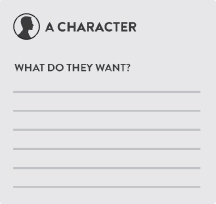
Once you fill out the first module of your StoryBrand BrandScript, you’ll be on your way to inviting customers into an incredible story. At this point, they’re interested in you and what you offer. But what can we do to entice them even further into a story? Let’s move on to part 2 and find out!
You will be tempted to fill out the rest of your StoryBrand BrandScript, but I encourage you to read the chapter associated with each module to be sure you’re filling it out correctly. Once you’ve completed your first BrandScript, section 3 of this book will help you create simple, effective marketing tools.