In the next section of this book, I’ll dive deep into the elements of the SB7 Framework, showing you how each important category of messaging makes your brand inviting to customers. For now, though, let’s fly over the framework so you can understand, in summary form, all that it can do to simplify your marketing and messaging.
THE STORYBRAND FRAMEWORK
1. A Character
STORYBRAND PRINCIPLE ONE: THE CUSTOMER IS THE HERO, NOT YOUR BRAND.

A major paradigm shift in the SB7 Framework is that the customer is the hero of the story, not your brand. When we position our customer as the hero and ourselves as the guide, we will be recognized as a trusted resource to help them overcome their challenges.
Positioning the customer as the hero in the story is more than just good manners; it’s also good business. Communication expert Nancy Duarte has done extensive research on how to create powerful presentations. The strategy she recommends to her clients is simple: when giving a speech, position yourself as Yoda and your audience as Luke Skywalker.1 It’s a small but powerful shift that honors the journey of the audience and positions us as a leader providing wisdom, products, and services our audience needs in order to thrive.
Once we identify who our customer is, we have to ask ourselves what they want as it relates to our brand. The catalyst for any story is that the hero wants something. The rest of the story is a journey about discovering whether the hero will get what they want.
Unless we identify something our customer wants, they will never feel invited into the story we are telling. As we explore the first element of the StoryBrand Framework, I’ll show you why and how to invite customers into a story that makes them want to pay attention to your brand.
2. Has a Problem
STORYBRAND PRINCIPLE TWO: COMPANIES TEND TO SELL SOLUTIONS TO EXTERNAL PROBLEMS, BUT CUSTOMERS BUY SOLUTIONS TO INTERNAL PROBLEMS.

In its purest form, a story starts with a character who lives in peace and stability. Suddenly that stability is disrupted: a bomb goes off, someone is kidnapped, or a disaster strikes. The hero then sets out on a journey to return to the peaceful life they once enjoyed.
Customers are attracted to us for the same reason heroes are pulled into stories: they want to solve a problem that has, in big or small ways, disrupted their peaceful life. If we sell lawn-care products, they’re coming to us because they’re embarrassed about their lawn or they simply don’t have time to do the work. If we sell financial advice, they’re coming to us because they’re worried about their retirement plan. It may not be as dramatic or sexy as James Bond going to Q to grab the latest high-tech spy weapons, but the premise is the same: our customers are in trouble and they need help.
By talking about the problems our customers face, we deepen their interest in everything we offer.
What most brands miss, however, is that there are three levels of problems a customer encounters. In stories, heroes encounter external, internal, and philosophical problems. Why? Because these are the same three levels of problems human beings face in their everyday lives. Almost all companies try to sell solutions to external problems, but as we unfold the StoryBrand Framework, you’ll see why customers are much more motivated to resolve their inner frustrations.
In the second part of the StoryBrand Framework, we’ll look at the three levels of problems our customers experience and create messages offering to resolve those problems. Understanding and addressing the three levels of problems our customers face will help us create a brand promise that will connect with customers on a primitive level and at their deepest point of need. This, in turn, will help us endear customers and create passionate brand evangelists.
3. And Meets a Guide
STORYBRAND PRINCIPLE THREE: CUSTOMERS AREN’T LOOKING FOR ANOTHER HERO; THEY’RE LOOKING FOR A GUIDE.

If heroes in a story could solve their own problems, they would never get into trouble in the first place. That’s why storytellers, through the centuries, have created another character to help the hero win. Depending on the scholar you talk to, there are many names for this character, but the term we use at StoryBrand is the guide.
In Tom Hooper’s Academy Award–winning film The King’s Speech, King George VI struggles to overcome a stutter. As Britain prepares for war against Germany, the Brits look to their leader for confidence and direction. Desperate, King George VI solicits the help of Lionel Logue, a dramatist turned speech therapist, who gives him a plan, coaches him to competency, and helps him transform into a powerful orator. This is the same service Obi-Wan (and Yoda) offers Luke Skywalker in Star Wars, Haymitch offers Katniss in The Hunger Games, and, to some degree, Bing Bong offers Joy in Pixar’s Inside Out.
It’s no accident that guides show up in almost every movie. Nearly every human being is looking for a guide (or guides) to help them win the day.
Brands that position themselves as heroes unknowingly compete with their potential customers. Every human being wakes up each morning and sees the world through the lens of a protagonist. The world revolves around us, regardless of how altruistic, generous, and selfless a person we may be. Each day is, quite literally, about how we encounter our world. Potential customers feel the same way about themselves. They are the center of their world.
When a brand comes along and positions itself as the hero, customers remain distant. They hear us talking about how great our business is and start wondering if we’re competing with them for scarce resources. Their subconscious thought pattern goes like this: Oh, this is another hero, like me. I wish I had more time to hear their story, but right now I’m busy looking for a guide.
In the third part of the StoryBrand Framework, we’ll look at two mental triggers that will help customers recognize us as the guide they’ve been looking for.
4. Who Gives Them a Plan
STORYBRAND PRINCIPLE FOUR: CUSTOMERS TRUST A GUIDE WHO HAS A PLAN.

At this point we’ve identified what the customer wants, defined three levels of problems they’re encountering, and positioned ourselves as their guide. And our customers love us for the effort. But they still aren’t going to make a purchase. Why? Because we haven’t laid out a simple plan of action they can take.
Making a purchase is a huge step, especially if our products or services are expensive. What customers are looking for, then, is a clear path we’ve laid out that takes away any confusion they might have about how to do business with us. The StoryBrand tool we will use to create this path is called the plan.
In almost every story, the guide gives the hero a plan, or a bit of information, or a few steps they can use to get the job done. In the Star Wars movies, Yoda tells Luke to trust the Force and then trains Luke on how to wield this power. People are looking for a philosophy they can embody or a series of steps they can take to solve their problems.
In the fourth part of the StoryBrand Framework, we’ll look at two kinds of plans: the agreement plan and the process plan. Each of these plans will earn trust and offer our customers a clear path to stability, greatly increasing the chance they will make a purchase.
5. And Calls Them to Action
STORYBRAND PRINCIPLE FIVE: CUSTOMERS DO NOT TAKE ACTION UNLESS THEY ARE CHALLENGED TO TAKE ACTION.

In stories, characters don’t take action on their own. They must be challenged. If we’re telling a story about a man who needs to lose thirty pounds and suddenly decides to do it of his own volition, the audience will check out. Why? Because that’s not how life works. There needs to be a reason. Our character has to run into a high school sweetheart who is now a yoga instructor, or he needs to lose a bet, forcing him to run a marathon. Characters only take action after they are challenged by an outside force.
This principle is true in story because it’s true in life. Human beings take action when their story challenges them to do so.
You would be surprised how many companies don’t create obvious calls to action for their customers. A call to action involves communicating a clear and direct step our customer can take to overcome their challenge and return to a peaceful life. Without clear calls to action, people will not engage our brand.
In the fifth part of the StoryBrand Framework, I’ll show you two calls to action that have worked for thousands of our clients. One call to action is direct, asking the customer for a purchase or to schedule an appointment. The other is a transitional call to action, furthering our relationship with the customer. Once we begin using both kinds of calls to action in our messaging, customers will understand exactly what we want them to do and decide whether to let us play a role in their story. Until we call our customers to action, they simply watch us, but when we call them to action (the right way), they will engage.
6. That Helps Them Avoid Failure
STORYBRAND PRINCIPLE SIX: EVERY HUMAN BEING IS TRYING TO AVOID A TRAGIC ENDING.

Stories live and die on a single question: What’s at stake? If nothing can be gained or lost, nobody cares. Will the hero disarm the bomb, or will people be killed? Will the guy get the girl, or will he be lonely and filled with self-doubt? These are the kinds of questions in the minds of a story-hungry audience.
If there is nothing at stake in a story, there is no story. Likewise, if there’s nothing at stake in whether or not I buy your product, I’m not going to buy your product. After all, why should I?
Simply put, we must show people the cost of not doing business with us.
In the eighties, the fast-food chain Wendy’s effectively asked America, “Where’s the beef?” The implication was that their competitors weren’t using enough meat. So what’s at stake for choosing another brand over Wendy’s? We might get stuck with a wimpy sandwich. Likewise, Whole Foods has built an enormous industry helping customers avoid the consequences of overly processed foods, and more recently Trader Joe’s has come along to help customers avoid the consequences of Whole Foods’ prices.
Brands that help customers avoid some kind of negativity in life (and let their customers know what that negativity is) engage customers for the same reason good stories captivate an audience: they define what’s at stake.
In the sixth part of the StoryBrand Framework, I’ll help you identify what’s at stake in your customers’ story as it relates to your brand. Before we move on, though, it’s important to note that not all of the seven elements should be used evenly in your communication. Think of the StoryBrand Framework as a recipe for a loaf of bread. Failure is like salt: use too much and you’ll ruin the flavor; leave it out and the recipe will taste bland. Regardless, the point is this: your story needs stakes.
7. And Ends in a Success
STORYBRAND PRINCIPLE SEVEN: NEVER ASSUME PEOPLE UNDERSTAND HOW YOUR BRAND CAN CHANGE THEIR LIVES. TELL THEM.

We must tell our customers how great their life can look if they buy our products and services. Ronald Reagan painted a picture of “a shining city on a hill.”2 Bill Clinton offered to help us “build a bridge to the twenty-first century.”3 During the dark and dreary Depression, Franklin Roosevelt used the song “Happy Days Are Here Again” as his official campaign song.4 Likewise, Apple provides tools that allow us to express ourselves and be heard, Weight Watchers helps us lose weight and feel great, and Men’s Wearhouse guarantees we will like the way we look.
Everybody wants to be taken somewhere. If we don’t tell people where we’re taking them, they’ll engage another brand.
In the seventh part of the StoryBrand Framework, I’ll elaborate on what is perhaps the most important element of your messaging strategy: offering a vision for how great a customer’s life could be if they engage your products or services.
WHEN YOU FEEL CONFUSED, CLARIFY YOUR MESSAGE
Right about now your head may be spinning. Even though there are only seven parts to the framework, how do we narrow down our message so our marketing material starts working again?
We’ve created a tool to simplify the process. This tool is going to reduce the hassle of creating a clear message, save you time, entertain you as you use it, and motivate you to create marketing material that works. As I mentioned earlier, this tool is called the StoryBrand BrandScript, and it’s going to become your new best friend.
You can create your StoryBrand BrandScript for free at mystorybrand.com, and it looks like this:
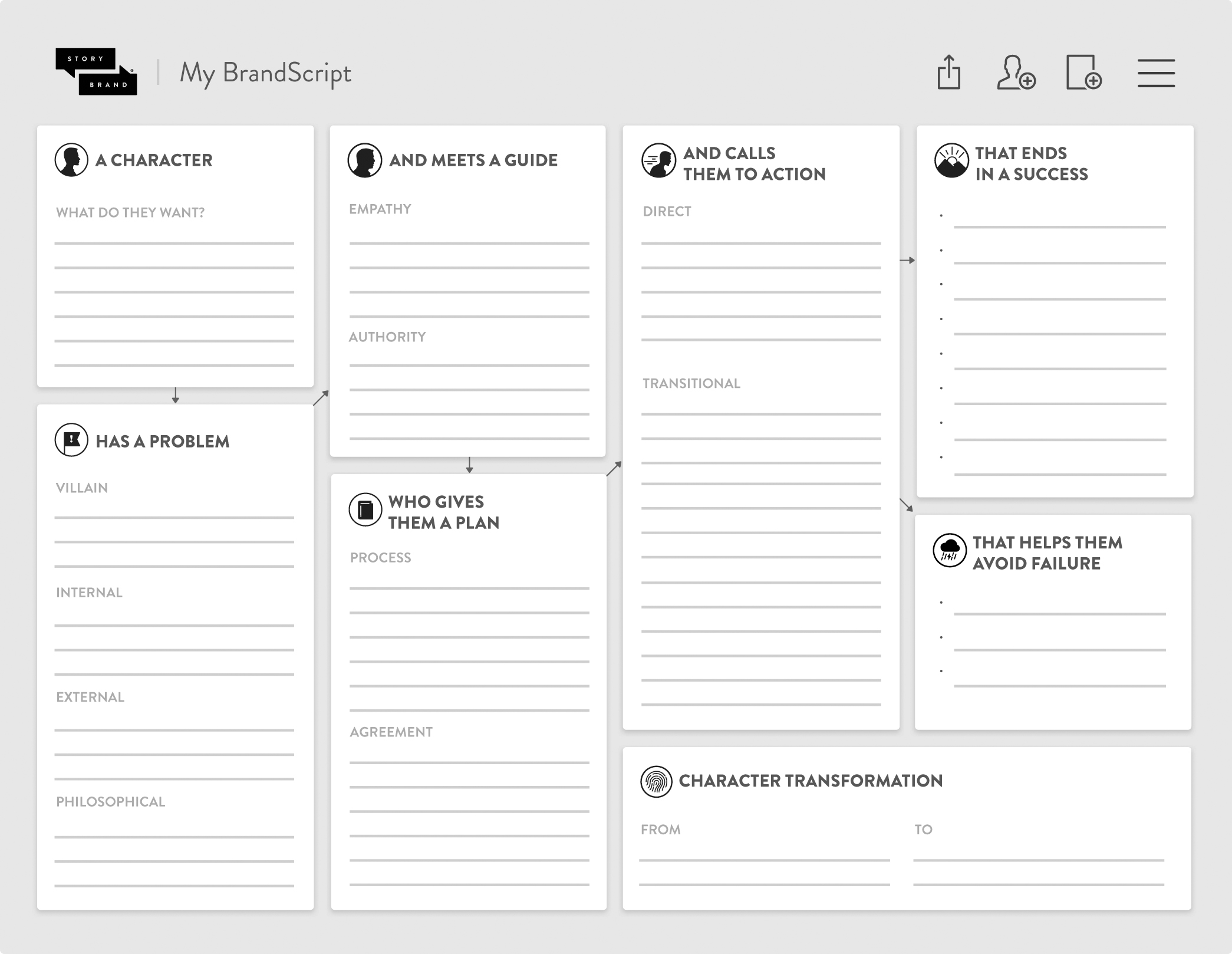
In the next seven chapters, I’m going to walk you through these seven elements and help you create your BrandScript. Once you’re done, you’ll no longer feel confused about how to talk about your products and services, and you’ll have messages that powerfully engage potential customers.
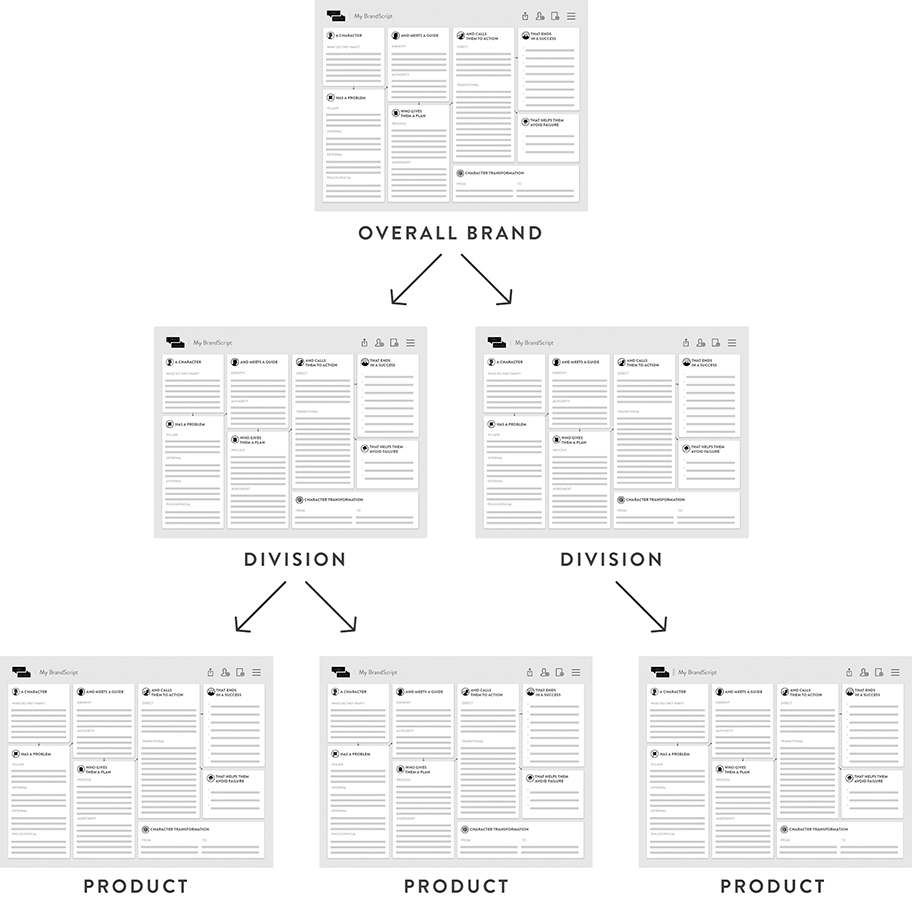
The first project I’d like you to BrandScript is the one that represents your overall brand. Next you’ll want to create a BrandScript for each division of your company, and after that, each product within each division. If you like, you can even create a BrandScript for each segment of your customer base. The uses of a StoryBrand BrandScript are endless.
Again, to create a BrandScript you can save, edit, and come back to over and over, go to mystorybrand.com. Because you bought this book, you get free access. Your StoryBrand BrandScript will be a powerful resource helping you organize and simplify your message, and you’ll use it again and again. With the StoryBrand BrandScript tool, you will be able to see your brand narrative on a single page, which, again, will translate into a clear message you can use to grow your business.
CLARIFY YOUR MESSAGE SO CUSTOMERS LISTEN
As you walk through the seven parts of the StoryBrand Framework, simply follow these three steps:
1. Read each of the next seven chapters.
2. After you read each chapter, brainstorm potential messages you might use to populate your BrandScript.
3. Carefully look at your brainstorm and then decide on a specific message to use in each section of your BrandScript.
Once you complete your BrandScript at mystorybrand.com, you will have the basic messages to employ the SB7 Framework on your websites, in keynotes, in elevator pitches, and in all manner of marketing and messaging collateral. This means your messages will be simple, relevant, and repeatable. And remember: simple, clear messages that are relevant to your customers result in sales.
Every human being is already speaking the language of story, so when you begin using the SB7 Framework, you’ll finally be speaking their language.
THE STAKES ARE HIGH
You’re going to be tempted to move ahead and skip thinking deliberately about each of the seven parts of the framework. You’ve already got the BrandScript, after all, so why not just fill it out?
Amateur screenwriters make the same mistake. They think they know how a story works, so they start typing and a couple of months later can’t figure out why their story is boring and unrelatable. I’ll tell you why. They had an overview of the process but never bothered to learn the actual rules.
Each module of the SB7 Framework has set-in-stone rules you cannot break—or else customers won’t find themselves in the story you’re telling and will be much less likely to engage your brand.
Thousands of companies shut their doors every year, not because they don’t have a great product, but because potential customers can’t figure out how that product will make their lives better. If we don’t closely analyze each element of our customers’ story, they’ll sense we don’t care and move on to a competing brand that took the time to do the work.
Some of you are probably thinking it’s too late. I mean, if it’s printed in a book, everybody else is probably doing it. But are they? How many people read the first twenty pages of a book and then stop reading? I’d say most, which means you’re already passing them. What would happen if you committed to executing this process and your competitor didn’t? You’d win, wouldn’t you? And how many people are actually going to put in the work even if they do read the book? Believe me, human nature tends toward complacency. Finish this process. Beat the competition. Clarify your message. Grow your company. The competition may be more talented than you are, but they will never outwork you if you don’t let them. That’s the one thing you get to control.
In the next seven chapters, I’ll show you how to create a clear and compelling message that will organize your thoughts, simplify your marketing, and grow your company.