THE SECRET WEAPON THAT WILL GROW YOUR BUSINESS
To help you grow your company, I’m going to guide you in simplifying your message into soundbites that come from seven categories. Once you have these seven messages down, any anxiety you experience talking about your brand will subside and customers will be more attracted to what you offer. We are going to figure out your customers’ story and place ourselves right smack in the middle of it.
Story is atomic. It is perpetual energy and can power a city. Story is the one thing that can hold a human being’s attention for hours.
Nobody can look away from a good story. In fact, neuroscientists claim the average human being spends more than 30 percent of their time daydreaming . . . unless they’re reading, listening to, or watching a story unfold. Why? Because when we are engaged in a story, the story does the daydreaming for us.
Story is the greatest weapon we have to combat noise, because it organizes information in such a way that people are compelled to listen.
STORY MAKES MUSIC OUT OF NOISE
Living in Nashville I’ve learned quite a bit about the difference between music and noise. Nearly half our friends here are musicians. I’m always amazed at their talent. Hardly a dinner party goes by without somebody grabbing a guitar.
I could summarize what I’ve learned about the difference between music and noise by saying my friends make music and I make noise, but there’s actually some complicated science involved.
Technically speaking, music and noise are similar. Both are created by traveling sound waves that rattle our eardrums. Music, however, is noise that has been submitted to certain rules that allow the brain to engage on a different level. If I played you a recording of a dump truck backing up, birds chirping, and children laughing, you’d not remember those sounds the next day. But if I played you a Beatles song, you’d likely be humming it for a week.
There is an obvious difference between a well-choreographed piece of music and the sound of a cat chasing a rat through a wind-chime factory, which is the equivalent of the average corporate website, keynote speech, or elevator pitch.
The brain remembers music and forgets about noise just like the brain remembers some brands and forgets about others.
Story is similar to music. A good story takes a series of random events and distills them into the essence of what really matters. There’s a reason the final cut of a movie is called a final cut. Prior to the theatrical version, a film has gone through rounds upon rounds of edits, omissions, revisions, and deletions. Sometimes entire characters end up on the cutting-room floor. Why? Because storytellers have filters to cut out the noise. If a character or scene doesn’t serve the plot, it has to go.
When clients want to add a bunch of confusion to their marketing message, I ask them to consider the ramifications of doing so if they were writing a screenplay. I mean, what if The Bourne Identity were a movie about a spy named Jason Bourne searching for his true identity but it also included scenes of Bourne trying to lose weight, marry a girl, pass the bar exam, win on Jeopardy, and adopt a cat? The audience would lose interest. When storytellers bombard people with too much information, the audience is forced to burn too many calories organizing the data. As a result, they daydream, walk out of the theater, or in the case of digital marketing, click to another site without placing an order.
Why do so many brands create noise rather than music? It’s because they don’t realize they are creating noise. They actually think people are interested in the random information they’re doling out.
This is why we need a filter. The essence of branding is to create simple, relevant messages we can repeat over and over so that we “brand” ourselves into the public consciousness.
STEVE JOBS AND THE MESSAGE OF APPLE
Apple grew much larger only after Steve Jobs began filtering his message through the lens of story. Transformation in his thinking happened after working with (and partially creating) the genius storytelling factory that is Pixar. When Jobs came back to Apple after being surrounded by professional storytellers, he realized story was everything.
Just think about the incredible transformation that took place in Steve’s life and career after Pixar. In 1983, Apple launched their computer Lisa, the last project Jobs worked on before he was let go. Jobs released Lisa with a nine-page ad in the New York Times spelling out the computer’s technical features. It was nine pages of geek talk nobody outside NASA was interested in. The computer bombed.
When Jobs returned to the company after running Pixar, Apple became customer-centric, compelling, and clear in their communication. The first campaign he released went from nine pages in the New York Times to just two words on billboards all over America: Think Different.
When Apple began filtering their communication to make it simple and relevant, they actually stopped featuring computers in most of their advertising. Instead, they understood their customers were all living, breathing heroes, and they tapped into their stories. They did this by (1) identifying what their customers wanted (to be seen and heard), (2) defining their customers’ challenge (that people didn’t recognize their hidden genius), and (3) offering their customers a tool they could use to express themselves (computers and smartphones). Each of these realizations are pillars in ancient storytelling and critical for connecting with customers.
I’ll teach you about these three pillars and more in the coming chapters, but for now just realize the time Apple spent clarifying the role they play in their customers’ story is one of the primary factors responsible for their growth.
Notice, though, the story of Apple isn’t about Apple; it’s about you. You’re the hero in the story, and they play a role more like Q in the James Bond movies. They are the guy you go see when you need a tool to help you win the day.
Despite what acolytes of the cult of Mac may say, Apple likely doesn’t make the best computers or phones. “Best” is subjective, of course. Whether Apple has the best technology, though, is debatable.
But it doesn’t matter. People don’t buy the best products; they buy the products they can understand the fastest. Apple has inserted themselves into their customers’ story like no other technology company, and as a result, they’re not only the largest technology company, they’re in the top ten largest companies period.1 If we want our companies to grow, we should borrow a page from their playbook. We should clarify our message.
STORY CAN GROW YOUR BUSINESS
To better understand what Steve Jobs learned during his days at Pixar, let’s take off our business hats for a few pages and pretend we’re learning about story for the first time. Once you understand how story integrates with your brand message, you’ll be able to create communication pieces (and even a brand strategy) that engages more customers and grows your business. And if you really get this down, people around the office will wonder how in the world you became such a marketing genius.
After studying hundreds of movies, novels, plays, and musicals across nearly every imaginable genre, and after having written eight books of my own along with a nationally released screenplay, I’ve narrowed down the necessary elements of a compelling story to seven basic plot points. If we were writing a full screenplay, of course, we’d need more, but for purposes of understanding and entering into our customers’ story, there are only seven.
Story in a Nutshell
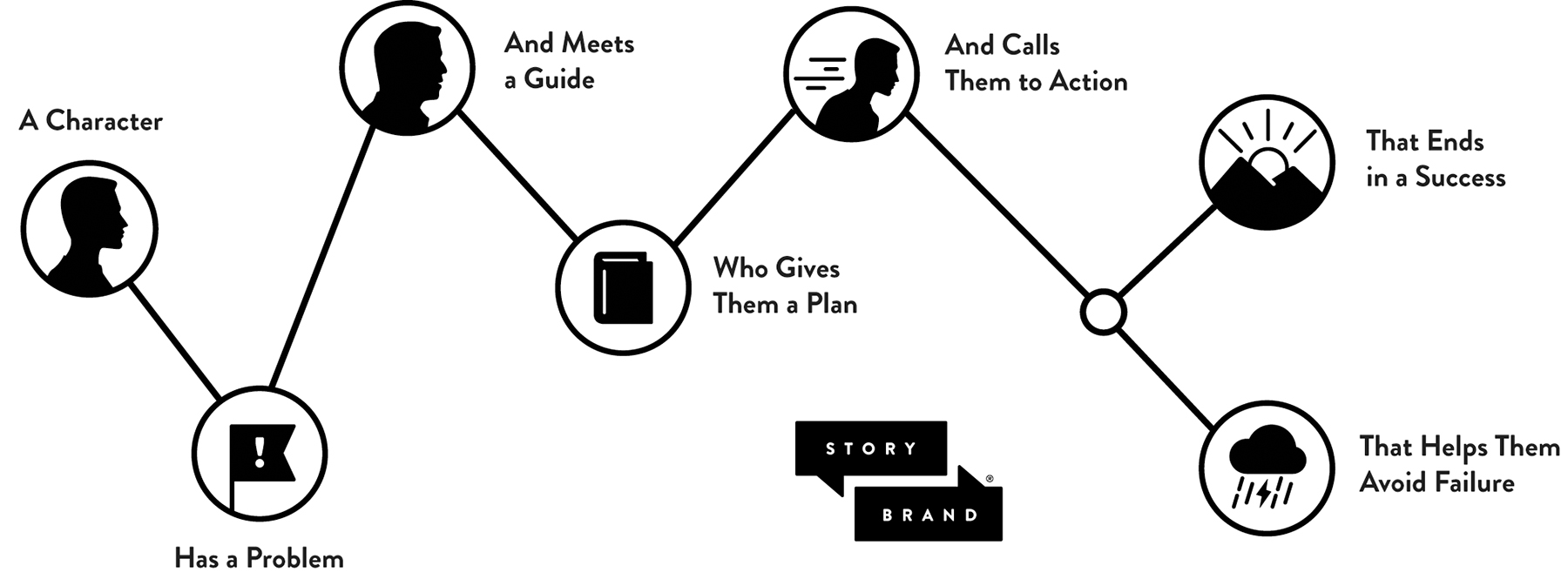
Here is nearly every story you see or hear in a nutshell: A CHARACTER who wants something encounters a PROBLEM before they can get it. At the peak of their despair, a GUIDE steps into their lives, gives them a PLAN, and CALLS THEM TO ACTION. That action helps them avoid FAILURE and ends in a SUCCESS.
That’s really it. You’ll see some form of this structure in nearly every movie you watch from here on out. These seven basic plot points are like chords of music in the sense that you can use them to create an infinite variety of narrative expression. Just like playing the guitar, with these seven chords you can create any number of songs. Varying too far from these chords, however, means you risk descending into noise.
Let’s look at how this simple framework plays out in a couple of familiar stories. Once you can recognize the framework in stories, you’ll start to understand exactly where the story of your brand is confusing customers by not sticking to the formula.
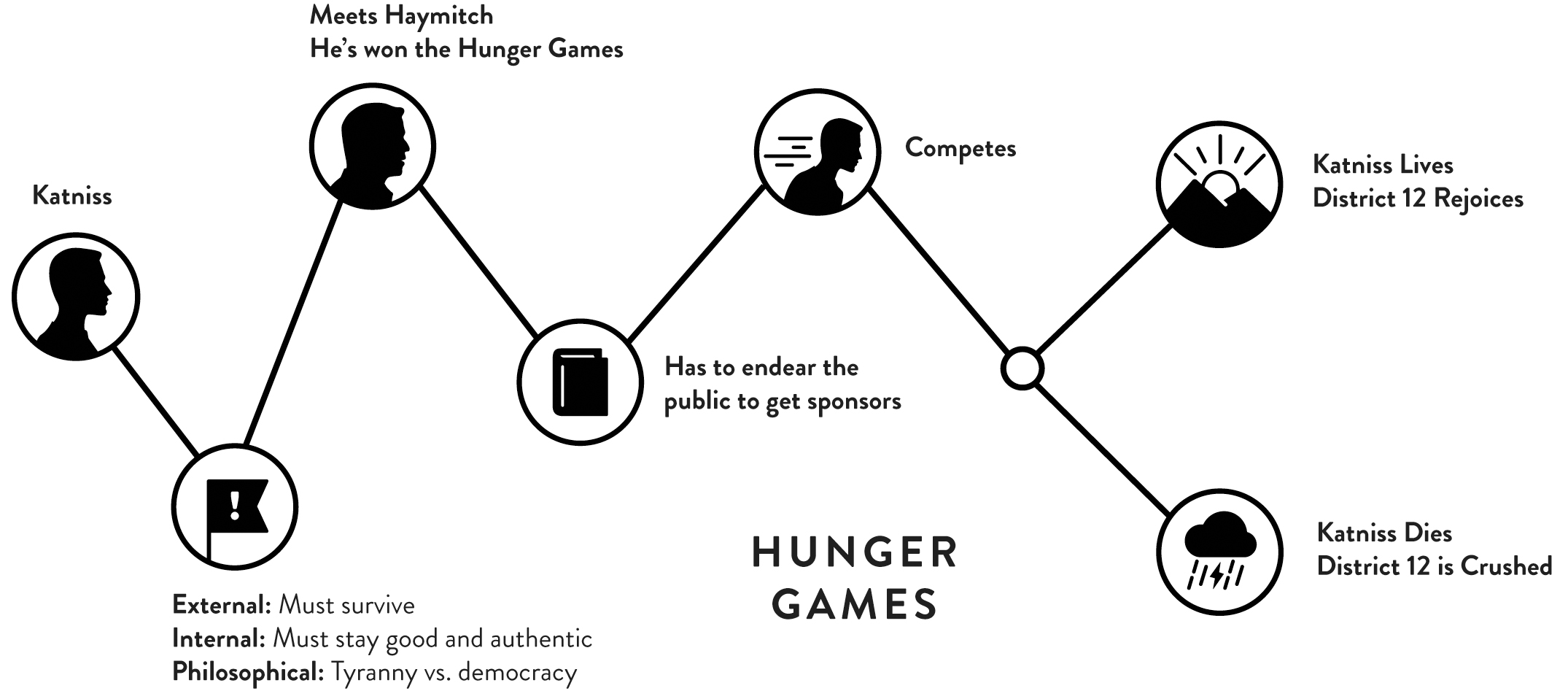
In the first Hunger Games movie, Katniss Everdeen must compete in a twisted fight-to-the-death tournament forced upon the people of Panem by an evil, tyrannical government called the Capitol. The problem she faces is obvious: she must kill or be killed. Katniss is overwhelmed, underprepared, and outnumbered.
Along comes Haymitch, the brash, liquor-loving, grizzled winner of a previous Hunger Games tournament. Haymitch assumes the role of Katniss’s mentor, helping her hatch a plan to win over the public. This gains Katniss more sponsors, thereby equipping her with more resources for the fight and increasing her chances of winning.
Here is the first Hunger Games story laid out on the StoryBrand grid:
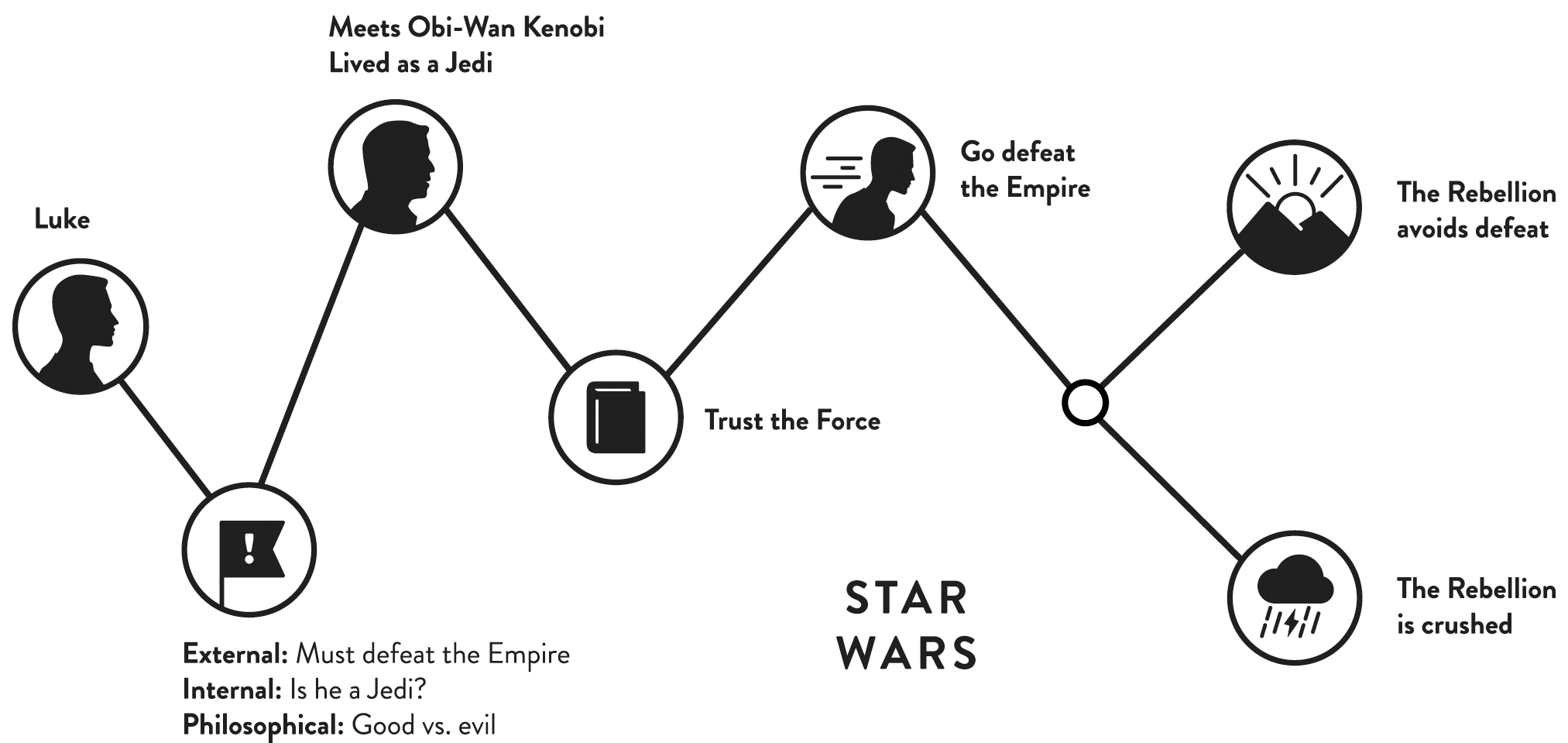
In Star Wars: A New Hope, our reluctant hero, Luke Skywalker, experiences a devastating tragedy: his aunt and uncle are murdered at the hands of the evil Empire. This sets a series of events in motion: Luke begins the journey of becoming a Jedi Knight and destroys the Empire’s battle station, the Death Star, which allows the Rebellion to live and fight another day. Enter a guide, Obi-Wan Kenobi, a former Jedi Knight who once trained Luke’s father.
Not every story works this way, but most do. Sometimes a writer will bring in multiple guides or (usually to the story’s peril) leave the guide out, but the formula holds up in almost every story you’ll encounter.
The fact that nearly every movie you go see at the theater includes these seven elements means something. After thousands of years, storytellers the world over have arrived at this formula as a means of best practices. Simply put, this framework is the pinnacle of narrative communication. The further we veer away from these seven elements, the harder it becomes for audiences to engage. This is why indie films, which often break from the formula to gain critical acclaim, fail miserably at the box office. Critics are hungry for something different, yet the masses, who do not study movies professionally, simply want accessible stories.
It seems true that some brands (as well as some screenwriters) break these formulas and succeed all the same, but when you look closely, this is rarely the case. Truly creative and brilliant marketers and screenwriters know how to use the formula while still avoiding cliché. This, in my opinion, is what makes them brilliant. When you get good at the SB7 Framework, hardly anybody will notice you are using it.
The Three Crucial Questions
So how do we make the story our company is telling clear?
Remember, the greatest enemy our business faces is the same enemy that good stories face: noise. At no point should we be able to pause a movie and be unable to answer three questions:
1. What does the hero want?
2. Who or what is opposing the hero getting what she wants?
3. What will the hero’s life look like if she does (or does not) get what she wants?
If you’ve ever started daydreaming in a movie, it was likely because you couldn’t answer one of these three questions, or worse, you didn’t care. Here’s the kicker: if these three questions can’t be answered within the first fifteen to twenty minutes, the story has already descended into noise and will almost certainly fail at the box office.
At StoryBrand our Certified Guides have reviewed thousands of pages of marketing copy that had nothing to do with the story of the customer. We tell our clients the same thing my filmmaker friends told me when I was writing screenplays: anything that doesn’t serve the plot has to go. Just because a tagline sounds great or a picture on a website grabs the eye, that doesn’t mean it helps us enter into our customers’ story. In every line of copy we write, we’re either serving the customer’s story or descending into confusion; we’re either making music or making noise.
Nobody remembers a company that makes noise.
DOES YOUR MARKETING PASS THE GRUNT TEST?
Just like there are three questions audiences must be able to answer to engage in a story, there are three questions potential customers must answer if we expect them to engage with our brand. And they should be able to answer these questions within five seconds of looking at our website or marketing material:
1. What do you offer?
2. How will it make my life better?
3. What do I need to do to buy it?
At StoryBrand we call this passing the grunt test. The critical question is this: “Could a caveman look at your website and immediately grunt what you offer?”
Imagine a guy wearing a bearskin T-shirt, sitting in a cave by a fire, with a laptop across his lap. He’s looking at your website. Would he be able to grunt an answer to the three questions posed above? If you were an aspirin company, would he be able to grunt, “You sell headache medicine, me feel better fast, me get it at Walgreens”? If not, you’re likely losing sales.
CLARITY PRODUCES RESULTS
One of our early clients, Kyle Shultz, was a fireman in Ohio who looked into StoryBrand because he wanted to leave his job and pursue his passion of teaching photography. He had recently launched an online photography course aimed at parents. He’d worked hard to create terrific video training allowing moms everywhere to finally start using that basic camera they’d placed in the junk drawer because they felt it was too complicated. Interest was decent. In his first launch, he sold $25,000 worth of online courses. He was ecstatic. Still, it wasn’t enough money for him to quit his job and pursue teaching photography full-time.
When Kyle subscribed to the Building a StoryBrand podcast, he began to wonder whether his message was too confusing. The night before his next launch he bought our online course and edited his website using the SB7 Framework. In fact, he removed 90 percent of the text he’d previously used on his sales page, and he also stopped using inside language like “f-stop” and “depth of field.” Instead, he used phrases like “Take those great pictures where the background is blurry.”
The next day Kyle sent a mass e-mail to the exact same e-mail list he’d contacted only six months before and offered the course again. He wasn’t expecting much because he’d already sold to this list, but to his surprise the course sold another $103,000 worth of registrations.
The difference? He highlighted the aspects of his course that would help parents survive and thrive (build stronger tribes, strengthen family connections, and connect more deeply with life’s greater meaning), and he did so in such a simple way (with fewer than three hundred words on his sales page) that people didn’t have to burn calories to figure out what was in it for them. Overnight he’d gone from a cluttered mess to the clear guide in his customers’ story.
Today, Kyle has quit his day job and runs shultzphotoschool.com full-time. Every day he gets e-mails from parents thanking him for helping them feel great about the photographs they’re taking of their children.
WE NEED A FILTER
Alfred Hitchcock defined a good story as “life with the dull parts taken out.”2 Good branding is the same. Our companies are complex, for sure, but a good messaging filter will remove all the stuff that bores our customers and will bear down on the aspects of our brand that will help them survive and thrive.
So how do we come up with these messages? It’s simple. We use the same grid storytellers use in telling stories to map out the story of our customers, then we create clear and refined statements in the seven relevant categories of their lives to position ourselves as their guides. When we do this, we become the people who help them overcome their challenges and achieve the life they want to live.
Once we begin filtering our message through the SB7 Framework and using it as a communication filter, we will be able to repeat powerful messages over and over that “brand” us into our customers’ story.
The SB7 Framework is simple, fun, and effective. And when you’re done, your entire brand message is going to sit on a single sheet of paper. We call this single sheet of paper (actually, it’s a free digital application I’m going to introduce you to) the StoryBrand BrandScript.
Once you’ve finished the process, you’ll use your BrandScript to create all manner of improved marketing material, and you’ll be more clearly positioned in the marketplace. When customers finally understand how you can help them live a wonderful story, your company will grow.
With that, let’s take a look at the StoryBrand Framework.