HOW STORYBRAND CAN TRANSFORM A LARGE ORGANIZATION
So far, we’ve seen how a solid StoryBrand BrandScript transforms customer engagement. But its value doesn’t stop there. Your BrandScript can also be leveraged to transform employee engagement. And that has enormous implications for large organizations.
Customers aren’t the only ones who get confused when the message is unclear. Employees get confused too, from the division president to the regional manager to the laborer earning minimum wage on the front line.
THE CURSE OF THE NARRATIVE VOID
You may not realize this, but your organization is haunted. I know this because every organization encounters the same sinister spirit that roams the halls looking for victims to oppress. I call this shifty shadow the Narrative Void.
The Narrative Void is a vacant space that occurs inside the organization when there’s no story to keep everyone aligned. In extreme cases the Narrative Void can take up residence in the very center of the organization, splintering it into factions of disconnected efforts that never quite come together as a unified mission.
For years, companies have attempted to exorcise the Narrative Void using the most sacred document available: the mission statement. The corporate mission statement is like the holy grail of organizational effectiveness. With monastic dedication, executives gather for off-site retreats where they etch painstaking phrases onto tablets few will ever read and even fewer will understand or apply. Talk about a story going nowhere.
Needless to say, only in very rare cases has a mission statement actually led a company to be on mission.
ARE YOUR PEOPLE CONFUSED?
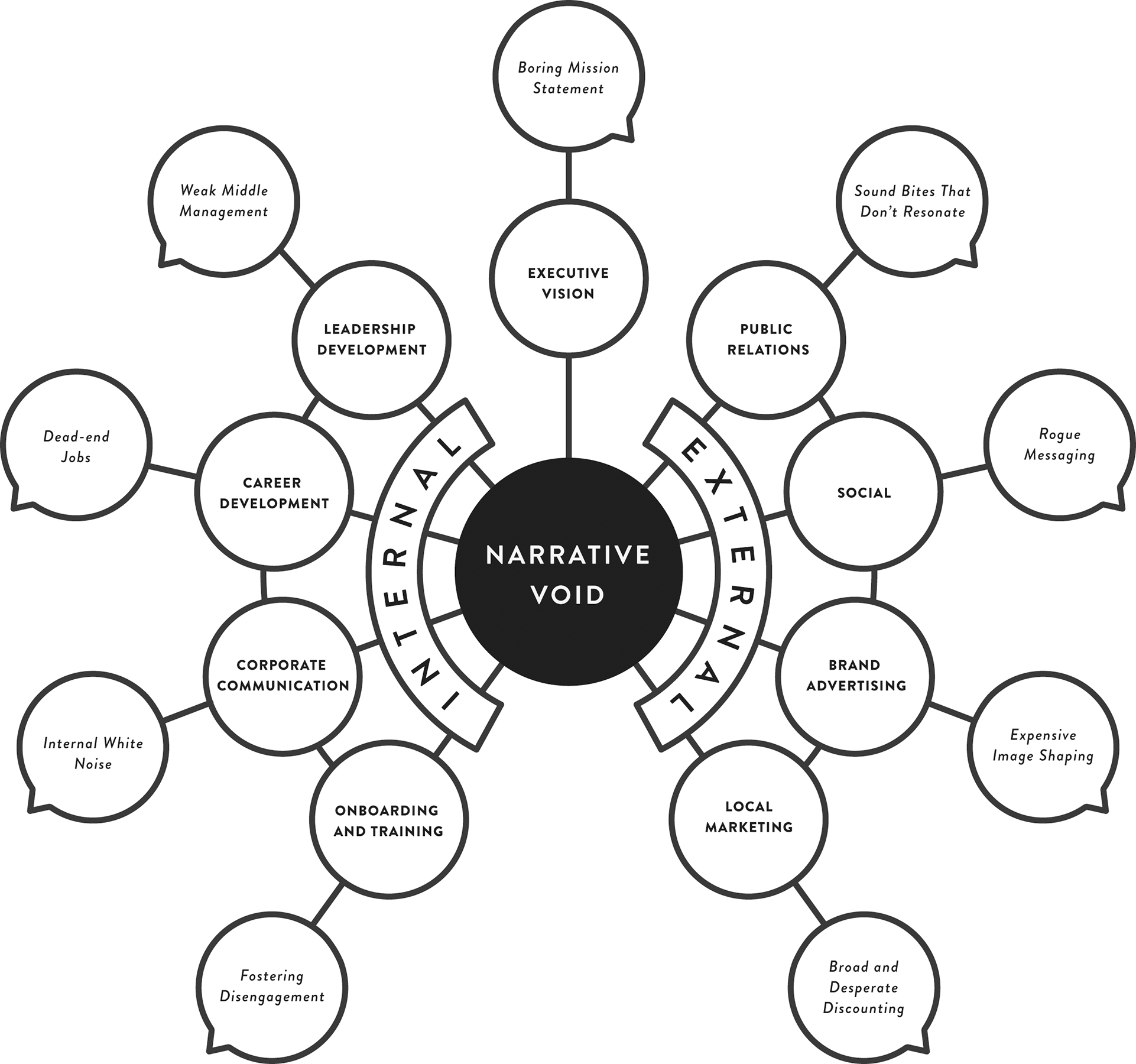
The diagram below gives a snapshot of an organization infected with a Narrative Void. It paints a picture of many companies today. The different divisions across the organization exist in microcosms that can only be truly understood by the people who live in them. Left to themselves, these people must make decisions and develop strategies to meet demands. They assume these decisions only affect them. But along the way their choices create tiny overtones that ripple across the organization. From an organizational perspective, it’s like bleeding to death from a thousand paper cuts.
As you can see, where there’s no plot, there’s no productivity.
THE COST OF A NARRATIVE VOID
In the 1990s, Gallup began measuring the level of commitment employees felt toward their job and their employer. The numbers were startlingly low. Their research found that about one out of every five employees nationwide were truly excited about the work they were doing.1 This is a problem. The obvious assumption is that an engaged associate gives more discretionary effort than someone who is not engaged. Not only that, but engaged associates took fewer sick days and were less likely to become a turnover statistic.
Gallup’s discovery revealed that companies were losing hundreds of millions through gaps in productivity and efficiency. Back in 2012, Gallup estimated this was costing the United States $450 billion to $550 billion each year.2 Needless to say, employers pay someone the same amount in salaries and benefits whether they’re engaged or not. So when leaders of companies began to get their heads around Gallup’s findings, the race was on to cure the disengagement epidemic.
As it turns out, one of the biggest contributors to the rise of disengagement has been the information explosion. As I mentioned earlier, people are bombarded with more than three thousand marketing messages every twenty-four hours. And that’s just marketing messages. The number of non-marketing messages—through articles, Internet posts, and slanted news stories—is even higher. Compare that to, say, the 1970s. We’ve gone from three TV networks and one local newspaper to more than two hundred channels, millions of news blogs, podcasts, Internet radio, Twitter, Instagram, Facebook, Snapchat, and LinkedIn.
Meanwhile, the communication of most companies has been going in reverse. The personal interaction that once fueled connection in the workplace has been replaced by telecommuting, remote field offices, and conference calls. The days of catching up around the water cooler are gone. Granted, they’ve added e-mail blasts and an employee portal, but studies show readership of those outlets is minimal.
Could it be the white noise is a breeding ground for the Narrative Void? I don’t think it’s a coincidence.
A strong, StoryBrand-inspired narrative expels the Narrative Void the way light drives out darkness. Companies who calibrate their activities around a common story don’t just state their mission, they operate on mission.
JUST BECAUSE YOU KNOW THE STORY DOESN’T MEAN YOUR TEAM DOES
So how does a StoryBrand BrandScript stop the bleeding? Let’s look at how most workplaces work.
In many cases it starts with onboarding. Without a StoryBrand BrandScript, it usually goes like this: HR person welcomes new employee, issues a company key fob, and sits him down in front of a sexual harassment video for ten minutes. Next they skim through the company manual together and cover some light gossip about the personal life of a certain senior manager. A quick trip to the lobby to read the company mission statement, drop the new guy off at his cube, and the HR person is back at his desk in an hour. Done.
For the next three to five years, the new guy does a solid job meeting all the performance management metrics laid out by his supervisor. He earns three bonuses, one promotion, and the department’s top award two years in a row—and never works past 6:00 p.m. He learns to navigate around the people that create resistance, picks his battles, accepts compromises, and absorbs occasional consequences. Then one afternoon a headhunter calls with a good-enough offer, and he’s on to the next chapter of his life.
No boats were rocked. No stars were reached. For the company, there were wins and losses and a few ties. It’s like a movie where nothing happens, nobody cares, and the popcorn’s stale.
Is it any wonder the workplace is wracked by disengagement?
Did you notice the Narrative Void in this story? Without a unifying narrative at the center, there was nothing to inspire the new hire beyond the status quo. The company didn’t do anything wrong. But they didn’t do anything special either. In a competitive environment, that approach won’t get you very far. That’s the intoxicating deception of the Narrative Void. It lulls the company to sleep. And eventually to death.
GETTING THE ORGANIZATION BACK ON MISSION
When customers are invited into a magnificent story, it creates customer engagement. Could the same be true for employees? Absolutely.
With a StoryBrand-inspired narrative, ordinary jobs become extraordinary adventures. With a unifying BrandScript, the above story would have gone more like this:
Before even applying for a job, the prospective employee has already heard the buzz on the street about this cool company. It’s somehow more alive. The people who work there love it and so do their customers. They exude a sense of competence within their industry as well as across the community in general. Their leaders are respected. Even their former employees talk about it with a hint of sentimental longing. On the list of ideal places to work, there are few that compare.
During the first interview, the candidate starts to understand where the buzz has been coming from. The hiring manager describes the company the way you might describe Lewis and Clarke preparing to tame the western frontier. There are interesting characters whose lives have led them to this place. Business goals sound like plot twists. There are mountains to climb and rivers to cross. There are storms to weather, bears to hunt, and treasure to find. The hiring manager is visibly excited as she walks effortlessly through the seven categories of the company’s narrative.
But not just anyone gets selected for this expedition. The employees of this company aren’t trying to be snobs, they’re just staying true to the story they’re following and they don’t want to compromise the plot. If you happen to be selected, it’s because destiny basically demands it. Instantly the candidate’s concept of work shifts up a level. It’s no longer just about what he can get out of it. It’s also about who he will become if he’s allowed to enter the story. He senses that working for this company will transform him.
By the second and third interviews, the candidate has met most of the team and even been interviewed by them. Everyone he meets tells the exact same story he heard on the street and in the first interview. The story is growing on him. He realizes he needs to be part of a story like this to be fully satisfied in life. We all do.
Finally, his first day on the job arrives, and the onboarding experience is more like being adopted than getting hired. He spends quality time with a facilitator who takes a small, new team through a curriculum explaining the story of their customer and how the company positions themselves as the guide in their customer’s story. Amazingly, the onboarding is more about the company’s customers than it is about the company itself. This organization loves their customers and is obsessed with seeing them win the day. Finally, the new employee discovers the secret. These people are here to serve a customer they love.
Our new recruit is then invited to a special luncheon for new hires hosted by the CEO. During the luncheon, the CEO delivers a short but powerful keynote based on the company’s BrandScript. The keynote is invigorating, the CEO is intoxicating in his love for the company’s customers, and the whole thing backs up what the new recruit learned during the onboarding course. The grand finale? A short film, based on the company’s StoryBrand BrandScript, about the amazing impact the organization is making not only in business but also in the lives of individuals. Our new recruit asks the HR director if he can get a link to the video so he can send it to his friends and family, more or less bragging about his amazing new job.
For the next three to five years, the new guy feels like he’s still getting to know the place. Every month he discovers new reasons why this is his dream job. Pictures of customers are plastered all over the walls, celebrating their successes. His daily tasks are not mundane but are specific objectives that have him working together with other teams to help their customers solve the problems that are frustrating them. His coworkers are not his competition but are a supportive community that actually wants him to thrive and grow as they live out a story about changing the world. Customers themselves visit the office to get a tour of the company that helped solve their problems.
Headhunters call every month with jobs that almost always represent a raise and a promotion. He usually forgets to call them back.
Across the organization, the people seem fully present not just physically but mentally. Productivity is high and efficiency is a matter of pride. Thanks to very low turnover, the organization maintains a rich repository of valuable experience that pays dividends most companies never realize.
Did you notice the alignment and consistency in this story? It’s not because they gather around a plaque in the lobby each morning and sing the company song like a bunch of communists obeying a dictator’s failed vision. If you didn’t know their secret, you’d think everything just sort of fell into place spontaneously. But behind it all is a leadership team that understands the power of story, has created a StoryBrand BrandScript, and has learned to implement that narrative in every facet of the organization.
WHEN A MISSION COMES TO LIFE
Mission statements were never a bad idea. They were just never enough. In fact, a mission is exactly what people need in order to come together as a company. But a statement is inadequate to turn a mission into a story. It’s like reading the tagline on a movie poster instead of seeing the actual movie.
Ben Ortlip is the director of the “On-Mission” division at StoryBrand. He specializes in implementing the StoryBrand Framework inside large organizations. A few years ago, a very popular fast-food restaurant chain approached his team about helping them with engagement. At the time, the brand had crossed the billion-dollar threshold and was experiencing about 5 percent growth. That might seem pretty solid to most people, but this place has amazing food and is made up of some of the finest people you’ll meet. Ben felt like they should be doing better.
After spending some time at headquarters and behind the scenes in restaurants in several states, it was clear that some complacency had begun to set in. There was nothing wrong with their operations. The product was phenomenal. And their marketing was effective. The problem was they’d grown large enough, and in so many directions, they’d lost their plot. It’s not unlike when a movie becomes a success and they turn it into a sequel. Often, the story just feels forced.
IS YOUR THOUGHTMOSPHERE ON SCRIPT?
Killing off a Narrative Void isn’t easy, and it takes time. Around the StoryBrand office, Ben uses the term thoughtmosphere. A thoughtmosphere is an invisible mixture of beliefs and ideas that drives employee behavior and performance. A thoughtmosphere improves when a StoryBrand-inspired narrative is created, talking points are devised, and a plan of execution is put in place to reinforce those talking points so every stakeholder understands their important role.
For the restaurant chain in question, this involved video curriculum, a series of regional meetings, a major national convention, and updates from the CEO often filmed in casual settings at headquarters. Retreats for franchise owners involved personal updates from the CEO followed by inspirational speakers who could speak into the organization’s narrative. The company held concerts on the beach for just the stakeholders, and other brands who had a similar mission were discussed and publicly praised for their similar work serving customers.
Almost immediately, you could sense a shift across the brand. There was renewed energy. People who hadn’t been seen or heard from in years started showing up at meetings, ready to lock arms again. The Narrative Void was gone.
And tangible growth? In less than three years, the chain went from 5 percent growth to nearly 30 percent, all with the very same people who had been inside the organization all along. For a billion-dollar company, that translated into hundreds of millions per year, every year.
The number-one job of an executive is to remind the stakeholders what the mission is, over and over. And yet most executives can’t really explain the overall narrative of the organization. Here’s the problem: if an executive can’t explain the story, team members will never know where or why they fit.
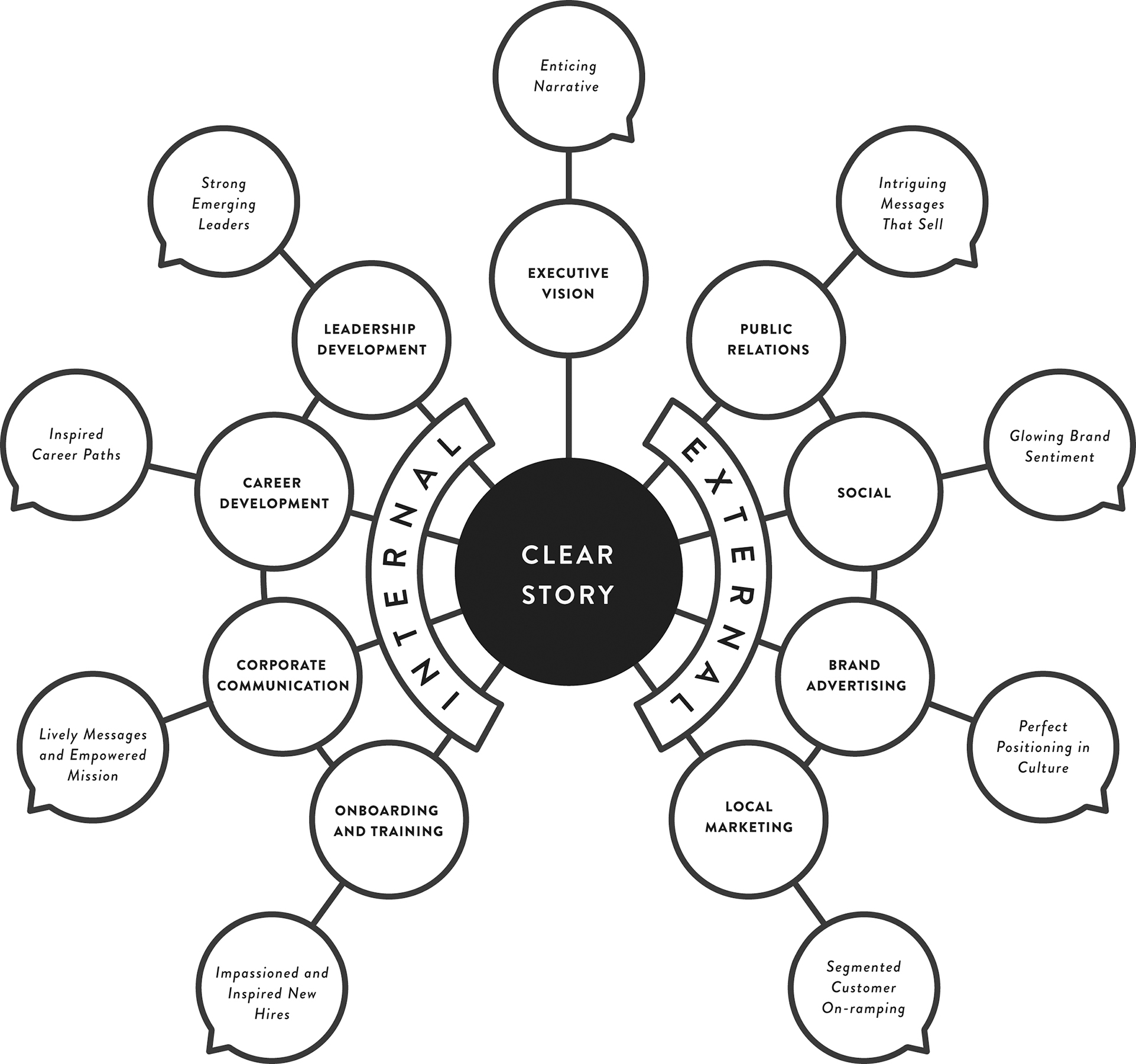
When a company gets on mission, everybody wins. A company that is on mission looks something like this:
READY TO GET YOUR COMPANY ON MISSION?
A true mission isn’t a statement; it’s a way of living and being. A mission is more than token rituals that make momentary reference to the things your employees should care about. A mission is a story you reinforce through every department strategy, every operational detail, and every customer experience. That’s what it means to be a company on mission.
And it all starts with your StoryBrand BrandScript.
We created the On-Mission program to provide a turn-key service for larger organizations to achieve a full, custom implementation of their StoryBrand BrandScript—to weave the elements of their vital narrative into the important functions that shape culture and foster employee engagement around the mission.
We guide many organizations through a process that goes something like this:
1. Create a BrandScript with your leadership team.
2. Audit the existing thoughtmosphere.
3. Create a custom On-Mission implementation plan.
4. Optimize internal communications to support the plan.
5. Install a self-sustained team for the On-Mission plan.
People often ask what an On-Mission company does differently from everyone else. I think they want a list. Yes, there are cool ideas you probably haven’t seen before, like using behavioral typologies to identify job fit, or introducing a platform called a “virtual water cooler” to foster connections between coworkers.
The reality is most of the things an On-Mission company does look strangely similar to the things other companies do. It’s just that On-Mission companies do these things while unified around a common, disciplined narrative.
An On-Mission Company Turns Their Entire Team into a Sales Force
The main distinctive of an On-Mission company is their attention to how the basic blocking and tackling of business is synchronized around a StoryBrand BrandScript. The BrandScript filters out all the noise and lets each stakeholder, each day, know why they’re doing what they’re doing.
When team members understand the story of the organization and can explain it in short, disciplined sound bites that have been reinforced through varying modes of communication from executives, they give words to potential customers that potential customers can use to spread the word. Brief, narrative ideas shared from inspired team members spread faster than muddled, confusing explanations shared by bored, disengaged employees.
An On-Mission Brand Understands the Story of Their Team Members
When you leverage the StoryBrand Framework externally, for marketing, it transforms the customer value proposition. When you leverage it internally, for engagement, it transforms the employee value proposition.
All engagement rises and falls on the employee value proposition. Increasing compensation is one way you might add value to employees, but that’s just the beginning. You can also raise value by improving the employee experience: advancement opportunities, recognition, meaningful work, camaraderie, and flexibility. All those things add value too.
To accomplish this, many StoryBrand BrandScripts are created. Certainly there is the external BrandScript that is pointed at the customer, but there are also BrandScripts created from the perspective of the leadership to the overall team. In these StoryBrand BrandScripts, the team is positioned as the hero and the company leadership is positioned as the guide. Compensation packages, leadership development, organized events, and more are all “tools” the leadership creates to help their employees win the day. Without understanding where a team member’s narrative is going, compensation, development, and events are all fueling fires heading in a thousand directions.
We’ve found time and time again that leaders desire to be seen as heroes when, in actuality, everything they think they want from playing the hero only comes by playing the guide. Guides are respected, loved, listened to, understood, and followed loyally.
When the story of the customer and the story of the company align with the story of the team, we get an alchemy that is not only profitable, it’s healing. Now that I’ve spent several years running a company that is on mission, I can never go back. There is more to life than dominating the market. Dominating the market is only a beautiful story if the team that accomplishes such a challenging task has tied that ambition to their own personal dreams.
Is your organization on mission? Does every stakeholder you interact with understand the story of your customer and what role the organization plays in that story? And do they understand their personal role in this important narrative? If not, getting your company on mission may be the first step in a turnaround. Not just for the company, but for your customers, your team members, and even you.
Where there’s no story, there’s no engagement.