StoryBrand Principle Seven: Never assume people understand how your brand can change their lives. Tell them.

Years ago, a friend gave me the best leadership advice I’ve ever received. He said, “Don, always remember, people want to be taken somewhere.”
I’ve found that advice applies to my family, my team, the books I write, and the speeches I give. And it certainly applies to our marketing.
Where is your brand taking people? Are you taking them to financial security? To the day when they’ll move into their dream home? To a fun weekend with friends? Without knowing it, every potential customer we meet is asking us where we can take them.
Ronald Reagan envisioned America as a shining city on a hill. Bill Clinton promised to build a bridge to the twenty-first century. Casting a clear, aspirational vision has always served a presidential candidate.
By foreshadowing a potential successful ending to a story, or, as Stew Friedman at the Wharton School puts it, defining a “compelling image of an achievable future,”1 leaders captivate the imaginations of their audiences.
Successful brands, like successful leaders, make it clear what life will look like if somebody engages their products or services. Nike promised to bring inspiration and innovation to every athlete. Likewise, Starbucks offered to inspire and nurture their customers, one cup at a time. For years, Men’s Wearhouse promised, “You’ll like the way you look,” and they even guaranteed it.
Without a vision, the people perish. And so do brands.
In the final and most important element of the StoryBrand Framework, we’re going to offer our customers what they want most: a happy ending to their story.
THE ENDING SHOULD BE SPECIFIC AND CLEAR
One of the problems we run into with StoryBrand clients is the vision they paint for their customer’s future is too fuzzy. Nobody gets excited about a muddled vision. Stories aren’t vague, they’re defined; they’re about specific things happening to specific people. Otherwise they’re not stories; they’re just lofty notions.
Harrison Ford had to defeat the terrorists on Air Force One to return to a peaceful White House. Erin Brockovich had to win the final verdict against Pacific Gas and Electric so the citizens of Hinkley, California, could know justice. In a good story, the resolution must be clearly defined so the audience knows exactly what to hope for.
Being specific matters. Kennedy would have bored the world had he cast a vision for a “highly competitive and productive space program.” Instead, he defined the ambition specifically and as such inspired a nation: “We’re going to put a man on the moon.”
BEFORE AND AFTER
My friend Ryan Deiss at DigitalMarketer created a great tool to help us imagine the success our customers will experience if they use our products and services.
In a simple grid, Ryan allows us to see how our customers’ lives will look after they engage us, how they will feel, what their average day will look like, and what kind of new status they will enjoy.
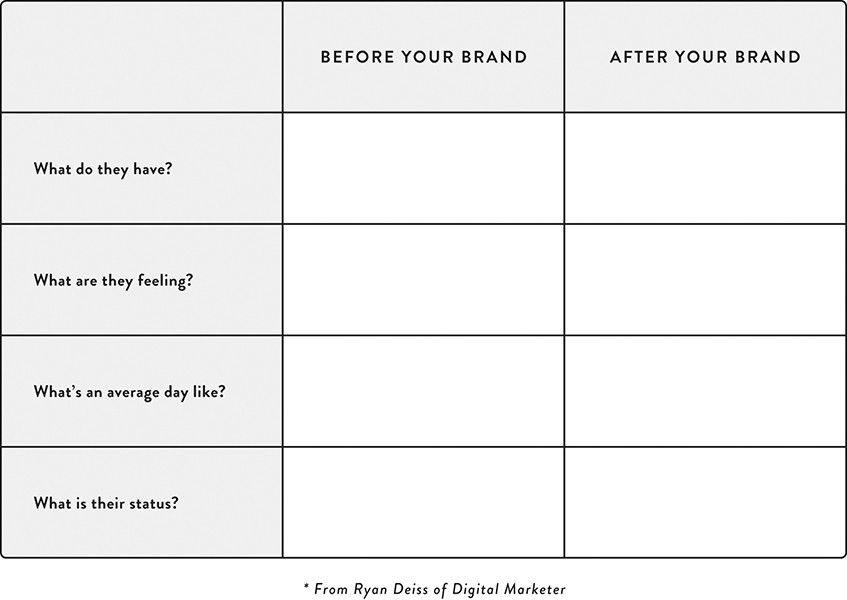
Filling out this grid for your brand is a terrific exercise. Once you know how your customers’ lives will change after they engage your brand, you will have plenty of copy to use in your marketing collateral.
The next step is to say it clearly. We must tell our customers what their lives will look like after they buy our products, or they will have no motivation to do so. We have to talk about the end vision we have for their lives in our keynotes, in our e-mail blasts, on our websites, and everywhere else.
Images are also important when it comes to casting a vision for our customers. If you’re selling kitchen flooring, your website might show a happy mom picking up her child from the beautiful and sparkling kitchen floor. If you’re selling education, show us students in the classroom having a great time learning in the environment you provide. Whatever it is you sell, show us people happily engaging with the product.
HOW TO END A STORY FOR YOUR CUSTOMER
Ultimately, the success module of your StoryBrand BrandScript should simply be a list of resolutions to your customers’ problems. Brainstorm what your customer’s life will look like externally if their problem is resolved, then think about how that resolution will make them feel, then consider why the resolution to their problem has made the world a more just place to live in. When we resolve our customers’ internal, external, and philosophical problems, we’ve truly created a resolution that will satisfy their story.
If you want to take the concept a little deeper, it’s worth exploring how most stories are resolved by story experts. Over the centuries, storytellers have learned what really gives an audience closure and a sense of satisfaction.
The three dominant ways storytellers end a story is by allowing the hero to
1. Win some sort of power or position.
2. Be unified with somebody or something that makes them whole.
3. Experience some kind of self-realization that also makes them whole.
The fact that these are the three most-employed story endings implies these are three dominant psychological desires shared by most human beings.
If our brand can promise a resolution that associates with one of these powerful desires, our BrandScript will be effective and our message will be enticing.
Let’s explore the three desires more closely:
1. Winning Power and Position (The Need for Status)
When I was in high school, a film came out called Can’t Buy Me Love in which a likable loser named Ronald Miller falls in love with a popular cheerleader named Cindy Mancini. Unfortunately for me, Ronald’s character was so overlooked and invisible in his school that most people called him Donald. You can imagine the teasing I received.
But we loved the movie all the same. Why? Because in the end, of course, Ronald gets the girl. But he gets more than the girl. He gains status. After winning the heart of Cindy, he becomes one of the popular kids, or, more accurately, he realizes trying to be somebody else is a waste of time, which, of course, makes him more popular.
Regardless, everybody wants status, which is evidenced by the number of “coming-of-age” stories in which a character realizes they’ve got what it takes to run with the big dogs.
As I mentioned earlier in the book, the primary function of our brain is to help us survive and thrive, and part of survival means gaining status. If our brand can participate in making our customers more esteemed, respected, and appealing in a social context, we’re offering something they want.
So how can our brand offer status? There are many ways:
Offer access: My wife loves using her Starbucks membership card because it gains her points, which gains her status and the occasional free latte. We’ve had many conversations about the intangibility of said status, but I’ve learned not to argue. She’s excited to be on her way to some kind of double-pump jazzy diamond level, which I’m pretty sure means she can cut in front of people at the drive-through.
Create scarcity: Offering a limited number of a specific item creates scarcity, and owning something that is scarce is often seen as a status symbol. When Jeep puts a badge that reads “limited” on the back of their Grand Cherokee, they’re promoting the scarcity of the luxury SUV.
Offer a premium: Most companies earn 70 percent or more of their revenue from a small percentage of their clients. Few, though, identify those clients and offer them a title such as “Preferred” or “Diamond Member.” I love being an “Emerald Club” member with National Car Rental because it means I get to bypass the counter, jump in a car, and drive off. We even recommend a status-associated title for the nonprofit brands we work with. People will be much more likely to donate if they know they are an “Anchor Donor” and even more likely if they get special privileges like updates from the founder or access to other anchor donors at fund-raisers.
Offer identity association: Premium brands like Mercedes and Rolex sell status as much as they do luxury. Is it worth it? Depends on who you ask. Status really does open doors, and by associating their brand, and thus their customers, with success and refinement, they offer them status.
2. Union That Makes the Hero Whole (The Need for Something External to Create Completeness)
The reason stories often end with the union of lovers has little to do with the desire for love or sex. Rather, union between male and female characteristics fulfills in the reader a desire for wholeness.
When the prince rescues the princess and they unite in a wedding at the end of the movie, the audience subconsciously experiences the joining of two halves. The subconscious idea is that the man needs to become more like a woman and the woman needs to become more like a man in order to be whole.
This need to be completed by an external source doesn’t have to include a wedding or even a male or female character, however. A superhero deficient in a particular way could be helped out by another superhero who reenters the story at the end, for example.
The controlling idea of this kind of ending is that the character is rescued by somebody or something else that they needed in order for them to be made complete. In love stories, of course, it’s all about the union of male and female characteristics, but the emotional need this kind of story resolves is much greater. It’s about being made whole by external provision.
So what are some of the ways we can offer external help for customers looking to become complete or whole? Here are a few examples:
Reduced anxiety: For years, brands that sell basic items like dish detergent and glass cleaner have almost comically positioned their products as anti-anxiety medication. As the hero in the commercial uses the product, his or her sense of frustration subsides until, at last, they’re able to see their bright shining face glowing back at them in the polished platter, and then off they go into the sunset. What is the brand really offering? Satisfaction for a job well done. A feeling of closure about a clean house. A better, more peaceful life. Will the use of your product lead to the relief of stress and a feeling of completeness? If so, talk about it and show it in your marketing material.
Reduced workload: Customers who don’t have the right tools must work harder because they are, well, incomplete. But what if a tool you offer could give them what they’re missing? Whether they’re selling wheelbarrows, software, jackhammers, or a fishing apparatus, manufacturers have been positioning tools as “the thing that will make you superhuman” for decades.
More time: For many customers, time is the enemy, and if our product can expand time, we’re offering to solve an external problem that is causing an internal frustration. Not being able to “fit it all in” is often perceived by our customers as a personal deficiency. Any tool, system, philosophy, or even person who can expand time may offer a sense of completeness.
3. Ultimate Self-Realization or Acceptance (The Need to Reach Our Potential)
Movies like Rudy, Hoosiers, and Chariots of Fire all tap into the human desire to reach our potential. And it’s not just sports movies. Legally Blonde, The Theory of Everything, and Whiplash are all about heroes who face great odds in their journey to prove themselves. Once proven, the heroes realize an inner peace and can finally accept themselves because they’ve reached their potential.
An outward demonstration of worth isn’t always necessary to create this kind of resolution. Heroes can also take an internal journey to come to the same conclusion. When Bridget Jones realized she was too good for the boss with whom she desired a relationship, she came to an ultimate self-realization that returned her to a place of peace and stability. And while it’s true she didn’t close the story loop of uniting with the man she wanted, resolution is brought about as she abandons that goal in exchange for the greater fulfillment of self-acceptance and contentment.
In 2013, the soap company Dove released a series of short films featuring women who were the subjects of an FBI-trained forensic artist. Without actually seeing the women, the artist would draw each woman based on how she described herself. Later, the artist would draw the same woman based on how a stranger described her. The reveal was shocking. The sketches drawn from the stranger’s description were always more beautiful than the ones in which the women described themselves. The point: many women don’t realize how beautiful they are. The ad was an attempt to help women accept themselves and find greater contentment in their intrinsic beauty.
Whether it’s by fulfilling some purpose or accepting themselves as they are, this return to contentment resolves something in a story that is universally human: the desire for self-acceptance.
How can a brand offer a sense of ultimate self-realization or self-acceptance? Here are a few ideas:
Inspiration: If an aspect of your brand can offer or be associated with an inspirational feat, open the floodgates. Brands like Red Bull, Harvard Business Review, Under Armour, The Ken Blanchard Company, Michelob Ultra, and even GMC have associated themselves with athletic and intellectual accomplishment and thus a sense of self-actualization.
Acceptance: Helping people accept themselves as they are isn’t just a thoughtful thing to do; it’s good marketing. Not unlike the Dove campaign, American Eagle turned heads when they launched their Aerie campaign. In the campaign, American Eagle used real people as models and refused to retouch the images. Tackling body-image issues, American Eagle went beyond basic product promotion and contributed to universal self-acceptance among their clientele.
Transcendence: Brands that invite customers to participate in a larger movement offer a greater, more impactful life along with their products and services. Tom’s Shoes built a name for itself by selling stylish shoes while simultaneously giving a pair to somebody in need in what they called a “one for one” model. Those who wore the shoes claimed a major factor in deciding to make the purchase was a sense of involvement with a larger movement. At less than ten years old, the for-profit brand sold for more than $700 million. Another example of a brand that helps customers achieve a level of transcendence is Daymond John’s clothing brand FUBU, an acronym for “For Us By Us,” in reference to the African American community being represented in the marketplace. The brand offers more than fashion; it offers a sense of unity, transcendence, and entrepreneurialism for the African American community.
CLOSING THE STORY LOOPS
The idea behind the success module in the SB7 Framework is that we offer to close a story loop. Human beings are looking for resolutions to their external, internal, and philosophical problems, and they can achieve this through, among other things, status, self-realization, self-acceptance, and transcendence. If our products can help people achieve these things, we should make this a core aspect of our brand promise.
KEEP IT SIMPLE
Offering to close a story loop is much more simple than you think. Even the inclusion of smiley, happy people on your website is a strong way to offer the closing of a story loop. People want to be happy, and those images promise your product will deliver.
If you sell rugs, a successful resolution might be a beautiful floor or a room that finally feels finished. If you sell ice cream, a successful resolution might be a rich, creamy taste of heaven. Camping gear? An adventure to remember.
While I’ve been slightly philosophical in this chapter, try not to overthink it. What problem are you resolving in your customer’s life, and what does that resolution look like? Stick to basic answers because basic answers really do work. Then, when you get good, start diving deeper into the levels of problems your brand resolves.
The important idea in this section is that we need to show repeatedly how our product or service can make somebody’s life better. If we don’t tell people where we’re taking them, they won’t follow. A story has to go somewhere.
Have you told your customers where you want to take them?
CLARIFY YOUR MESSAGE SO CUSTOMERS LISTEN
• Go to mystorybrand.com and either create a StoryBrand BrandScript or log in to your existing BrandScript.
• Brainstorm the successful resolution you’re helping your customers achieve. What will their lives look like if they use your products and services?
• Use the bullet points in the success module of your BrandScript to capture your best answers.

Now that you’ve created your StoryBrand BrandScript, let’s take a look at the biggest motivator your customer has for making a purchase: the desire to become somebody different.