9
9Spotting Sensory Preferences
9Recognizing which senses other people rely on to experience the world and then using this information in your dealings with others—whether personal, professional or social—can have a profound effect upon how they respond to you. This chapter deals with picking up the initial cues that other people give us without knowing it. Whether Visual, Auditory or Kinesthetic, their signals are there for us to interpret and utilize in establishing rapport.
In the question period at the end of one of my seminars, a middle-aged woman in the second row asked slowly, “Do you feel that it’s hard to put your finger on what a person’s sensory preference is?” This delightful woman wore a big, comfortable knit coat and was twiddling her finger slowly through her hair as she spoke. I thanked her for the question and immediately asked her not to move. Obviously a very good-natured person, she froze in position. “I’m going to ask you to repeat your question in exactly the same way,” I said to her. “But I want the rest of the audience to observe. Is that okay?” She nodded, paused and repeated her question, complete with hair twiddling. There was a collective smile from the other people in the audience as they understood what they had just witnessed. Then the lady herself looked up toward the top of her head and chuckled.
Her choice of the words “feel,” “hard” and “put your finger on,” her easy way of speaking, her comfortable coat, her slightly full figure and her habit of playing with her hair were quite the giveaways. She had dropped enough clues to give the whole audience a strong indication as to what this woman’s sensory preference might be.
You weren’t there, but what sense do you think she most relies on?
You’re right on if you said Kinesthetic.
Each group displays subtle differences in physical and mental makeup. These are definitely not hard-and-fast distinctions. They are simply indicators. Visuals, Auditories and Kinesthetics can come in all shapes and sizes. We are dealing with people here, unique individuals with unlimited beliefs and values, opinions and talents, shades and sparkles, innuendos and dreams. Each one is different; yet, deep down, there are fundamental similarities. Find a person who strongly favors one sense in a number of the areas discussed in this chapter, and chances are that he or she will be signaling a personal sensory preference.
A quick tip:
Visuals usually talk very fast.
Kinesthetics tend to talk slowly.
Auditories fall somewhere in between.
As you become aware of the differences among these three groups of people, Visual, Auditory and Kinesthetic, what seems subtle at first will become more and more obvious to you.
Perhaps you’ve had the experience of buying a new car. Let’s say you bought a nifty little blue Prius. Very unique? Not quite. Suddenly blue Priuses are everywhere. Whereas before you only noticed them once in a great while, you start to see them all over the place. Of course, these cars were there all the time—they just held no interest for you.
When you become more accomplished at distinguishing one person from another, the same thing will happen. The distinctions will reveal themselves before your eyes. And yet they’ve been there all the time.
TV talk shows are a great place to brush up on your preference-spotting talents. The late shows, where everyone tends to overdress, are usually not the best venues for this exercise. Far better are the interview shows with hosts like Charlie Rose or Larry King or local talk shows where people are more themselves.
Turn down the volume and try to figure out—through physical appearance, hand gestures, eye movements and clothing—whether the person is a V, an A or a K. Then turn up the volume and listen to the words, the pace of speech and the tonality of the voice.
You can do the same with radio interviews. Concentrate on the words. Radio talk shows are a mine of information about sensory preferences. You can practice while you’re stuck in traffic.
Take it slowly. Have fun.
Visual people care a lot about how things look. They need to see proof, or evidence, before they take anything seriously. Being visualizers, they think in pictures and wave their hands around, sometimes touching their pictures when talking. Pictures come quickly into their mind’s eye, so they think clearly; this makes them the fast talkers among us. Sometimes they are the ones with the monotonous voices. Visuals frequently look up to the left and right when they speak. When it comes to their wardrobe, they tend to be snappy, impeccable dressers who put a lot of work into looking good and surrounding themselves with good-looking stuff. Physically, because they are concerned with appearances, they aim to be trim and tidy. When they stand and sit, their body and head will usually be upright.
You will find Visuals working where confident, fast decisions are needed or where specific procedures are to be followed. They want to have control because they probably have some kind of vision of how things should be. Many—but definitely not all—visual artists fall into this category.
Auditory people respond emotionally to the quality of sound. They enjoy the spoken word and love conversation—but things must sound right for them to tune in and give their attention. They have fluid, melodic, sensitive, persuasive, expressive voices. “Audis” move their eyes from side to side as they talk and gesture somewhat less than Visuals; but when they do, it’s from side to side, like their eye movements. When it comes to clothes, they think they are snappy dressers. They like to make a statement with their clothing—and sometimes they don’t quite make it. Physically, they are somewhere in between the trim Visuals and the comfortable Kinesthetics.
Audis work where words and sound are the currency. Many broadcasters, teachers, lawyers, counselors and writers are Auditory.
For our sensitive “Kinos,” things have to be solid, well constructed and right-feeling in order for them to go along. They have lower, easygoing voices and gestures. Some Kinesthetics have been known to speak unbelievably slowly and add all sorts of unnecessary details that can drive Visuals and Auditories to the point of wanting to yell, “Please, for heaven’s sake, get to the point!” That’s just the way many of them are. The fact of the matter is that it takes longer to put feelings into words than it does to translate pictures or sounds into words. When they speak, Kinos will look down, toward their feelings. They enjoy the way things feel. They like textured clothing with quiet tones. Any man with permanent facial hair may well be Kinesthetic. You’ll find Kinos in hands-on positions: plumbers, electricians, carpenters, product salespeople and workers in the arts, medicine and the food business.
Physically, there are two types of Kinos: in one group are the athletes, dancers, emergency services and trades folk, the superfit types for whom the physicality of touch and contact are paramount; in the other group are the sensitive, laid-back, down-to-earth, bighearted types who may have a higher proportion of heavier bodies among their number.
This simple technique has proved helpful in determining a person’s sensory preference. Start by asking a couple of nonspecific questions: “Do you live in the city or out in the suburbs?” followed up, after the response, by “Do you like it?”
If the answer is yes, ask, “What do you like most about it?” (If the answer is no, follow with “What don’t you like about it?”)
As the reasons are given, push for more. Expanding on answers like “Well, for one thing, it’s peaceful” can be encouraged by the question “What else?” And don’t stop there. Pursue your line of questioning until you have enough verbal cues to get a handle on the person’s favorite sense.
You can probably see for yourself that the chances of establishing a loving relationship with someone “like” you are high. But is this always a good idea? Yes and no. If you want to spend your life with someone very much like you, then yes. But what if you want some spark and excitement?
I am frequently asked whether there is any validity in the age-old aphorism that opposites attract. The answer is yes, they most definitely do. But how? And what do they attract?
First let me say that this book is about establishing rapport and making people like you. If rapport and liking lead to friendship and romance, that’s up to you. I like, trust and care about a lot of people, but they are not all my friends and they are definitely not my partners. Falling for someone romantically is more complex. To write my book How to Make Someone Love You Forever in 90 Minutes or Less, we questioned nearly 2,000 people whose relationships have lasted more than 20 years and are still vibrant. We found a simple pattern. I coined the term “Matched Opposites” because these great couples are a blend of “like attracts like,” because they actually like each other, and “opposites attract,” because there has to be an ongoing spark. Some of the “opposites” part can be seen in their patterns of sensory preferences. In this aspect, most were complete opposites.
You’ll remember from the self-test in Chapter 8 that the tally at the end allowed you to rank your preferences. Let’s use my own rating as an example. I ranked first A, then V and last K, or AVK. The complete opposite of my ranking would be KVA. Stack these side by side and they look like this:
A K
V V
K A
This would give us opposites at the top, A and K, for spark and interest, but the same in the middle—in this case, V. The relationship is held together by the common visual link, a mutual subconscious sharing of the same wavelength. And the relationship is kept vital by the opposing A and K as primary personal sensory preferences.
My observation is that when two people “meet in the middle” and share a central sensory preference, whether Visual, Auditory or Kinesthetic, it is that bond that will get them through the rough times and add sparkle to the good times. Any shared sensory preferences, be they primary, secondary or tertiary, will work in the favor of the relationship when the going gets tough.
There are no fixed rules here, except that the people you meet will tend to reveal how they change their experiences into words by the types of words they favor. Listen for these words and take them into account when you set out to establish rapport.
A tendency to favor “picture” words and metaphors—“if we look more clearly,” “the difference was like night and day”—may be a strong indication that the person relies mainly on the visual sense.
For one entire day—from dawn to dusk—focus on the Visual words and phrases that you hear in other people’s vocabulary. Notice them until they appear as clear as the three extremely visual words I just used in this one sentence. The list of picturesque words below will give you perspective and focus as you observe people who scrutinize the world with their eyes. Then demonstrate how well you can use these Visual words. Make the effort in your conversations with other people to “talk in color” by painting word pictures. Describe your experiences vividly so other people can “see” them.
analyze
angle
appear
aspect
blind
bright
brilliant
clarity
clear
colorful
conspicuous
dark
diagram
dim view
dull
enlighten
envision
examine
focus
foresee
fuzzy
glance
glare
glimpse
glow
hide
hindsight
illuminate
illusion
imagine
inspect
light
looks great
mental picture
mind’s eye
obscure
observe
outlook
oversight
notice
peek
perception
perspective
picture
plainly
portray
reflect
reveal
see
scrutinize
show
sketch
staring
survey
view
vision
vivid
watch
witness
zoom in
How do you see yourself?
It’s a bit hazy right now.
I see what you’re saying.
He’s such a colorful character.
A sight for sore eyes.
Let’s get some perspective.
We are a company with a vision.
We see eye to eye on the subject.
It’s a bit vague. Beyond a shadow of a doubt.
See you later.
Can you imagine? Let me make this clear.
Can you shed some light on this?
We have a bright future.
Tune in to Auditory words and phrases as people express themselves to one another. Call to mind and amplify all those harmonious discussions within your hearing range until you are well informed about how they sound. Listen to how these Auditory words just click into place! Open your ears to those who see and feel the world through their hearing. You’ll get the message loud and clear.
announce
articulate
babble
blabbermouth
boom
call (me)
chime
clang
clash
click
converse
crashing (bore)
deaf
debate
describe in detail
discuss
divulge
earful
earshot
express yourself
gossip
harmonize
hear
hidden message
hush
idle talk
inquire
listen
loud
manner of speaking
mention
noisy
outspoken
overtones
phrase
proclaim
pronounce
question
quiet
rasp
remark
report
resonate
resounding
roar
rumor
say
scream
shout
shrill
silence
speak
speechless
squawk
state
talk
tell
tinkling
tone
tongue-tied
tune in/out
unheard of
utter
vocal
well-informed
whine
word-for-word
yell
Sounds familiar.
Tell me more.
Does what he said ring a bell with you?
He gave a satisfactory account of himself.
At last we have harmony at home.
They granted me an audience.
She had me completely tongue-tied.
These colors are really loud.
I didn’t like his tone of voice.
Let me tell you.
Tell me how.
She’s a scream.
In a manner of speaking …
I want everybody in the room to voice an opinion.
He received thunderous applause.
That’s as clear as a bell.
Hold your tongue!
The following physical words are the currency of the Kino. Tap into the emotions around you until you get a handle on how they flow. Overcome any and all stumbling blocks. Build a firm foundation on which you can base your own contact with other people. Use those concrete, touching words that move Kinesthetic people, thanks to their sensitivity to feelings.
bearable
boils down to
break
catch on
cold
come to grips with
concrete
connect
dig
emotional
explore
feel
firm
(go with the) flow
foundation
freeze
grasp
hand-in-hand
handle
hard
heated
hold
hunch
hurt
intuition
light-headed
make contact
motion
muddled
nail
pain in the neck
pressure
push
rush
sensitive
set
shallow
sharp
shift
shocking
smooth operator
softly
solid
sort through
squeeze
stir
strain
stress
stretch
structured
support
tap into
tension
throw out
tied up
topsy-turvy
touch
unbearable
underhanded
unfeeling
unravel
unsettled
warm
How do you feel about … ?
There were a few stumbling blocks.
I’ll get in touch with her.
It slipped through the cracks.
I’m all shook up.
I’m not following you.
Let’s sort things out.
Get a load of this!
Can you pull some strings?
She came to grips with the problem.
Get over it.
I can’t handle the pressure.
He’s a pain in the neck. Stay in touch.
Hang in there.
I can’t put my finger on anything concrete.
Start from scratch.
Walk me through the ceremony one more time.
I felt calm, cool and collected.
Let’s explore the possibilities.
Over the years, I have shot more fashion magazine covers with more models in more countries than I can remember, and frequently the models’ first language was not English. When all you have to work with is a face, neck and shoulders (and, of course, the extraordinary talents of hair, makeup and fashion stylists), you soon realize that, besides subtle tilts and leans, most of the “innuendo” suggested by this kind of close-up comes from facial expression—from the eyes and mouth. When you want a model to smile, you don’t tell her to smile. You make her smile.
To initiate eye movements, there are a few code words that always seem to work in any language. When you want your subject to look up and to the side, it’s enough to say, “Just dream,” and up go the eyes to one side or the other. Words such as “secret” or “telephone” will send the eyes sideways toward the ears, and “sad,” “romantic” or “thoughtful” will normally send the eyes down and to the left or right.
Once again, the originators of NLP had observed these phenomena of eye movements and codified them into an intriguing paradigm. On the basis of their findings, we can think of the human eyeball as a six-way switch that must be flicked into any one of six positions as it searches for information—each position activating a sense, sometimes to remember, sometimes to create an answer.
If you ask a man to tell you the color of his favorite shirt, you may see him look up and to his left as he pictures the shirt before he gives you an answer. Ask a woman to tell you what silk feels like, and chances are she’ll look down and to her right as she remembers how silk feels in her mind. In other words, when asked a question, people often have to look away in order to generate the answer. The reason is quite simple: they are accessing their senses.
Keep your eye on the ball. Turn down the sound on your TV during an interview and watch the guest’s eyes hunt about for answers to the interviewer’s questions.
Before you read any further, go and ask someone a question. Without telegraphing your intent, look the person in the eye and ask a nonspecific question such as “What did you like most about your last holiday (or birthday or job)?” Then watch as the person’s eyes dart off to get the information. This will give you a fairly good idea of how he or she stores and accesses information, i.e., as pictures, sounds or feelings. Consistent references to one sense are also an indication of sensory preference.
People who answer such questions while looking up to the left or right are most likely visualizing their answer. If they look left or right toward their ears, they are probably recalling sound information. If they look down to the left, they may well be accessing their feelings, and down to the right indicates some type of internal dialogue. Research has varying views as to the validity of these NLP eye cues, but I find them fairly accurate, and most importantly they lead to proactive eye contact for many people who are often too shy to look another person directly in the eye without discomfort.
Another valuable detail to be aware of here is that when we look to the left, we are remembering information, while looking the other way, to the right, means we are constructing it.
Keep in mind that when you converse with someone, there may be several mental activities going on at once. For example, a fellow asks a young woman, “Seen the latest Bruce Willis movie?” “Yes, I have,” she says, going into her mind and picturing herself in the waiting line as she remembers. But at the same time she’s having an internal dialogue: “What a boring twit. Am I judging too quickly? No, he’s a bore. How can I dump him?” Then he says, “Wanna go out Saturday night?” Grasping for any excuse, she finally mutters, “Gosh, I can’t, I have to, er, finish off a report for a Monday-morning deadline,” her eyeballs darting off to the other side as she constructs a picture of herself at the kitchen table with her laptop.
Feeling a bit confused? Look at this diagram:
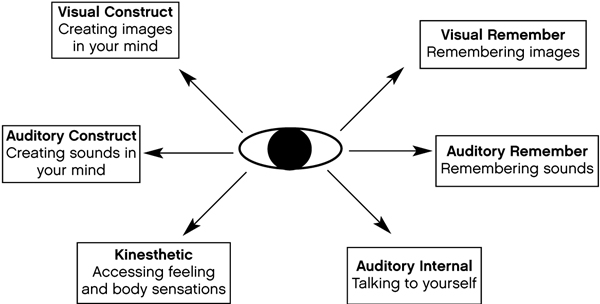
To avoid all confusion, imagine that this diagram is pasted on the forehead of the person you’re facing. Don’t worry about the person’s left vs. your right; simply look at the diagram as if you were directly facing the other person. (In general, the directions apply to right-handed people, who make up 90% of the population.)
Incidentally, these actions are not the same as the movements your eyeballs make when you look around a room or across a landscape—they are totally independent of the requirements of the ability to see. Your eyeballs serve two purposes: 1) roving about to see what’s going on; 2) activating sensory memory channels.
When you first begin looking for eye cues, people’s eyes may appear to dart about randomly. All you need is a little practice at reading these movements.
Have fun, let it happen naturally and, above all, never tell anyone what you’re doing. That would, quite rightly, make people self-conscious and embarrassed. Keep these skills to yourself.
An Exercise in Spotting Preferences
Brain Lock
Challenge a friend to answer the following questions without moving his eyes. Tell him to look directly at you at all times and to keep his eyeballs perfectly still. Then ask the first question:
“Do you like the house (apartment or whatever) you live in?”
Depending on whether he answers yes or no, ask this follow-up question:
“Quickly list six things you like (or don’t like) about where you live.”
Either your friend will be completely tongue-tied, or he’ll find himself struggling to think of his answer. Searching for how things look, sound or feel without any eye movement is almost impossible. He’ll be like a rabbit paralyzed in the grip of a car’s headlights.
Hypnotists know that if they can stop your eyeballs from moving, you won’t be able to think. A meditative state is easily accessed in the same way. Stare at a stationary spot with your eyes open, or place your attention in one spot—your forehead, for example—with your eyes closed. Provided you can keep your attention fixed, you will stop your inner dialogue and lose all sense of time.
The Eyes Have It
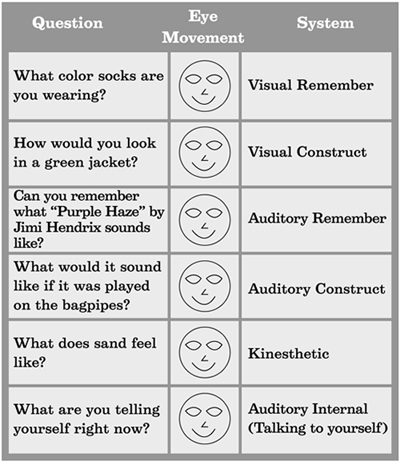
Using the diagram as a guide, pencil in the eyeball position you would expect to see in response to each question below.
The print edition of this book includes a chart for An Exercise in Eye Cues.
Please download a PDF of the chart here:
It’s her 40th birthday, and Ingrid has decided to treat herself to an all-inclusive holiday in Portugal. She’s wandering through her neighborhood mall when she discovers a travel agency that she hasn’t noticed before. There she meets Sheldon, who runs the place, and tells him of her exciting plans.
“I just feel I need to get away and pamper myself at long last!” Ingrid says to Sheldon as she sits down in a chair facing his desk. She smooths out her dress over her knees and looks down to her right. “I’m under so much pressure at work that I really need to unwind.” Sighing, she crosses one leg over the other, leans forward and shakes her head slightly. “The tension at the office is eating me alive.”
Sheldon is delighted. An obvious sale is sitting right there in front of him. He leans back in his chair, opens his arms wide, then slaps his hands together sharply and smiles at Ingrid.
“Oh boy,” he says, “have I got the dream vacation for you.” He riffles through a pile of brochures on his desk. “Just feast your eyes on this!”
He hands Ingrid a colorful brochure plastered with the usual palm trees and bright blue skies, then continues his pitch without waiting for her reaction:
“Looks fantastic, eh? Check out the color of the water—brilliant turquoise! Look at these cute villas with their red-tiled roofs! And can’t you just see yourself on that long white stretch of beach?” He looks up and to his right, just imagining the view.
Ingrid slides back in her chair, her heart sinking. Somehow, despite the gorgeous pictures in the brochure, despite Sidney’s passionate descriptions, Portugal feels farther away than ever.
What’s the problem?
You guessed it. Ingrid understands the world through her feelings. Look at her words: she “feels” that she wants to “pamper” herself; she longs to “unwind” from the “pressure” and “tension” at her office. Her language, intonation and gestures are a giveaway. She looks down toward her feelings. What counts most to Ingrid is the way things feel.
If Sheldon had been watching for cues, he would have gently led her toward a feeling of confidence and anticipation and warmth. “Okay, Ingrid,” he would have said. “I follow you. I know what you mean about pressure, and I have just the place for you. I’ve actually been there myself. The sand is warm and soft, and, oh, the feel of those gentle waves as they break over you and around you! And the beds in these particular villas are amazingly comfortable and cool …” He would have accessed the same channel that Ingrid has been tuned in to for the past four decades.
Sheldon should have taken the four steps of rapport by design to “connect” with his customer:1) adopting a Really Useful Attitude to lead her toward his goal; 2) synchronizing her body language and voice tone during their conversation;3) using open questions and actively listening to her responses; and 4) picking up on her sensory preferences along the way.
The implications of verbal and eye cues discussed in this chapter are vitally important to anyone who wants to “connect” with other human beings and establish rapport by design. When you learn to recognize which “type” or “group” a new acquaintance belongs to, you will be able to communicate with him or her on a more appropriate wavelength, be it Visual, Auditory or Kinesthetic.
In this way, you will be hours—sometimes years—ahead of where you would have been if you had not known how to figure out an individual’s sensory preference.
Developing a knack for detecting sensory preferences means paying close attention to others—and this alone makes you more people oriented.
On the next pages you will find four quick, written exercises that will help you consolidate your learning. Fill in what you can without referring back to this chapter or to the chapter before it.
Auditories will want to talk their way through these exercises and tell themselves the answers, and Visuals will want to picture the answers in their head, but the answers must be written down. Writing down the answers will oblige you to use all three senses—and that’s the quickest way to incorporate this information into your memory and your life skills.
After you’ve filled in as much as you can, flip back over the previous pages to add to your answers.
The print edition of this book includes fill-ins for The Big Picture.
Please download a PDF of these fill-ins here:
The foregoing “clues” in spotting sensory preferences are generalizations, of course. But when several of these generalizations point in the same direction, the chances are pretty good that you have discovered the primary way a person perceives the world. This will be your most effective tool in establishing rapport and connecting with others.