8
8Making Sense of Our Senses
8On one level, we humans are not much more than mobile sensing devices. We see, hear, feel, smell and taste. And then we process the information gained through our senses into words, then thoughts, ideas, actions and habits (in that order), which in turn forms our personality. Every day, we experience the world through sensory input, and then we explain our experiences to ourselves and to others. That’s it. We go to bed and get up the next day and experience all over again. This is how we evolve. Obviously this is a major oversimplification, but it’s a good place to start.
There are basically two ways, or styles, of explaining our experiences using words. One positive, the other negative. Upon waking up in the morning and seeing that it’s raining outside, an individual with a negative explanatory style might say, “Oh, heck, it’s raining. It’s going to be a lousy day,” whereas someone with a positive style might say, “Hey, free car wash, and great for the garden.” Given the same information, some people are very good at spotting problems while others are good at spotting opportunities. And so, our really useful, or useless, attitudes are triggered by pictures, sounds and feelings.
We can loosely categorize these responses into familiar mind-sets and patterns. In the 1970s Richard Bandler and John Grinder, the founders of Neuro-Linguistic Programming, noticed in their early work with clients that people could be roughly divided into three types, depending on how they filtered the world through their senses. They called these types Visual, Auditory and Kinesthetic. Let’s say three students go to a rock concert. Judy is primarily Visual, Phyllis is Auditory and Alex is Kinesthetic. When they later describe their experience to their friends, Judy will paint word pictures to tell what the concert looked like: “Oh, wow, you should have seen it—all these people jumping about and the singer ripped his pants and his toupee flew off!” Phyllis will say what the concert sounded like: “The music was incredible. The beat was deafening; everyone was yelling and singing along. You should have heard it. It was a real screamer!” Alex, who relates to feelings and touch, will describe what it felt like: “Oh man, you could just feel the energy. The place was packed. We could hardly move, and when they played ‘Blue Rodeo’ the whole place erupted.”
In other words, Visuals tend to use picture words, Auditories choose sound words and Kinesthetics favor physical words.
What we are talking about here is a new dimension of synchrony and rapport. This chapter will go beyond attitude, body language and voice tone to the very way our senses take in and literally make sense of the world around us.
Because we receive our information from the outside primarily in pictures, sounds and feelings, these are the three ways in which we can be inspired: by something we see externally, or internally in our mind’s eye as an image or a vision; by something we hear either externally or emanating from that little voice inside; or by something we feel or touch. Usually it’s a combination of these experiences that helps us interpret the outside world, but one of these three senses—sight, sound or touch—tends to dominate the other two.
To the untrained eye (or ear), all of us look, sound and feel just like ordinary folks; however, to the trained person there are subtle but important differences. As you might imagine, an individual who gives primary importance to the way things look will be concerned with and influenced by appearances. Similarly, someone to whom sound is important will respond to the way things sound, and a person who experiences the world through physical sensations will be concerned with the way things feel, both internally and externally, through touch.
Last year I was listening to two politicians being interviewed on the radio. They were both thinking of running for the leadership of their party. When the interviewer asked them to “voice their plans,” one said, quite thoughtfully, “I’m leaning heavily toward giving it a shot.” The much quicker response from the other man was “Now that we have a clearer view of the future, I can see the possibilities.” The interviewer responded, “Sounds like you’re both ready to announce your intentions.”
What do you reckon? Can you grasp the distinction? The interviewer, using phrases like “voice your plans” and “announce your intentions,” was probably Auditory. (In all fairness, that would be natural language to use on the radio, but still a surprising number of radio hosts turn out to be Auditory.) The first aspiring leader used physical language—“lean heavily,” “give it a shot”—and spoke deliberately, indicating a Kinesthetic inclination. The second hopeful candidate had “a clearer view” and could “see the possibilities,” and therefore came across as pretty Visual to me.
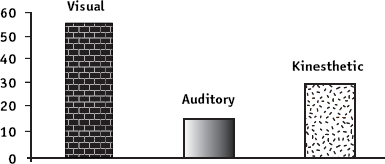
Of course, no one is totally Visual, utterly Auditory or 100% Kinesthetic. Naturally, we are a mixture of all three. Yet, in every person, one of these systems (rather like left- or right-handedness) dominates the other two. Studies have shown that as many as 55% of all people in our culture are motivated primarily by what they see (Visual), 15% by what they hear (Auditory) and 30% by physical sensation (Kinesthetic).
Take the self-test on pages 120–123, and you’ll begin to see why you connect easily with some people when you first meet them but not at all with others, and why you feel as if you know certain people even though you’ve never seen them before. It comes down to natural sensory harmony. When two Visuals meet, they are familiar to each other because they see things the same way (this doesn’t mean they agree) and express their experiences in the same way. The same goes for two Auditories or two Kinesthetics. On the other hand, if the person you meet sees, hears or feels the world in a different way from yours, you need to learn how to recognize that fact and how to adapt and tune in to his or her wavelength to establish rapport that can lead to a meaningful friendship or relationship.
To give you an idea of how sensory preferences impact on our day-to-day life, let me tell you about my own situation. I am Auditory and my wife is Kinesthetic. If we have a falling out, Wendy knows to connect to me in my “language,” with Auditory words. She gets my immediate attention by saying, “Nick, you’re not listening to me. You’re not hearing a word I’m saying.” If she were to say, “Can’t you see what I’m saying” or, even worse, “Can’t you see how that makes me feel?” the truth is, no, I could not.
Sure, I make the obvious intellectual connection, but I have to stop and think about it; my brain has to take the extra step of translating her language into something I can relate to. When she sends a message on my Auditory wavelength, she makes a direct connection—fast.
Conversely, if I want to connect directly to her sensibilities, I say, “I know how you feel when that happens.” In other words, I use a touchy-feely, Kinesthetic approach. Simple, yet extraordinarily effective.
What’s Your Favorite Sense?
Where would you place yourself among the Visuals, Auditories and Kinesthetics? Like many people, you’ll probably say, “Oh, I’m a Visual, for sure.” But you might be in for a big surprise. Take the following test to see how you tune in to the world. Choose only one answer from each question, and circle the letter next to your answer.
1) If only three rooms are left at a beach resort,
I’ll choose the room that offers
a) An ocean view but lots of noise.
b) Sounds of the ocean but no view.
c) Comfort but lots of noise and no view.
2) When I have a problem,
a) I look for alternatives.
b) I talk about the problem.
c) I rearrange the details.
3) When riding in a car, I want the inside to
a) Look good.
b) Sound quiet or powerful.
c) Feel comfortable or secure.
4) When I explain a concert or event I’ve just attended, I first
a) Describe how it looked.
b) Tell people how it sounded.
c) Convey the feeling.
5) In my spare time, I most enjoy
a) Watching TV or going to the movies.
b) Reading or listening to music.
c) Doing something physical (crafts/gardening) or playing a sport.
6) The one thing I personally believe everyone should experience in his or her lifetime is
a) Sight.
b) Sound.
c) Feeling.
7) Of the following activities, I spend the most time indulging in
a) Daydreaming.
b) Listening to my thoughts.
c) Picking up on my feelings.
8) When someone is trying to convince me of something,
a) I want to see evidence or proof.
b) I talk myself through it.
c) I trust my intuition.
a) Quickly.
b) Moderately.
c) Slowly.
10) I normally breathe from
a) High in my chest.
b) Low in my chest.
c) My belly.
11) When finding my way around an unfamiliar city,
a) I use a map.
b) I ask for directions.
c) I trust my intuition.
12) When I choose clothes, it is most important to me that
a) I look immaculate.
b) I make a personal statement about my personality.
c) I feel comfortable.
13) When I choose a restaurant, my main concern is that
a) It look impressive.
b) I can hear myself talk.
c) I will be comfortable.
a) Quickly.
b) Moderately.
c) Slowly.
Tally:
a’s = ___
b’s = ___
c’s = ___
a) is Visual, b) is Auditory and c) is Kinesthetic. The higher the number in each category, the stronger the tendency.
By taking this test, not only will you now have a strong indication of how your three main senses stack up, but you’ll also begin to understand how people can have differing priorities. However, there are many variables at work here, not the least of which is that you already knew the purpose of the test before you took it. In my seminars, I generally have people complete this test before they realize its significance.
Try it on a few friends and see how they fare. Use their results to further your insight into being able to recognize sensory preferences.
What do sensory types have to do with making people like you in 90 seconds or less? More than you might expect. When you can figure out other people’s sensory preferences, you can communicate on their wavelength. If you want to better relate to your spouse, win a judge over to your side of an argument, make that sale, land that job or impress somebody at a party, recognizing Visual, Auditory and Kinesthetic people can be invaluable.
The day after one of my seminars, I received an excited phone call from a woman who had been sitting in the audience. Her name was Barbara, and she owned a flooring store.
“It’s incredible!” she said. “It’s nine-thirty, we’ve been open for an hour and I’ve just sold to my fifth out of five customers. I’ve never done that before!
“This is perfect for my business,” she continued, referring to my lecture on figuring out the Visual, Auditory and Kinesthetic people we come across in the course of our daily adventures. “The first four sales were probably normal, even though I was aware of what I’d learned. But the fifth … This lady came into the shop dragging her husband along with her. It was obvious that he didn’t want to be there. I figured out immediately that he was a feeler, a Kinesthetic, and within 30 seconds I had him on his hands and knees feeling the carpet. And they bought it.
“I just knew that if I’d said to him, ‘Imagine how this will look in your house,’ he couldn’t do that because he’s not Visual. Or if I’d said, ‘You’ll discover just how quiet it’ll be when your kids run around on it,’ he wouldn’t connect to that, either, because he doesn’t think that way—he’s not Auditory. I knew by the way he dressed and moved and spoke that he was Kinesthetic, so I said, ‘Just feel it.’ And he did. Just like that. He got down on the floor and felt it.”
Find out what you’re getting. Change what you do until you get what you want. These are the “F” and “C” in our KFC. Figure out which sense a person relies on most and change your approach to take this into consideration.
If you’re not sure how to handle a situation, don’t worry. Be prepared to include all three preferences in your approach. Look good for the Visuals; after all, they make up over half the people you’re likely to see during your day. Sound good; develop your pleasing tonality for the Auditories to whom you’ll be speaking. And be sensitive and flexible for the Kinesthetic folk you’ll be bumping into. And, of course, if you’re dealing with a group, the same thing applies. Your group will be made up of all three categories, and you’ll want to appeal to all of them.
Above all, remember that the ability to tune in to the way other people experience the world can be one of the most important discoveries of your life.
A few months ago I gave the opening address at a home builders’ convention. During my talk, I used role-playing (with me playing all the roles) to illustrate some of the behavioral differences that Visual, Auditory and Kinesthetic people display in face-to-face communication. At the end of the talk, a big, tough-looking but well-groomed man pulled me to one side. He was very emotional and looked like he was on the verge of tears. Shaking his head from side to side, he began, “I don’t know what to say. I’m leaving right now to go to my son’s school and give him a hug.” He was choking up. “For years, I’ve been furious with him. When I talk to him, he turns his head away and doesn’t look at me. It drives me crazy, and I yell at him, ‘Look at me when I’m talking!’ He hardly ever looks me straight in the eye when I’m giving him instructions. From everything you’ve said, you’ve made me realize that he’s Auditory, and he’s not ignoring me when he looks away. He’s turning his ear toward me so he can concentrate. And me, I’m Visual, I need eye contact.” He pumped my hand and left.
It’s amazing. Things like this go on right under our noses every day of our lives and we never realized—until now, that is.
The words “I have scoured the four corners of the earth” tell a lot more than “I’ve looked everywhere”; they force the connection to scrutiny, diligence, detail, determination and more. They also easily involve sight, sound and feeling, and this is why metaphors appeal simultaneously to Visuals, Auditories and Kinesthetics. Visuals can picture them, Auditories can hear them and Kinesthetics can get a feel for what’s happening.
Metaphors are containers for ideas. They link our internal imagination to external reality. We use metaphors regularly, often unconsciously, to explain our thinking. We also use them to make things more interesting. Parables, fables, storytelling and anecdotes are some of the oldest and most powerful communication tools we have, and their metaphorical aspects are effective in virtually every setting. They fire up the imagination and appeal to all the senses.
In short, metaphors help to make understanding easier, quicker and richer.
Despite the good Colombian coffee and fresh croissants, the O’Connors are not enjoying a very pleasant breakfast.
“It’s a bright yellow Maserati!” exclaims John. “It’s gorgeous! Can’t you just picture the two of us blazing down the highway to the coast?”
“Actually, I can’t,” says Lizzie icily. “All I can hear are the monthly car bills dropping through our mail slot. I don’t think you ever listen when I tell you we have more important things to spend money on …”
John stomps out of the house in a rage, but that evening, after leaving work, he buys a luxurious, multicolor silk scarf for Lizzie in an attempt to win her over. Arriving home, he finds her in the living room and hands her the exquisitely wrapped box.
“And what is this for?” Lizzie asks distantly as she removes the scarf from its box. “What’s the occasion?”
“Why, it’s just to show how much I love you!” protests John, feeling rejected.
“A scarf doesn’t tell me anything!” Lizzie snaps. She walks crisply out of the room.
John slumps down on the couch, slowly winding the expensive scarf around his hand and tightening it until his fingers throb with pain.
What happened here? John is Visual. He makes sense of the world primarily through what he sees: the yellow Maserati, his “picture” of them in the car, the multihued scarf. Lizzie is Auditory. She hears the car bills dropping through the mail slot; she doesn’t think John “listens” when she “tells” him something.
Can this marriage (or at least the hoped-for Maserati purchase) be saved? You bet. A pair of concert tickets to Lizzie’s favorite band—something that appeals to her ears—would sound much better to her. Here’s how John could have handled it had he been more sensitive to the way Lizzie hears the world:
“I’m really sorry, Lizzie,” declares John in a soft, pleasant voice (after giving her the tickets). He proceeds to use some “auditory” words with his wife. “I’ll tell you what—let’s put some harmony back in this house and talk it through a bit. Does that sound okay to you?”
Lizzie nods, taking in the suddenly more acceptable words and the meaning they convey.
“Have I told you how the Maserati purrs like a kitten and shifts so quietly you can barely hear it?” John asks sweetly. “And wait until we discuss the surprisingly reasonable payments.”
“Oh, I finally see the picture you’re painting, John,” says his wife. “It’s all so clear to me now!”