5
5Actions Do Speak Louder Than Words
5First impressions are powerful. Along with the instinctive fight-or-flight appraisals, we are also weighing the opportunities involved in almost every new face-to-face encounter.
No matter how hard we try, we cannot get away from the fact that image and appearance are important when meeting someone for the first time. Dressing well goes a long way toward making a positive impression as you begin to establish rapport, but how do you make people warm to you? And how do you project the likable parts of your own unique personality?
Your body language, which includes your posture, your expressions and your gestures, accounts for more than half of what other people respond to and make assumptions about.
When we think of body language, we tend to think it means what happens from the neck down. But much of what we communicate to others—and what they make assumptions about—comes from the neck up. Facial gestures and nods and tilts of the head have a vocabulary that equals or exceeds that of the rest of the body.
The signals we send with our bodies are rich with meaning and global in their scope. Some of them are hardwired into us at birth; others are picked up from our society and culture. Everywhere on the planet, panic induces an uncontrollable shielding of the heart with the hands and/or a freezing of the limbs. A smile is a smile on all continents, while sadness is displayed through down-turned lips as often in New York as in Papua New Guinea. The clenched fists of determination and the open palms of truth convey the same message in Iceland as they do in Indonesia.
And no matter where on earth you find yourself, mothers and fathers instinctively cradle their babies with the head against the left side of their body, close to the heart. The heart is at the heart of it all. Facial expressions and body language are all obedient to the greater purpose of helping your body maintain the well-being of its center of feeling, mood and emotion—your heart.
Volumes have been written about body language, but when all is said and done, this form of communication can be broken down into two rather broad categories: open and closed. Open body language exposes the heart, while closed body language defends or protects it. In establishing rapport, we can also think in terms of inclusive gestures and noninclusive gestures.
Open body language exposes your heart and body (within limits of decency, of course!) and signals cooperation, agreement, willingness, enthusiasm and approval. These gestures are meant to be seen. They show trust. They say “YES!”
Your body doesn’t know how to lie. Unconsciously, with no directions from you, it transmits your thoughts and feelings in a language of its own to the bodies of other people, and these bodies understand the language perfectly. Any contradictions in the language can interrupt the development of rapport.
In his classic work How to Read a Person like a Book, Gerard I. Nierenberg explains the value of open gestures. These gestures include open hands and uncrossed arms as well as the occasional subtle movement toward the other person that says “I am with you” and shows acceptance: an open coat or jacket, for example, both literally and symbolically exposes the heart. When used together, such gestures say “Things are going well.”
Positive, open-body gestures reach out to others. These gestures are generally slow and deliberate. When an open person makes contact with the heart of another person, a strong connection is made and trust becomes possible. (You know the feeling of a good hug? Or a heart-to-heart talk? You can accomplish much the same feeling using open body language.)
When you meet someone new, immediately point your heart warmly at that person’s heart. There is magic in this.
Other common open gestures include standing with your hands on your hips and your feet apart, a stance that shows enthusiasm and willingness, and moving forward in your chair (if accompanied by other open gestures). Leaning forward shows interest, and uncrossing your arms or legs signals you are open to suggestions.
Defensiveness is shown through gestures that protect the body and defend the heart. These gestures suggest resistance, frustration, anxiety, stubbornness, nervousness and impatience. They are negative gestures, and they say “NO!”
Crossed arms are common to all manifestations of defensiveness. They hide the heart and defend one’s feelings. Although you can also be relatively relaxed with your arms crossed, the difference between a relaxed crossed-arm position and a defensive crossed-arm position is in the accompanying gestures. For example, are your arms loosely folded or pressed close to your body? Are your hands clenched or open?
Defensive gestures are often fast and evasive and beyond your conscious control. Your body has a mind of its own and is ruled by your attitude, useful or useless. In addition to crossed arms, the most obvious defensive gestures are avoiding eye contact with the other person and turning your body sideways. Fidgeting is another negative gesture, which can also show impatience or nervousness.
Right away, you can see the difference between a person who faces you squarely and honestly, and someone who stands sideways to you with crossed arms and hunched shoulders while the two of you talk. In the first instance, the person is openly pointing his heart directly at your heart. In the second, the posture is defensive; the person is pointing his heart away from you and protecting it. One is being open with you, the other closed. Being in the presence of these two postures produces very different feelings.
Hand gestures are also part of the vocabulary of body language. They, too, can be divided into open gestures (positive responses) and closed or concealed gestures (negative responses), except that their range is far more intricate and expressive. I should point out that individual gestures, just like the individual words on this page, don’t say much. Only when you’re presented with more than one gesture, perhaps combined with an expression and topped off with some overall body language, can you deduce that a particular clenched fist means “Wow, my team won the playoffs!” and not “I’m so mad I want to slap him!”
A similar set of differences occurs in body language above the neck. The open face smiles, makes eye contact, gives feedback, shows curiosity and raises the eyebrows to show interest. In a casual encounter, a quick look and a lowering of the eyes says “I trust you. I’m not afraid of you.” A prolonged look strengthens the positive signal. In conversation, we may use a nod of the head at the end of a statement to indicate that an answer is expected.
In contrast, the closed face frowns, purses the lips and avoids eye contact. And there is yet another negative category to add to facial responses. We politely call it the neutral, or expressionless, face. It’s the one that just gawks at you like a dead trout. In the next chapter, you’ll find out how to react to this “non-face,” which can be very disconcerting if you don’t know how to deal with it.
Frequently I look around at my audiences and recognize people who have heard me talk before. I recognize them because they have “the look of recognition” on their face when they see me. It’s a look, or even an attitude, of silent anticipation that any minute I’ll recognize them. Well, this look can work wonders—from time to time—with people you haven’t met before. If you’re on your own, try it out right now. Let your mouth open slightly in a smile as your eyebrows arch and your head tilts back a little with anticipation as you look directly at an imaginary person. A variation is to tilt your head as you look slightly away and then look back at the person with the bare minimum of a frown and/or pursed lips. Practice. Then give it a try. Be as subtle as you possibly can.
Last spring, I rented a bus for my daughter and her friends to be chauffeured around in on the night of their prom. While I was paying at the rental office, I noticed a woman sitting at the next desk over. She had a look on her face that said she knew me, and I racked my brain to place her. I couldn’t.
In the end I had to say, “I’m sorry, but have we met before?”
“No,” she replied seriously. Then she stood up at her desk, held out her hand to me and smiled. “Hi, I’m Natalie,” she said.
I had been obliged to speak first, and she had done the polite thing. She had stood up, offered her hand, smiled and introduced herself. All completely innocent—or was it? I have no idea. But we had rapport, and she had me talking.
Classic flirting behavior involves letting someone know you like him or her and that you’d like to pursue it further. Not surprisingly, body language plays a huge part in this game, and even less surprisingly, so does eye contact. Dozens of little gestures are used to send out sexual messages: the tilt of the head, holding eye contact a little longer than normal, the angle of the hips and the hands through the hair. Glancing sideways is a gesture that can suggest doubt on its own, but combined with a slight smile and a narrowing of the eyes it is a powerful gesture of flirtation.
A man sends out signals with his swagger; a woman, by rolling her hips. A man loosens his tie ever so slightly; a woman moistens her lips. On and on, the parties convey their interest in each other through their stances, glances and postures until some small gesture synchronizes and sends the O.K.
Why do we like great actors and take them seriously when we know they’re only speaking lines that someone else wrote? Because they are believable; because they are congruent.
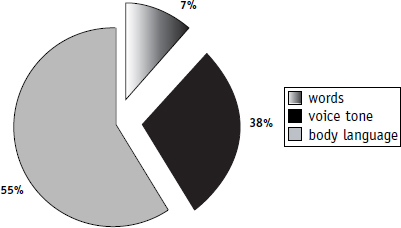
In 1967, Albert Mehrabian, professor emeritus of psychology at UCLA, carried out the most widely quoted study on communication. He determined that believability depends on the consistency, or congruity, of three aspects of communication. In a paper titled “Decoding of Inconsistent Communication,” he reported the percentages of a message expressed through our different communication channels in this way: interestingly, 55% of what we respond to takes place visually; 38% of what we respond to is the sound of communication; and 7% of what we respond to involves the actual words we use.
The professor called these the three “V’s” of communication: the visual, the vocal and the verbal. And to be believable, they must all give out the same message. This is at the very foundation of rapport by design. Over half of all communication is nonverbal! It is the look of the communication, our body language, that counts the most: the way we act, dress, move, gesture and so on.
Need proof? Think of the last time you were with someone who stood with her arms crossed, tapping her foot and looking annoyed, and then huffed the words “I’m fine.” Which clues did you believe—the words or the body language and tone of voice? Physical messages often send a much louder message than spoken words. Because 55% of your communication occurs as body language, see how easy it is, whether consciously or not, to signal either openness or defensiveness to another person by means of your body language. Gestures, rather than words, are the true indicators of your instinctive reactions.
If you want others to believe that you can be trusted, you must be congruent. Your spoken language and your body language must say the same thing. If they don’t, the other person’s body will signal its discomfort to your body. In response to this communication, your body will signal to your brain by mixing up a chemical cocktail that corresponds to the discomfort that the other person is feeling. Then you will both be uncomfortable, and rapport will be that much harder to achieve. When they notice a discrepancy between your words and gestures, other people will believe the gestures and react accordingly.
So, congruity occurs when your body, voice tone and words are all in alignment. And when your body, tone and words are communicating the same thing, you will appear sincere and people will tend to believe you. This is why a Really Useful Attitude is so important. Appearing sincere, or congruent, is a key ingredient for building the trust that opens the door to likability and rapport.
Make sure that your words, your tonality and your gestures are all saying the same thing. Be on the lookout for incongruity in others. Notice how it makes you feel.
We’ve all seen those old movies where a couple of people are driving along in a car, and they’re rocking the steering wheel even though the background shows a road that’s straight as an arrow. It’s phony—you know they’re really in a studio being bounced around in a box. Your senses have told you that something isn’t right, something is out of alignment, and so you can’t believe what you see. Or have you ever had someone get mad at you and then, in the middle of bawling you out, flash a sinister little smile that disappears as fast as it came? Very chilling. This is another example of incongruent behavior. The smile doesn’t belong with the anger; it’s insincere.
Recognizing incongruent behavior is another survival instinct. If you’re on vacation and you’re approached by a complete stranger who grins at you while he rubs his hands briskly together, licks his lips and says, “Good morning, how would you like to invest in the world’s best time-share deal,” the chances are you’ll be on your guard. A quick congruence check is instinctive and is another reason why first impressions are paramount.
Frequently a person’s emotions and intentions are misunderstood by those around them. For instance, a woman at one of my seminars discovered that she unconsciously used a tone of voice that was incongruent with her words. “No, I’m not confused, I’m interested,” she would insist when tested. And again, “No, I’m not sad, I’m relaxed.” This went on and on until she came to the verge of tears and said, “Now I know why my kids are always saying, ‘Mom, how come you get mad at us all the time?’ And I’m not mad at them. Sometimes I’m just excited.”
The same woman also told us that her coworkers accused her of sarcasm but that, to her, nothing could be further from the truth. In fact, sarcasm is simply words said with conflicting voice tone. It is structured so the person on the receiving end will believe what’s inferred by the tonality. Suppose you let your team down and somebody is heard to quip, “That was brilliant,” with a tonality that communicates annoyance. It’s a very different case when you score a fantastic goal and the same person is heard saying with excitement, “That was brilliant!”
Congruity, then, has one unshakable rule and it is this: if your gestures, tone and words do not say the same thing, people will believe the gestures. Go up to someone you know, purse your lips and say, “I really like you,” with your eyebrows raised and your arms folded. Ask them what they think. Even better, go find a mirror and try it. Well? You get my point. Your gestures are a giveaway to what you really mean.
Rosa, a waitress, folds up the ad she’s torn from a newspaper, clears off the table where her new computer will sit and leaves her apartment.
At the electronics store, as Rosa hovers over the latest desktop model from Megahype, a young salesman notices the ad in her hand and wanders over to her. He unbuttons his jacket, spreads his hands out, palms up, and looks her in the eye. “I see you found it already,” he says with a smile. “Hi, my name’s Tony.”
For the next 10 minutes, a relaxed and sincere Tony talks to Rosa. He faces her with his hands exposed and leans forward from time to time as they discuss the features of the computer. Rosa listens with interest, her head tilted to one side and her hand on her cheek, as Tony offers to “throw in” $95 of extras and even agrees to “eat the tax.”
Finally, stroking her chin as she forms a decision, Rosa nods. “Yes,” she says, “this is the model for me.”
“Great,” says Tony, eagerly rubbing his palms together. “It will take about five minutes to take it down and find some boxes.”
Rosa looks sideways at him and frowns. “You don’t have a new one in a box?”
“That might be hard to find right now.” Tony’s hands become fists, and he pops them into his pockets. “They’re such an unbelievable deal—they’ve just been flying out of the store.” He buttons up his jacket, shrugs his shoulders and laughs nervously.
“So this is a demonstration model?” Rosa tilts her head, inquiring.
“Just came on the floor this morning,” Tony shoots back with an insincere smile. He folds his arms in front of his chest and turns himself sideways to her, pretending to be distracted by something going on in the TV department nearby. His voice falters and weakens as he says, “It has the same warranty as a new one.”
Rosa rubs the side of her nose in doubt. “Came on the floor this morning? Fine. Can I have that in writing?”
Tony’s back is turned to her as he leans over the monitor, fiddling with the cables—any excuse not to look at her. He catches a glimpse of himself in one of the wall mirrors. Oh boy, what an idiot I am, he thinks. He bites his lip and turns back to face Rosa.
But Rosa is gone.
As a good waitress, Rosa is used to reading body language. She saw that the salesman’s gestures conflicted (lacked congruity) with his words, and she knew that she should believe the gestures. The change in Tony’s voice tone from informing to pleading just served to confirm her feelings of doubt.
Words vs. Tone
Say each phrase below with different tonality: anger, boredom, surprise and flirtatiousness. Notice how your body language, facial expression and breathing combine to alter your emotional state.
“It’s late.”
“I’ve had enough.”
“Look at me.”
“Where were you born?”
To check your tonality, find a friend and say one or two of these phrases. See if your friend can tell you which of the four feelings you’re expressing. If it’s not obvious, keep working at it until it’s clear.
Do you feel nervous when you meet someone new? Physiologically, being nervous and being excited have a lot in common: pounding heart, churning tummy, high chest breathing and the general jitters. But one of these states might send you hightailing it for the nearest dark corner while the other one can serve you well and propel you forward. There is a tendency for panic to accompany nervousness, and this quite naturally makes bodily activities speed up. Because much of your nervousness stems from increased awareness, try redirecting some of your awareness toward slowing down and being more deliberate. One great technique is to imagine that your nostrils are just below your navel and that your in-and-out breaths are happening down there. The slower you are, within reason, the more in control you will appear.
The sooner you start telling yourself that you’re excited rather than nervous, the sooner you’ll be able to convince your subconscious that this is actually how you feel. And, in fact, that’s really all that matters. Change your attitude, and your body language and voice tone will change to reflect your new attitude. Keep in mind that most people are as eager as you are to establish rapport. They will generously give you the benefit of the doubt.
Don’t try too hard! In a study conducted at Princeton University, students of both sexes were questioned about their methods of sizing up people they met for the first time. Overeagerness was one of the most reported turnoffs. Don’t smile too hard, don’t try to be too witty, don’t be overpolite and avoid the temptation to be patronizing.
As you become more at ease with your attitude, people will begin to notice characteristics that are unique to you—that set you apart from the others and define you as an individual. You will naturally and easily project the likable parts of your own unique personality and have more conscious control and confidence in your ability to create rapport at will.
All relationships are built on trust. Trust is built on congruence. It doesn’t matter whether you’re selling real estate, designing concept cars, recommending the lamb chops over the chili, looking for the perfect partner or giving the State of the Union address, you have to fully connect with people. Fully connecting means that unconsciously, people will say to themselves, “I trust you, you make sense and you move me.” Of these three, trust always comes first. Without congruence, you can never make someone like and trust you in 90 seconds or less.