 Workbook
First Things First
WorkbookThere’s only so much you can learn about riding a horse by reading a book. Sooner or later you’re going to have to climb up into the saddle. At first all that wobbling around might feel silly and unnatural, but before you know it, with a little practice, horseback riding becomes natural and easy. The same goes for connecting with people. At first it might seem awkward and embarrassing to approach people you don’t know, or don’t know very well, and assume rapport with them. With a little practice, though, it soon becomes second nature. And so it should. After all, you were born with everything you need to connect and communicate with others: a body, a voice, five senses and what I call “Super Powers,” namely enthusiasm, curiosity, the ability to process feedback, empathy and imagination. In face-to-face communication, as in horseback riding, baking, game playing, rocket science, you name it, it’s almost always the small things that make the big differences.
You might be saying to yourself, “Fine, I buy all that, and I’ve read the book. But how do I actually practice making people like me?” The answer’s right here: 21 small, simple exercises to fine-tune your natural-born abilities to connect with other people, not just for friendship but for success at school, work, everywhere. They’ll even help you find a loving relationship, if that’s what you’re after.
Many of the exercises in this little workbook can be grasped in 90 seconds or less. To get the most out of them, it’s important to remember the golden rule: There is no such thing as failure, there is only feedback.
The key is to process the feedback you receive, and use it to do better next time. All human behavior is a feedback loop. Try something. If it doesn’t work, learn from it, change your tactic, and try again.
A pilot doesn’t take off from London and aim her plane at Miami and leave it at that. She evaluates her course, the weather and other air traffic, and makes corrections along the way. She continually processes feedback and makes adjustments until she gets to her desired destination. If she didn’t, the plane could end up in the Atlantic Ocean or the Sahara Desert! The same thing goes for the exercises in this workbook. Try them out, see how they go and make corrections until they work for you.
This workbook is not about becoming someone you are not; it’s about making the most of what you’ve got and being yourself. You were born with what it takes. You’ll get there with practice and feedback. You can do it—there’s no question about it.
If your heart’s not really in it, these simple exercises aren’t going to work for you. So, let’s start by taking stock of your commitment so we can get some leverage on your determination.
On a scale of 1 to 10, with 10 being the strongest:
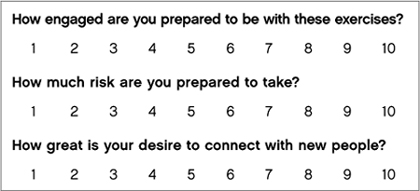
Total your score. If it is less than 15, either your heart’s not really in it or your lack of self-confidence is getting you down. This book’s preface begins with a simple quotation: “The ‘secret’ of success is not very hard to figure out. The better you are at connecting with other people, the better the quality of your life.” No matter how old you are, when you are open and able to connect easily and quickly with others, you will flourish. It has nothing to do with brains, beauty or talent and everything to do with your enthusiasm for getting cooperation from others. Tell yourself to put that enthusiasm to work right here, starting with the next exercise, and carry it on through to the very last one.
Picture your life. What do you want it to be like in, say, a year’s time? Dare to dream a little. Gather together a bunch of magazines (used is fine). At least a few should be magazines you wouldn’t normally read. Cut out pictures, words, bits of advertisements—anything you see that relates to your image—and put them together in a collage that creates a picture of your life as you want it to be. Create images that are as specific and concrete as you can. You can write or draw on it if you like. Put it on a wall or someplace where you can see it every day.
The next step helps it work much better: explain to a friend or family member (or even your pet will do) what your collage means. What’s important is hearing yourself describe out loud the life you want. Seeing and hearing your dream will make it more real in your mind.
With your collage in front of you, think about the types of people you’ll need to connect with to make your dream happen. Who are they? Make a list of people (specific individuals and/or a type of person) for each of the categories below:
Colleagues
Association or club members
Neighbors
Parents of children your children play with
Friends or relatives you aren’t close to but would like to know better
Others
Using a scale of 1 to 10 with 10 being the strongest, answer the questions below in the context of meeting someone new at school or work and in a social setting:
The print edition of this book includes a fill-in for Your Comfort Level When Meeting People.
Please download a PDF of the fill-in here:
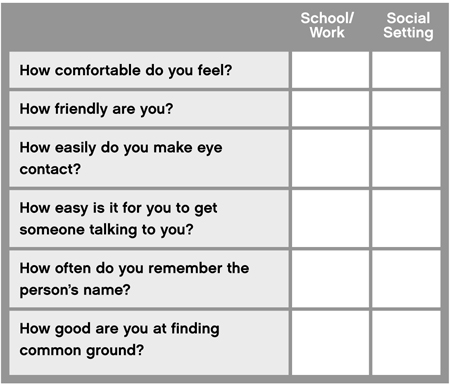
If there is a difference in your comfort level at work and in social situations, why do you think that is? What are some things you could do to increase your comfort level in different settings?
First impressions can be lasting impressions. The first impression people get from you doesn’t stem from what you’re wearing or how you’ve done your hair, it comes from your attitude. Take a look again at the lists of Really Useful and Really Useless Attitudes on page 41, then answer the following questions:
1. What is the ideal me that I would like everyone to see?
2. What kind of attitudes can I adopt to present the best possible me?
3. What are some specific ways I can convey my best attitude(s) when meeting people?
During the next week, be on the lookout for people you come across who seem appealing to you. Analyze their behavior and answer the following questions:
1. What was their attitude?
2. What specifically did they do or say that gave you that first impression?
3. Did being around them make you feel somewhat the same way?
Now, think back to a time recently when you felt enthusiastic.
1. What was responsible for your enthusiasm?
2. Do you think you displayed your enthusiasm in a way that other people picked up on?
3. How can you link how you felt at that time to yourself and your approach to finishing every single exercise in this book—in order?
4. How can you convey your enthusiasm to others during conversations?
5. What attitude or combination of attitudes would you like to show when you meet someone new?
Read the following scenarios. Using the details of the situation, decide what you would say. Come up with a conversational statement or two for each, and then follow it with an open question. For example, if you found yourself waiting in a huge line at an airport to reschedule your flight, which was canceled because of stormy weather, you might say to your neighbors, “Man, this line is long!” Then ask, “Have you heard a recent weather forecast?” or, “I’m glad I’m not the clerk doing all that reticketing—can you imagine dealing with so many frustrated people?”
1. It’s raining, and as you leave the store, several people are waiting under the awning for the rain to let up. Like you, they have no umbrellas. You are standing near someone and you say______
2. You’re at work, and you go to the lounge for a cup of coffee. You notice someone you don’t know, who works in another department. You approach and say______
3. On your way to class, you stop at a convenience store for a snack and notice someone you’ve seen around campus perusing the chip offerings. You say______
Did you ever miss an opportunity because you deliberated about it so long that the chance passed? Or talk yourself out of doing something and then regret it later? Have you ever sat in a café nursing a cold latté watching other people enjoy themselves while you never budged or made a move? “I’ll just order another latté, then I’ll go for it and strike up a conversation.” “Next time he looks this way, I’ll smile at him.” If you just hang around wishing, waiting and hoping for something to happen, nothing ever will. Then you end up feeling bad because you talked yourself out of something or just plain chickened out. The longer you wait, the more reason you have to beat yourself up for procrastinating.
Sometimes we just have to go for it. The more you practice, the easier it gets.
Over the course of a week, approach three new people every day and say something simple.
Spot a person you’re interested in, count to three, and on three go up and speak to him or her. If you hesitate, you lose. So zoom right in. You are creating a new habit, with “one, two, three” as your trigger. Practice, practice, practice—just do it. The worst that can happen is that you put a dent in your ego. The best is that you make a new connection. Assume the best.
Your goal here is not to start a conversation. The purpose of this exercise is to eliminate hesitation and self-censorship. The important thing is that you make your way over to the people the moment you spot them. You’ll say, “One, two, three” in your head, and go without hesitation. This will help you create a new habit. Here are a few examples of simple openers you could use:
“Excuse me, which end of the mall is closer to the train station?”
“Hi. Can you tell me where I can get a good cup of coffee near here?”
“Pardon me, do you know what time it is?”
Remember that the first move is just as important as the first impression. So practice, practice, practice, until you feel comfortable—and then keep on doing it.
At the heart of establishing instant rapport is the hunt for common ground, and one of the best ways to find it is to look for “Me too” moments (see page 68). Simply pay attention to what’s being said, and when the opportunity arises, jump in and say it—as long as it’s true. For example, if someone says, “I love the Caribbean,” you can simply say, “Me too!” However, don’t just keep repeating “Me too.” Mix it up by using phrases like “Wow, what a coincidence,” “No kidding, I totally agree” and “I love it there too.” And of course you can add to the conversation by asking follow-up questions; for instance, “What’s your favorite island?” and “Do you snorkel?”
During your next three conversations with people you don’t know particularly well (in other words, not your best friend or mother!), make an effort to find “Me too” moments.
For each conversation, what was the first thing you were able to find in common?
Conversation 1 ______
Conversation 2 ______
Conversation 3 ______
1. Did you feel that these moments changed the feeling of the conversation?
2. Did you feel a stronger connection to the person?
3. Did the person respond differently to you?
4. Did the conversation come more easily?
Take each of the following statements and turn it from a negative take on what you don’t want to a positive approach to what you do want:
Don’t leave home without an umbrella.
Don’t be shy.
Don’t forget to lock your bike.
Don’t forget to give me a call.
Don’t worry.
Don’t leave the lights on when you depart.
When you meet someone new, it’s important to be able to look him or her in the eye. This exercise will help you practice that skill and, hopefully, set you on the path to establishing rapport.
The next time you greet three new people or people you don’t know well (for example, the person behind the deli counter; a person you often see in your elevator at work), keep the following questions in mind, then write down the answers as soon as you get a chance.
Were you able to make eye contact?
Did you say hello?
How did they respond to you?
Did you feel you were able to establish rapport with them?
Did you learn their names? What are they?
Not everyone has an easy, natural smile, so here’s a simple trick that fashion models use. They keep saying the word “great”—after a few seconds it makes a person’s eyes smile.
Look into a mirror and say “great” over and over, each time using a different, crazy tone of voice until you crack up. Say it loud, whisper it, say it in a laid-back voice, in a sexy voice. It will not only make you smile, it will also make you feel good. It’s simply that it’s a very positive word. (It also has that “ay” syllable in the middle that requires you to bare your top teeth in a kind of smile during the process.)
For one day, every time you meet someone, smile. If you have trouble, say “great” to yourself three times before you approach the person. You’ll be smiling by the time you get there.
For the next few days, be observant of people’s body language and see how it affects you. Do your best to keep your body language open and relaxed. When you meet someone new, point your heart warmly at the person’s heart. Rather than crossing your arms over your chest, keep your heart open, signaling that you don’t mean any harm.
Practice opening and closing your body language when you are talking with someone and notice the difference in your attitude as well as the response. Get into the habit of using open body language when you are seeking cooperation from others.
The next time you are talking with someone, synchronize your body language with his or hers for 30 seconds (for a refresher on synchronizing, see page 69). Take a break for 30 seconds and then synchronize again. Did you notice a difference between the synchronized and unsynchronized period? Did people respond positively when you were synchronized?
Read the following closed questions, then change each one into an open question—one that begins with who, why, what, when, where or how.
1. Have you thought about my suggestions?
2. Are you interested in the Buy One, Get One Free promotion we have going on right now?
3. Do you want to go out for dinner sometime?
4. Have you taken the finance course already?
5. Have you thought about how you’re going to market yourself in the interview?
Sometimes a closed question is unavoidable. The key in this situation is to quickly follow it with an open question. For instance, if you ask, “Do you live in the neighborhood?” and the person replies, “Yes,” you should continue the conversation by following up with an open question, such as “How do you like it?”
Write an open question that you could use to follow each closed question below:
1. Is this the right track for the 7:15 train into the city?
2. Can I help you find something?
3. Have you signed up to volunteer yet?
Questions beginning with “Are you,” “Did you” and “Have you” often get a yes or no answer and don’t encourage dialogue. But questions that begin with Who, What, Why, Where, When or How tend to open people up and get them talking. Come up with three open questions that you could ask new people in each of the following situations:
Before a meeting
At a party
In line before a movie
The best open question isn’t even a question. Try starting a conversation with “Tell me about …”
What good is meeting someone for the first time, creating a favorable impression and establishing rapport if two weeks later the person has forgotten you?
1. List three people you’ve met who have “trademark” looks and describe the qualities that make them memorable.
2. What are things about you that your friends comment on? (Do you have great hair, do you wear bold colors, have a great voice? Are you short or tall?)
3. What is the signature style or persona you picture for yourself?
4. What aspect of your current self could you emphasize to create a “trademark” look?
5. Is there something new that you could adopt and make your signature (e.g., wearing a brightly colored scarf or stylish eyeglasses)?
6. What concrete steps do you need to take to achieve this memorable persona or style?
Everybody has a primary sense that they use to perceive the world. Some people respond to the world and make their decisions based mostly on how things look (Visual), others by how things sound (Auditory) and others by physical sensation or how they feel (Kinesthetic). Imagine being able to know which sense somebody relies on most. When you find out, you can appeal to that sense above all others. The other person won’t realize why, but he or she will feel drawn to you.
Visual, Auditory and Kinesthetic groups of people are very different from each other. They think differently. They want different things, have different desires, have differing motivations; they speak and dress differently.
When you can find out the sensory preference of the people in your life you will communicate at a much deeper level.
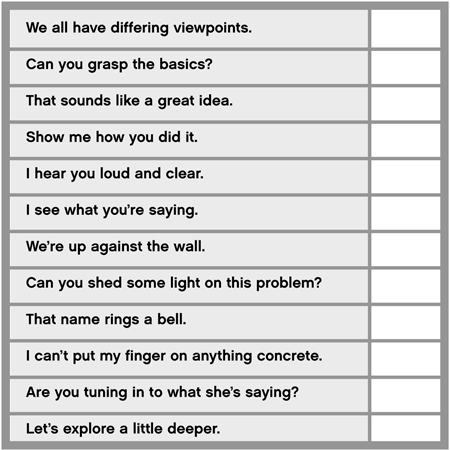
To practice identifying Visual, Auditory and Kinesthetic types of people, read each phrase and fill in the blank to the right with the type of person who would say it.
The print edition of this book includes a fill-in for Sensory Preferences.
Please download a PDF of the fill-in here:
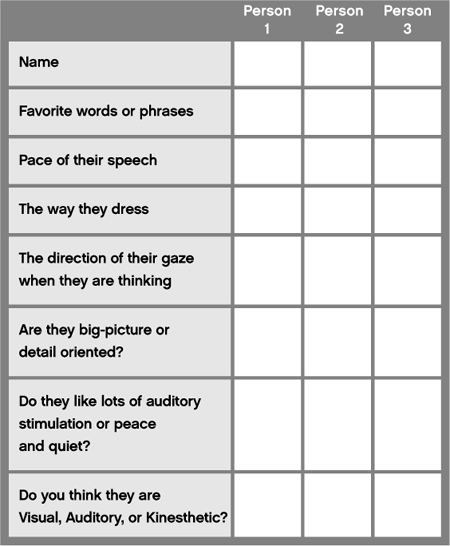
Think of three people you know well—for example, your best friend, your spouse, a coworker—and put their names in the spaces below. Try to recall discussions you’ve had with them and see if you can determine what their dominant approach is.
The print edition of this book includes a fill-in for Sensory Identification.
Please download a PDF of the fill-in here:
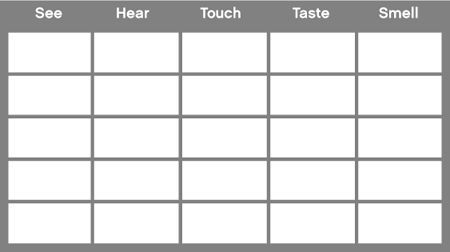
Close your eyes and imagine you are at a busy airport with an hour to spare before your flight. Using the chart below, write down all the things you can see, hear, touch, taste, and smell.
Once you have made your list, take 30 seconds to describe to yourself in sharp detail what you see. Then take another 30 seconds to do the same for what you hear, then for what you feel, smell and taste.
Which of the senses came most easily and which was most difficult?
When you can figure out the primary sense of the people you know and meet, you can communicate with them more effectively on their own wavelength. If they think in pictures, talk to them in images, or at least talk about how things look. If they favor sounds, tell them how things sound. And if they are concerned with physical sensation, tell them how things feel.
To see this in action, go back and reread the story of “Ingrid’s Hard-Earned Vacation” on page 152.
The print edition of this book includes a fill-in for Talking Sense.
Please download a PDF of the fill-in here:
To practice speaking to different types of people, describe each of the following items first using Visual words, then using Auditory and finally using Kinesthetic words. (If you need help, check out the word lists on pages 140–145.)
Your dream house
Your dream vacation
Conversation often entails describing your experiences to others. The more senses you involve in your descriptions, the more interesting people will find you and the better they will remember you and what you say.
This exercise works better with a partner who can respond to you. If you don’t have anyone to do this with, write your answers down.
Describing sights, sounds, touch, smells, and tastes,
Talk about how patience feels.
Talk about your most cherished possession.
Talk about winter.
Talk about one of the promises you keep making to yourself.
Talk about the things you do to entertain yourself.
The point of this exercise is to get away from talking in facts and figures because they fade fast and are boring. Mental images are worth a thousand words; they trigger emotions and stick in the mind.
It sounds obvious, but you have to get out and meet people before you can make friends with them. You’re not going to make friends with everyone you meet, but the more activities you participate in, the more places you visit, the sooner you’ll make new friends and acquaintances.
There are dozens of ways to get your foot in the door of places where people get together. This plan will help you figure out a plan of attack for getting involved and socializing.
1. What type of group are you most interested in joining?
Sports (leagues/yoga/gym/snowboarding)
Cultural interests (music/books/film)
Volunteering/outreach
Classes (cooking/languages/crafts/spot-welding/yoga/pottery)
Religious organizations
2. What is one thing you’ve always wanted to do? Go hot-air ballooning; drive a cab; learn Flamenco dancing; become a bullfighter, a synchronized swimmer; build a tree house. Write down something you’d really like to try.
3. What could be a first step to achieving that goal? Is it looking online or in the yellow pages and making a call? Asking a friend or a local organization?
4. Make yourself take the first step, and the rest will follow more easily.
As you go out and start meeting new people, one final thing that can make a big difference for the worse—if you let it—is the way you handle rejection. I had more than my share of rejection when I was growing up, and I learned the hard way that there are essentially three things you can do with rejection: you can dismiss it, you can let it get to you and wreak havoc with your self-confidence or you can welcome it.
What are you going to do when you are rejected? It’s bound to happen sometime; it’s part of life. Handling rejection requires an immediate adjustment in attitude. If a person doesn’t return your interest, that’s not a cue to give up and get depressed, it’s a call to move on! If you were an apple picker and you came upon a tree without apples on its branches, would you take it personally and feel hurt and sorry for yourself? Of course not! You’d just admit there was nothing there for you and move on to the next tree. If you feel sorry for yourself, you’ve lost sight of your goal.
Most people will let you know they’re not interested in friendship in a diplomatic way, but you’ll probably meet some rude and ungracious characters along the way too. When you do, just excuse yourself politely and give thanks that you found out what kind of person he or she was relatively quickly, before you invested more of your time and emotions in this “relationship.” Ideally, the rejection/selection process would be painless, but you’ll probably get your feelings bruised once or twice. It’s human nature to feel bad in situations like this, but don’t let yourself wallow. Instead, you have to welcome rejection/selection as part of the exploration, the journey, the adventure.
Understanding the principle that there’s no rejection, only selection, means that if you’re chatting with someone and things aren’t clicking, it’s not anybody’s fault. It has nothing to do with you as an individual. It just means you don’t have enough in common or you’re not psychologically compatible. So, enjoy your time together, be yourself, remain polite and gracious. At the end say thanks and good-bye and move on. And remember, you may end up doing some rejection (politely and diplomatically as well, of course) yourself: you don’t have to try to be lifelong friends with everyone you meet.
In closing, my wish for you is simple. If you’re reading this book, one of your priorities is to connect with people. Don’t ignore this important part of your life! You have to make time. Set aside at least 15 minutes a day to get out and practice, practice, practice these exercises. Sure, you might find it difficult at first, but keep at it. Try one or two a day until they become second nature. Turn off the TV, the computer, the PlayStation, set aside your work and dedicate your time for the next three weeks to working your way through all the exercises. Nobody—except you—even has to know you’re doing them. Don’t try too hard, be yourself and place this phrase on the tip of your tongue: “There is no such thing as failure, there is only feedback.”