Round Two: Spotting the Detail
After your heroic efforts in learning all of the prime ministers in order (well done, by the way), it’s very possible that someone may try to persuade you that your brain has been filled to bursting point with these many facts, that it is somehow full.
You must be careful to extract the five pounds you’ve won off them for successfully reciting the PMs, before you explain just how wrong they are.
Memories, you can clarify, always grow out of other memories. The greater the stock of memories you have, the more opportunity there is for new memories to take root.
By learning the list of PMs, you’ve basically created a great deal of space in which new memories can grow – a fertile flowerbed, if you like, in which you can help cultivate a colourful garden of recollections.
What follows is a first step down that road – and a guide to the techniques involved in gardening the world of your memory. As ever, try to make sure you vividly imagine the images that follow.
1
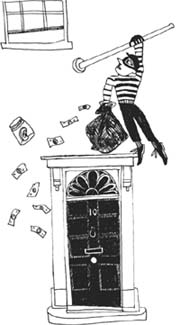
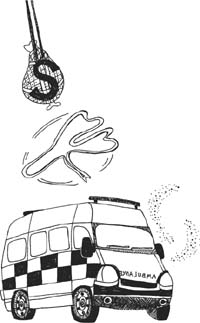
So, here we are watching Walpole again, our robber leaping out of the window on to his wall-pole. And don’t think it unfair that he’s a crook in our story – before becoming prime minister Walpole spent time in prison for accepting illegal payments and, as all this money tumbling from his sack attests, he wasn’t shy of getting his way with the odd bribe once he took office.
Look what else is spewing from his sack – that’s a glass jar and, if I’m not mistaken, there’s a severed ear jinkin’ around inside! It belonged to one Captain Jenkins, and Walpole waged the War of Jenkins’ Ear from 1739 against the Spanish for cutting it off. The whole Spanish empire in South America was briefly imperilled, but the British fought pathetically, and as a result Walpole’s popularity soon declined.
2
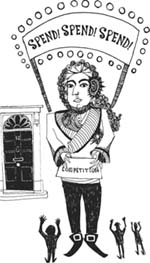
Beneath Walpole, we’ve got Spencer Compton running his spending competition.
What an incredibly swollen ear he’s got; it looks as if it’s shortly going to burst with infection. These days we’d probably say that it ‘will ming tons’. This reminds us that Compton was Earl of Wilmington, poor man.
But what high spirits everyone in the spending competition seems to be in!
Not for long – Compton’s most significant act as prime minister was to raise the duty on spirits to curb such public exuberance. This of course made him extremely unpopular, and there was huge relief when, after a short time, he died. Imagine the crowd cheering as he is brained by one of Pelham’s hams (which didn’t actually happen) to help you remember that he was the first prime minister to die in office.
3
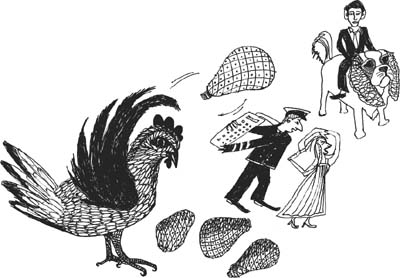
And he’s not the only one to be attacked by Henry Pelham’s pelted hams. Prince Charles is trying to get past by riding the dog Bonnie – but a single ham takes care of Bonnie Prince Charlie’s little rebellion of 1745–6.
Watch now as a newly married couple tries to sneak past. The beautiful seventeen-year-old bride and her fifty-three-year-old naval-officer hubbie try to protect themselves with a giant cardboard calendar, but they can’t stop the reorganization of the Royal Navy, the marriage act of 1753 (which stopped people under twenty-one marrying without parental permission) nor indeed the introduction of the Gregorian calendar (which is used to this day).
4
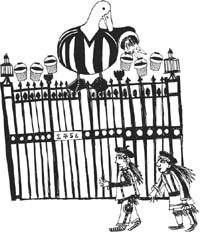
As we pass to the bottom of the street, you’ll see that the Newcastle duck has seven buckets of water atop his gate, which he’s tipping, one by one, on some beret-wearing American Indians who are trying to pass through.
Why? Well, in his first term, the Duke of Newcastle precipitated the Seven Years’ War – a massive global conflict in which more than a million people died. You can see the beginning date (1756) on the gates. Britain fought mainly (and unsuccessfully) in the North America portion of this war, called the French and Indian War because of the opponents’ nationality. The lack of success severely dented Newcastle’s popularity.
5
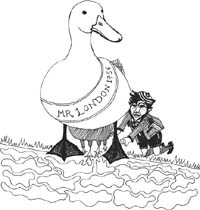
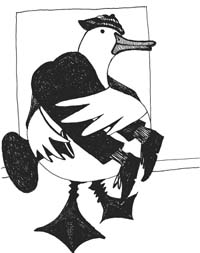
Beyond the gates, you can see the Duke of Devonshire wearing a sash saying ‘Mr London 1756’. No wonder – he was thought to be London’s best-looking man when he became prime minister.
And now we can see why he is gushing quite so much cream; he’s being milked! Look, it’s that schoolboy with grey armpit hair – William Pitt the Elder. He’s working the teats like crazy.
William Pitt the Elder dominated mid-eighteenth-century politics long before he actually became prime minister. He was already the dominant power within the government; Devonshire was just the pretty face of this administration.
The duck is not enjoying it at all, though, and once he’s been relieved of 225 litres of cream he gives up after just 225 days in power.
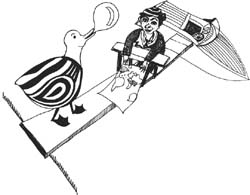
On the gangplank, the Duke of Newcastle is standing nervously next to Pitt (again!), fretfully blowing bubbles in his bubblegum. The elderly schoolboy sets up an architect’s table on the gangplank so he can design the British Empire. He’s got this idea that war should be waged for trade, and he’s colouring in Canada, India, West Africa and the West Indies. During Newcastle’s second term, Pitt thus invents the imperial policy that will build the British Empire. The duke’s bubble-blowing reminds us how his nickname was Hubble-bubble (for his hurrying everywhere and fussing so much).
6
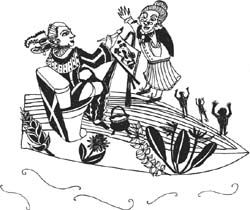
Down the gangplank, past Newcastle (and Pitt) on to the boat, we can see that John Stuart’s john (which has a Scottish flag on it) is surrounded by exotic plants – the Earl of Bute adored foreign flora and helped found the Royal Botanic Gardens of Kew in London.
His Scottish stew art isn’t very popular with us the passengers, though, and he is being roundly abused from all sides – rather like he was when prime minister.
And, given his role in the gran’s death, you will appreciate that Bute died when he fell off a cliff.
7
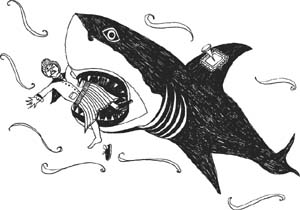
In the waters below, while the shark George Grenville is digesting his granful, note how his fin has a giant stamp tacked to it. This is the harsh stamp tax he introduced to the colonies in an attempt to gain popularity by lowering British taxes correspondingly. Its introduction led to the tragedy that was the American Revolution.
8
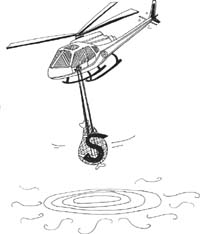
Ah yes, here comes our rescue helicopter, just in time. As we’re hoisted from the waters, note how the big S stamped on to the Marquess of Rockingham is peeling off. Rockingham repealed the American Stamp Act. But in doing so he peels himself out of a job, with George III sacking him for being weak-headed.
9
Like so many schoolboys, William Pitt the Elder, hauling us in, has a cricket bat under his arm (he was the first prime minister to show an interest in the game). He keeps shouting, ‘I’m mad that I got out,’ over and over again. In fact, he has gone mad and has gout. They plagued his premiership and disastrously impeded his capacity to deal with the American colonies in the run up to their Declaration of Independence.
10
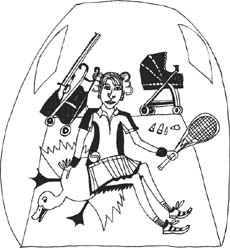
Just take a closer look at Steffi Graf on her duck inside the chopper. What a youthful hairdo she has! See how her plaits each make the shape of a three in the air. The Duke of Grafton was just thirty-three when he became prime minister – for about a year.
You’ll also notice that the inside of the chopper is full of prams and hunting equipment. Grafton had sixteen children; he was also in the habit of missing important governmental appointments to indulge his love of hunting. He didn’t last long in the job.
11
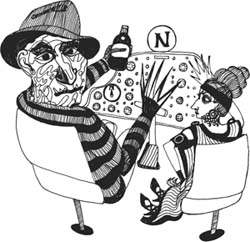
Up in the cockpit our pilot, Freddie ‘Krueger’ North carries us twelve miles – mirroring North’s twelve years as prime minister.
But the journey is a disaster. Look how Sarah Jessica Parker, wearing a toga, is fighting Lord North for control of the chopper. She wants to go to ‘York Town’ (as she calls it).
This reminds us of the battles of Saratoga and Yorktown in the American War of Independence – disastrous losses against the soon-to-be USA in a war Britain had no business losing.
Did you know that cats hate gin? The bottle of gin in North’s hand is anti-cat-lick Gordon’s stuff. This reminds us of the anti-Catholic unrest known as the Gordon Riots, which hastened the end to his premiership.
12
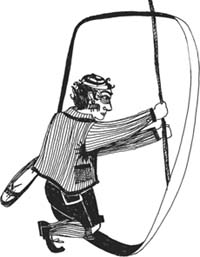
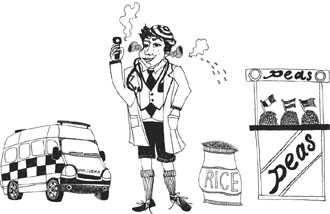
As we descend on our second Rockingham, the ham rocks so wildly it makes the shape of a shamrock (the symbol of Ireland) in the air. That’ll be because Rockingham was a champion for Irish independence. And the rope’s inconvenient snapping reminds us that Rockingham died in office – in the year 1782. Lying dazed from our fall, we have to ask how this Just William before us manages to get his shell earrings to burn so fulsomely. The answer is that he is filling them with rice. Look he can fit more rice into those things than you’d ever believe. His full name is William Fitzmaurice, Earl of Shelburne.
He’s been buying peas, you can see, from a little market stall on the bridge. And he has made a very international set of purchases – French, Spanish and American peas are among the ones he’s secured for himself. Shelburne also succeeded in securing peace with the French, Spanish and Americans in his short term in office.
13
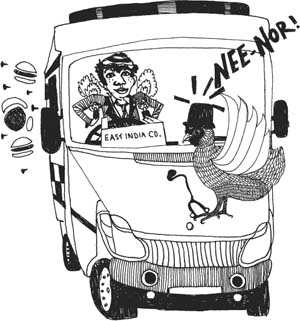
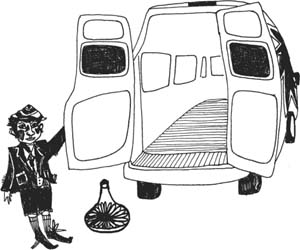
At last, we’re off to hospital. In the back of the ambulance, among the port bottles, notice how we’ve been joined by more than just a schoolboy duck: it’s the Duke of Portland.
Freddie ‘Krueger’ North has joined us, glowering from his seat on a curly-haired Fox.
To have curls means that you are a Charles in our story – so North must be sitting on Charles Fox, the influential MP.
Fox and North are the Fox–North coalition of 1783; it is they who are really running the country – Portland is just the titular head.
They’re spending their time trying to eat a spicy Indian meal but – oh dear – it’s obviously too hot for them. That they try (and fail) to eat Indian cuisine reminds us of the East India Company, which they tried (and failed) to nationalize.
14+15
Pitt meanwhile has done better – he’s finished half of his Indian meal: not bad for a toddler of just twenty-four months of age. Pitt the Younger was twenty-four when he became prime minister (having already turned down the job three times – an amazing fact) and soon established the government as dual controllers of the East India Company.
On the subject of food, Pitt is also throwing rotten burgers out of the window as he attempts to correct ‘rotten boroughs’ – electoral seats which could be bought.
And see those tacks he’s firing out of the window with the burgers? The wind is blowing them back in! They’re incoming tacks, and remind us how Pitt introduced the first income tax, raising funds in response to the threat of Napoleon’s expected invasion.
Our hen adding tone (to the siren) on the bonnet is of course Henry Addington. He is using a stethoscope as a microphone and is making himself comfortable, leaning back against the middle of the glass windscreen. Our man adding tone was a doctor before he became prime minister, and was our first middle-class prime minister. Occasionally, he grins at the driver William Pitt the Younger, a childhood friend of his.
When Pitt the Younger opens the doors of the ambulance during his second term as prime minister to let us out he unfortunately decides he’ll have a quick swig of port – but he’s too young for the stuff and this sip, which amounts to excessive consumption of port, is what causes him to die.
16
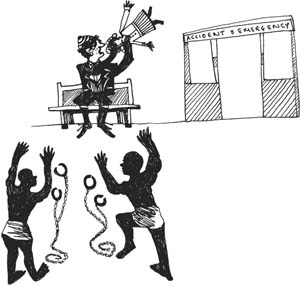
Over on the bench, William Grenville is still eating his gran. Though this is morally reprehensible and he doesn’t lift a finger to help us either, he was, on balance, a very good man. Look at all these slaves running around whooping: it was Grenville who abolished the slave trade in 1807.
Portland, summoned again from the ambulance, struggles to carry us through the doors into the hospital: knocking into walls as his legs go wobbly with the strain. Portland’s second term as prime minister was blighted by terrible ill-health.
17+18
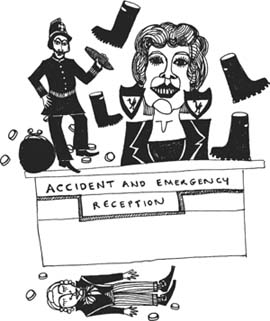
At the front desk the tiny Spencer Perceval is offering the purse strings to anyone and everyone who passes. Since nobody is interested, he decides to spend the money himself – by getting up on the tips of his toes and pouring it out over Cilla’s desk.
Similarly, Perceval, the shortest prime minister in history, was such an unpopular leader that despite offering the position of chancellor to at least six people no one would take it – so he did it himself.
But oh dear! A die-hard Cilla fan (perhaps) has just shot him in the head! He’s been assassinated! His brains are all over the money! In 1814, Perceval, a lawyer, became the only prime minister to be assassinated.
Behind the hospital reception desk, there’s the Earl of Liverpool – Cilla Black. She is surrounded by a field full of Wellington boots – these represent the Duke of Wellington’s victories on the continent against Napoleonic forces during Cilla’s premiership, victories that greatly increased the Earl of Liverpool’s popularity – helping him to fourteen consecutive seasons at number 10.
Also on the desk is an angry-looking policeman with a corn on the cob for a truncheon. This corn-wielding man of the law is the 1815 Corn Law, a tax on foreign crops that Liverpool introduced to protect British farmers. But why is the policeman so angry? That’s because Cilla has been robbin’ banks when her work at the hospital check-in is on. The Earl of Liverpool’s full name is Robert Banks Jenkinson.
19
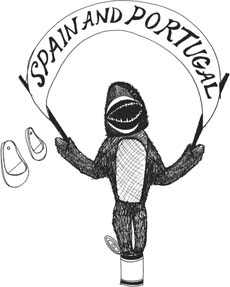
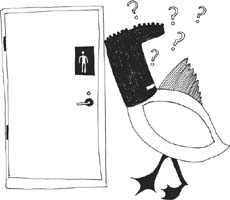
Passing into the toilets, we meet George Canning. Or is it? Lo! That’s not a real shark! That’s a person in a shark-suit, surely? Indeed it is: George Canning was known for playing practical jokes.
Interesting that he was also the first prime minister to campaign widely for election: but this slogan he has up above him – Spain and Portugal – is surely a joke too?
Maybe, but look what’s happening now! He’s slipping into his can. We’re losing sight of him! The last we see are the words ‘Spain and Portugal’. These were indeed ‘the lost prime minister’s’ last words. He was a particularly gifted man, much missed after dying in office after only a few months.
20
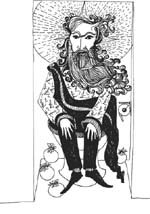
Viscount Goderich in the cubicle, despite the celestial light, achieved nothing of note during his premiership. As we close the door, though, he roars with delight. He was delighted to retire from office, and was much happier afterwards.
21+22
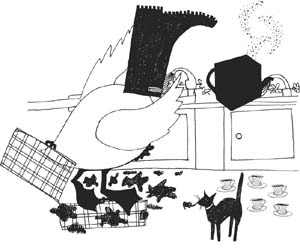
Time to wash our hands, and at the sink you’ll notice that the Duke of Wellington has erected a protective iron cage around himself. He famously put iron shutters at the windows of his house when, because of his unpopularity, pedestrians started throwing stuff through them. That’s what earned him the title ‘the Iron Duke’ – his iron-will and military discipline had nothing to do with the nick-name, oddly enough.
Note how there’s a cat licking appreciatively in the muddy water at the basin – and no wonder: Wellington oversaw Catholic emancipation in 1829, granting almost full civil rights to them. The boot on his head, by the way, is named after him. We cast our attention next to the pot of Earl Grey tea in the adjacent basin (this variety of tea, coincidentally, was named after the same Earl Grey that it represents), and the seventeen miniature cups around it. With seventeen children Earl Grey holds the record for having had the most of any prime minister.
And, wow, look at this – his body is taking on a new shape… It’s reforming and now looks like something between a teapot and a ballot box. This reminds us of Earl Grey’s 1832 Reform Act, in which many more people got the vote, setting in motion 130 years of parliamentary reform that resulted in everyone being able to vote today (except our under-18s!).
23
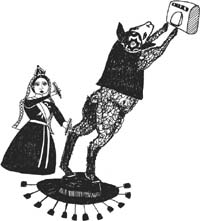
Over now to the hand dryer and the adorably cute William Lamb.
Queen Victoria, you’ll notice, is combing his hair with a biro. He was her tutor, then mentor, then close friend. That she’s using a biro unfortunately reminds us of how William Lamb’s wife had an affair with the poet Biro, I mean Byron, and then wrote a book about it – causing hair-curling embarrassment.
On our way out of the toilets, we ask Wellington, who is bumping against the door, what, exactly, he’s looking for. He says he’s looking for Sir Robert Peel who has been appointed prime minister, but can’t be found anywhere. Wellington’s second term was as a stop-gap while everyone else looked for Peel – who was off in Italy.
24
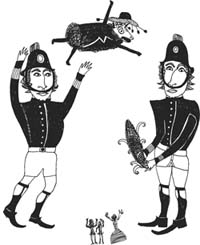
Peel, our policeman peeling his clothes off, was in fact the founder of the modern police force. Policemen are called bobbies after Bobby Peel. He’s being cheered along by lots of sooty women and children as he plays catch – and quite right too: it was Peel’s laws that stopped them working in the mines.
And we now understand why William Lamb, clearly a Brit, was wearing the Aussie hat with ‘Melbourne’ on the rim. It turns out that the Australian city of Melbourne was named after Viscount Melbourne.
The second peeling bobby now catching the lamb has got the same corn truncheon as the bobby we saw on Cilla’s desk. But he is peeling the leaves off this corn very carefully – reminding us of how Sir Robert Peel repealed the Corn Law in his second term (1846).
25
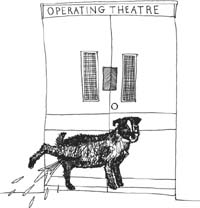
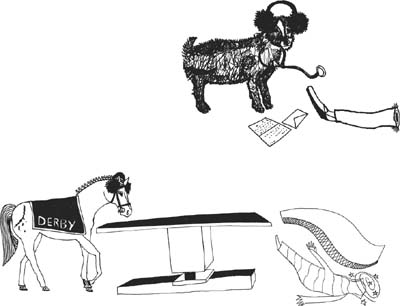
Off we go to revisit our surgery. As we barge our way into the theatre and the Jack Russell begins peeing on our leg, notice just how weak its urine is: as clear as water. Mind you, it’s no weaker than Lord John Russell’s wretched leadership. Which is a shame, because Russell was an imaginative and instinctive reformer who limited women’s working hours and improved teachers’ pay.
26–28
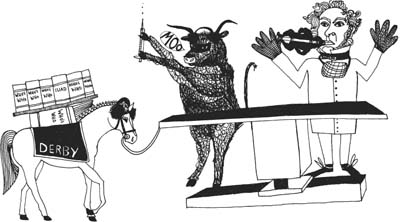
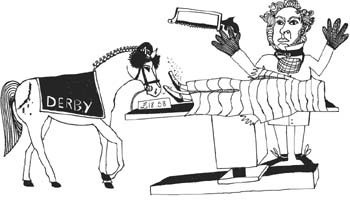
The Earl of Derby, our racehorse, has a shelf on his saddle full of Who’s Whos, that directory of important names. Derby’s cabinet was nicknamed the ‘Who? Who? cabinet’ after he was forced (because of infighting among the big guns) to appoint a selection of people no one had ever heard of before. The shelf also holds a copy of the Iliad – a poem the scholarly Derby translated into blank verse.
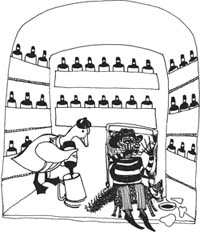
Next in this farmyard of an operating theatre is the Earl of Aberdeen. He is mooing enthusiastically, trying to gather the surgeons in a tight medical coalition. But his moo is too weak – he doesn’t have the presence to control such big personalities.
The Earl of Aberdeen’s coalition – featuring Russell, Palmerstone and Gladstone among others – was too big on talent and ambition to be effective, and Aberdeen was soon ousted by his eager underlings.
His appearance can’t have helped – check out the grimy criminal look he’s got going on. Aberdeen’s Crimean War, a disaster of a conflict, made him very unpopular at home.
We all wondered earlier at the exceptional stillness of Palmerstone’s hands. It’s partly down to his experience – he’d spent four decades as a politician by the time he became prime minister in 1855 at the age of seventy-one. His nickname is Pumice Stone – that’s what his stone palms are made of – and it gives a clue as to his abrasive style.
You see that china opium pipe he’s smoking that’s shaped like King Kong? This should remind us of the Second Opium War in China while he was in office that won Britain the imperial possession of Hong Kong.
Palmerstone’s first term ends up with him cutting a chunk from Derby’s bottom. As Derby bolts and we zoom along behind him during this, the earl’s second term, we manage to pilfer a whole Indian takeaway off an upended trolley – worth £18.58! This reminds us of the India Act of 1858, where the East India Company was entirely transferred to government control.
When Palmerstone rather impressively cuts us off at the end of Derby’s second term, we spot some evidence of his racy private life poking from his pocket – that’s a court ruling saying he’s been cited in a divorce case, even though he’s in his late seventies now.
He dies at the end of our surgery at the age of eighty-one, a splendid age for a prime minister.
John Russell takes over for his second term, during which he tried to liberalize trade laws. He’s not really concentrating on us – he’s reading a letter from his grandson, the philosopher Bertrand Russell, whom he brought up. When we crash off the operating table into the lift doors during Derby’s third term as prime minister we get to see his feet for the first time: he hasn’t got hooves, but rather twenty-two exceedingly expensive toe-rings.
This reminds us of how he was head of the Tory party for twenty-two years – and was in fact the founder of the party in its recognizable modern form.
Well, after landing on the floor at Derby’s sudden stop, we’re well into our heart attack now.
29
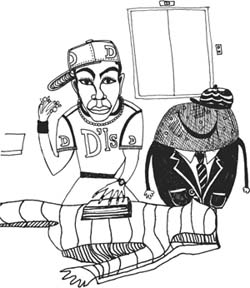
Dizzee Benjamin Disraeli is the first to start chest compressions, placing a book over our heart and pumping away with one hand. He’s using the other to force bonbons into his vigorously chewing mouth.
The book is one of his witty and underrated novels, Vivien Grey, I believe. And he’s obviously got bonbon fever – he’s a bon viveur, and he feels so much like chewing because he’s the first Jewish prime minister.
We hardly need comment on the rivalry that exists between Gladstone and Disraeli – look how they’re fighting over the chance to bring us back to life.
30
Gladstone is made of stone for a very practical reason: he’s a firebrand, you see, and needs the high melting point to be able to heat up like he does in parliamentary debates.
He comes back and forth so many times during our resuscitation that you have to ask where he goes when not in office. The answer is that our stone man has a heart of gold – he’s nipping over to some prostitutes round the corner to persuade them to mend their ways, just as he did around London, even when prime minister; unprecedented behaviour for a PM, but very liberal.
Which should come as no surprise: he was the father of the Liberal Party.
31
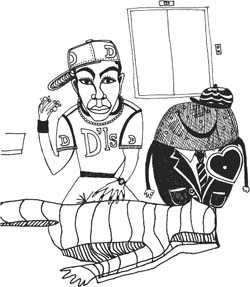
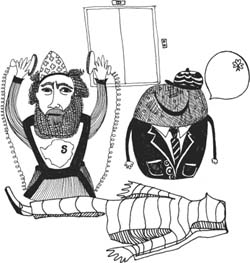
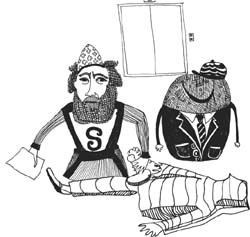
Ah, the lift! Out comes the Marquess of Salisbury to swap places with Disraeli and work on our heart. Take a closer look this time at the S marked on Salisbury’s frock.
We can see a map of Zimbabwe on his chest, and also that it is the capital of this country that’s been marked with an S. S for Salisbury – it was during his time in power that Britain gained Zimbabwe (then known as Rhodesia) as an imperial colony, and its capital was named after him.
During the Salisbury–Gladstone–Salisbury–Gladstone spell, each has his own distinctive behaviour.
Gladstone, on the one hand, has begun to blow great big green bubbles in his gum – he’s become known as the G.O.M., or Grand Old Man, and now spends much of his energy trying to pass bills for Irish Home Rule. That’s why the gum blows out like a shamrock completely independently of its blower’s behaviour. Salisbury, meanwhile, insists on explaining everything he’s doing – and making us colour in maps of the heart. It was his Elementary Education Act of 1891 that mandated free primary school education for everyone.
Don’t forget the sequence of zaps to breaths: it goes Gladstone, Disraeli, Gladstone, Salisbury, Gladstone, Salisbury, Gladstone. By that last breath of Gladstone he’s had four puffs, or turns in office, when…
32
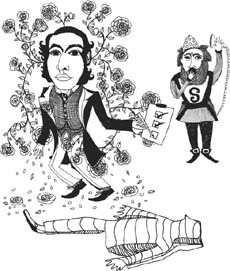
Out of the lift emerges the Earl of Rosebery, buried in the bushes of roses sprouting from his ears. He’s appeared at the last possible moment, but manages to save us for the simple reason that he’s the luckiest man in Britain. Anything he tries to do comes off.
As a student, Rosebery made a list of his three aims in life: to marry the richest woman in England, to win the Derby and to become prime minister. He achieved all three. And he had little interest in clinging to the job of prime minister once he’d ticked it off his things-to-do list, which you can see him doing now.
As Salisbury comes in for his third and final zap, he’s really become quite bored of the task – so bored, in fact, that he’s yawning. This reminds us that the Boer War was taking place at this time.
33
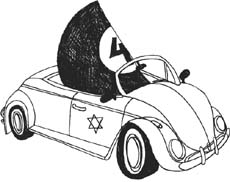
After that last zap, we only regained consciousness when we felt half a ball four bouncing around in our bed in the ward. That was Arthur Balfour, and I, for one, seriously doubted whether he was real.
How apt! Balfour first became famous for producing dense works of philosophy, such as A Defence of Philosophical Doubt in which he argued that doubting the reality of things is, well, good practice.
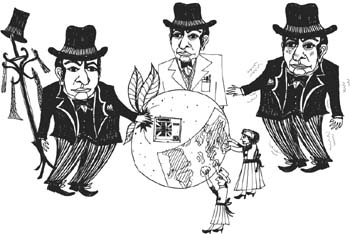
And we have to doubt things rather a lot when Balfour is driving a car around our bed loudly declaring how he’s working out where he’ll put a new country called Israel on the world map.
As well as being a doubting philosopher, Balfour was the first prime minister to own a car. He authored the Balfour Declaration – an early step on the road to the creation of the state of Israel in Palestine.
34
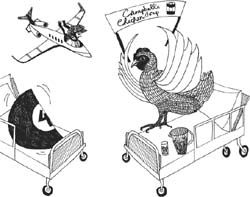
Rather amazingly, Sir Henry Campbell-Bannerman, the mad hen advertising Campbell’s Chicken Soup opposite us, is drinking Pimms. He’s celebrating becoming the first PM to be called prime minister officially (there’d been various names before that, none of them as pithy). You’ll notice how his cluck is distinctively Scottish – he’s from Glasgow, is old Campbell-Bannerman.
And check out the bright little jet plane, piloted by a determined-looking woman, which he’s having to suffer buzzing around his head: this was the era of suffragettes – women campaigning for the vote. Let’s follow this little jet as it flies all the way over to the ass on the TV – chased by the hen’s raw Glaswegian cluck.
35
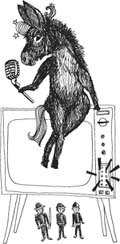
It’s no surprise that Herbert Asquith, our ass with a sherbet-encrusted quiff, is sitting with his legs over the screen on the TV. He thinks the audio is enough – and he was the first prime minister to use commercial recordings to direct public opinion via the radio.
Meanwhile, a gaggle of newly uniformed young soldiers is waiting behind us in the queue, hoping to taste glory. Asquith signs them up for the trenches of WWI, since they’re here. He was the prime minister who led Britain into the Great War.
36+37
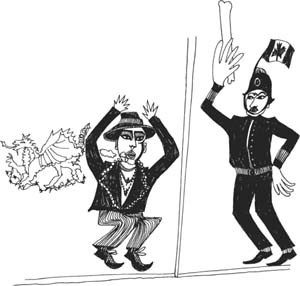
I’m not sure if this is just the rabies talking or shell shock, but rabid Boy George, beyond Asquith, has drooled a picture of a Welsh dragon stuck in barbed wire on to the window.
The only Welsh prime minister to date, David Lloyd George led Britain for the second half of the nightmare of WWI and is remembered as the Man Who Won the War.
And hello again to Andrew Bonar Law, our bone-wielding law enforcer, who was born in Canada. You can tell from the flag he’s got on the top of his hat. He must have attempted to knock him out – now he’s carrying Lloyd George away.
Well, of course! Bonar Law was in coalition with Lloyd George – though he did break from it in due course to become PM. As an aside, he once said the following: ‘If I am a great man, then a good many great men of history are frauds.’
38
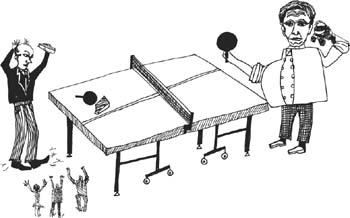
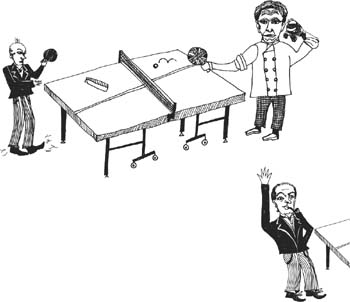
Let’s head out of the ward again. Over at the ping-pong table, Stanley Baldwin wants to win so badly because lots of people have come to see him. He feels it would be ‘social justice’ if he, the crowd’s favourite, won. As a politician, his actions were dominated by such concern for social justice.
He’s just paused for a bite of Mr Kipling’s cakes to gain some energy before this important match point – well, he was Rudyard Kipling’s cousin.
39
Ramsay MacDonald, for his part, is eating a Big Mac – but he’s also giving birth. A noisy process that reminds us of how he was the first Labour prime minister.
He’s about to give birth to a shower of little James Bonds, who will all tumble on to a soft field of margarine below. This margarine field of Bonds reminds us that Ramsay was the first PM to include a woman, Margaret Bondfield, in his cabinet. So, the rally starts: Baldwin to MacDonald, back to Baldwin, back to MacDonald who then takes out a paddle with the Union Jack on it for a third strike. This was where he became the leader of the National Labour Party, as opposed to the normal one. National or not, he fails to return Baldwin’s third strike as PM.
40
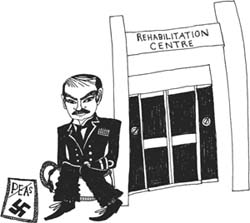
Poor Neville Chamberlain is up next. His chamber pot is full of really expensive German peas – Chamberlain having sought peace with Germany at any price. The trouble is that he was sold the peas by a man named Hitler – and they’re fake. That’s why he’s too upset to acknowledge us as we walk past – history does not smile upon his policy of appeasement, rather unfairly, and he is often thought to be personally responsible for WWII.
41+42
Here we are now with our Churchill–Churchill–Attlee–Churchill jamboree. The first Churchill is carrying a hat stand covered in party gear – a memento from his birth in a cloakroom during a dance at Blenheim Palace. But you probably already know more about Churchill (great saviour of Britain, of the free world indeed, during World War II) than could be fitted in this book, so we’ll carry straight on past. Clement Attlee, our clementine atlas in the middle, is being polished by nurses – and he deserves it: he founded the NHS. He also has an ATM in his side with a Union Jack showing on the screen – which reminds us that he nationalized the Bank of England.
You may wonder how a fruit became arguably the most successful prime minister of the twentieth century, but he pipes up now to offer us an explanation: ‘Often the experts make the worst possible ministers in their own fields. In this country we prefer rule by amateurs.’
Our third Winston Churchill is shivering dreadfully on the far side, and looking terribly aged. As the clementine reaches him, his hands are too cold, his legs too tired, to do anything with it. This is a clue to Churchill’s third term as prime minister, a frustrating spectacle as the great man found himself at his very advanced age quite unable to resolve the Cold War as he had hoped.
43
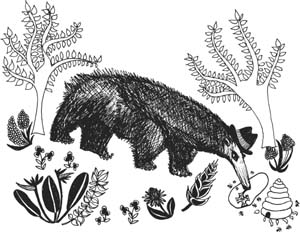
Anthony Eden, our anteater who’s eatin’, has his long nose down a hole; he’s snuffling around for food. Note the trademark homburg hat (often now called an Eden, after this prime minister) and the way he’s using his military cross, won for bravery in WWI, as a plunger to test the depth of this ant colony.
But, dear me, he’s just realized that this is a sewer and not an ant colony that he has his long nose down! Yuk! Eden’s career was ruined by the Suez crisis, in which he schemed and lied enough to justify this long nose of his.
44
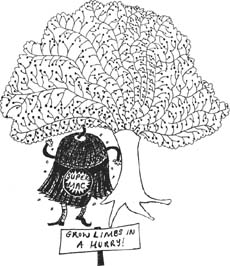
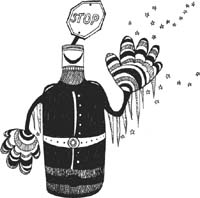
In need of healing in a hurry, we head towards the tree-of-all-therapies, where Harold Macmillan the Scotch melon greets us amiably. He seems to be really enjoying defrosting in the sun; indeed, a warming in Cold War relations, combined with gains in Britain’s prosperity, meant Macmillan enjoyed a hugely successful first term. And, yes, that is a Supermac badge he’s got on his belt. Supermac was what we Brits used to call him.
Unfortunately, when we move close to him, he becomes a bit uncomfortable at the scandalous amount of perfume we’re wearing and starts blustering, just like his inept response to the Profumo scandal that marred his latter days as prime minister.
45
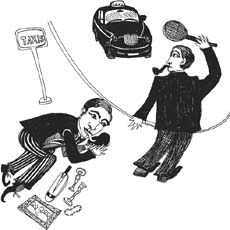
Along at the taxi rank, Alec Douglas-Home is licking himself a hole so he can make a nice secret home for all his aristocratic regalia. He had to put away his aristocratic title to join the Commons after becoming prime minister.
You’ll notice he’s also burying his cricket bat: a keen sportsman in his youth, he remains the only prime minister to have played first-class cricket.
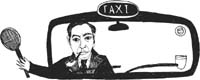
Our hurried tennis player, in between waving for a cab, turns to abuse Alec Douglas-Home every so often for being quite so aristocratic. Just as he did, mercilessly, in the Commons.
46
Generally speaking, however, Harold Wilson has a rather intellectual look to him. And when we get into the cab he insists on putting on an Open University tape about the ethics of capital punishment. This relates to two of Wilson’s momentous achievements: he oversaw the foundation of the Open University and also the banning of capital punishment.
Once in the cab, I have to confess that I’m finding all this speeding very frightening – and I can’t help myself embracing Wilson, hugging him close to reassure myself. He doesn’t mind in the least, of course, even if my gesture had been romantic: it was he who legalized expressions of physical affection between men in 1967.
47
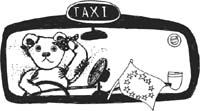
Wow – look at our cab driver’s body! The more pressure we put on this teddy to get a move on, the more sawdust begins to fly from its seams. But this shouldn’t surprise us: Edward Heath was, after all, the son of a carpenter.
He’s done something very clever here, though, has Teddy Heath: he’s installed a European flag on the bonnet, which makes everyone think we’re a diplomatic vehicle and they make way for us.
So too did Heath enter Britain into the European Community without anyone managing to object too much.
But his slowness prompts a show of hands on whether the ted should continue. Although he receives more votes than Wilson, who wants to replace him, Wilson still kicks him out of the car. In the general election of 1974, Ted won more votes than his opponent, but found himself out of a job regardless. With Wilson driving the car, we zoom along until we reach the traffic policeman with the coloured hands waving us down in the road.
48
This man is the tallest person we’ve seen all day – six foot one – a towering height for the late seventies. Jim Callaghan has got a big sunny smile on his face despite the (extremely local) blizzard that’s coating him in icicles.
He managed to live up to his nickname, Sunny Jim, during the Winter of Discontent in 1978 (when industrial action brought the nation to a standstill). During the crisis, he was photographed laughing away on a foreign beach as the nation saw rats infest the streets and unemployment rise to historic highs. He wasn’t very popular as a result, and was soon booted out of office.
49
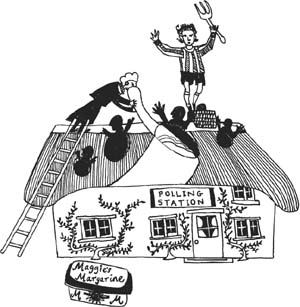
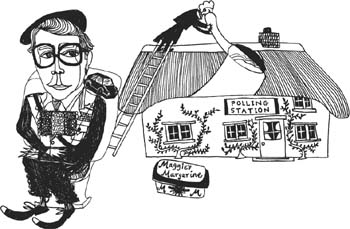
At last, the end is in sight as we head once more towards Maggie Thatcher’s thatching operation. The first thing to note is that her iron ladder has eleven rungs, which reminds us that Maggie, the ‘Iron Lady’, was prime minister for eleven years. She is using her margarine to seal holes in the roof. From these holes, you can see miners fleeing: Thatcher controversially closed most of the nation’s coal mines.
And now look: an Argentinian footballer is bounding across the roof to attack Maggie with a fork – but she squashes him brutally into the thatch with her knife. It was of course Margaret Thatcher who responded so decisively to quash the Argentinians during the Forklands, or rather Falklands, War.
50
At the bottom of the ladder, John Major has a very well-decorated army major’s uniform. First, he’s got a miniature Volkswagen Golf on his shoulder – representing the first Gulf War.
He’s also got an Irish flag on his breast, made entirely from peas, a symbol of the peace in Northern Ireland, which he all but secured. Finally, imagine he’s wearing an ‘I love Brixton’ badge from his time growing up in South London.
It’s also worth pointing out his enormous clown shoes, which belonged to his father. Major remains the only prime minister whose father worked as a clown.
51
Inside the polling station, here’s Tony Blair with his toe-knees blurred, running around doing his last minute campaigning. To be sure, he’s very young (the youngest prime minister since the Earl of Liverpool – back at the hospital’s front desk) so you can expect a certain amount of vigour. But what exactly is he up to? Well, Tony is running so much because he likes to do everything and be everywhere: as prime minister he assumed almost presidential control of all aspects of government. But right now he’s trying to grab some stuff off a high rack. He can’t reach, though, because he has no shins.
In his desperation to get to the stuff on the high rack he puts in huge amounts of effort: his maimed legs go into overdrive and spin a million times in just a couple of minutes. This all reminds us of the political spin that accompanied Blair’s attempt to conquer Iraq, and the disaster it turned out to be when more than a million Iraqi people were killed or seriously hurt.
52
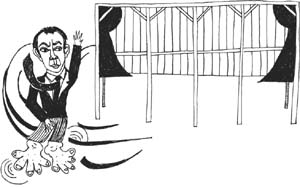
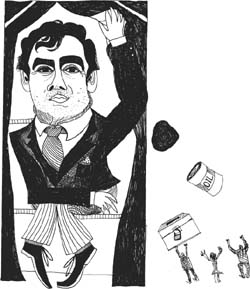
With seconds to go, here’s Gordon Brown again, pulling his golden-brown cordon across the voting booth. He’s trying to cancel the election. When Brown became prime minister after Blair resigned, he also planned to have a quick election, but wimped out at the last minute, denting his reputation in the process. Brown was one of the unluckiest prime ministers: a large black rock has just hit him on the head – this is the Northern Rock crisis, where a bank collapsed and the economy tottered. Now there’s a huge oil barrel spiralling through the air – this symbolizes the increasing oil prices, fanning consumer discontent. And did you feel that? The whole building just shook – that’s the housing price crash.
Brilliant. We’ve added the first few dabs of colour to the story of the British prime ministers. The thing to do now is go out and discover a few extra facts about one of these PMs and to try to insert images for these facts into the narrative. You’ll soon find that it’s a very natural, creative way to learn, well, as much as you want to. Good luck!