IN A FAMOUS study from the 1970s, a researcher showed nursery school children one at a time into a room with no distractions except for a marshmallow resting on a tray on a desk. As the researcher left the room, the child was told he could eat the marshmallow now, or, if he waited for fifteen minutes, he would be rewarded with a second marshmallow.
Walter Mischel and his graduate students observed through a mirror as the children faced their dilemma. Some popped the marshmallow into their mouths the moment the researcher left, but others were able to wait. To help themselves hold back, these kids tried anything they could think of. They were observed to “cover their eyes with their hands or turn around so that they can’t see the tray, start kicking the desk, or tug on their pigtails, or stroke the marshmallow as if it were a tiny stuffed animal,” the researchers wrote.
Of more than six hundred children who took part in the experiment, only one-third succeeded in resisting temptation long enough to get the second marshmallow.
A series of follow-up studies, the most recent in 2011, found that the nursery school children who had been more successful in delaying gratification in this exercise grew up to be more successful in school and in their careers.
The marshmallow study is sublime in its simplicity and as a metaphor for life. We are born with the gift of our genes, but to a surprising degree our success is also determined by focus and self-discipline, which are the offspring of motivation and one’s sense of personal empowerment.1
Consider James Paterson, a spirited, thirty-something Welshman, and his unwitting seduction by the power of mnemonic devices and the world of memory competitions. The word “mnemonic” is from the Greek word for memory. Mnemonic devices are mental tools that can take many forms but generally are used to help hold a large volume of new material in memory, cued for ready recall.
James first learned of mnemonics when one of his university instructors fleetingly mentioned their utility during a lecture. He went straight home, searched the web, bought a book. If he could learn these techniques, he figured, he could memorize his classwork in short order and have a lot more time to hang out with friends. He started practicing memorizing things: names and dates for his psychology classes and the textbook page numbers where they were cited. He also practiced parlor tricks, like memorizing the sequence of playing cards in a shuffled deck or strings of random numbers read from lists made up by friends. He spent long hours honing his techniques, becoming adept and the life of the party among his social set. The year was 2006, and when he learned of a memory competition to be held in Cambridge, England, he decided on a lark to enter it. There he surprised himself by taking first place in the beginner category, a performance for which he pocketed a cool 1,000 euros. He was hooked. Figuring he had nothing to lose by taking a flyer, he went on to compete in his first World Memory Championships, in London, that same year.
With mnemonics James had figured to pocket some easy facts to ace his exams without spending the time and effort to fully master the material, but he discovered something entirely different, as we will recount shortly.
Memory athletes, as these competitors call themselves, all get their start in different ways. Nelson Dellis, the 2012 US Memory Champion, began after his grandmother died of Alzheimer’s disease. Nelson watched her decline over time, with her ability to remember being the first cognitive faculty to go. Although only in his twenties, Nelson wondered if he were destined for the same fate and what he could do about it. He discovered mind sports, hoping that if he could develop his memory to great capacity, then he might have reserves if the disease did strike him later in life. Nelson is another memory athlete on his way up, and he has started a Foundation, Climb for Memory, to raise awareness about and funds for research for this terrible disease. Nelson also climbs mountains (twice reaching near the summit of Mt. Everest), hence the name. We meet others in this chapter who, like Paterson and Dellis, have sought successfully to raise their cognitive abilities in one way or another.
The brain is remarkably plastic, to use the term applied in neuroscience, even into old age for most people. In this chapter’s discussion of raising intellectual abilities, we review some of the questions science is trying to answer about the brain’s ability to change itself throughout life and people’s ability to influence those changes and to raise their IQs. We then describe three known cognitive strategies for getting more out of the mental horsepower you’ve already got.
In a sense the infant brain is like the infant nation. When John Fremont arrived with his expeditionary force at Pueblo de Los Angeles in 1846 in the US campaign to take western territory from Mexico, he had no way to report his progress to President James Polk in Washington except to send his scout, Kit Carson, across the continent on his mule—a round-trip of nearly six thousand miles over mountains, deserts, wilderness and prairies. Fremont pressed Carson to whip himself into a lather, not even to stop to shoot game along the way but to sustain himself by eating the mules as they broke down and needed replacing. That such a journey would be required reveals the undeveloped state of the country. The five-foot-four-inch, 140-pound Carson was the best we had for getting word from one coast to the other. Despite the continent’s boundless natural assets, the fledgling nation had little in the way of capability. To become mighty, it would need cities, universities, factories, farms and seaports, and the roads, trains, and telegraph lines to connect them.2
It’s the same with a brain. We come into the world endowed with the raw material of our genes, but we become capable through the learning and development of mental models and neural pathways that enable us to reason, solve, and create. We have been raised to think that the brain is hardwired and our intellectual potential is more or less set from birth. We now know otherwise. Average IQs have risen over the past century with changes in living conditions. When people suffer brain damage from strokes or accidents, scientists have seen the brain somehow reassign duties so that adjacent networks of neurons take over the work of damaged areas, enabling people to regain lost capacities. Competitions between “memory athletes” like James Paterson and Nelson Dellis have emerged as an international sport among people who have trained themselves to perform astonishing acts of recall. Expert performance in medicine, science, music, chess, or sports has been shown to be the product not just of innate gifts, as had long been thought, but of skills laid down layer by layer, through thousands of hours of dedicated practice. In short, research and the modern record have shown that we and our brains are capable of much greater feats than scientists would have thought possible even a few decades ago.
All knowledge and memory are physiological phenomena, held in our neurons and neural pathways. The idea that the brain is not hardwired but plastic, mutable, something that reorganizes itself with each new task, is a recent revelation, and we are just at the frontiers of understanding what it means and how it works.
In a helpful review of the neuroscience, John T. Bruer took on this question as it relates to the initial development and stabilization of the brain’s circuitry and our ability to bolster the intellectual ability of our children through early stimulation. We’re born with about 100 billion nerve cells, called neurons. A synapse is a connection between neurons, enabling them to pass signals. For a period shortly before and after birth, we undergo “an exuberant burst of synapse formation,” in which the brain wires itself: the neurons sprout microscopic branches, called axons, that reach out in search of tiny nubs on other neurons, called dendrites. When axon meets dendrite, a synapse is formed. In order for some axons to find their target dendrites they must travel vast distances to complete the connections that make up our neural circuitry (a journey of such daunting scale and precision that Bruer likens it to finding one’s way clear across the United States to a waiting partner on the opposite coast, not unlike Kit Carson’s mission to President Polk for General Fremont). It’s this circuitry that enables our senses, cognition, and motor skills, including learning and memory, and it is this circuitry that forms the possibilities and the limits of one’s intellectual capacity.
The number of synapses peaks at the age of one or two, at about 50 percent higher than the average number we possess as adults. A plateau period follows that lasts until around puberty, whereupon this overabundance begins to decline as the brain goes through a period of synaptic pruning. We arrive at our adult complement at around age sixteen with a staggering number, thought to total about 150 trillion connections.
We don’t know why the infant brain produces an overabundance of connections or how it subsequently determines which ones to prune. Some neuroscientists believe that the connections we don’t use are the ones that fade and die away, a notion that would seem to manifest the “use it or lose it” principle and argue for the early stimulation of as many connections as possible in hopes of retaining them for life. Another theory suggests the burgeoning and winnowing is determined by genetics and we have little or no influence over which synapses survive and which do not.
“While children’s brains acquire a tremendous amount of information during the early years,” the neuroscientist Patricia Goldman-Rakic told the Education Commission of the States, most learning is acquired after synaptic formation stabilizes. “From the time a child enters first grade, through high school, college, and beyond, there is little change in the number of synapses. It is during the time when no, or little, synapse formation occurs that most learning takes place” and we develop adult-level skills in language, mathematics, and logic.3 And it is likely during this period more than during infancy, in the view of the neuroscientist Harry T. Chugani, that experience and environmental stimulation fine-tune one’s circuits and make one’s neuronal architecture unique.4 In a 2011 article, a team of British academics in the fields of psychology and sociology reviewed the evidence from neuroscience and concluded that the architecture and gross structure of the brain appear to be substantially determined by genes but that the fine structure of neural networks appears to be shaped by experience and to be capable of substantial modification.5
That the brain is mutable has become evident on many fronts. Norman Doidge, in his book The Brain That Changes Itself, looks at compelling cases of patients who have overcome severe impairments with the assistance of neurologists whose research and practice are advancing the frontiers of our understanding of neuroplasticity.
One of these was Paul Bach-y-Rita, who pioneered a device to help patients who have suffered damage to sensory organs. Bach-y-Rita’s device enables them to regain lost skills by teaching the brain to respond to stimulation of other parts of their bodies, substituting one sensory system for another, much as a blind person can learn to navigate through echolocation, learning to “see” her surroundings by interpreting the differing sounds from the tap of a cane, or can learn to read through the sense of touch using Braille.6
One of Bach-y-Rita’s patients had suffered damage to her vestibular system (how the inner ear senses balance and spatial orientation) that had left her so unbalanced that she was unable to stand, walk, or maintain her independence. Bach-y-Rita rigged a helmet with carpenters’ levels attached to it and wired them to send impulses to a postage-stamp-sized strip of tape containing 144 microelectrodes placed on the woman’s tongue. As she tilted her head, the electrodes sparkled on her tongue like effervescence, but in distinctive patterns reflecting the direction and angle of her head movements. Through practice wearing the device, the woman was gradually able to retrain her brain and vestibular system, recovering her sense of balance for longer and longer periods following the training sessions.
Another patient, a thirty-five-year-old man who had lost his sight at age thirteen, was outfitted with a small video camera mounted on a helmet and enabled to send pulses to the tongue. As Bach-y-Rita explained, the eyes are not what sees, the brain is. The eyes sense, and the brain interprets. The success of this device relies on the brain learning to interpret signals from the tongue as sight. The remarkable results were reported in the New York Times: The patient “found doorways, caught balls rolling toward him, and with his small daughter played a game of rock, paper and scissors for the first time in twenty years. [He] said that, with practice, the substituted sense gets better, ‘as if the brain were rewiring itself.’ ”7
In yet another application, interesting in light of our earlier discussions of metacognition, stimulators are being attached to the chests of pilots to transmit cockpit instrument readings, helping the brain to sense changes in pitch and altitude that the pilot’s vestibular system is unable to detect under certain flight conditions.
Neural cell bodies make up most of the part of our brains that scientists call the gray matter. What they call the white matter is made up of the wiring: the axons that connect to dendrites of other neural cell bodies, and the waxy myelin sheaths in which some axons are wrapped, like the plastic coating on a lamp cord. Both gray matter and white matter are the subject of intense scientific study, as we try to understand how the components that shape cognition and motor skills work and how they change through our lives, research that has been greatly advanced by recent leaps in brain imaging technology.
One ambitious effort is the Human Connectome Project, funded by the National Institutes of Health, to map the connections in the human brain. (The word “connectome” refers to the architecture of the human neurocircuitry in the same spirit that “genome” was coined for the map of the human genetic code.) The websites of participating research institutions show striking images of the fiber architecture of the brain, masses of wire-like human axons presented in neon colors to denote signal directions and bearing an uncanny resemblance to the massive wiring harnesses inside 1970s supercomputers. Early research findings are intriguing. One study, at the University of California, Los Angeles, compared the synaptic architecture of identical twins, whose genes are alike, and fraternal twins, who share only some genes. This study showed what others have suggested, that the speed of our mental abilities is determined by the robustness of our neural connections; that this robustness, at the initial stages, is largely determined by our genes, but that our neural circuitry does not mature as early as our physical development and instead continues to change and grow through our forties, fifties, and sixties. Part of the maturation of these connections is the gradual thickening of the myelin coating of the axons. Myelination generally starts at the backs of our brains and moves toward the front, reaching the frontal lobes as we grow into adulthood. The frontal lobes perform the executive functions of the brain and are the location of the processes of high-level reasoning and judgment, skills that are developed through experience.
The thickness of the myelin coating correlates with ability, and research strongly suggests that increased practice builds greater myelin along the related pathways, improving the strength and speed of the electrical signals and, as a result, performance. Increases in piano practice, for example, have shown correlated increases in the myelination of nerve fibers associated with finger movements and the cognitive processes that are involved in making music, changes that do not appear in nonmusicians.8
The study of habit formation provides an interesting view into neuroplasticity. The neural circuits we use when we take conscious action toward a goal are not the same ones we use when our actions have become automatic, the result of habit. The actions we take by habit are directed from a region located deeper in the brain, the basal ganglia. When we engage in extended training and repetition of some kinds of learning, notably motor skills and sequential tasks, our learning is thought to be recoded in this deeper region, the same area that controls subconscious actions such as eye movements. As a part of this process of recoding, the brain is thought to chunk motor and cognitive action sequences together so that they can be performed as a single unit, that is, without requiring a series of conscious decisions, which would substantially slow our responses. These sequences become reflexive. That is, they may start as actions we teach ourselves to take in pursuit of a goal, but they become automatic responses to stimuli. Some researchers have used the word “macro” (a simple computer app) to describe how this chunking functions as a form of highly efficient, consolidated learning. These theories about chunking as integral to the process of habit formation help explain the way in sports we develop the ability to respond to the rapid-fire unfolding of events faster than we’re able to think them through, the way a musician’s finger movements can outpace his conscious thoughts, or the way a chess player can learn to foresee the countless possible moves and implications presented by different configurations of the board. Most of us display the same talent when we type.
Another fundamental sign of the brain’s enduring mutability is the discovery that the hippocampus, where we consolidate learning and memory, is able to generate new neurons throughout life. This phenomenon, called neurogenesis, is thought to play a central role in the brain’s ability to recover from physical injury and in humans’ lifelong ability to learn. The relationship of neurogenesis to learning and memory is a new field of inquiry, but already scientists have shown that the activity of associative learning (that is, of learning and remembering the relationship between unrelated items, such as names and faces) stimulates an increase in the creation of new neurons in the hippocampus. This rise in neurogenesis starts before the new learning activity is undertaken, suggesting the brain’s intention to learn, and continues for a period after the learning activity, suggesting that neurogenesis plays a role in the consolidation of memory and the beneficial effects that spaced and effortful retrieval practice have on long-term retention.9
Of course, learning and memory are neural processes. The fact that retrieval practice, spacing, rehearsal, rule learning, and the construction of mental models improve learning and memory is evidence of neuroplasticity and is consistent with scientists’ understanding of memory consolidation as an agent for increasing and strengthening the neural pathways by which one is later able to retrieve and apply learning. In the words of Ann and Richard Barnet, human intellectual development is “a lifelong dialogue between inherited tendencies and our life history.”10 The nature of that dialogue is the central question we explore in the rest of this chapter.
IQ is a product of genes and environment. Compare it to height: it’s mostly inherited, but over the decades as nutrition has improved, subsequent generations have grown taller. Likewise, IQs in every industrialized part of the world have shown a sustained rise since the start of standardized sampling in 1932, a phenomenon called the Flynn effect after the political scientist who first brought it to wide attention.11 In the United States, the average IQ has risen eighteen points in the last sixty years. For any given age group, an IQ of 100 is the mean score of those taking the IQ tests, so the increase means that having an IQ of 100 today is the intelligence equivalent of those with an IQ 60 years ago of 118. It’s the mean that has risen, and there are several theories why this is so, the principal one being that schools, culture (e.g., television), and nutrition have changed substantially in ways that affect people’s verbal and math abilities as measured by the subtests that make up the IQ test.
Richard Nisbett, in his book Intelligence and How to Get It, discusses the pervasiveness of stimuli in modern society that didn’t exist years ago, offering as one simple example a puzzle maze McDonald’s included in its Happy Meals a few years ago that was more difficult than the mazes included in an IQ test for gifted children.12 Nisbett also writes about “environmental multipliers,” suggesting that a tall kid who goes out for basketball develops a proficiency in the sport that a shorter kid with the same aptitudes won’t develop, just as a curious kid who goes for learning gets smarter than the equally bright but incurious kid who doesn’t. The options for learning have expanded exponentially. It may be a very small genetic difference that makes one kid more curious than another, but the effect is multiplied in an environment where curiosity is easily piqued and readily satisfied.
Another environmental factor that shapes IQ is socioeconomic status and the increased stimulation and nurturing that are more generally available in families who have more resources and education. On average, children from affluent families test higher for IQ than children from impoverished families, and children from impoverished families who are adopted into affluent families score higher on IQ tests than those who are not, regardless of whether the birth parents were of high or low socioeconomic status.
The ability to raise IQ is fraught with controversy and the subject of countless studies reflecting wide disparities of scientific rigor. A comprehensive review published in 2013 of the extant research into raising intelligence in young children sheds helpful light on the issue, in part because of the strict criteria the authors established for determining which studies would qualify for consideration. The eligible studies had to draw from a general, nonclinical population; have a randomized, experimental design; consist of sustained interventions, not of one-shot treatments or simply of manipulations during the testing experience; and use a widely accepted, standardized measure of intelligence. The authors focused on experiments involving children from the prenatal period through age five, and the studies meeting their requirements involved over 37,000 participants.
What did they find? Nutrition affects IQ. Providing dietary supplements of fatty acids to pregnant women, breast-feeding women, and infants had the effect of increasing IQ by anywhere from 3.5 to 6.5 points. Certain fatty acids provide building blocks for nerve cell development that the body cannot produce by itself, and the theory behind the results is that these supplements support the creation of new synapses. Studies of other supplements, such as iron and B complex vitamins, strongly suggested benefits, but these need validation through further research before they can be considered definitive.
In the realm of environmental effects, the authors found that enrolling poor children in early education raises IQ by more than four points, and by more than seven if the intervention is based in a center instead of in the home, where stimulation is less consistently sustained. (Early education was defined as environmental enrichment and structured learning prior to enrollment in preschool.) More affluent children, who are presumed to have many of these benefits at home, might not show similar gains from enrolling in early education programs. In addition, no evidence supports the widely held notion that the younger children are when first enrolled in these programs the better the results. Rather, the evidence suggests, as John Bruer argues, that the earliest few years of life are not narrow windows for development that soon close.
Gains in IQ were found in several areas of cognitive training. When mothers in low-income homes were given the means to provide their children with educational tools, books, and puzzles and trained how to help their children learn to speak and identify objects in the home, the children showed IQ gains. When mothers of three-year-olds in low-income families were trained to talk to their children frequently and at length and to draw out the children with many open-ended questions, the children’s IQs rose. Reading to a child age four or younger raises the child’s IQ, especially if the child is an active participant in the reading, encouraged by the parent to elaborate. After age four, reading to the child does not raise IQ but continues to accelerate the child’s language development. Preschool boosts a child’s IQ by more than four points, and if the school includes language training, by more than seven points. Again, there is no body of evidence supporting the conclusion that early education, preschool, or language training would show IQ gains in children from better-off families, where they already benefit from the advantages of a richer environment.13
What about “brain training” games? We’ve seen a new kind of business emerge, pitching online games and videos promising to exercise your brain like a muscle, building your cognitive ability. These products are largely founded on the findings of one Swiss study, reported in 2008, which was very limited in scope and has not been replicated.14 The study focused on improving “fluid intelligence”: the facility for abstract reasoning, grasping unfamiliar relationships, and solving new kinds of problems. Fluid intelligence is one of two kinds of intelligence that make up IQ. The other is crystallized intelligence, the storehouse of knowledge we have accumulated through the years. It’s clear that we can increase our crystallized intelligence through effective learning and memory strategies, but what about our fluid intelligence?
A key determiner of fluid intelligence is the capacity of a person’s working memory—the number of new ideas and relationships that a person can hold in mind while working through a problem (especially with some amount of distraction). The focus of the Swiss study was to give participants tasks requiring increasingly difficult working memory challenges, holding two different stimuli in mind for progressively longer periods of distraction. One stimulus was a sequence of numerals. The other was a small square of light that appeared in varying locations on a screen. Both the numerals and the locations of the square changed every three seconds. The task was to decide—while viewing a sequence of changed numerals and repositioned squares—for each combination of numeral and square, whether it matched a combination that had been presented n items back in the series. The number n increased during the trials, making the challenge to working memory progressively more arduous.
All the participants were tested on fluid intelligence tasks at the outset of the study. Then they were given these increasingly difficult exercises of their working memory over periods ranging up to nineteen days. At the end of the training, they were retested for fluid intelligence. They all performed better than they had before the training, and those who had engaged in the training for the longest period showed the greatest improvement. These results showed for the first time that fluid intelligence can be increased through training.
What’s the criticism?
The participants were few (only thirty-five) and were all recruited from a similar, highly intelligent population. Moreover, the study focused on only one training task, so it is unclear to what extent it might apply to other working-memory training tasks, or whether the results are really about working memory rather than some peculiarity of the particular training. Finally, the durability of the improved performance is unknown, and the results, as noted, have not been replicated by other studies. The ability to replicate empirical results is the bedrock of scientific theory. The website PsychFileDrawer.org keeps a list of the top twenty psychological research studies that the site’s users would like to see replicated, and the Swiss study is the first on the list. A recent attempt whose results were published in 2013 failed to find any improvements to fluid intelligence as a result of replicating the exercises in the Swiss study. Interestingly, participants in the study believed that their mental capacities had been enhanced, a phenomenon the authors describe as illusory. However, the authors also acknowledge that an increased sense of self-efficacy can lead to greater persistence in solving difficult problems, encouraged by the belief that training has improved one’s abilities.15
The brain is not a muscle, so strengthening one skill does not automatically strengthen others. Learning and memory strategies such as retrieval practice and the building of mental models are effective for enhancing intellectual abilities in the material or skills practiced, but the benefits don’t extend to mastery of other material or skills. Studies of the brains of experts show enhanced myelination of the axons related to the area of expertise but not elsewhere in the brain. Observed myelination changes in piano virtuosos are specific to piano virtuosity. But the ability to make practice a habit is generalizable. To the extent that “brain training” improves one’s efficacy and self-confidence, as the purveyors claim, the benefits are more likely the fruits of better habits, such as learning how to focus attention and persist at practice.
Richard Nisbett writes of environmental “multipliers” that can deliver a disproportionate effect from a small genetic predisposition—the kid who is genetically just a little bit more curious becomes significantly smarter if she’s in an environment that feeds curiosity. Now stand that notion on its head. Since it’s unlikely I’ll be raising my IQ anytime soon, are there strategies or behaviors that can serve as cognitive “multipliers” to amp up the performance of the intelligence I’ve already got? Yes. Here are three: embracing a growth mindset, practicing like an expert, and constructing memory cues.
Let’s return to the old saw “If you think you can, or you think you can’t, you’re right.” If turns out there is more truth here than wit. Attitude counts for a lot. The studies of the psychologist Carol Dweck have gotten huge attention for showing just how big an impact one simple conviction can have on learning and performance: the belief that your level of intellectual ability is not fixed but rests to a large degree in your own hands.16
Dweck and her colleagues have replicated and expanded on their results in many studies. In one of the early experiments, she ran a workshop for low-performing seventh graders at a New York City junior high school, teaching them about the brain and about effective study techniques. Half the group also received a presentation on memory, but the other half were given an explanation of how the brain changes as a result of effortful learning: that when you try hard and learn something new, the brain forms new connections, and these new connections, over time, make you smarter. This group was told that intellectual development is not the natural unfolding of intelligence but results from the new connections that are formed through effort and learning. After the workshop, both groups of kids filtered back into their classwork. Their teachers were unaware that some had been taught that effortful learning changes the brain, but as the school year unfolded, those students adopted what Dweck calls a “growth mindset,” a belief that their intelligence was largely within their own control, and they went on to become much more aggressive learners and higher achievers than students from the first group, who continued to hold the conventional view, what Dweck calls a “fixed mindset,” that their intellectual ability was set at birth by the natural talents they were born with.
Dweck’s research had been triggered by her curiosity over why some people become helpless when they encounter challenges and fail at them, whereas others respond to failure by trying new strategies and redoubling their effort. She found that a fundamental difference between the two responses lies in how a person attributes failure: those who attribute failure to their own inability—“I’m not intelligent”—become helpless. Those who interpret failure as the result of insufficient effort or an ineffective strategy dig deeper and try different approaches.
Dweck came to see that some students aim at performance goals, while others strive toward learning goals. In the first case, you’re working to validate your ability. In the second, you’re working to acquire new knowledge or skills. People with performance goals unconsciously limit their potential. If your focus is on validating or showing off your ability, you pick challenges you are confident you can meet. You want to look smart, so you do the same stunt over and over again. But if your goal is to increase your ability, you pick ever-increasing challenges, and you interpret setbacks as useful information that helps you to sharpen your focus, get more creative, and work harder. “If you want to demonstrate something over and over, ‘ability’ feels like something static that lies inside of you, whereas if you want to increase your ability, it feels dynamic and malleable,” Dweck says. Learning goals trigger entirely different chains of thought and action from performance goals.17
Paradoxically, a focus on performance trips up some star athletes. Praised for being “naturals,” they believe their performance is a result of innate gifts. If they’re naturals, the idea goes, they shouldn’t have to work hard to excel, and in fact many simply avoid practicing, because a need to practice is public evidence that their natural gifts are not good enough to cut the mustard after all. A focus on performance instead of on learning and growing causes people to hold back from risk taking or exposing their self-image to ridicule by putting themselves into situations where they have to break a sweat to deliver the critical outcome.
Dweck’s work has extended into the realm of praise and the power it has in shaping the way people respond to challenges. Here’s an example. A group of fifth grade students are individually given a puzzle to solve. Some of the students who solve the puzzle are praised for being smart; other students who solve it are praised for having worked hard. The students are then invited to choose another puzzle: either one of similar difficulty or one that’s harder but that they would learn from by making the effort to try solving. A majority of the students who are praised for their smarts pick the easier puzzle; 90 percent of the kids praised for effort pick the harder one.
In a twist on this study, students get puzzles from two people, Tom and Bill. The puzzles Tom gives the students can be solved with effort, but the ones Bill gives them cannot be solved. Every student gets puzzles from both Tom and Bill. After working to solve the puzzles, some of the kids are praised for being smart, and some for their effort. In a second round, the kids get more puzzles from both Tom and Bill, and this time all the puzzles are solvable. Here’s the surprise: of the students who were praised for being smart, few solved the puzzles they got from Bill, even though they were the same puzzles these students had solved earlier when they got them from Tom. For those who saw being considered smart as paramount, their failure to solve Bill’s puzzles in the first round instilled a sense of defeat and helplessness.
When you praise for intelligence, kids get the message that being seen as smart is the name of the game. “Emphasizing effort gives a child a rare variable they can control,” Dweck says. But “emphasizing natural intelligence takes it out of a child’s control, and it provides no good recipe for responding to a failure.”18
Paul Tough, in his recent book How Children Succeed, draws on Dweck’s work and others’ to make the case that our success is less dependent on IQ than on grit, curiosity, and persistence. The essential ingredient is encountering adversity in childhood and learning to overcome it. Tough writes that children in the lowest strata of society are so beset by challenges and starved of resources that they don’t stand a chance of experiencing success. But, and here’s another paradox, kids at the top of the heap, who are raised in cosseted settings, praised for being smart, bailed out of predicaments by helicopter parents, and never allowed to fail or overcome adversity on their own initiative, are also denied the character-building experiences essential for success later in life.19 A kid who’s born on third base and grows up thinking she hit a triple is unlikely to embrace the challenges that will enable her to discover her full potential. A focus on looking smart keeps a person from taking risks in life, the small ones that help people rise toward their aspirations, as well as the bold, visionary moves that lead to greatness. Failure, as Carol Dweck tells us, gives you useful information, and the opportunity to discover what you’re capable of doing when you really set your mind to it.
The takeaway from Dweck, Tough, and their colleagues working in this field is that more than IQ, it’s discipline, grit, and a growth mindset that imbue a person with the sense of possibility and the creativity and persistence needed for higher learning and success. “Study skills and learning skills are inert until they’re powered by an active ingredient,” Dweck says. The active ingredient is the simple but nonetheless profound realization that the power to increase your abilities lies largely within your own control.
When you see stellar performances by an expert in any field—a pianist, chess player, golfer—perhaps you marvel at what natural talent must underlie their abilities, but expert performance does not usually rise out of some genetic predisposition or IQ advantage. It rises from thousands of hours of what Anders Ericsson calls sustained deliberate practice. If doing something repeatedly might be considered practice, deliberate practice is a different animal: it’s goal directed, often solitary, and consists of repeated striving to reach beyond your current level of performance. Whatever the field, expert performance is thought to be garnered through the slow acquisition of a larger number of increasingly complex patterns, patterns that are used to store knowledge about which actions to take in a vast vocabulary of different situations. Witness a champion chess player. In studying the positions on a board, he can contemplate many alternative moves and the countless different directions each might precipitate. The striving, failure, problem solving, and renewed attempts that characterize deliberate practice build the new knowledge, physiological adaptations, and complex mental models required to attain ever higher levels.
When Michelangelo finally completed painting over 400 life size figures on the ceiling of the Sistine Chapel, he is reported to have written, “If people knew how hard I worked to get my mastery, it wouldn’t seem so wonderful after all.” What appeared to his admirers to have flowed from sheer genius had required four torturous years of work and dedication.20
Deliberate practice usually isn’t enjoyable, and for most learners it requires a coach or trainer who can help identify areas of performance that need to be improved, help focus attention on specific aspects, and provide feedback to keep perception and judgment accurate. The effort and persistence of deliberate practice remodel the brain and physiology to accommodate higher performance, but achieving expertise in any field is particular to the field. It does not confer some kind of advantage or head start toward gaining expertise in another domain. A simple example of practice remodeling the brain is the treatment of focal hand dystonia, a syndrome affecting some guitarists and pianists whose repetitive playing has rewired their brains to think that two fingers have been fused into one. Through a series of challenging exercises, they can be helped gradually to retrain their fingers to move separately.
One reason that experts are sometimes perceived to possess an uncanny talent is that some can observe a complex performance in their field and later reconstruct from memory every aspect of that performance, in granular detail. Mozart was famous for being able to reconstruct complex musical scores after a single hearing. But this skill, Ericsson says, rises not out of some sixth sense but from an expert’s superior perception and memory within his domain, which are the result of years of acquired skill and knowledge in that domain. Most people who achieve expertise in a field are destined to remain average performers in the other realms of life.
Ten thousand hours or ten years of practice was the average time the people Ericsson studied had invested to become expert in their fields, and the best among them had spent the larger percentage of those hours in solitary, deliberate practice. The central idea here is that expert performance is a product of the quantity and the quality of practice, not of genetic predisposition, and that becoming expert is not beyond the reach of normally gifted people who have the motivation, time, and discipline to pursue it.
Mnemonic devices, as we mentioned, are mental tools to help hold material in memory, cued for ready recall. (Mnemosyne, one of the nine Muses of Greek mythology, was the goddess of memory.) Some examples of simple mnemonic devices are acronyms, like “ROY G BIV” for the colors of the rainbow, and reverse acronyms, as in “I Value Xylophones Like Cows Dig Milk” for the ascending value of Roman numerals from 1 to 1000 (e.g., V = 5; D = 500).
A memory palace is a more complex type of mnemonic device that is useful for organizing and holding larger volumes of material in memory. It’s based on the method of loci, which goes back to the ancient Greeks and involves associating mental images with a series of physical locations to help cue memories. For example, you imagine yourself within a space that is very familiar to you, like your home, and then you associate prominent features of the space, like your easy chair, with a visual image of something you want to remember. (When you think of your easy chair you may picture a limber yogi sitting there, to remind you to renew your yoga lessons.) The features of your home can be associated with a countless number of visual cues for retrieving memories later, when you simply take an imaginary walk through the house. If it’s important to recall the material in a certain order, the cues can be sequenced along the route through your house. (The method of loci is also used to associate cues with features you encounter along a very familiar journey, like your walk to the corner store.)
As we write this passage, a group of students in Oxford, England, are constructing memory palaces to prepare for their A-level exams in psychology. Every week for six weeks, they and their instructor have visited a different café in town, where they have relaxed over coffee, familiarized themselves with the layout of the place, and discussed how they might imagine it occupied with vivid characters who will cue from memory important aspects of psychology that they will need to write about at exam time.
We’ll come back to these students, but first a few more words about this technique, which is surprisingly effective and derives from the way imagery serves to contribute vividness and connective links to memory. Humans remember pictures more easily than words. (For example, the image of an elephant is easier to recall than the word “elephant.”) So it stands to reason that associating vivid mental images with verbal or abstract material makes that material easier to retrieve from memory. A strong mental image can prove as secure and bountiful as a loaded stringer of fish. Tug on it, and a whole day’s catch comes to the surface. When a friend is reminding you of a conversation with somebody the two of you met on a trip, you struggle to recall it. She tells you where the discussion happened, and you picture the place. Ah, yes, it all comes flooding back. Images cue memories.21
Mark Twain wrote about his personal experiences with this phenomenon in an article published by Harper’s. In his days on the speaking circuit, Twain used a list of partial sentences to prompt himself through the different phases of his remarks, but he found the system unsatisfactory—when you glance at snippets of text, they all look alike. He experimented with alternatives, finally hitting on the idea of outlining his speech in a series of crude pencil sketches. The sketches did the job. A haystack with a snake under it told him where to start his story about his adventures in Nevada’s Carson Valley. An umbrella tilted against a stiff wind took him to the next part of his story, the fierce winds that blew down out of the Sierras at about two o’clock every afternoon. And so on. The power of these sketches to evoke memory impressed Twain and gave rise one day to an idea for helping his children, who were still struggling to learn the kings and queens of England, despite long hours invested by their nanny in trying to hammer the names and dates into them through brute repetition. It dawned on Twain to try visualizing the successive reigns.
We were at the farm then. From the house porch the grounds sloped gradually down to the lower fence and rose on the right to the high ground where my small work den stood. A carriage road wound through the grounds and up the hill. I staked it out with the English monarchs, beginning with [William] the Conqueror, and you could stand on the porch and clearly see every reign and its length, from the Conquest down to Victoria, then in the forty-sixth year of her reign—EIGHT HUNDRED AND SEVENTEEN YEARS of English history under your eye at once!…
I measured off 817 feet of the roadway, a foot representing a year, and at the beginning and end of each reign I drove a three-foot white-pine stake in the turf by the roadside and wrote the name and dates on it.
Twain and the children sketched icons for each of the monarchs: a whale for William the Conqueror, because both names begin with W and because “it is the biggest fish that swims, and William is the most conspicuous figure in English history”; a hen for Henry I, and so forth.
We got a good deal of fun out of the history road; and exercise, too. We trotted the course from the Conqueror to the study, the children calling out the names, dates, and length of reigns as we passed the stakes.… The children were encouraged to stop locating things as being “over by the arbor,” or “in the oak [copse],” or “up at the stone steps,” and say instead that the things were in Stephen, or in the Commonwealth, or in George III. They got the habit without trouble. To have the long road mapped out with such exactness was a great boon for me, for I had the habit of leaving books and other articles lying around everywhere, and had not previously been able to definitely name the place, and so had often been obliged to go to fetch them myself, to save time and failure; but now I could name the reign I left them in, and send the children.22
Rhyme schemes can also serve as mnemonic tools. The peg method is a rhyme scheme for remembering lists. Each number from 1 to 20 is paired with a rhyming, concrete image: 1 is bun, 2 is shoe, 3 is tree, 4 is store, 5 is hive, 6 is tricks, 7 is heaven, 8 is gate, 9 is twine, 10 is pen. (After 10 you add penny-one and start over with three-syllable cue words: 11 is penny-one, setting sun; 12 is penny-two, airplane glue; 13 is penny-three, bumble bee; and so on up to 20.) You use the rhyming concrete images as “pegs” on which to “hang” items you want to remember, such as the tasks you want to get done today. These twenty images stay with you, always at the ready whenever you need help to remember a list of things. So when you’re running errands: bun gives you the image of a hairstyle and reminds you to buy a hat for your ski trip; shoe reminds you of being well dressed, prompting you to pick up the dry cleaning; tree reminds you of family tree, cuing that birthday card for your cousin. The rhyming images stay the same, while the associations they evoke change each time you need to hold a new list in mind.
A song that you know well can provide a mnemonic structure, linking the lyrics in each musical phrase to an image that will cue retrieval of the desired memory. According to the anthropologist Jack Weatherford, the preeminent historian of Genghis Khan and the Mongol Empire, traditional poems and songs seem to have been used as mnemonic devices for sending messages accurately over vast distances, from China at one end of the empire to Europe at the other end. The military were forbidden from sending written messages, and how they communicated remains a secret, but Weatherford thinks mnemonic devices were a likely method. He notes that the Mongol song known as the Long Song, for example, which describes the movement of a horse, can be sung in varying tones and trills so as to communicate movement through a particular location, like a crossing of the steppe or of the low mountains.
The versatility of mnemonic devices is almost endless. What they hold in common is a structure of some kind—number scheme, travel route, floor plan, song, poem, aphorism, acronym—that is deeply familiar and whose elements can be easily linked to the target information to be remembered.23
To return to the psychology students preparing for their A-level exams: In a classroom at Bellerbys College in Oxford, a dark-haired eighteen-year-old whom we’ll call Marlys sits down to write her A2 exams in psychology. She will be asked to write five essays over the course of two testing sessions totaling three and a half hours. A-level courses are the British equivalent of Advanced Placement courses in the United States and are prerequisites for going on to university.
Marlys is under a lot of pressure. For one thing, her exam scores will make the difference in whether or not she gets into the university of her choice—she has applied to the London School of Economics. To be assured a spot in a top university in the United Kingdom, students are required to take A-levels in three subjects, and the grades they must earn are published in advance by the universities. It’s not at all unusual that they are required to earn an A grade in each subject. If they earn less than the required grade, they must compete in a difficult clearing process by which the universities fill up their remaining spaces, a process that bears a lot in common with a lottery.
If that weren’t stress-inducing enough, the scope of the material for which Marlys must be prepared to show mastery in the next hour and a half is enormous. She and her fellow psychology students have studied six major topics in their second year of A-level preparations: eating behavior, aggression, relationships, schizophrenia, anomalistic psychology, and the methods of psychological research. Within each of the first five topics she must be prepared to write essays on seven different questions. Each essay must illuminate the answer in twelve short paragraphs that describe, for instance, the thesis or condition, the extant research and its significance, the countervailing opinions, any biological treatments (say, for schizophrenia), and how these relate to the foundational concepts of psychology that she mastered for her first-year A-levels. So she faces: Five major topics, times seven essay questions for each topic, with a dozen succinct, well-argued paragraphs in each essay to show mastery of the subject. In other words, the universe of different essays she must master going into exams is a total of thirty-five—plus a series of short answers to questions on psychological research methods. Marlys knows which of the main topics will be the subject of today’s exam, but she has no idea which essay questions will be assigned, so she’s had to prepare herself to write on all of them.
Many students who reach this point simply freeze. Despite being well grounded in their material, the stakes at play can make their minds go blank the moment they confront the empty exam booklet and the proctor’s ticking clock. That’s where having taken the time to construct a memory palace proves as good as gold. It’s not important that you understand the intricacies of British A-levels, just that they are difficult and highly consequential, which is why mnemonic devices are such a welcome tool at exam time.
Today, the three test topics turn out to be evolutionary explanations of human aggression, the psychological and biological treatments for schizophrenia, and the success and failure of dieting. Okay. For aggression, Marlys has got the she-wolf with her hungry pups at the window of the Krispy Kreme shop on Castle Street. For schizophrenia, she’s got the over-caffeinated barista at the Starbucks on High Street. For dieting, that would be the extremely large and aggressive potted plant inside the café Pret-a-Manger on Cornmarket Street.
Excellent. She settles in her seat, sure of her knowledge and her ability to call it up. She tackles the dieting essay first. Pret-a-Manger is Marlys’s memory palace for the safekeeping of what she has learned about the success and failure of dieting. Through a prior visit there, she has become thoroughly familiar with its spaces and furnishings and populated them with characters that are very familiar and vivid in her imagination. The names and actions of the characters now serve as cues to the dozen key points of her essay.
She enters the shop in her mind. La Fern (the man-eating plant in “Little Shop of Horrors,” one of her favorite movies) is holding Marlys’s friend Herman captive, her vines wrapped tightly around him, restraining him from a large dish of mac and cheese that sits just beyond his reach. Marlys opens her exam book and begins to write. “Herman and Mack’s restraint theory suggests that attempting not to overeat may actually increase the probability of overeating. That is, in restrained eaters, it is the disinhibition (loss of control) that is the cause of overeating.…”
In this manner Marlys works her way through the café and the essay. Herman breaks free of his restraints with a mighty roar and makes a bee line for the plate, practically inhaling the pasta to the point of bursting. “Restraint theory received support in studies by Wardle and Beale, which found that obese women who restrained their eating actually ate more [inhaled the pasta] than obese women who took up exercise, and more than those who made no changes to their diet or lifestyle. However, Ogden argues …” and so on. Marlys moves mentally through the café clockwise, encountering her cues for the boundary model of hunger and satiety, biases arising from cultural inclinations to obesity, the problems with diet data based on anecdotal evidence, metabolic differences related to high levels of lipoprotein lipase levels (“little pink lemons”), and the rest.
From Pret-a-Manger she moves on to the Krispy Kreme shop, where a mental walk through the interior cues images that in turn cue what she’s learned about the evolutionary explanations of aggression. Then on to Starbucks, where the crazed barista and the shop’s floorplan and clientele cue her through twelve paragraphs on the biological treatments of schizophrenia.
Marlys’s psychology teacher at Bellerbys College is none other than James Paterson, the boyish-looking Welshman who just happens to be a rising figure in world memory competitions.24 When teachers at Bellerbys fill out the paperwork to take students on field trips, it’s typically to a lecture at the Saïd Business School, or perhaps to the Ashmolean Museum or Bodleian Library in Oxford. Not so with James. His paperwork will more likely seek approval to take students to any of half a dozen different cafés around town, comfortable settings where they can tap into their imaginations and construct their mnemonic schemes. In order for the students to nail all thirty-five essays securely in memory, they divide the topics into several groupings. For one group they build memory palaces in cafés and at familiar locations around the Bellerbys campus. For another group they use the peg method. Still other groups they link to imagery in favorite songs and movies.
We should make one important point, though. Before Paterson takes students on their mnemonic outings to construct memory palaces, he has already thoroughly covered the material in class so that they understand it.
Among Paterson’s former students who have graduated from Bellerbys and gone on to use the technique at university is Michela Seong-Hyun Kim, who described for us how she prepares for her university-level exams in psychology. First, she pulls together all her material from lecture slides, her outside reading, and her notes. She reduces this material to key ideas—not whole sentences. These form the plan for her essay. Next she selects the site for her memory palace. She ties each key idea to a location in the palace that she can visualize in her mind’s eye. Then she populates each location with something crazy that will link her to one of the key ideas. When she sits in the exam hall and finds out the essay topics, she takes ten minutes to mentally walk through the relevant memory palaces and list the key ideas for each essay. If she’s forgotten a point, she moves on to the next one and fills in the blank later. Once the plan is sketched out, she sets to work, free of the stressful anxiety that she won’t remember what she’s learned under the pressure of getting it right.25 What she does is not so different from what Mark Twain did when he used sketches to remember his speeches.
Michela says that the idea of skipping a bullet point that she cannot remember but will fill in later would have been completely alien to her before learning to use mnemonics, but the techniques have given her the confidence to do this, knowing that the content will come to mind momentarily. The memory palace serves not as a learning tool but as a method to organize what’s already been learned so as to be readily retrievable at essay time. This is a key point and helps to overcome the typical criticism that mnemonics are only useful in rote memorization. To the contrary, when used properly, mnemonics can help organize large bodies of knowledge to permit their ready retrieval. Michela’s confidence that she can pull up what she knows when she needs it is a huge stress buster and a time saver, James says.
It’s worth acknowledging that Krispy Kreme and Starbuck’s shops are not often called palaces, but the mind is capable of wondrous things.
At Paterson’s first World Memory Championships, that rookie year of 2006, he acquitted himself well by placing twelfth, narrowly edging out the American Joshua Foer, who later published an account of his experiences with mnemonics in the book Moonwalking with Einstein. Paterson can memorize the sequence of playing cards in a shuffled deck in less than two minutes, hand you the deck, and then recite them back to you with his eyes closed. Give him an hour, and he will memorize ten or twelve decks and recite them back without error. Top champs can memorize a single deck in thirty seconds or less and upward of twenty-five decks in an hour, so Paterson has a ways to go, but he’s a dedicated competitor and coming on strong, building his skills and memory tools. For example, just as the peg method involves memorizing an image for the digits 1 through 10 (1 is bun, 2 is shoe, etc.), in order to remember much longer strings of digits, Paterson has committed to memory a unique image for every numeral from 0 to 1,000. This kind of achievement takes long hours of practice and intense focus—the kind of solitary striving that Anders Ericsson tells us characterizes the acquisition of expertise. The thousand images locked into memory took Paterson a year to master, fitted in between the other demands of family, work, and friends.
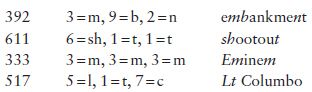
We caught up with Paterson in a school office and asked if he’d mind giving us a quick memory demonstration, to which he readily agreed. We recited, once, the random number string 615392611333517. Paterson listened closely and then said, “Okay. We’ll use this space.” He looked around at the fixtures. “I see this water cooler here becoming the space shuttle, which is taking off just as an underground train comes shooting out the bottom of the cooler. In the bookshelves there behind the cooler, I see the rapper Eminem having a gunfight with Leslie Nielsen from Naked Gun, while Lieutenant Columbo looks down on them.”26
How to make sense of this? He remembers digits in groups of three. Every three-digit number is a distinct image. For example, the number 615 is always a space shuttle, 392 is always the Embankment tube station in London, 611 is Leslie Nielsen, 333 is Eminem, and 517 is Lieutenant Columbo. To make sense of these images, you need to understand another, underlying mnemonic: for each numeral 0 through 9, James has associated a sound of speech. The numeral 6 is always a Sheh or Jeh sound, the 1 is always a Tuh or Duh sound, and 5 is an L sound. So the image for the number 615 is Sheh Tuh L, or shuttle. Virtually every three-digit number from 000 to 999 lives in Paterson’s mind as a unique image that is an embodiment of these sounds. For our spontaneous quiz, for example, he drew on these images in addition to the space shuttle:
In the memory championship event of spoken numbers, which are read aloud to contestants at the rate of one per second, Paterson can memorize and recite back seventy-four without error, and, with much practice, he’s raising that count. (“My wife calls herself a memory widow.”) Without mnemonic tools, the maximum number of digits most people can hold in working memory is about seven. That is why local telephone numbers were designed to be no more than seven digits long. By the way, at the time of this writing the world record in spoken digits—what psychologists call memory span—is 364 digits (held by Johannes Mallow of Germany).
James is quick to acknowledge that he was first drawn to mnemonics as a shortcut for his studies. “Not the best of motives,” he admits. He taught himself the techniques and became a bit of a slacker, walking into exams knowing he had all the names, dates, and related facts readily at hand.
What he didn’t have, he discovered, was mastery of the concepts, relationships, and underlying principles. He had the mountaintops but not the mountain range, valleys, rivers, or the flora and fauna that compose the filled-in picture that constitutes knowledge.
Mnemonic devices are sometimes discounted as tricks of memory, not tools that fundamentally add to learning, and in a sense this is correct. The value of mnemonics to raise intellectual abilities comes after mastery of new material, as the students at Bellerbys are using them: as handy mental pockets for filing what they’ve learned, and linking the main ideas in each pocket to vivid memory cues so that they can readily bring them to mind and retrieve the associated concepts and details, in depth, at the unexpected moments that the need arises.
When Matt Brown, the jet pilot, describes his hours on the flight deck of a simulator drilling on the rhythm of the different hand movements required by potential emergencies, he reenacts distinct patterns he’s memorized for different contingencies, choreographies of eye and hand, where the correct and complete sequence of instruments and switches is paramount. Each different choreography is a mnemonic for a corrective maneuver.
Karen Kim is a virtuoso violinist. When we spoke with her, Kim was second violin in the world-renowned string ensemble Parker Quartet, who play much of their material from memory, a rarity in classical music. Second violin is often largely accompanimental, and the mnemonic for memorizing the harmonies is the main melodic theme. “You sing the melody in your head,” Kim says, “and you know that when the melody goes to this place, you change harmony.”27 The harmonies of some works, like fugues, with up to four themes that pass around the group in intricate ways, are especially challenging to memorize. “You need to know that while I’m playing the second theme, you’re playing the first. Memorizing the fugues is very difficult. I need to learn everybody else’s part better. Then I start to recognize patterns that I maybe knew intellectually before, but I wasn’t listening out for them. Memorizing the harmonies is a big part of knowing the architecture of the piece, the map of it.” When the quartet is mastering a new piece, they spend a lot of time playing through things slowly without the sheet music, and then gradually speeding it up. Think Vince Dooley gradually synchronizing the different positions on the Georgia Bulldogs football team as they tailor their plays to take on a new Saturday night opponent. Or the neurosurgeon Mike Ebersold, examining a gunshot victim in the emergency room and methodically rehearsing what he’s likely to encounter in a brain surgery that he’s about to perform.
Seeing the pattern of physical movements as a kind of choreography, visualizing a complex melody as it is handed off like a football from one player to another, “seeing the map of it”: all are mnemonic cues to memory and performance.
With continued retrieval, complex material can become second nature to a person and the mnemonic cues are no longer needed: you consolidate concepts like Newton’s 3 laws of motion into mental models that you use as a kind of shorthand. Through repeated use, your brain encodes and “chunks” sequences of motor and cognitive actions, and your ability to recall and apply them becomes as automatic as habit.
It comes down to the simple but no less profound truth that effortful learning changes the brain, building new connections and capability. This single fact—that our intellectual abilities are not fixed from birth but are, to a considerable degree, ours to shape—is a resounding answer to the nagging voice that too often asks us “Why bother?” We make the effort because the effort itself extends the boundaries of our abilities. What we do shapes who we become and what we’re capable of doing. The more we do, the more we can do. To embrace this principle and reap its benefits is to be sustained through life by a growth mindset.
And it comes down to the simple fact that the path to complex mastery or expert performance does not necessarily start from exceptional genes, but it most certainly entails self-discipline, grit, and persistence; with these qualities in healthy measure, if you want to become an expert, you probably can. And whatever you are striving to master, whether it’s a poem you wrote for a friend’s birthday, the concept of classical conditioning in psychology, or the second violin part in Hayden’s Fifth Symphony, conscious mnemonic devices can help to organize and cue the learning for ready retrieval until sustained, deliberate practice and repeated use form the deeper encoding and subconscious mastery that characterize expert performance.