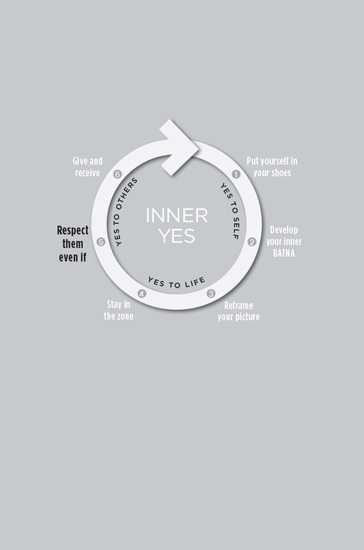

He drew a circle that shut me out—
Heretic, rebel, a thing to flout.
But love and I had the wit to win:
We drew a circle that took him in!
—EDWIN MARKHAM
The atmosphere was tense. There were sixty people in the room, forty from management and twenty from the union about to start a labor contract negotiation. Relations had been strained for decades with many protracted strikes and court fights. This time around promised to be no different. “Let’s be clear. We are only here because the law requires it,” the chief representative from management began. “We don’t trust you and we don’t like what you are doing.” His tone was cold, antagonistic, and demeaning. On the other side of the table, the union representatives were boiling with rage.
Dennis Williams, the union leader, felt like counterattacking, but instead he controlled his temper and replied in a calm and respectful tone: “I hear you and I will tell you why we are here. We’re here to see if we can work with you so that together we can do the best for your employees, the tens of thousands of people who make your business successful.”
As Dennis told me some years later:
Even though I felt hotter than hell and my instinct was to fire back, I realized it would get us nowhere. My people were mad at me for not firing back, but eventually they understood we had to take this approach. And I can tell you, that one opening response set the tone for the rest of the negotiation. Later many people from the other side came up to me and told me that they appreciated what I had said. That little bit of respect really changed the course of how the negotiation went. It was one of only three times in over sixty years that we succeeded in reaching agreement on a contract without a big fight.
In my negotiation experience, I’ve long noticed that the cheapest concession you can make, the one that costs you the least and yields the most, is to give respect. To respect simply means to give positive attention and to treat the other with the dignity with which you would like to be treated. The word respect comes from Latin roots that mean “re” as in repeat and “spect” as in spectacles. In this sense, respect means to “look again.” It is to see the other person with new eyes as a human being worthy of positive regard. If we want to get to yes with others, there can be no more important way to begin than to give them basic human respect.
Yet, as beneficial as it can be, giving respect is often a difficult concession for people to make. In a problematic situation or relationship, respect may be the last thing we feel like giving. We may think that they do not deserve our respect and that they need to earn it. They may not be respecting us, so why should we respect them? If we feel rejected, as the union leader did, we naturally reject back. If we feel excluded, we naturally exclude back. If we feel attacked, we attack back. Out of pain, we cause pain. It is a mutually destructive cycle that has no end as I have witnessed countless times from families to businesses to communities to entire societies. The usual results are losses all around.
But, as the story of the tense negotiation between union and management suggests, it often only takes one person to change his or her attitude toward the other—from antagonism and rejection to respect—in order to change the tone and outcome of a difficult conversation. That person could be us. Once we show respect to the other party, he or she is more likely to show us respect. Respect can breed respect, inclusion can lead to inclusion, and acceptance can foster acceptance. Just as the union leader did, we can reverse the destructive cycle and make it a constructive one.
To offer respect, we don’t need to approve of the other person’s behavior, nor do we need to like that individual. We just need to make the conscious choice to treat each person with the dignity that is every human being’s birthright, as difficult as this may be for us. Respect shows up as a behavior but it originates inside of us as an attitude. Respect is essentially a yes to others, not to their demands, but rather to their basic humanity. In this sense, respect is indivisible. When we give respect to others, we are honoring the very same humanity that exists in us. When we acknowledge the dignity of others, we are acknowledging our own dignity. We cannot truly respect others without respecting ourselves at the same time.
So how in difficult situations do we change our internal attitude from antagonism to respect? It is a natural process that cannot be forced, only nurtured. Indeed, an attitude of respect begins to emerge organically from within in the process of getting to yes with ourselves: if we have already given ourselves respect through putting ourselves in our shoes, we will find it much easier to respect others. If we have chosen to take responsibility for our lives and actions, we are not likely to blame others. If we say yes to life, we will tend naturally to extend respect to others.
Still it can be difficult to give our respect, particularly in conflicts. Three specific actions can help you strengthen your attitude of respect: Put yourself in the other person’s shoes. Expand your circle of respect. And, as the opening poem suggests, respect even those who at first may reject you.
While I was writing this book, I spent some days on the Turkish-Syrian border helping to conduct intensive interviews with Syrian rebel leaders in order to explore possible openings for an end to the raging civil war. My colleagues and I began by asking each leader how and why they got involved in the fight. It was one thing to read or see the news, but dramatically different to hear the tales firsthand from people living the story.
These leaders had once been pediatricians, dentists, lawyers, businesspeople, and students. Almost to a person, they had begun with peaceful protest and had suffered horrendous torture at the hands of the security services. Many of their loved ones had been killed, in some cases as recently as the day before we interviewed them. They were literally stepping out of a hellish experience in order to speak with us, and then going immediately back into the hell of war. The emotions were palpable in the air. My colleagues and I found ourselves moved and shaken as we imagined ourselves in the place of those to whom we were listening. To a greater extent than any of us had anticipated, we were feeling the others’ sorrow.
Our last interview was with a young heavyset bearded man in his late twenties, a Muslim of ultraconservative Salafi belief, the commander of three thousand fighters. He looked like the Western stereotype of a fundamentalist terrorist. But any preconceptions we might have had changed as we listened to his story. We asked him how he had joined the fight. “I was in university,” he replied.
“What were you studying?”
“Poetry.” The young man, who came from a family of poets, had won first prize for his poetry in a national contest. When he was seventeen, he had been arrested for writing a poem that the security services found subversive. Jailed and tortured on three occasions, he joined the fight after his fellow peaceful protesters were slaughtered. He was in love with a young woman in Egypt whom he was wistfully hoping to see again if he survived.
When we asked him what his biggest concern was if his side won, we were surprised to hear him say it was religious extremism. While he believed that Islamic Sharia law was a good thing, he did not believe it should be imposed on anyone. “I’m not going to pull a gun and force my views on anyone.” When at the end of the interview I asked if he had any message he would like us to convey back in our own countries, he said: “Yes, as people watch this conflict from afar, they may think we are just numbers. Please put yourself here and imagine that your child or wife is one of the numbers. Every single number has a life and a soul.”
It was yet another confirmation for me of the wisdom of setting prejudgment aside and, instead, putting myself in the place of another person with dreams, loves, and grief. In the words of the poet H. W. Longfellow, “If we could read the secret history of our enemies, we should find in each man’s life sorrow and suffering enough to disarm all hostility.” Perhaps the easiest way to change our attitude from antagonism to respect is to put ourselves in the shoes of other people.
To show respect for those we interviewed, we set aside three hours for each interview so that the leaders would have ample time to tell their stories and feel heard. And the gesture was noticed. A number of our interviewees told us, “You are the first ones to come from abroad and actually listen to us.” In that atmosphere of mutual respect, not only did we come to understand the conflict better, but we also laid the groundwork for future work on a Syrian-led solution for the Syrian conflict.
The best way to listen to others is to bring an attitude of respect, in other words, full positive attention and regard. Typically, I have observed in my negotiation work, we listen to others from within our frame of reference, judging what they say from our point of view. With an attitude of genuine respect, we can practice the art of listening to others from within their frame of reference, from their own points of view. We can listen not just to the words, but also to the feelings and unspoken thoughts that lie behind the words. We can listen not just to the content of what is being said, but also to the human being behind the content.
In my negotiation experience, I find that the simple act of imagining myself in the shoes of another person is a more powerful tool than it may seem. What does the world look like through that individual’s eyes? What does it feel like to be that person? If I had lived his or her life, how would I act and react? I may not be wholly accurate in my understanding of the other person, but it never ceases to surprise me just how accurate I, or indeed anyone, often can be, simply by dint of sharing a common humanity. Our ability to empathize is a talent that is vastly underused. And, if we truly understand the other person and what he or she wants, it will naturally be a lot easier to reach agreement with that person.
Paradoxically, if we wish to become more aware of others and their concerns, there is perhaps no better work we can do than developing self-awareness. Consider the findings of a team of psychologists led by Professor David DeSteno, who recruited thirty-nine people from the Boston area for an unusual experiment. Twenty people were assigned to take a weekly meditation class for eight weeks and then to practice at home, while the remaining nineteen were informed that they were on a waiting list.
At the end of the eight-week period, the participants were invited, one by one, to come to the lab for an experiment. As each participant entered the waiting area, he or she found three chairs, two of them already occupied. As the participant took a seat and waited, a fourth person entered the room on crutches, wearing a boot for a broken foot, sighing audibly in pain as she leaned uncomfortably against the wall. Neither of the other two sitting people, who worked for the experimenters, gave up their seats. Researchers wanted to find out whether the participants in the experiment would give up their chair to the injured patient or not.
The results: 50 percent of those who had practiced meditation gave up their chair, compared to 16 percent of those who hadn’t meditated—a threefold difference! DeSteno explains this dramatic difference by pointing to the documented ability of meditation to enhance attention—our ability to see others—as well as to foster a view that all beings are connected. “The increased compassion of meditators, then, might stem directly from meditation’s ability to dissolve the artificial social distinctions—ethnicity, religion, ideology and the like—that divide us,” DeSteno writes. It all comes down then to elementary respect—the ability to see another human being. Having given ourselves a “second look” through meditation, we are better able to give others a second look too.
The paradox reflected in this research is striking. By paying attention inside themselves through the practice of meditation, people were better able to pay attention outside themselves by showing kindness. The deeper we go inside ourselves, the farther we can go outside.
Larry married a Mexican American woman and became the first non-Hispanic in her family, which provoked unspoken tensions among her in-laws, particularly with his brother-in-law Jose. Ten years later, Jose called Larry up to invite him out for a drink. After some small talk, Jose took a deep breath and went straight to the point. “He apologized,” Larry remembers. “He said that he hadn’t wanted an Anglo in the family. He’d lobbied behind the scenes to get his sister to break up with me. He said he’d felt bad about it for all these years. He decided it was finally time to make it right.” Jose changed his attitude toward Larry from rejection to respect. He finally accepted Larry in his family and in the process resolved years of felt but unspoken conflict.
We have all probably felt rejected and excluded at some point in our lives. As children, we’ve felt the pain of being ignored or left out by our parents, teased or bullied by classmates, or even just picked last for games in gym class. As adults, we’ve all probably felt anger at being excluded, whether it is being left out of an important meeting by a boss or forgotten from an invitation to get together after work with colleagues, or simply having our ideas or needs ignored by fellow members of groups we belong to—book clubs, volunteer organizations, school meetings, you name it.
More seriously, we may get excluded from opportunities, denied rights or privileges, or treated dismissively by others or even society at large because of the color of our skin or our physical appearance, our gender or sexual preference, our nationality or ethnic heritage, or our religion, or a host of other reasons. Feeling excluded, seeing our interests and voices and basic humanity ignored, can leave deep wounds.
These painful feelings of exclusion are at the core of the great majority of the conflicts I have witnessed in my work. Israelis and Palestinians, Irish Protestants and Catholics, Serbs and Croats—I have listened at length to their stories of feeling discriminated against and humiliated, stories that often go back many generations or even centuries. These feelings fuel conflict and often trigger acts of violence. In business, I have also seen relationships break down and conflicts break out because of perceived slights such as excluding a key business partner from an important corporate meeting. And, of course, family feuds are frequently fed by feelings of being treated as less than another family member: Why did the father pick the younger brother to run the family business rather than the older brother, or the sister rather than the brother?
The only remedy I know for the wound of rejection and exclusion is the balm of recognition and acceptance—in other words, inclusion. Whether it is a family feud or an ethnic conflict or workplace tension, the way we can begin to resolve the conflict is to change our attitude and consciously expand our circle of respect to encompass others whom at first we might not want or think to include.
While I was writing this chapter, I had the chance to walk the floor of a large factory that had experienced a lot of strife and to interview workers about how they felt under the new ownership of a company called Barry-Wehmiller. Big machines were whirring away noisily. One worker tending a large machine stepped away for a moment to speak, taking off his goggles and protective earmuffs. I asked him if he had felt any difference since the change in ownership. “Yup,” he replied. “The difference is that they listen to us.” That was the essence of the change. The previous management had treated employees pretty much as paid automatons and excluded them from key decisions. The new management made real and sustained efforts to recognize them as human beings with dignity and talent and to welcome their ideas and suggestions for improving the factory. Each employee was treated as if he or she mattered, with respect.
The new attitude from management was not just talk but was reflected in their actions. Many workers at the plant recalled their experience in the midst of the 2008 financial crisis, when companies, including their competitors, were laying off employees to cut costs. The workers had expected a layoff as the previous owners had resorted to layoffs many times before. But this time, to their surprise, the CEO Robert Chapman suggested that everyone from the top down take a six-week unpaid leave so that no one would need to be laid off. It was a telling example of the principle of inclusion and the recognition of the importance of all employees and their families. Before and after the financial crisis, many factories like this one had shut down under the pressure of global competition and clashes between labor and management. Both employees and management attributed the turnaround in the business in good measure to the new attitude of respect, which inspired people to perform at their best.
Few political leaders have developed the ability to expand their circle of respect more than Abraham Lincoln. A man of great heart, he had the tragic responsibility of leading the United States during its darkest hour, the devastating and fratricidal Civil War. During the waning months of the war, Lincoln spoke publicly about the need to bind the wounds of the nation and to treat the defeated South with generosity. On one occasion in the White House when Lincoln was speaking sympathetically of the plight of the South, a Yankee patriot took him to task. “Mr. President,” she decried, “how dare you speak kindly of our enemies when you ought to be thinking of destroying them?” Lincoln paused and addressed the angry patriot: “Madam,” he asked, “do I not destroy my enemies when I turn them into my friends?”
Taking a lesson from Lincoln, we might look around and ask ourselves if there are any “enemies” in our lives whom we can “destroy” by turning them into our friends.
What if the person on the other side of the table rejects us, as happens so often in conflict situations? When we feel rejected—our point of view dismissed or attacked, our needs and interests ignored—our every instinct is to protect ourselves: to pull back and reject back. It is only human to build defensive walls around ourselves if we feel attacked. Yet, when we counterattack with more rejection and disrespect, we only perpetuate the destructive cycle and render agreement impossible.
My friend Landrum Bolling, a noted peacemaker, remembers how, as a boy in school in Tennessee in the 1930s, he heard the well-known poet Edwin Markham, with a shock of white hair, declaim the poem that begins this chapter. The poet dramatically drew with his finger in the air the circle that shut him out—and then, equally dramatically, drew a much larger circle that took the other person in. That is the radical contrarian response to being excluded by others. It is a form of psychological jujitsu. In the face of rejection, do the opposite of what you at first feel like doing. Instead of rejecting others, surprise them with respect. Take the lead and change the cycle of mutual rejection into a cycle of mutual respect. That is what the union leader did in the opening story of this chapter.
Few situations are as challenging as hostage negotiations. I have had the opportunity to learn from and train police hostage negotiators, professionals who confront situations on a daily basis in big cities where people have been taken hostage, whether by bank robbers or emotionally distraught individuals. Police SWAT teams surround the place where the hostage is being held. All the weapons are drawn and everyone is on edge ready to fire. A generation ago, the standard next step was to pull out a bullhorn and shout: “You’ve got three minutes to come out with your hands up!” When the deadline elapsed, in would go the SWAT team with tear gas and guns. As often as not, someone was hurt or dead—the hostage, the hostage taker, or a member of the SWAT team, or all three.
Today, the police forces of major cities where hostage incidents happen regularly have adopted a wholly different approach. Now when a hostage is taken, a professional hostage negotiation team is called in to deal with the crisis alongside the SWAT team. What is their first rule? Be polite. Give the hostage taker a hearing. Listen with close attention and acknowledge his or her point of view. Don’t react, even if, as often happens, the hostage taker goes on the verbal attack. Stay cool and courteous, patient and persistent. In other words, respect and accept the very person who is attacking and rejecting. Meet exclusion with inclusion.
In the overwhelming majority of these hostage situations, the strategy of treating hostage takers with basic human respect works. It gives the hostage takers a face-saving way out. The process may take many hours, but in the end, the hostage taker usually surrenders and the hostages go free and unharmed. The parties get to yes.
As the hostage negotiators demonstrate, accepting people who reject or attack us doesn’t mean ignoring injustice or evil, but rather giving respect to their humanity even as we confront their wrongful actions. Accepting those who reject us doesn’t mean saying yes to their demands; as the hostage negotiators show, it can often mean saying no, but in a positive manner that acknowledges the other person’s inherent dignity. Even where we may draw clear limits for the sake of protecting ourselves and others, accepting those who reject us means treating them as human beings just like ourselves.
It can be difficult to extend our respect to those who attack us or attack those we care about, but it is possible. I think of the story of Azim Khamisa, an American businessman I once had the privilege to meet, whose twenty-year-old son, Tariq, was killed by a young gang member. Studying during the day, Tariq worked at night delivering pizzas. One night, he came to the door of an apartment and was met by a fourteen-year-old boy named Tony who took the pizza and shot Tariq. It was a gang initiation. “When I got the phone call saying that Tariq was dead, I kind of left my body, because the pain was too much to bear,” Azim said in an interview describing how he felt when he heard the news. “It was like a nuclear bomb going off inside my heart. . . . For the next few weeks I survived through prayer and was quickly given the blessing of forgiveness, reaching the conclusion there were victims at both ends of the gun.”
Victims at both ends of the gun—that was Azim’s astonishing and compassionate insight about his son’s tragic death. Through prayer, he began to let go of the dark feelings and painful thoughts that threatened to sweep his sanity away. He was able to reframe the situation and come to see Tony through new eyes. By putting himself in the shoes of his own son’s killer, he was able to forgive him—although not to forget.
Azim reached out to Tony’s grandfather and guardian, Ples Felix. Deeply moved by Azim’s gesture, Ples accepted Azim’s offer of forgiveness. “I urged Tony to take responsibility for his actions; to minimize the pain and harm he’d done to the Khamisa family,” Ples explained. “He broke down and cried. ‘I’m so sorry, Daddy,’ he sobbed. I held him and tried to console him. The next day everyone was expecting a plea of ‘not guilty,’ but Tony gave a very remorseful and emotional speech in which he pleaded guilty and asked for Mr. Khamisa’s forgiveness.”
Azim’s courageous choice to forgive opened the possibility for Tony, the young perpetrator, to take responsibility for his actions and feel the pain of guilt and remorse rather than numb it. Azim’s healing process deepened as it spread to include Tony and Ples too. Together Azim and Ples began to give talks in schools to encourage students to stop using violence against each other. They formed a foundation to advance the cause of nonviolence in schools. Azim was invited to speak around the nation, including at the White House. Five years after the killing, Azim visited Tony in jail and invited him to work at the foundation after his release. Tony told his grandfather Ples, “That is a very special man. I shot and killed his one and only son and yet he can sit with me, encourage me, and then offer me a job.”
Azim’s remarkable story offers us some clues about how to change our attitude from rejection to respect. Even when faced with an extreme violation, the murder of his child, Azim chose not to pursue the path of revenge but to respond by respecting Tony, his son’s murderer, as a human being. Without condoning the crime in any way, he chose to forgive Tony and to include both him and his grandfather in a common effort to stop the youth violence that had claimed his son’s life. Azim found a new mission in life and a deep sense of personal fulfillment. When I met him, he was on fire, an alive and contented man. Just as in the opening poem, Azim drew a larger circle and took them in.
If this strategy of meeting rejection with respect can be applied in more extreme situations like hostage taking or tragedies like Azim’s, it is far easier to consider in ordinary daily situations. The next time your boss or your spouse or a colleague says or does something that makes you feel rejected and you feel the natural impulse to react, try going to the balcony instead to observe your feelings and thoughts. Put yourself in your own shoes and remember your inner BATNA, your commitment to take care of your deepest needs. If you feel more confident in your ability to make your own happiness, you will be less reactive to the other person’s offensive behavior. Having given yourself respect, it will be easier for you to give others respect and to accept them even if at first they reject you. It is not easy, of course, but with practice and courage you can often turn the cycle of mutual rejection into mutual respect.
The Abraham Path is a path of cultural tourism in the Middle East that retraces the ancient footsteps of Abraham, who is revered as a forefather by over half of humanity—including Christians, Muslims, and Jews. Helping to recreate the Abraham Path has been one of my great passions. On the inaugural journey, I traveled with twenty-three companions by bus across five countries, all the way from Harran in northern Mesopotamia, where Abraham set off on his journey four thousand years ago, to Hebron in the heart of the West Bank, where he is buried. At Harvard, my colleagues and I had been studying for years the possibility of re-creating this ancient trail as a way to inspire greater understanding among clashing cultures and faiths around the world. We encountered a lot of skepticism from those who said it would be impossible to traverse this region of roiling conflict, but we were determined to show the world that it could be done.
After twelve days of travel by bus, stopping here and there to visit places associated with Abraham and to consult with local civil, religious, and political leaders about the possibility of reestablishing this ancient path as a long-distance walking trail, we crossed the Jordan River and arrived in the city of Bethlehem in the Palestinian West Bank. The atmosphere was tense, as it happened to be the second anniversary of the death of Palestinian president Yasser Arafat. Demonstrations were expected—and who knew what else?
We visited the ancient church that sits atop the traditional birthplace of Jesus and then walked across the street to the Peace Center in Manger Square. There we sat down around a huge rectangular table for a meeting with forty or so Palestinian leaders from nonprofits, religious institutions, and government departments to present the Abraham Path project and to listen to their feedback. The minister of tourism was present as were the governor of Hebron, the chief justice of Palestine, and the imam of the Ibrahimi Mosque, the site of Abraham’s traditional burial place.
My colleague Elias opened the meeting with some remarks and then turned to me to present the project. Afterward, we opened the floor for questions and suggestions from our Palestinian colleagues, giving each a chance to speak and reserving our response for the very end. While some of their comments were positive, others were cautious and critical, and still others were suspicious and hostile, even aggressive.
“The idea is unclear and ambiguous,” declared one leader. “What is the Global Negotiation Project that incubated this? Who is behind this project? Does it have any links with foreign intelligence agencies or governments?” As he brought up the question of intelligence agencies, gunshots could be heard in the square outside. I could feel a tremor of nervousness pass through the room.
Then another leader spoke up: “I call on the initiators to respond to the heartbeat of the Palestinian street. We fear conspiracies based on our experience. Who is participating? What is the Israeli role?” And yet another: “How many Palestinians will be on the board? You must take a clear political stand for Palestine. For us, peace is a life and death issue.” The level of tension in the room escalated as each speaker sought to outdo the previous one in being tough. Finally, after two hours of often harshly critical comments, all eyes turned back to us, and Elias asked me to respond.
I didn’t know quite what to say. Under attack, I had started questioning myself: Was the Abraham Path just a pipe dream, born from naive outsiders, destined to fail like so many other well-intentioned projects? I felt this cherished dream of mine beginning to slip away as it was exposed to hard cold reality. But then I managed to go to the balcony, observe my thoughts and feelings, reassure myself that all was okay, and turn to the challenge facing me. Many skeptical questions had been raised, hard conditions set, and red lines drawn. How could I diminish the distrust and win the support of the critics while still keeping the project strictly nonpolitical? I realized that, if I tried to address each of their issues judiciously, I would appear defensive and only increase their suspicions. No matter what I could say, it would not be enough to satisfy them.
I tried to look at the skeptical leaders with new eyes, putting myself in their shoes. Underneath the suspicious and critical comments, I was hearing the wound of exclusion, understandably strong for people in their circumstances. The only remedy I knew for that wound was inclusion. I decided there was only one thing I could do: to step to their side.
“I am grateful for your comments. Friends are those who tell you the truth, even if it is hard to hear,” I told the group of Palestinian leaders. “I understand your distrust—it is born through painful experience. You are right to have these questions and concerns. Here is the key point: you refer to us as the leaders of the project but that is not how we see ourselves. Yes, we have been studying the social and economic potential of this path. The true leaders, however, can only be the peoples in the region and here in this place the leaders must be Palestinians. We can study the possibilities and we can lend our support to overcome obstacles, but the leadership role belongs to you. And there is no rush. We can wait until you tell us you are ready. Tell us what you would like to do.”
Instead of rejecting their criticism or defending the project, I accepted their concerns and invited them to take the lead. It was a calculated risk of course—the project could have ended there—but it was a risk I felt it was necessary to take.
The atmosphere shifted perceptibly. Suddenly the ball was in their court. They began to talk among themselves about what to do. One pronounced it a good thing for the people of Palestine. Gradually they began to take ownership of the idea and, in the end, one of the harshest critics declared that he was optimistic about the initiative. Both the minister of tourism and the imam were genuinely enthusiastic. Everyone began to relax as we adjourned for a dinner downstairs. It was a turnaround from the earlier confrontational conversation. At that moment, we began to get to yes.
At dinner, a colleague asked me: “It felt like there were forty rifles firing at us. How did you dodge all those bullets?” The truth is that I had not tried to dodge any bullets. I had simply sought to respond to rejection with respect, to exclusion with inclusion or, in other words, to no with yes.
During that meeting, the Abraham Path was born. The West Bank, the place that we had imagined might be the most challenging area for the Abraham Path, would over the following years become the place of greatest local ownership, of most communities involved, and of most travelers walking. Since that opening journey, the Abraham Path has become an established cultural walking trail in a number of countries across the Middle East, receiving thousands of walkers from around the world, and being recognized in National Geographic Traveller magazine as the world’s best new walking trail. It is still in its early years, but its long-term promise in a region where there is a lot of pain and despair is to build understanding, prosperity, and hope.
It may not be easy to change the dynamic of a difficult interaction or relationship from antagonism and rejection to respect, particularly when you feel under attack, but the rewards are great. By showing respect, we are more likely to receive respect. By accepting, we are more likely to be accepted. By including, we are more likely to be included. If we can say yes to the basic dignity of others, getting to yes becomes a lot easier and our relationships at home, at work, and in the world become far more productive and satisfying.
One final challenge remains in the process of getting to yes with yourself: to change the win-lose mindset that so often prevents us from arriving at mutually satisfying solutions.