1
The Changing Game
Examples of major changes in the whole system of a major industry are few and far between, except in technology. Virtually every aspect of investment management—fees, competitors, technology, regulators—and information have changed over the last half-century. Even the speed of change has changed.
Charles Darwin lamented that his innovative theory of evolution would not be accepted by the scientific community until his friends and colleagues had died or retired. His peers would have to be replaced by others whose careers were not so invested in or based on and devoted to pre-Darwinian concepts that they had become unwitting captives of their prior work and stature as traditional biologists.1
The stock market itself is Darwinian—always evolving. And as increasing numbers of investment professionals with more training and better tools and more access to more information and as investors move money toward more capable managers and as managers compete to attract more business, fund executives promote their best performing portfolio managers and analysts, it cannot be surprising that the effectiveness of active investors as a group continues to increase. That's why we say, “Markets are always learning.” And that's why securities markets have been unrelenting in their increasing efficiency—and harder and harder to beat or even match—particularly after covering the higher fees now being charged. The fees may well have been justified in the early or middle years of a 50-year transformation, but a rich variety of charges have combined to bring to an end the era of successful active management.
In his classic book, Scientific Revolutions, Thomas Kuhn explained why the problem Darwin faced was not confined to biology or science: It is universal. Those who have succeeded greatly and have risen to the top positions in their fields naturally resist—often quite imaginatively and often quite stubbornly—any new, “revolutionary” or disruptive concept. There are two main reasons for resistance: First, most of the new hypotheses, when rigorously tested, will not prove valid. So, over time, leading members of the Establishment can get over-confident and dismissive of all new ideas. Second, the members of the Establishment in any field have too much to lose in institutional stature, their carefully developed reputations as experts, the value of their many years of past work, and their earning power—all dependent on the status quo—their status quo. So they defend against the “new.” Usually, they are proven right—so they win. But not always.
Dynamics of Innovation
There is a remarkably consistent iterative process by which the best innovations overcome resistance and eventually gain acceptance. The process of change follows a repeating pattern although the pace of change can differ markedly from one innovation to another.2 Two kinds of actors play key roles: Innovators and Influentials. Innovators tinker and experiment all the time, looking for the next new thing. Unlike most people, they are so keen to find and use the latest innovation and they enjoy being first so much that they do not mind the costs in time, energy, or expense of most innovations not proving out, so they continue experimenting with what's new. Figure 1.1 shows how Innovators are the first to try things out.
Influentials are different. While they like finding new and better ways, they dislike the cost, bother, and frustrations of “new way” failures. So their strategy is to watch the Innovators and their experiments closely and, when the Innovators' experiments work, selectively adopt the most promising successes. As a result, Influentials learn about successes early and develop considerable skill at evaluating which Innovators have the best innovation records and are most repeatedly successful. And this is why they become Influentials.
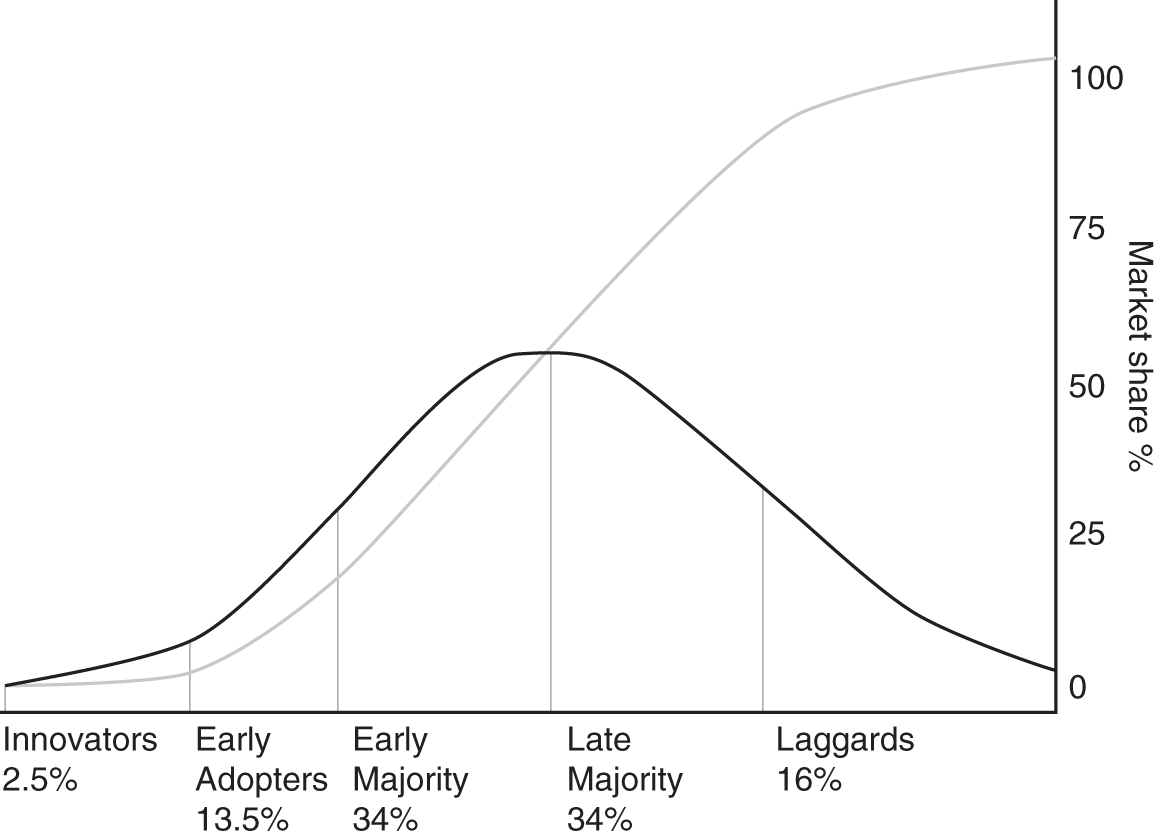
Figure 1.1 Incremental and Cumulative Acceptance
While Influentials are monitoring the Innovators for successful innovations, many Followers are monitoring the Influentials. When Influentials adopt a new way, the Followers3 will then—in increasing numbers and with increasing commitment—follow their lead. (Of course, that's why they are called Influentials.)
In his scholarly book, Diffusion of Innovations, Everett Rogers established the classic paradigm by which innovation reaches a “tipping point” and then spreads exponentially through a large social group. Most members of a social system rely on observing the decisions of others when making their own decisions.4 Decisions to adopt a new way repeatedly follow a five-step process:
- Awareness of the new way.
- Evaluation: forming a favorable (or unfavorable) opinion.
- Deciding whether or not to change to the innovation.
- Action: Adopting (or rejecting) the innovation.
- Confirmation: evaluating the results of the innovation.
Deciding, the third step, depends on the decider's confidence in the benefits, the decision's compatibility with current habits and norms, and how the decider anticipates others will perceive the decision and whether they will approve.
The speed with which new and better ways of doing things are adopted is a function of several contributing factors: how large and how visible are the benefits; the speed with which benefits become visible; the ease and low cost of experimentation; the ease and low cost of reversing a mistaken decision; and the quality of the channels or networks by which information and social influences get communicated and expressed. Resistance to change, on the other hand, is a function of uncertainty about the benefits of the innovation or the ease of adoption; the risk of social approbation the new adopter may experience; the risk tolerance of the prospective adopter; the speed with which rewards and benefits will be received; etc.
Diffusion is the social process by which individual adopters influence others to adopt. Opinion leaders are important in any social movement, so diffusion will be retarded by any stigma attached to adoption. As an example of social stigma, Rogers cites the failure of a public heath campaign in Peru because local culture held that only “unwell” people would drink boiled water. So healthy people refused to boil theirs. Significantly, index investing was attacked, several years ago, as a haven for “wimps without skill,” just “settling for just average,” and even dismissed as “unAmerican.”
Combining Kuhn's and Rogers' theories on innovation together provides a way of understanding how and why the inevitable triumph of indexing is steadily advancing and how and why its advance is still being resisted or even ignored by many practitioners devoted to active management. The distribution of an innovation and its adoption works through the interaction of a social system5 and its opinion leaders. The speed of distribution varies with the strength of the social system. The informal social system for the selection of investment managers is remarkably weak. For individual investors, three inhibiting characteristic factors dominate: the all-too human desire among individuals to “do better” by trying harder; the “yes, you can” encouragements of investment advisors, consultants, and other perceived experts who make their living as advocates of trying harder to do better; and the media advertising, articles, and program content that focus on and celebrate winning.6 You will, or course, hear little about the numbing consistency with which a majority of active managers fall short of the index or how seldom past years' “winners” are winners again over the next few years or longer.
The iterative process of social acceptance and resistance can seem glacially slow as they work their way through many layers and kinds of social resistance—particularly the resistance by those with a lot to lose if substantial acceptance develops. But impatient observers might consider the difficult pathway of, for example, the theory of evolution. Texas still requires public schools to treat evolution and creationism as equally serious alternatives. Persuading Americans to use seat belts—even when the historical data was powerful—took years and lots of public service advertisements, deliberately annoying noises, and local police enforcement.7
Early “Performance Investing”
In his General Theory, J. M. Keynes wrote: “The game of professional investment is intolerably boring and over-exacting to anyone who is entirely exempt from the gambling instinct; whilst he who has it must pay to this propensity the appropriate toll.” Note the word “game” as coined for all time in ‘Adam Smith's8 mid-1960s best seller, The Money Game, where he chronicled and explained with delightfully sardonic humor the amazing new world of “performance” investing. It was, as he said, “an exercise in mass psychology, in trying to guess better than the crowd how the crowd would behave.”9 The author went on to explain, “The true professionals in the Game—the professional portfolio managers—grow more skilled all the time. They are human and they make mistakes, but if you have your money managed by a truly alert mutual fund or even by one of the better banks, you will have a better job done for you than probably at any time in the past.”
‘Adam Smith’ then turned appropriately to the grand old man of performance mutual funds, Fidelity's Edwin C. Johnson, as his ultimate source of profound thought:
‘Adam Smith’ then led his readers through a charming review of Gustave Le Bon's The Crowd, linked that with Sigmund Freud, reflected on Chester Bernard's The Functions of the Executive, and then returned to Keynes. “… Americans are apt to be unduly interested in discovering what average opinion believes average opinion to be; and this national weakness finds its nemesis in the stock market … Investment based on genuine long-term expectation is so difficult today as to be scarcely practicable.”
Turning next to Ben Graham, ‘Adam Smith’ quoted from the Dean of Analysts' great book, The Intelligent Investor,
‘Adam Smith’ also popularized the question that seemed to capture the imagination of investors in the 1960s: “Do you sincerely want to be rich?” as in, “Do you really want to detach yourself from reality?” He provided his readers with an attention-getting bit of history:
The early 1960s practitioners of “performance” investing experienced early-stage difficulties that would be unfamiliar to later participants. Block trading was just beginning; brokerage commissions were fixed—at an average per share of over 40 cents; in-depth research from Wall Street was new; computers were confined to the “cage” or back office; Quotron machines that could show current prices were new; and trading volume was 1/10 of 1% of today's volume. “Performance” investing was costly and overcoming the costs was not easy.
Those who succeeded attained “hero” status—particularly among the managers of the major mutual funds. Understandably, these heroes attracted lots of business to their mutual funds.
As demand for “performance” built up, supply expanded in both the number of mutual fund providers and the variety of fund offerings: open-ended, closed-ended, no-load, balanced, growth, value, small cap, bonds, high-yield bonds, international, emerging markets, and even frontier markets. Today, mutual funds serve over 52 million American households14 and manage $26 trillion world-wide.
Another example of change came with the surge in corporate pension assets in the 1950s and 1960s—beginning with the GM-UAW labor settlement in 1952. With Federal wage and price controls firmly prohibiting a large pay increase, the parties solved their conflict by agreeing to fund “fringe benefit” for the auto workers, primarily pensions. Uncomfortable with the 5% limit on equities imposed on insured pensions, General Motors and other corporations turned to their major banks' trust departments—they had had traditional investment experience caring for the personal trusts of wealthy customers—for 50:50 stock and bond portfolios. Accepted as a “customer accommodation” at little or no fee,15 corporate pension assets accumulated rapidly. Soon, the larger money center banks became enormous investment managers, as well as the major consumers of brokers' research and big customers for Wall Street's emerging capabilities in block trading.
Change led to further change as new investment firms organized to compete for the burgeoning pension business—some as dedicated subsidiaries of mutual fund organizations, but most as independent firms. Their main proposition: active management by the most talented young analyst/portfolio managers—who would be first to find and act on investment opportunity—could meet or beat the same results that “performance” mutual funds were achieving and would work directly with your corporation's pension fund. The “new breed” and their proposition were compelling, particularly in comparison to the committee-centric, conservative, even stodgy trust administrators at the banks.
As mutual funds advertised “performance” and performance investing, a new service16 was created that measured the performance of the banks and insurance companies that were managing most major pension funds and compared their results to the new breed of investment firms. The data on the money-center banks' performance was often disconcertingly disappointing to the banks' customers. Adding insult to injury, these new firms were often populated with the “best and brightest” young men and women who were leaving the banks whose formal trust department procedures they found stultifying and financially unrewarding. Increasingly, the money that was accumulating in pension funds began pouring out of the bank trust departments and into the new investment counsel firms that promised superior performance.
Significantly, the terms of competition had changed in ways that continued to surprise the banks and insurers. With their long experience in institutional financial services, such as bank loans or cash management or commercial insurance, the banks knew to expect tough price competition and bargaining by major corporate customers. So, the banks and insurers competed on low price. But pension management had been converted by performance investing from a cost-driven market into a value-driven market—with value determined by perceptions and expectations of future investment performance.
Pricing of investment management services has had an interesting history and a single direction: higher. Before the thirties, conventional fees for separate account clients were charged as a percent of the income received in dividends and interest. During the 1930s, Scudder, Stevens & Clark shifted the base for fee calculation to a 50:50 split—half based on incomes and half based on assets. Still, the level of fees charged was low. So investment counseling might be a fine profession, but it certainly was not a great business. Those going into investment management typically hoped only to cover their costs of operation with client fees and then make some decent money by investing their own family fortunes. If the investment profession was interesting, the investment business certainly was not.
“Performance” investment management was different. The new investment managers were pricing their services on the basis of expected or perceived value. While all fees were seen as quite low—“only 1%”—the new managers found they could easily charge fees much higher than the banks and insurance companies had ever charged. Happily for investment managers, higher fees became a confirmation of the higher value expected to be delivered and “quibbling” about fees was increasingly dismissed. (“You wouldn't choose your child's brain surgeon on the basis of price, would you?”) Over the 1960s, 1970s, and 1980s, assets of mutual funds, pension funds, and endowments ballooned at the same time fees for investment management rose steadily higher and higher. So the business became increasingly profitable—eventually, one of the world's most profitable businesses. And this profitability flowered into higher and higher compensation to successful analysts and portfolio managers and higher profits for investment firms. High pay—and interesting work—attracted more aspiring analysts and portfolio managers—meaning more competition for each other—which developed into the dynamics that would inevitably make it increasingly difficult to achieve sufficiently superior performance, to justify the increased fees being charged—a reality we will return to later.
Soon, a new kind of corporate middle management role emerged: the internal management of external investment managers of pension funds. Supervising 10, 20, or even 30 investment managers and meeting each year with 25 to 50 investment firms hoping to be selected and then selecting the best of breed—and doing all three well—required the expertise of full-time specialists—typically aided by external investment consultants.17 At most corporations, pension fund executives—often on a few years' rotation through differing jobs in financial management—report to an investment committee. Most committee members are internal finance people who are understandably preoccupied by their own daunting responsibilities in capital budgeting, controllership, capital raising, etc. and usually have not studied investing or investment management extensively. So internal executives often hired external investment consultants who wielded increasingly great influence, particularly on selecting and monitoring numerous active managers.
In the early 1970s, investment consultants began providing a specialist service for an annual fee that was less than the all-in cost of another junior fund executive. Based on regular in-depth interviews and careful assessment of past investment performance, these consultants offered to provide independent evaluations of dozens of investment managers and bring the “best of the best” for a final evaluation by the fund executive and his investment committee. (It cannot be surprising that indexing was seldom recommended.) By the mid-1980s, over half of the larger pension funds were using one or more investment consultants. With dozens of these consultants18 scouring the nation for promising new investment managers and recommending the use of dozens of specialist managers, getting into business became easier and faster for promising new investment firms. Increasing numbers of energetic investment managers formed new firms—or new pension divisions for established investment organizations—to pursue the burgeoning demand.
Because securities markets always have more noise than information, observers relying on available data—individual investors, institutional fund executives, investment consultants, and even the managers themselves—will be unable to sort out sufficient information from the noise when evaluating active managers to make good estimates of which managers will achieve superior future results. This difficulty traces back, layer after layer, to the well-known prediction troubles in stock selection and portfolio management: Success in a securities market is not determined by whether you are right, but by whether you are more right than other buyers and sellers who are acting on their beliefs that they are more right than you are. In his wonderful book, The Signal and the Noise, Nate Silver19 explains why we mistake more confident predictions for more accurate ones. He reminds us: “… it is not so much how good your predictions are in an absolute sense that matters, but how good they are relative to the competition. In poker, you can make 95 percent of your predictions correctly and still lose your shirt at a table full of players who are making the right move 99 percent of the time.” As Silver says, “That's why poker is a hard way to make an easy living.”20
Vanguard examined reported mutual fund performance over time and found no significant pattern. The Vanguard study concluded:
As Vanguard explained its research:
The results, as shown in Figure 1.2, were disconcertingly close to completely random.
Changes in supply and demand and the role of intermediaries interact repeatedly in the dynamic investment management marketplace to create new forms of change. One early example of change centers on mutual funds. Beginning with Massachusetts Investors Trust and State Street Fund in the late 1920s, mutual funds provided individual investors—who typically invested in only a few stocks and had been using expensive retail stockbrokers—with a better product that incorporated diversification, convenience, and professional supervision by experienced investment professionals overseen by distinguished boards of directors—all delivered reliably and regularly for a moderate fee. As experience proved out the advantages, demand for mutual funds increased and as demand increased, supply, of course also increased. More and more mutual funds were organized, distribution channels developed, and funds got increasingly advertised. Initially, mutual funds were sold primarily to small, “uneconomic” customers that the investment counselors didn't want to service (such as large clients' grandchildren) but the funds gradually carved out a wider and deeper market, eventually attracting even large individual investors and smaller institutions.
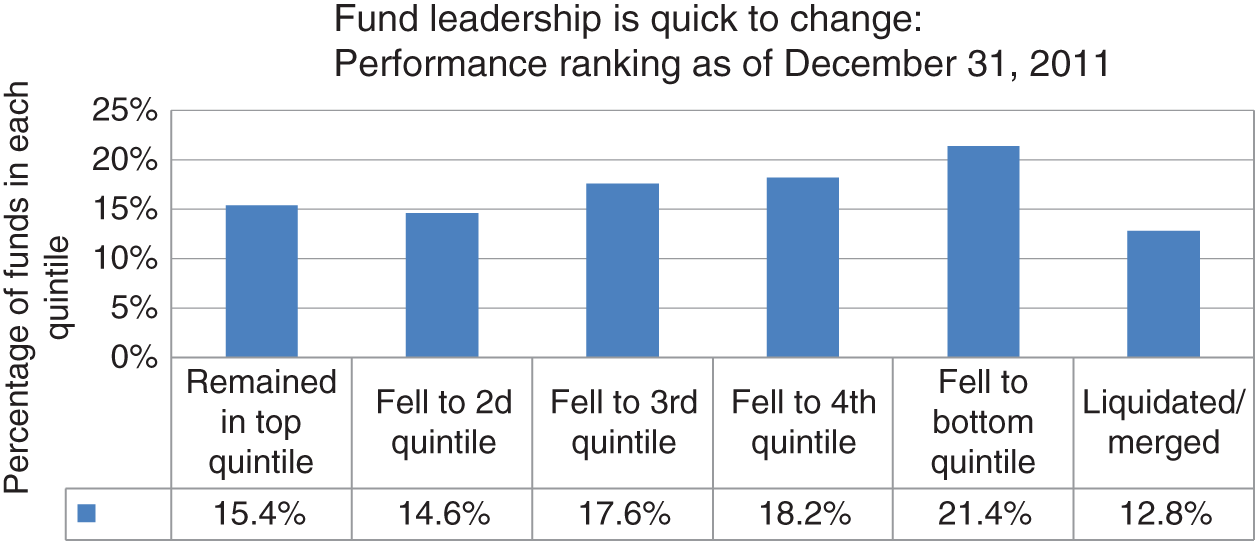
Figure 1.2 Fund Leadership Is Quick to Change: Performance Ranking as of December 31, 2011
Innovation in investment “products” continued and accelerated. Rare before the 1980s,21 hedge funds gained favor with wealthy individuals in the 1990s and then, after the millennium, with institutions. In 2000, an estimated 3,335 hedge funds and 583 “funds of funds” had assets of $500 billion (Figure 1.3). By 2012, the numbers had more than doubled to 7,768 hedge funds and 1,932 funds of funds. (The latter figure was down from 2,682 in 2007.) Currently, in a “normal” year, 1,000 new hedge funds are launched and 750 old funds are liquidated.22 Total hedge fund assets have been estimated at $2 trillion with at least one fund being over $50 billion.23
Hedge funds are different from other institutions. Fees are typically “2 and 20,” substantial leverage is used, portfolio turnover is high, and every aspect of their operations is intensive as they all strive in various ways to “get an edge”—to find and exploit market opportunities. As highly efficient “money machines,” hedge funds have become Wall Street's largest accounts, so they routinely get “the first call.” Spawning enormous compensation—one manager was allegedly paid $4 billion for a single year—hedge funds attract “the best and brightest” and the most intensively competitive.24 And as they scour the market for anomalies, the hedge funds increase the market's efficiency.
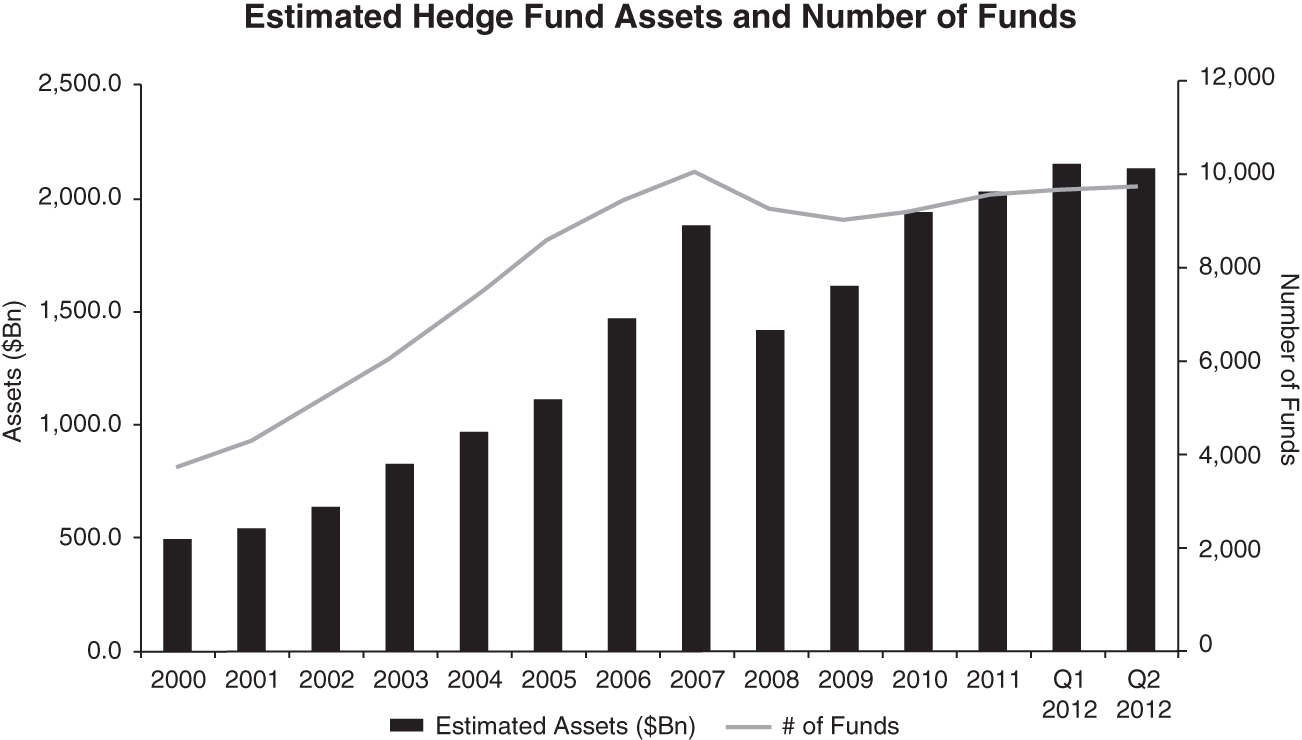
Figure 1.3 Estimated Hedge Funds' Assets and Number of Funds, 2000–2012
Index Funds' Growth
Change begets change and one important long-term change began back in 1971. Wells Fargo Bank created an index fund for a $6 million portfolio of Samsonite Corporation's pension fund. Originally an equal weighted fund, the fixed brokerage commissions created serious cost problems, so the fund was switched in 1976 to the market-weighted S+P 500 index. In 1974, Batterymarch and the American National Bank also launched index funds.25 In 1976, Vanguard launched the first index mutual fund. It is now the largest mutual fund in the world and Vanguard has become one of the nation's largest and most respected investment managers. (Worldwide, there are over 100 index funds matching one or another market index.) After adjusting for survivorship bias, over the past 25 years Vanguard's index fund has beaten 85% of the nation's actively managed mutual funds.
Index funds have increased rapidly. In the 15 years from 1997 to 2011, the number of index mutual funds nearly tripled from 132 to 383. In assets, index funds grew twice as rapidly, up six times from $170 billion to $1.1 trillion. (While nearly 80% of index funds are equity funds, index bond funds grew twenty-five times—from $10 billion to $222 billion.)
The growth of indexing cannot have been helped by a major “branding blunder” by indexers when accepting confinement to a culturally pejorative name: passive. In our active, can-do, competitive culture, who is such a timid soul that he or she would rather be known as “passive” than “active”? Fairly or not, names do matter. Consider the following pairs and decide, which would you prefer?
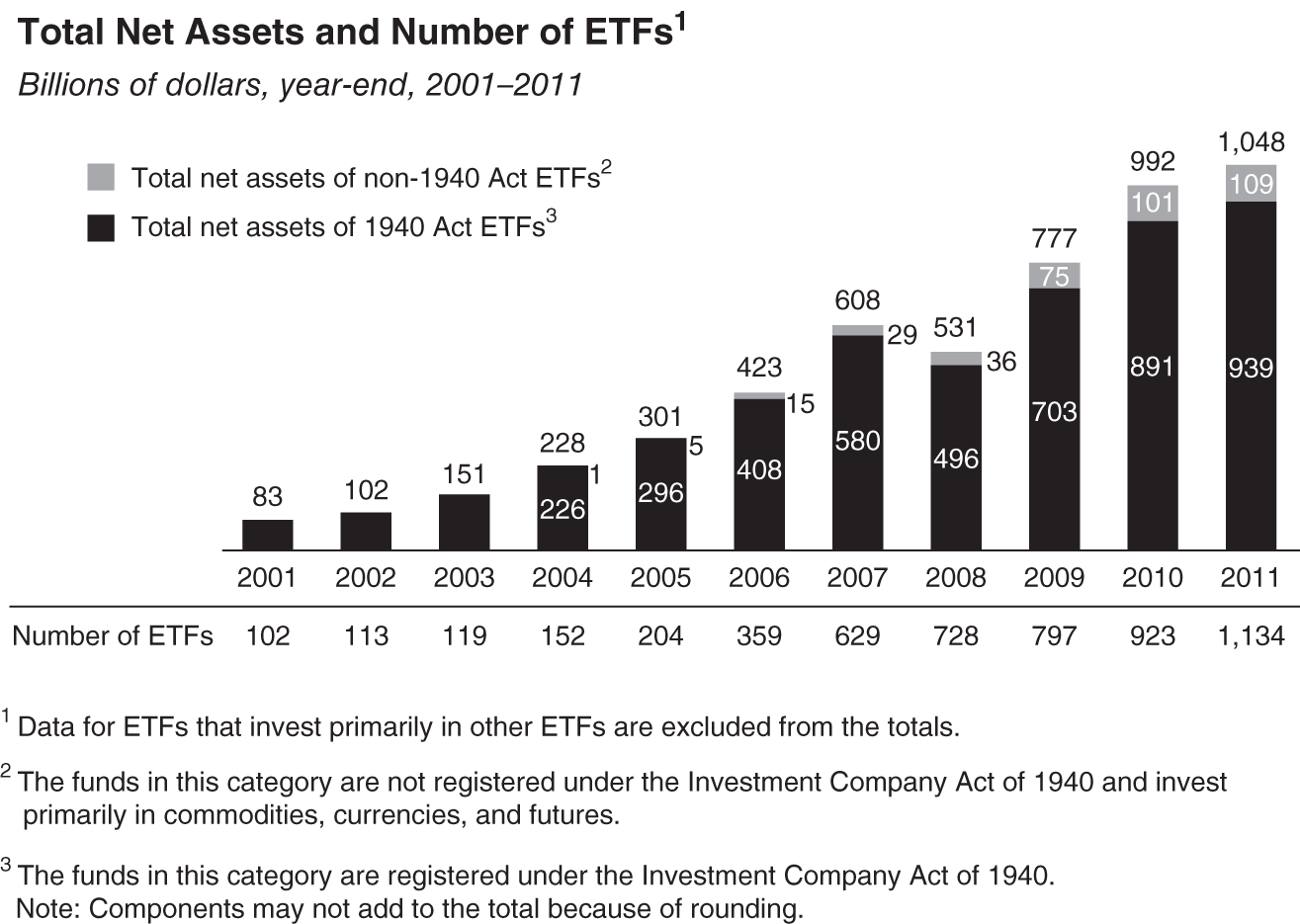
Figure 1.4 Total Net Assets and Number of ETFs, 2000–2011.
- Tony Curtis vs. Bernard Schwartz
- Rita Hayworth vs. Margarite Cansino
- Ralph Lauren vs. Ralph Lifshitz
In recent years, ETFs (Exchange Traded Funds)26 that match indexes have also proliferated and attracted many investors. ETFs got off to a slow start but were soon surging in volume and proliferating in variety.27 Assets of ETFs have increased from $83 billion in 2001 to over $1 trillion in 2011 and now to nearly $3 trillion (Figure 1.4).28 There are now over 4,700 ETFs and trading in ETFs represents over 15% of total NYSE trading volume.
Accumulating Evidence
Long before the build-up in index fund investing, academic research was providing increasingly powerful theoretical and documentary support for a shift away from active investing over to passive or index investing. (Practitioners—busy ringing the cash registers—paid little or no attention.) In 1952, a 14-page paper by 25-year-old Harry Markowitz clarified that risk and return are both separate and correlated and that a rational investor should strive to minimize risk and maximize returns at the portfolio level.29
In the 1960s, Bill Sharpe showed how to separate market or systemic risk from manager-determined non-market risk, a different kind of risk that could be minimized through diversification and why investors should always diversify as much as practicable. In 1967, Michael Jensen published in The Journal of Finance a study of mutual funds from 1945 to 1964 and reported that despite taking more risk, the average fund lagged the market index by 1.1% per annum.
Years later, Sharpe explained what all investors need to know and understand in his short Financial Analysts Journal article, “The Arithmetic of Active Management.”30 Sharpe stated two simple propositions:
- Before costs, the return on the average actively managed dollar will equal the return on the average passively invested dollar.
- After costs, the return on the average actively invested dollar will be less than the return on the average passively invested dollar.
Sharpe went on to explain that for any active manager to recover all his costs and produce a net return above the market index, other investors “must be foolish enough to pay”—via inferior performance—all the costs incurred by the institutions and an attractive incremental profit that would compensate adequately for the risks of falling short.
Eugene Fama led in the formulation of the efficient market hypothesis in the 1960s and tested it by examining the performance of all domestic mutual funds with 10 years or more of recorded performance. His conclusion: “superior investment has escaped detection.” (His conclusion would have been even more negative had he used a capitalization-weighted index such as the S&P 500.) As Fama recently summarized his research:
Quantitative observers will surely be forgiven if they point out that only 3% of active managers beating their chosen markets is not far from what would be expected from a purely random distribution. Meanwhile, qualitative observers will caution that odds of 97 to 3 are terrible—particularly when risking real money that will be sorely needed by millions of people in retirement or to help finance our society's most treasured educational, cultural, and philanthropic institutions.
In 1973, Burt Malkiel's ever-popular A Random Walk Down Wall Street—destined to sell over 2 million copies—provided an easy-to-read compendium of the proliferation of academic studies of investing. Diversification, as Malkiel notes, is “investing's only free lunch.” Malkiel reported the daunting data that even without adjusting for survivorship bias, more than 60% of large cap equity funds underperform the market over 5 years; more than 70% underperform over 10 years, and over 80% underperform over 20 years!32 The funds' “slugging average” is even worse because those that underperform do so by over 1½ times as much as out-performers' margin of market superiority.
In 1974, Nobel Laureate Paul Samuelson's article “Challenge to Judgment” in the Journal of Portfolio Management concluded, “the best of money managers cannot be demonstrated to be able to deliver the goods of superior … performance.” Over the next 35 years, study after study continued to document the same grim overall results. Model-based estimates and market reality have come into dauntingly close alignment.
More recently, Allen Roth estimated the percent of actively managed funds that would be expected—if all results were perfectly random—to outperform a broad market index fund over various intervals at 43% over one year, 30% over five years, 23% over 10 years and only 12% over 25 years. (For a portfolio of five funds, expected outperformance would drop to 11% over 10 years and only 3% over 25 years.)33
Studying actual results, Richard Ferris found the same small 12% of actively managed funds had actually outperformed the S&P 500. Similar results have been found with “small cap” funds and for funds in Japan, Asia ex-Japan, the UK, Canada, and in emerging markets and for REITs. For bond funds, success is even less frequent: only 20% achieve superior results and once again, past performance does not predict future results.
Curiously, academics, who have objectively studied the most extensive data, have had little impact on the thinking or actions of practical decision-makers. MBAs may study efficient markets while in school, but apparently leave “all that theory” behind when they go into investing or financial management at corporations. As C.P. Snow would have recognized, practitioners and academics live in different worlds, hold different sets of beliefs, and speak separate languages, and have no great respect for each other.
Meanwhile, back in the “real world” of actual investing, the self-chosen task of the investment consulting firms proved far more difficult than expected. They were not able to identify winning firms consistently. (This cannot be entirely surprising. If, for example, a consulting firm were able to select superior managers consistently, we would soon know it—probably with help from that masterful firm. But “the dog isn't barking” because there's no one there.) Of course, investment consultants do deliver other kinds of value to their clients: data on performance of the client's managers versus many other managers; advice on asset mix, rate of return assumptions, spending rules, or new investment ideas; and steadying advice when temptations are strongest at market highs or lows.
The challenge investors accept when selecting an active manager is not to find a talented, hard-working, and highly disciplined manager. That would be easy because there are so many of them. The challenge is to select a manager sufficiently more hard-working, more highly disciplined, and more creative than the other managers equally aspirational investors have chosen—more by at least enough to cover the manager's fees. This has become exceedingly difficult to do for one major ironic reason: increasingly consistent excellence among investment managers has been increasing market efficiency.
As a result of combining all these powerful change forces, market activity has been transformed from the activities of amateur “market outsiders” making only occasional one-stock decisions over to dominance by professional “market insiders” continuously comparison shopping the market. The result is that the securities markets have become increasingly efficient. And this means that deviations from the equilibrium prices based on informed experts' expected returns—in turn, based on analyzing all accessible information—are only increasingly unpredictable and random “noise.”
Given the “noise” in the data on managers' investment performance records, Fama went on to conclude: “An investor doesn't have a prayer of picking a manager that can deliver true alpha. Even over a 20-year period, the past performance of an actively managed fund has a ton of random noise that makes it difficult, if not impossible, to distinguish luck from skill.” (What he did not say, but we know is important, is this: behind any long-term record are many, many internal organizational changes in the important factors: markets change, portfolio managers change, assets managed by a firm change, managers age, families, incomes, and interests change, organizations change, etc. etc. All that means any long-term performance record must be interpreted with great care.)
Bayesians think in two importantly powerful ways: continuously using new data to come closer and closer to approximating reality and thinking about and estimating the future in probabilistic terms. Despite the specificity of prices, the stock market is an extraordinary aggregation of complex forces and variables. Unfortunately for our investment performance, we humans are notoriously biased in our evaluations. We favor the stocks of companies we have studied and even more strongly favor the prospects of stocks we already own in our portfolio. Each corporation is a complexity of many changing economic conditions, changing demand in each of many market segments, changing competition, changing technologies, changing internal leadership, and, importantly, both bad and good luck. Some variables are reinforcing, some self-correcting, some conflicting, some self-canceling, some brief, some enduring. The flutter of statistical uncertainty is inherent and persistent. Even the causes of changes are uncertain and often hidden. The variety of changing factors, their varying significance, and their many complex interactive dynamics of leading and lagging causation are dazzling. Estimating and forecasting the future of any variable are difficult; forecasting the interacting futures of many changing variables is extraordinarily difficult.34
Changing Markets
Fifty years ago, when institutions did only 10% of total NYSE trading and amateurs—averaging less than one trade a year—did the other 90%, beating the market (i.e. beating the part-time amateur competition) was not just possible, it was probable for a well-informed active professional. Individual investors were not only amateurs without access to research, they also made their decisions primarily for outside the market reasons: an inheritance or bonus received or a down-payment on a home or college tuition to pay. Today, the markets are overwhelmingly dominated by expert professionals armed with extensive research and a continuous flood of extensive market information, economic analyses, industry studies, and company reports and they are constantly comparison shopping inside the market for any comparative advantage.
Over the past 50 years, as well-educated, experienced, full-time, dedicated and highly motivated professionals have displaced the amateur individual investors, the stock markets have become increasingly efficient. Trading by professional investors has surged from a small minority of all trading to an overwhelming majority, over 95% of all listed trading in stocks and nearly 100% of off-board trading in listed stocks; plus 100% of algorithmic trading plus nearly 100% of trading in derivatives (which may now equal or exceed the value of shares traded in the “cash” market).
In 1961—for the first time since 1929—annual trading volume on the New York Stock Exchange was over 1 billion shares. By 1972, volume was 4.1 billion—and that was just the beginning. Volume multiplied 8-fold over the next 20 years and then, another 12-fold from there over the next decade. Turnover rose from 15% in 1961 to 23% in 1972 to 105% in 2002 and even higher in 2012 and over those 40 years, trading volume surged upward nearly 90 times! Table 1.1 shows the rise in shares traded from 1973 to 2011.
Table 1.1 Rise in Shares Traded, 1973–2011
| Year | Shares traded |
| (billions) | |
| 1973 | 4.1 |
| 1982 | 16.5 |
| 1992 | 31.6 |
| 2002 | 363.1 |
| 2011 | 533.5 |
Professional investors that dominate today's markets have steadily become more and more consistently advantaged in education, analytical skills, industry and company expertise, access to information, and organizational resources—computers, Internet, and teams of analysts. MBAs and PhDs from leading universities are now “a dime a dozen” normal. Bloombergs and CFAs are ubiquitous. CFA Charters are one indicator of the world-wide persistent change toward professionalism. With the deliberately low entry threshold of a single not-very-difficult exam in 1963, 267 CFA Charters were awarded in that first year. Interest among analysts increased and in 1966, 564 won Charters, even though the exams were now three in annual sequence and substantially more demanding and the preparatory study of the “body of knowledge” more daunting. With the sharp market drop, new Charters fell to 214 in 1971. Then, with only occasional relapses,35 Charters rose to over 11,000 in 2012. The total number of Chartered Financial Analysts is now over 130,000 and another 220,000 have registered as candidates—worldwide (see Figure 1.5).36
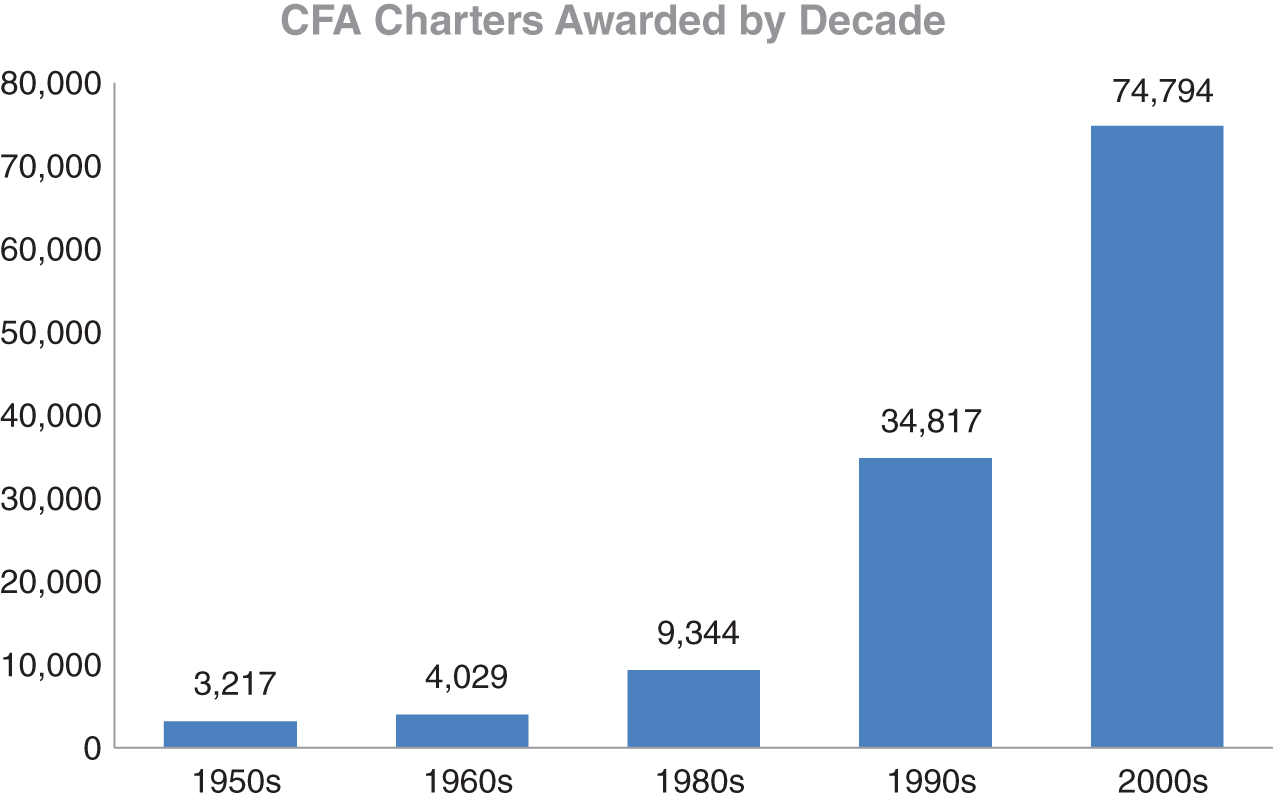
Figure 1.5 CFA Charters Awarded by Decade
Research reports of all sorts on industries, companies, economies, demographics, politics, etc. flood the Internet, fax machines, and mailbags every day. Everybody has access to more market information than they can possibly use. And with Regulation FD to “level the playing field,” the SEC is assuring that all information is always disclosed to all investors at the same time.
Each of the individual changes noted below may have been important. The compound change has been astounding. Over the past 50 years,
- NYSE trading volume has risen from 2½ million shares a day to 5 billion—a 2,000 times increase.
- Equity derivatives trading has gone from zero to more in value than the NYSE cash market.
- Bloomberg machine placements have gone from 0 to over 300—and were rising rapidly.
- In absolute terms, the capabilities of the first and second quartile investment professionals have been steadily rising.
The unsurprising result: the stock market got harder and harder to beat because the competition got better and better and harder to beat or keep up with, particularly after the substantial fees.
Significantly, no method has been found to identify in advance which actively managed funds would prove to be the winners and once again, the losing funds lost more (1.7%) than the winners won (1%) before taxes.37 Table 1.2 shows the large majority of actively managed funds—of all types and sizes—that underperform.
For all investors, the quality of competition has again and again raised the standard of excellence to a higher and higher level of speed,38 expertise, and skill required to keep up with the competition or to be a Top Quartile or Top Decile manager.39 The market has been changing in many ways that collectively raise the standards of capability required just to keep up with the average competitor, let alone significantly outperform. And more and more rational, educated, informed, and competitive participants continue to join in the search for pricing errors and that all have ready access to almost all the same information. So the probabilities continue to rise that any mispricing will be discovered—and swiftly arbitraged away into insignificance.
Table 1.2 Percentage of Funds Underperforming Benchmarks, Adjusted for Survivorship Bias: 15 Years to December 31, 2011
| Size | Value funds | Blended funds | Growth funds |
| Large | 57 | 84 | 75 |
| Medium | 100 | 96 | 97 |
| Small | 70 | 95 | 78 |
Importantly, given the many collectively transformative ways in which the gathering, processing, and distribution of investment information have increased in breadth, depth, speed, and accuracy, a rational observer would accept that securities market prices—determined by the consensus of thousands of experts committing substantial real money in virulent competition with all other experts—are more efficient than ever. And the levels of skill needed to be “competitive” are now higher than ever. So, the core question is not whether the markets are perfectly efficient, but only whether markets are sufficiently “efficient” that active managers burdened with the handicaps of operating costs and fees—correctly understood—are unlikely to be able to keep up with and very unlikely to get much ahead of the market—the trading-weighted consensus of experts. The important question is whether investors have sufficient reason to accept the risks and uncertainties of active management, given the difficulty of successful manager selection and the poor prospects for superior net returns.
Of course, realization of the ever-increasing difficulty will not come quickly or easily—particularly from active managers. We cannot reasonably expect them to say, “We, the emperors, have no clothes,” and give up active management when they are so well paid for continuously striving. In addition, Kahneman recommends recognizing the socializing power of a culture like the one that pervades investment management:
The most potent psychological cause of the illusion is certainly that the people who pick stocks are exercising high-level skills. They consult economic data and forecasts, they examine income statements and balance sheets, they evaluate the quality of top management, and they assess the competition. All this is serious work that requires extensive training, and the people who do it have the immediate (and valid) experience of using these skills.40 Unfortunately for advocates of active investing, Kahneman is also familiar with the extensive research over the past 50 years that shows conclusively that “for a large majority of fund managers, the selection of stocks is more like rolling dice than playing poker. Typically, at least two out of three mutual funds underperform … in any given year.”
Kahneman, relying on objective data, shows little mercy as he rounds on to his conclusion:
And, as the market has become increasingly dominated by increasingly skillful and well-informed competitors, the importance of the illusion has increased asymptotically toward no longer credible.42
Kahneman is even-handed in his balloon pricking. Reviewing the popular business literature on how superior managerial practices can supposedly be identified and somehow put to work with favorable results, he says, “Both messages are overstated. The comparison of firms that have been more or less successful is to a significant extent a comparison between firms that have been more or less lucky.”
Kahneman uses a specific example to explain his thesis:
A client selecting active managers has to answer two different and increasingly difficult questions:
- Will Manager A be one of the best managers over the next several years?
- Will Manager A be enough better, in today's expert market—after adjusting for risk—to justify the fees?
Despite all the extensive accumulating evidence that active managers have not, and by the iron logic of competition, will not, outperform the market they themselves dominate, clients somehow continue to believe their managers can and will outperform. (The triumph of hope over experience is not confined to repetitive matrimony. The average US institutional client expects its managers to outperform by a cool 100 basis points.)46 Of course, the difficulty of selecting significantly superior managers increases as the number of managers used by an institution or by an individual increases, and most institutions use multiple managers.
Consider the many factors that have encouraged investors to pursue active management: media advertising is extensive and notoriously concentrates on “superior” performance; media coverage centers on reporting the “winners” who cheerfully provide ex post explanations of how they believe they achieved their successes; investment committees focus on selecting only the best manager from a group of pre-selected “winners;” and investment consultants are retained to search the world to find the best of the best. Given the reality that their firm economics depend on clients continuing to use their services, why would they be expected to tell their fee-paying clients that they are on a “mission improbable”? Another possible explanation is that fund executives believe they can easily and successfully switch from manager to manager. As one fund executive recently declared to a large audience, “We don't marry our managers; we date them through Match.com.”47 Unfortunately, in the years after the decision to change, the fired manager typically out-performs the newly hired manager.48
The persistent drumbeat of disappointing underperformance by active managers was for many years deniable because there were no clear alternatives to trying harder and hoping for the best. Blessed in most situations with the benefit of optimism, clients continued to see the fault as theirs and gamely continued to try to find Mr. Right, convinced there were no valid alternatives. But now, with the proliferation of low-cost index funds and ETFs, there are clear-cut alternatives. And clients are increasingly recognizing that reality and even taking action. The real question now is “Why are clients not changing from active to indexing?” The answer lies with deeply rooted human optimism.
Behavioral Economics
Many puzzling examples of less-than-rational human behavior can be explained by turning to behavioral economics—and many clues can be found to help explain why the pace of change to indexing has been so slow and why the pace is likely to continue gradually accelerating. Behavioral “tilt” affects the way we form our perceptions and beliefs, how we behave, and how we make decisions. Many well-documented “tilts” help to explain why the pace of shifting has been so slow, including the following:
- Ambiguity effect: since future performance data is unknown, that uncertainty makes it easier to say, “Well, let's wait and see. This manager still looks like a winner.”
- Base rate fallacy: Basing beliefs or decisions on specific exceptions and ignoring the normal experience. “We only consider Top Quartile managers—and then we pick the best of them, so we should get superior performance.”
- Choice-supportive bias: “Well, we haven't taken a lot of time studying our own past experience, but I'm pretty sure that overall, we've done things pretty well.”
- Confirmation bias: “We know there are superior managers and we've seen lots of data from our consultant on the managers they recommend, so we're confident our process will bring us a superior group of managers.”
- Past-purchase rationalizing: “We wouldn't have chosen these managers if we weren't confident, they would eventually out-perform.”
As Kahneman warns:
Kahneman goes on to explain that errors of prediction are inevitable because the world we live in is itself highly unpredictable and that a high level of confidence is not to be trusted as an indicator of accuracy. He then asks: “Why do investors, both amateur and professional, stubbornly believe that they can do better than the market, contrary to an economic theory that most of them accept, and contrary to what they could learn from a dispassionate evaluation of their personal experience?”
He then laments, “Unfortunately, skill in evaluating the business prospects of a firm is not sufficient for successful stock trading, where the key question is whether the information is already incorporated in the price of its stock.”50 As we now know, most of the relevant and attainable information about the economy, the industry, the company, and the stock is already known or anticipated and so is incorporated in each stock's price almost all of the time.
Behavioral economists' studies show, with remarkable consistency, that Pareto's 80:20 Law applies to most groups of people when asked to rate themselves on whether they are above average or below average. As we see ourselves, we hail from America's favorite hometown: Lake Wobegon. Over and over again, about 80% of us rate ourselves “above average”51 on each of these parameters:
- Being a good listener.
- Having a good sense of humor.
- Being a good conversationalist.
- Being a good friend to others.
- Being a good driver.
- Being a good dancer
and …
- Being a good investor.
The last rating—with 80% of us rating ourselves as “above average” as investors—may be the key to explaining why indexing has not been pursued more boldly. Institutional fund executives—despite all the extensive and consistently contradictory data from past years—are remarkably confident that in the future, their active managers will somehow achieve significantly superior results. Year after year, research by Greenwich Associates reports that institutional investors expect their managers to beat their benchmarks by one hundred basis points annually. With this degree of confidence in active management—no matter how sternly contradicted by extensive past data—there's little wonder that demand for active management continues strong.
In The Right Stuff, Tom Wolfe showed his readers what the outstanding test pilots he wrote about could not see: The cause of deadly accidents was not “pilot error”; the accidents were predictable and inevitable. In work so exceedingly difficult in an environment so fraught with inherent variability, even the world's best test pilots could not always be in control. Similarly, the young white women in the (2011) film, The Help, could not see the social wrong that we now see all too clearly from a different perspective. As Burt Malkiel says, “It's hard for people to accept [indexing] because it's like telling someone there is no Santa Claus. People don't like to give up believing.”
Fees Are Not Low
Meanwhile, investors continue to look right past one factor—fees—because almost everyone assumes that fees are not important. But seen correctly—compared to results actually achieved—fees are very important. Let's contrast conventional perceptions with reality. Conventionally, fees for equity management are typically described with one four-letter word and a single number. The four-letter word is “only,” as in “only 1%” for mutual funds or “only ½ of 1%” for institutions. If you accept 1%,52 you'll easily accept the “only.” But isn't that a self-deception?53
“Only 1%” is the ratio of fees to assets, but is that in any way the right way to define and calculate fees? The investor already has the assets, so active investment managers must be offering to deliver something else—returns. If annual future equity returns are, as the consensus now holds, 7%, then that 1% of assets quickly balloons to nearly 15% of returns—a much higher and much more realistic charge. But that's not the end of it.
A more informed and rigorous definition of fees for active management would begin with recognizing the wide availability of a market-matching “commodity” alternative at a very low fee: indexing. Since indexing consistently delivers the full market return at no more than the market level of risk, the correct definition of fees for active management that informed realists would use, after adjusting for market risk, is the incremental or marginal fee as a percent of incremental or marginal returns.
Among mutual funds, fees vary significantly from fund to fund and by type of fund—and even between comparable index funds. In America, actively managed funds average more than 1% as shown in Table 1.3. Note that mutual fund fees in America are significantly lower than funds in other countries.
In addition to expense ratios, another charge of, typically, 25 basis points has been levied as 12b-1 or “distribution fee.”54 These fees are either paid directly to brokers for “shelf space” or pay for advertising and other marketing expenses. These fees add significantly to investors' total costs—particularly when correctly calculated versus incremental returns.55, 56
Table 1.3 Fees for Mutual Funds in US in Basis Points, 2011
| Average fees | 90th percentile fee | |
| Equity funds | 144 | 220 |
| Aggressive growth | 149 | 221 |
| Growth | 137 | 209 |
| Sector | 154 | 237 |
| Growth income | 121 | 195 |
| Income equity | 124 | 193 |
| International equity | 157 | 232 |
So now the crucial question is clear: What marginal benefit do active managers offer at what marginal cost? Fees of 50 basis points (½ of 1% of assets) for institutions are an incremental 45 basis points higher than institutional index fund fees of, say, 5 basis points (or less). That 45 basis point charge is the correct incremental fee to compare to incremental returns.
Very few of the most successful active managers outperform by an average of 100 basis points over the long run, but even for these heroes, the true fee—marginal fee as a percent of incremental return—would be 45%. For an active manager consistently out-performing by ½%—surely a compelling Top Decile performance—the true or marginal fee would be 90%.
Objectively, the incremental fees for incremental risk-adjusted returns from active management are not low. They are high—very high. Fama's research says only 3% of active managers cover the cost of their fees. Since a majority of managers underperform the market, the true fee for the average active manager is actually well in excess of 100% of incremental returns. This grim reality has gone largely unnoticed by clients—so far. But “not yet being caught” is certainly not the strong protective moat that Warren Buffett wants around a business.
Ironically, the active managers' inability to “beat the market” is most certainly not a slam on them as investment experts, but rather a tribute to the extraordinary skill, hard work, and persistent striving for excellence shown every day by the many remarkable people attracted to investment research and management over the past 50 years. In brief, the professionals are so “good at the game” that only a very few can be capable of both covering their costs and out-performing the expert consensus.
For our profession, for each individual and for each firm in active investment management, the question is: When will we recognize that the skills of other market participants have increased so much that we can no longer expect to outperform by enough to cover the costs of trading and management fees and offer—after fees and costs—a good value to our clients? Another central question is: When will our clients decide that continuing to strive to beat the market is not a good deal for them? These questions are crucial because to continue selling the service after passing that tipping point would clearly raise the kinds of ethical questions that separate a profession from a business.
As a business, investment management is a booming success, but as a profession, investment management has been repeatedly failing. Understandably, practitioners want both a great business and an admired profession, but our collective decisions and behaviors—far more than insiders yet recognize—show that in what we do versus what we say, we put “great business” far ahead of “admired profession.”
Part of the reason we are able to put business first is that most clients are part-timers who don't realize what's really going on and part of the reason is that we insiders don't see reality all that clearly either—so we see no particular reason to worry or take action. If the “emperor has no clothes,” why do these beliefs persist? One way to test our thinking is to ask the question in reverse: If your manager consistently and reliably delivered the full market return with no more than market risk for 1/10 of 1%, would you switch to one of a group of managers who charge well over 1% and produce unpredictably varying results that fall short nearly twice as often as they out-do the market, and when they fall short lose, on average, $1.65 versus gaining $1.00 when they do out-perform? The question answers itself.
For those who are willing to move forward from the Loser's Game of trying to beat the market consensus of informed, skillful, determined professionals, the good news is that they can re-frame their client relationships into a Winners' Game,57 in which both clients and managers can be successful. The “secret” is to put the interests of clients first and integrate investment product with the all-important service of investment counselling: guiding each client toward an explicit and well-reasoned specification of that particular client's realistic investment objectives and the specific investment program most likely to achieve those objectives within that client's interim risk tolerance and helping each client stay on course through market extremes—both highs and lows.
Of course, the Winners' Game may not be as financially rewarding to investment managers as a business, but as a profession it would be fulfilling and it is the only admirable way forward that will inspire client and customer loyalty—with all the attendant economic benefits—and provide practitioners with deep professional satisfaction.
Source: Conference paper given at Oxford University in 2012.