Plan using units of customer-visible functionality. "Handle five times the traffic with the same response time." "Provide a two-click way for users to dial frequently used numbers." As soon as a story is written, try to estimate the development effort necessary to implement it.
Software development has been steered wrong by the word "requirement", defined in the dictionary as "something mandatory or obligatory." The word carries a connotation of absolutism and permanence, inhibitors to embracing change. And the word "requirement" is just plain wrong. Out of one thousand pages of "requirements", if you deploy a system with the right 20% or 10% or even 5%, you will likely realize all of the business benefit envisioned for the whole system. So what were the other 80%? Not "requirements"; they weren't really mandatory or obligatory.
Early estimation is a key difference between stories and other requirements practices. Estimation gives the business and technical perspectives a chance to interact, which creates value early, when an idea has the most potential. When the team knows the cost of features it can split, combine, or extend scope based on what it knows about the features' value.
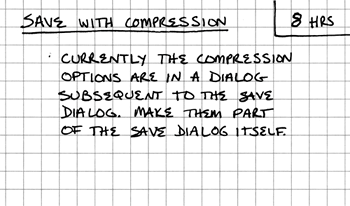
Give stories short names in addition to a short prose or graphical description. Write the stories on index cards and put them on a frequently-passed wall. Figure 7 is a sample card of a story I wish my scanner program implemented. Every attempt I've seen to computerize stories has failed to provide a fraction of the value of having real cards on a real wall. If you need to report progress to other parts of the organization in a familiar format, translate the cards into that format periodically.
One feature of XP-style planning is that stories are estimated very early in their life. This gets everyone thinking about how to get the greatest return from the smallest investment. If someone asks me whether I want the Ferrari or the minivan, I choose the Ferrari. It will inevitably be more fun. However, as soon as someone says, "Do you want the Ferrari for $150,000 or the minivan for $25,000?" I can begin to make an informed decision. Adding new constraints like "I need to haul five children" or "It has to go 150 miles per hour" clear the picture further. There are cases where either decision makes sense. You can't make a good decision based on image alone. To choose a car wisely you need to know your constraints, both cost and intended use. All other things being equal, appeal comes into play.