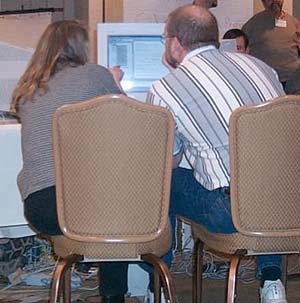
Write all production programs with two people sitting at one machine. Set up the machine so the partners can sit comfortably side-by-side. Move the keyboard and mouse back and forth so you are comfortable while you are typing. Pair programming is a dialog between two people simultaneously programming (and analyzing and designing and testing) and trying to program better. Pair programmers:
Keep each other on task.
Brainstorm refinements to the system.
Clarify ideas.
Take initiative when their partner is stuck, thus lowering frustration.
Hold each other accountable to the team's practices.
Pairing doesn't mean that you can't think alone. People need both companionship and privacy. If you need to work on an idea alone, go do it. Then come back and check in with your team. You can even prototype alone and still respect pairing. However, this is not an excuse to act outside of the team. When you're done exploring, bring the resulting idea, not the code, back to the team. With a partner, you'll reimplement it quickly. The results will be more widely understood, benefitting the project as a whole.
Pair programming is tiring but satisfying. Most programmers can't pair for more than five or six hours in a day. After a week like that, they are ready for a relaxing weekend away from work. I keep a bottle of water beside me while I pair. It's good for my health and I'm eventually reminded to take a break. The breaks keep me fresh for the whole day.
Rotate pairs frequently. Some teams report good results obeying a timer that tells them to shift partners every sixty minutes (every thirty minutes when solving difficult problems). I don't think I'd like this, but I haven't tried it. I like to program with someone new every couple of hours, switching at natural breaks in development.
An issue that has come up and requires comment is the close contact in pair programming. Different individuals and cultures are comfortable with different amounts of body space. Pairing with an Italian who communicates best when very close is completely different than pairing with a Dane who likes a few feet of personal space. If you aren't aware of the difference it can be acutely uncomfortable. Personal space must be respected for both parties to work well.
Personal hygiene and health are important issues when pairing. Cover your mouth when you cough. Don't come to work when you are sick. Avoid strong colognes that might affect your partner.
Working effectively together feels good. It may be a new experience in the workplace for some. When programmers aren't emotionally mature enough to separate approval from arousal, working with a person of the opposite gender can bring up sexual feelings that are not in the best interest of the team. If these feelings arise when pairing, stop pairing with the person until you have taken responsibility for and dealt with your feelings. Even if the feelings are mutual, acting on them will hurt the team. If you want to have an intimate relationship, one of you should leave the team so you can build a personal relationship in a personal setting without confusing the team's communication with a sexual subtext. Ideally, emotions at work will be about work.
It is important to respect individual differences when pairing. In Figure 6 the man has moved closer to the woman than is comfortable for her. Neither is making his or her best technical decisions at this point, although they may be completely unaware of the source of their discomfort.
If you are uncomfortable pairing with someone on the team, talk about it with someone safe; a respected team member, a manager, or someone in human resources. If you aren't comfortable, the team isn't doing as well as it could. And chances are others are uncomfortable too.