Chapter 4. Cryptography
Keys and Addresses
Public Key Cryptography and Cryptocurrency
Note
Tip
Tip
Private Keys
Tip
Generating a Private Key from a Random Number
Tip
Warning
f8f8a2f43c8376ccb0871305060d7b27b0554d2cc72bccf41b2705608452f315
Public Keys
Warning
Note
Elliptic Curve Cryptography Explained
Note
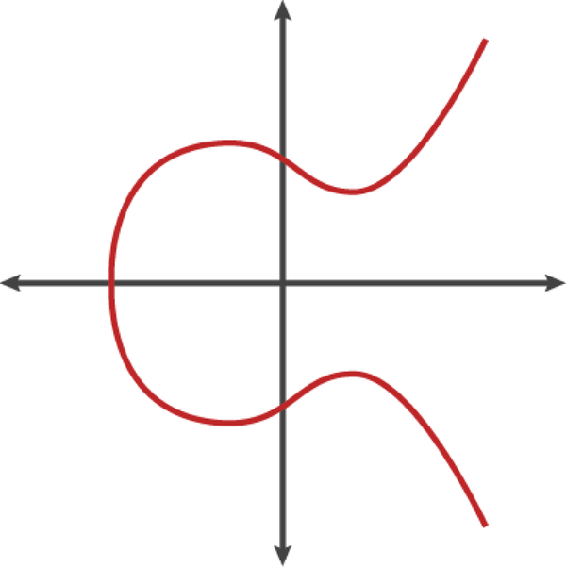
Figure 4-1. A visualization of an elliptic curve
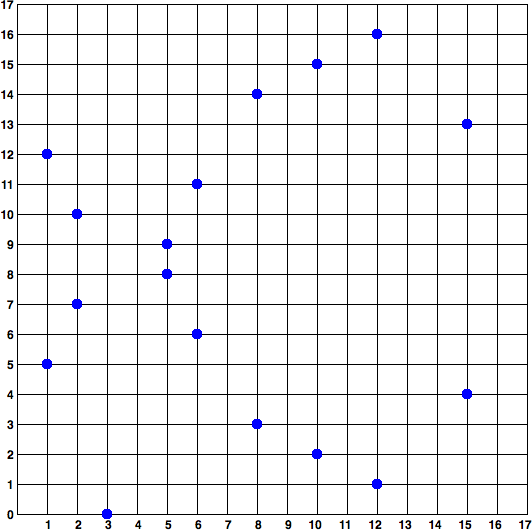
Figure 4-2. Elliptic curve cryptography: visualizing an elliptic curve over F(p), with p=17
Q =
(49790390825249384486033144355916864607616083520101638681403973749255924539515,
59574132161899900045862086493921015780032175291755807399284007721050341297360)
Example 4-1. Using Python to confirm that this point is on the elliptic curve
Python 3.4.0 (default, Mar 30 2014, 19:23:13)
[GCC 4.2.1 Compatible Apple LLVM 5.1 (clang-503.0.38)] on darwin
Type "help", "copyright", "credits" or "license" for more information.
>>> p = 115792089237316195423570985008687907853269984665640564039457584007908834 \
671663
>>> x = 49790390825249384486033144355916864607616083520101638681403973749255924539515
>>> y = 59574132161899900045862086493921015780032175291755807399284007721050341297360
>>> (x ** 3 + 7 - y**2) % p
0L
Elliptic Curve Arithmetic Operations
Generating a Public Key
Tip
K = f8f8a2f43c8376ccb0871305060d7b27b0554d2cc72bccf41b2705608452f315 * G
K = (x, y)
x = 6e145ccef1033dea239875dd00dfb4fee6e3348b84985c92f103444683bae07b
y = 83b5c38e5e2b0c8529d7fa3f64d46daa1ece2d9ac14cab9477d042c84c32ccd0
| Prefix | Meaning | Length (bytes counting prefix) |
|---|---|---|
|
Point at infinity |
1 |
|
Uncompressed point |
65 |
|
Compressed point with even |
33 |
|
Compressed point with odd |
33 |
04 + x-coordinate (32 bytes/64 hex) + y-coordinate (32 bytes/64 hex)
046e145ccef1033dea239875dd00dfb4fee6e3348b84985c92f103444683bae07b83b5c38e5e2b0 \
c8529d7fa3f64d46daa1ece2d9ac14cab9477d042c84c32ccd0
Elliptic Curve Libraries
- OpenSSL
-
The OpenSSL library offers a comprehensive set of cryptographic primitives, including a full implementation of
secp256k1. For example, to derive the public key, the functionEC_POINT_mulcan be used. - libsecp256k1
-
Bitcoin Core’s
libsecp256k1is a C-language implementation of thesecp256k1elliptic curve and other cryptographic primitives. It was written from scratch to replace OpenSSL in Bitcoin Core software, and is considered superior in both performance and security.
Cryptographic Hash Functions
- Determinism
-
A given input message always produces the same hash output.
- Verifiability
-
Computing the hash of a message is efficient (linear complexity).
- Noncorrelation
-
A small change to the message (e.g., a 1-bit change) should change the hash output so extensively that it cannot be correlated to the hash of the original message.
- Irreversibility
-
Computing the message from its hash is infeasible, equivalent to a brute-force search through all possible messages.
- Collision protection
-
It should be infeasible to calculate two different messages that produce the same hash output.
-
Data fingerprinting
-
Message integrity (error detection)
-
Proof of work
-
Authentication (password hashing and key stretching)
-
Pseudorandom number generators
-
Message commitment (commit–reveal mechanisms)
-
Unique identifiers
Ethereum’s Cryptographic Hash Function: Keccak-256
Warning
Which Hash Function Am I Using?
Keccak256("") =
  c5d2460186f7233c927e7db2dcc703c0e500b653ca82273b7bfad8045d85a470

SHA3("") =
  a7ffc6f8bf1ed76651c14756a061d662f580ff4de43b49fa82d80a4b80f8434a
Note
Ethereum Addresses
k = f8f8a2f43c8376ccb0871305060d7b27b0554d2cc72bccf41b2705608452f315
Public key K (x and y coordinates concatenated and shown as hex):
K = 6e145ccef1033dea239875dd00dfb4fee6e3348b84985c92f103444683bae07b83b5c38e5e...
Note
Keccak256(K) = 2a5bc342ed616b5ba5732269001d3f1ef827552ae1114027bd3ecf1f086ba0f9
001d3f1ef827552ae1114027bd3ecf1f086ba0f9
0x001d3f1ef827552ae1114027bd3ecf1f086ba0f9
Ethereum Address Formats
Inter Exchange Client Address Protocol
- Direct
-
A big-endian base-36 integer comprised of up to 30 alphanumeric characters, representing the 155 least significant bits of an Ethereum address. Because this encoding fits less than the full 160 bits of a general Ethereum address, it only works for Ethereum addresses that start with one or more zero bytes. The advantage is that it is compatible with IBAN, in terms of the field length and checksum. Example:
XE60HAMICDXSV5QXVJA7TJW47Q9CHWKJD(33 characters long). - Basic
-
Same as the Direct encoding, except that it is 31 characters long. This allows it to encode any Ethereum address, but makes it incompatible with IBAN field validation. Example:
XE18CHDJBPLTBCJ03FE9O2NS0BPOJVQCU2P(35 characters long). - Indirect
-
Encodes an identifier that resolves to an Ethereum address through a name registry provider. It uses 16 alphanumeric characters, comprising an asset identifier (e.g., ETH), a name service (e.g., XREG), and a 9-character human-readable name (e.g., KITTYCATS). Example:
XE##ETHXREGKITTYCATS(20 characters long), where the##should be replaced by the two computed checksum characters.
$ helpeth keyDetails \
  -p 0xf8f8a2f43c8376ccb0871305060d7b27b0554d2cc72bccf41b2705608452f315

Address: 0x001d3f1ef827552ae1114027bd3ecf1f086ba0f9
ICAP: XE60 HAMI CDXS V5QX VJA7 TJW4 7Q9C HWKJ D
Public key: 0x6e145ccef1033dea239875dd00dfb4fee6e3348b84985c92f103444683bae07b...
XE60HAMICDXSV5QXVJA7TJW47Q9CHWKJD
Tip
Hex Encoding with Checksum in Capitalization (EIP-55)
0x001d3f1ef827552ae1114027bd3ecf1f086ba0f9
0x001d3F1ef827552Ae1114027BD3ECF1f086bA0F9
-
Hash the lowercase address, without the
0xprefix:
Keccak256("001d3f1ef827552ae1114027bd3ecf1f086ba0f9") =
23a69c1653e4ebbb619b0b2cb8a9bad49892a8b9695d9a19d8f673ca991deae1
-
Capitalize each alphabetic address character if the corresponding hex digit of the hash is greater than or equal to
0x8. This is easier to show if we line up the address and the hash:
Address: 001d3f1ef827552ae1114027bd3ecf1f086ba0f9
Hash   : 23a69c1653e4ebbb619b0b2cb8a9bad49892a8b9...
Address: 001d3F1ef827552Ae1114027BD3ECF1f086bA0F9
Hash   : 23a69c1653e4ebbb619b0b2cb8a9bad49892a8b9...
Detecting an error in an EIP-55 encoded address
0x001d3F1ef827552Ae1114027BD3ECF1f086bA0F9
0x001d3F1ef827552Ae1114027BD3ECF1f086bA0E9
Keccak256("001d3f1ef827552ae1114027bd3ecf1f086ba0e9") =
5429b5d9460122fb4b11af9cb88b7bb76d8928862e0a57d46dd18dd8e08a6927
001d3F1ef827552Ae1114027BD3ECF1f086bA0E9
5429b5d9460122fb4b11af9cb88b7bb76d892886...