6
Cognition, Emotion, and Behavior
Chapter summary: discusses the scientific evidence for how the body is involved in cognition, emotion, and behavior, how intricately interrelated the three are, and how embodying emotion can improve outcomes in all three spheres.
In the early chapters of this book, we saw examples of emotional embodiment being followed by changes in thought and behavior that helped individuals to deal better with situations that were causing them emotional difficulties. In this chapter, we will look more systematically at the science of how embodying emotions could help in improving all aspects of cognition and behavior in situations where difficult emotions occur.
The New Science of Embodied Cognition, Emotion, and Behavior
Cognition can be defined narrowly and identified solely with thinking; or it can be understood broadly to include mental processes of attention, focus, concentration, perception, thought, evaluation, memory, symbolization, language, etc. Behavior can be defined as what we do, do not do, or are unable to do; and how we express, do not express, or cannot express ourselves, vocally through language and sound, and nonverbally through facial and other body expressions such as posture and gesture.
There has been a virtual revolution in our understanding of the neuroscience of cognition, emotion, and behavior in the past twenty years. The research paradigm of embodied1 and embedded2 cognition studies the dependence of cognition on the body and the environment around it. The approach of enactive emotion explores emotion as a product of interaction of the brain, the body, and their environment.3 These research approaches are discovering that our cognition, emotion, and behavior are functions of not only our brain but also our body, as well as the environment we find ourselves in; and that cognition, emotion, and behavior are ultimately inseparable in our experience as well as in the physiology of our body and brain. We will collectively refer to these new paradigms of research in cognitive and affective neuroscience and cognitive psychology, from which such important findings have emerged, as the science of embodied cognition, emotion, and behavior.
The Role of the Body and the Environment in Cognition
We saw in the last chapter how generation of emotional experience could involve the whole of our brain and body. It is relatively easy to establish that our behaviors (actions and expressions) are enacted through the body and are facilitated or constrained by the environment. What has not been obvious to us are the important roles the body and the environment play in cognition, over and above the roles they play in providing the brain with the energy to perform its various functions, including cognition. This is in part because scientific research has suffered from a basic but erroneous assumption that cognition has to do only with the brain. Before we look at the scientific evidence for the role of the body and the environment in cognition, let us intuitively and easily grasp how the brain, body, and environment could be involved in cognitive, emotional, and behavioral aspects of an ordinary but extremely important experience: bonding between a child and their birth mother.
The experience of mother–child bonding cannot be isolated to the brain alone. The experience of the relationship between mother and child involves their brains as well as their bodies as they interact in numerous and often intimate ways, including breastfeeding, from the very beginning of life. The quality of the experience of bonding in the body of the child, whether it is good or bad, depends very much on what is happening in the environment of the mother–child dyad: whether there is a supportive father, whether it is a time of war or peace, whether it is a time of plenty or poverty. Therefore, from the very beginning of life the cognitive, emotional, and behavioral aspects of a child’s bonding experience involve not only the brain and the body, but also the bodies of others in the environment, as well as events in the larger body of the world in general.
Let us now see how the science of embodied and embedded cognition has teased out the role of the body and the environment in cognition.
How the Body Plays a Role in Learning
The brain learns about the body through the experience of the body. The brain also learns about the world through the experience of the body as it interacts with the world. This, in essence, is the philosophy of embodied and embedded cognition. A steady drumbeat of experimental evidence in cognitive psychology and neuroscience has established a scientific basis for these paradigms. Clinical research from body psychotherapy schools, especially Bodynamic Analysis, has contributed additional evidence from clinical settings. Let us examine a few examples of such research findings.
Learning the Alphabet and the Law of Inertia
The importance of the body in learning abstract symbols, such as the alphabet, was established through experiments demonstrating that young children who also practice writing the alphabet learn it faster than children who do not.4 The importance of the body and the environment in learning a complex physics theory, the law of inertia, was established by an experiment we will discuss below. Before we examine the experiment, let us get acquainted with the law of inertia through an example.
If two objects, such as two balls, have identical weight and shape but differ in how their weight is distributed between their center and periphery, and if the two balls are rolled down an incline toward the ground at the same time, the law of inertia tells us that the ball with more weight toward its center will gather more velocity and reach the bottom faster than the ball with its weight distributed toward the surface. This is the law that figure skaters use to speed up their movements while spinning on the ice, when they draw their limbs in toward their core and curl their bodies inward. To slow down their movement, they simply do the opposite.
In the experiment,5 two groups of undergraduate students who had signed up for a physics class were asked to predict which of two objects, a disc and a ring of equal weight and diameter, would reach the ground first if they were rolled down an incline at the same time. The disc’s weight was concentrated more toward its center, and the ring’s weight was concentrated more toward its edge. The experiment was conducted before the students had learned the law of inertia in the class. Both groups were given the same scenario and were asked the same question, but one group had to engage in an additional activity involving a plastic ruler and a binder clip. That group was asked to hold one end of the plastic ruler between their thumb and forefinger and move it up and down by flicking their wrists, first with the binder clip attached at the other end of the plastic ruler and then with the binder clip attached to the plastic ruler close to their fingers. Please note that when the binder clip is at the far end of the plastic ruler, it is analogous to the ring that had its weight distributed away from its center. The pencil with the binder clip close to the grip is equivalent to the disk with its weight concentrated toward its center. If you were to do this exercise yourself, you would find it more strenuous to flip your wrist up and down when the binder clip is at the end of the plastic ruler than when it is close to the grip. The law of inertia says the object with its weight distributed toward the periphery will encounter more physical resistance to its movement, which makes the movement slower.
The students were then asked to make their best guess as to which object, the disk or the ring, would reach the ground first. They expected the second group of students who played with the plastic ruler and the binder clip to learn the law of inertia implicitly through their body, by experiencing it as it interacted with the object. And that is what they found. The students in the group that had the opportunity to learn the law of inertia implicitly this way were twice as likely to answer the question correctly as the other group, even though they had not learned about the law of inertia before.
Learning through Psychomotor Movement
Psychomotor movement can be defined as bodily movement that assists in learning different psychological functions or capacities. In the somatic developmental psychology model of Bodynamic Analysis, the theory holds that children learn more psychological functions or develop more psychological capacities through the increasing number of psychomotor movements they are able to perform as their physiology matures. The empirical research done at the Bodynamic Institute in Copenhagen has resulted in a comprehensive theory of the psychological functions of the muscular system that correlates major muscle groups with their psychological functions through their psychomotor movements.6
For example, the biceps group of muscles on the front of the upper arm is involved in the action of bringing things we like closer to us. The triceps group of muscles on the back of the upper arm is involved in the act of pushing things we do not like away from us. When the environment is not attuned sufficiently to our needs—e.g., we are forced to take in things we do not want on a repeated basis, as in forced scheduled feeding of predetermined quantities of food in infancy regardless of what, when, and how much we need—it can lead to extreme rigidity or flaccidity in these muscle groups. The tendency toward abnormal rigidity or flaccidity in a muscle group interferes with its physical function and, in turn, its psychomotor function.
A child who undergoes such parenting in the first two years of life without subsequent corrective experiences could grow into an adult with a deep distrust of others or a despair of the world meeting their needs in an appropriate and satisfying manner. Because of this distrust or despair, such a person is prone to not reaching out to get their needs met and pushing away things that might be actually available to them. Cognitive, emotional, and behavioral experiences from childhood related to reaching out or pushing away often emerge in the process of working with these muscle groups. Working with such experiences is necessary to restore these psychological functions to an individual who has difficulties with them.
Let us now see how these findings from a body psychotherapy approach can help explain the results of an experiment in cognitive psychology in the embodied cognition research paradigm.
Let’s Go Shopping in the Netherlands!
When we go to a grocery store, we usually have the choice of a hand basket or a shopping cart on wheels. Some of us spurn both these options and choose to use our God-given hands, at times out of a misplaced sense of pride because we imagine ourselves to be less consumerist than others. On our trips to a grocery store, we usually take a shopping list with us, either on paper or at least mentally. Some scientists in the Netherlands became interested in finding out if the choice of a hand basket or larger shopping cart influenced whether shoppers bought items they did not have the intention of buying when they went into the store.7 These are often called impulse purchases, like the candy bar at the checkout counter—spur-of-the-moment acquisitions that shoppers often consider to be things that are not good for them and are ambivalent toward. The researchers were interested in finding out which group ended up buying more unplanned items on an impulse, those who used hand baskets or those who used shopping carts.
When I ask my students which group bought more unplanned items, I often get a very logical answer: those using shopping carts, of course, because they have more space to buy things they did not plan to get. The researchers actually found the opposite: those who use hand baskets are more likely to buy unplanned items! How does one explain that? Remember that choosing whether to buy something is an act of cognition, and we are discussing embodied cognition. The researchers obtained this counterintuitive result because different muscle groups are engaged in the use of the basket versus the cart, which affects shoppers’ cognition in different ways. When we use the hand basket, the biceps muscle group—with the psychological function of bringing things we like toward ourselves—is more active. The heavier the basket gets, the more engaged the biceps become in order to keep it from dragging our arm and the rest of the body down to the ground. When we use the shopping cart, we use the triceps muscle group to push the basket ahead of us. The more the cart is loaded, the more engaged this muscle group is, with its psychological function of pushing things we do not like away from us.
Now, think of how many times in life we have used these two opposing muscle groups to bring things we like toward us and push things we do not like away from us. So, when faced with that chocolate bar at the checkout counter judiciously placed there to tempt us, we are more likely to give into the impulse of buying it if we are shopping with a hand basket rather than a shopping cart. Reading this piece of research made me think of all the times I have found myself walking down the aisles of a supermarket with my hands full of things I had not really planned to purchase, and wishing I had chosen to take a basket or a cart on my way in! The researchers did not study people like me, but if they had, they might have found an even stronger result. The more things I have in my hands, the more likely I am to use the biceps to clutch the things even closer to my chest, as I would hold a beloved!
The field of embodied cognition continues to reveal multiple ways in which the body is involved in different aspects of cognition. Research has consistently shown that exercise improves all brain functions, including all aspects of cognition such as attention and memory.8 Basic cognitive functions of attention, focus, and perception depend on the physiology of the five senses in the body. Research has shown that posture affects cognition.9 Research has also shown that body postures that are inconsistent with an emotion being experienced lead to decreased ability in the brain to cognitively process the emotions and their contexts, such as when subjects are asked to lean backward while processing attraction and to lean forward while processing aversion.10
The question is no longer whether the body is involved in cognition. The inquiry now focuses on the extent to which the body is necessary and involved in different types of cognition, such as abstract conceptual reasoning and its close cousin, language. To what extent can all language be reduced to body metaphors that can in turn be reduced to body experience? Does the brain need the body even in abstract conceptual reasoning of the highest order? To both questions, some respond with an affirmative “yes,” while others dispute such a definitive conclusion. For a brief review of the field of embodied and embedded cognition, the reader is referred to the article by Winkielman et al. cited here.11
As with the research on emotion we discussed in the previous chapter, the roles played by the body and the brain in cognition continue to be debated, with evidence supporting the involvement of both. This suggests that an integrative view that they are both involved in different ways could provide the necessary reconciliation. In this integrative view, the body might be absolutely necessary to cognize things in early stages of childhood development and throughout our lives for certain functions such as perception and sense of connection in a relationship—probably for more things than we realize, coming from a brain-biased understanding of cognition as we do. But as we grow from child to adult and our capacity for abstract cognition of conceptualization, symbolization, reasoning, logic, inference, and language develop, perhaps there are some things about the world we can cognize through the brain alone. As Piaget states in his theory of cognitive development, the child becomes increasingly capable of abstract thinking.
It is possible that all of our knowledge of the world, regardless of the degree of abstract cognition involved in generating that knowledge, can be reduced to something we learned through the body at some point. Given that what we know about the world is insignificant in comparison to what we do not know about it, it may be true that the body is essential for additional learning about new things throughout our lives. It is also possible that we can learn new things about the world on the basis of what we have learned about the world through abstract modes of cognition, and the body might be necessary even in those instances for a reality check of the products of such abstract cognition.
Now that we have established the importance of the body in cognition, let us look at how the availability of the body for cognition—or, for that matter, emotion as well as behavior—might become compromised.
Hindered Body Implies Hindered Cognition
The body is involved in cognition on an ongoing basis in many ways and is necessary for a reality check of knowledge generated through abstract modes of cognition in the brain. But the body’s availability for cognition could be compromised through the inhibition of emotion, behavior, or cognition itself. When a behavior can lead to severe adverse emotional consequences, such as pain, or unbearable cognitive consequences, such as severe dissonance, we might inhibit the body to inhibit the behavior and, in the process, compromise its availability for cognition. The body thus inhibited is also compromised for generating and coping with emotional experience, because emotion is potentially an entire body and brain phenomenon.
Similarly, when we inhibit the body to cope with unbearable emotional experiences (body defenses against emotions are the subject of the next chapter), we might end up making the body less available for cognition as well as behavior. For example, we might hold ourselves back from getting angry and pushing a person we love away when the person is abusive to us because of the emotional consequences of losing connection with the person, or because doing so is so contrary to our self-concept that it creates a very uncomfortable cognitive dissonance. Please note that even when the consequence of a behavior or emotion is cognitive, such as dissonance, it is ultimately the discomfort of the emotion generated by the dissonance that leads to inhibition of the body. Feeling bad is often a natural emotional reaction to cognitive dissonance, and inhibiting the body is one way to try not to feel the unpleasantness of it as well as to weaken the cognition of the dissonance itself, because cognition has been found to depend on the embodiment of the emotion associated with it. We will present the evidence for these assertions later in this chapter.
How might inhibition of cognition lead to the body being compromised for cognition, emotion, and behavior? Consider again the example of a victim of violent domestic abuse who suppresses the thought that the abuser does not care for them by inhibiting their fear, anger, and impulse to leave the situation. In this situation, inhibition of cognition compromises the body’s ability to learn through emotion and behavior, and perhaps in other situations as well if the inhibitions in the body persist and the situation is ongoing. This is one reason why a traumatized person’s mental functioning might show a decline across situations. Inhibition of cognition can take the form of constraints placed on the physiology of the brain itself, as in disabling the connection between the brain regions involved in the cognition, or inhibiting the neuronal patterns associated with the specific cognition.
For example, to sustain the cognition that the abuser is not all that abusive, the abused person’s brain might suppress the connection between the reasoning part of the brain and the part that has memories of the repeated abuse that contradict the erroneous conclusion. The abused person’s brain might also inhibit the pattern of neuronal firing associated with the correct conclusion that the abuser does not indeed care for them. Such physiological constraints in the brain can narrow not only cognitive possibilities but also emotional and behavioral possibilities (because they also depend on the brain). By extending to the body, these constraints can reduce the body’s availability for optimal cognition, emotion, and behavior in the domestic situation, and perhaps in similar situations—and perhaps even in all situations, if the specific adverse situation is a constant presence in the person’s life.
The dynamic systems perspective of the brain proposes that cognition, emotion, and behavior share brain physiology to a greater extent than in the functional specialization view, in which each function is allocated to a different brain area. From this perspective we can think of a cognition that is not allowed to occur as placing a constraint on the pattern of firing across the neurons, which is what embodies the cognition in the brain. The greater the number of disallowed cognitions, the more shut down and less available the brain is, not only for cognition but also for emotion and behavior, because they share the same physiology. In the same way, constraints placed on emotional or behavioral possibilities in the brain constrain the brain’s cognitive possibilities too. And constraints on cognitive, emotional, and behavioral possibilities in the brain restrict corresponding possibilities in the body as well. Research shows that cognition, emotion, and behavior are highly interrelated in the brain and the body physiology, which is why constraints placed against one of the three—either in the brain or in the body—affect the other two. The embodied interrelationships among cognition, emotion, and behavior are further explored in the rest of this chapter.
How Lack of Emotional Capacity Can Compromise the Body’s Cognition and Behavior
Whenever we inhibit cognition, emotion, or behavior in the brain or the body, we end up inhibiting the body in some way and compromising its ability to contribute to all three functions more fully. The main reason why we shut the body down or the body gets dysregulated is because we cannot tolerate the emotions, especially the unpleasant or unacceptable emotions, involved. The main reason why we inhibit certain cognitions or behaviors is because we cannot tolerate the emotional consequences of allowing them. For example, because I cannot tolerate the shame of being rejected, I cannot leave the person who is humiliating me or think of that person as being bad for me. Conversely, if I am able to tolerate the emotions (especially the unpleasant emotions) in a situation, it increases the likelihood that my body is more regulated, available, and connected to the environment so I can improve cognition and behavior in the situation, because I do not have to compromise my brain or body by shutting them down to cope with unbearable or unacceptable emotional experiences.
Therefore, the capacity to tolerate emotional experiences plays a central role in ensuring that the body and its connection to the environment are as optimally available as possible for cognition and behavior in the situation. Because emotional embodiment work increases the body’s capacity for emotional experiences, it offers the possibility of improving a person’s cognition as well as behavior in the situation by ensuring the body is more regulated, available, and connected to its environment for both functions.
Let us now examine the evidence from the science of embodied cognition, emotion, and behavior for improvement in cognition and behavior from optimizing and embodying emotion.
How Embodying Emotion Affects Cognition
Psychologist Paula Niedenthal became interested in finding out whether increasing the embodiment of emotion improved cognition.12 Niedenthal and her colleagues set up an experiment in which subjects were exposed to emotionally charged stories. The subjects were divided into two groups: those whose facial muscles were prevented from participating in their emotional experiences while hearing the stories, and those whose facial muscles were allowed to function normally. (The facial muscles are well known for their role in emotion.) To make the facial muscles unavailable for one group, the researchers had those participants bite hard on a pen while hearing the stories, to make their facial muscles go into a fixed position. The researchers recorded patterns of neurons firing in the brain during the experiment, immediately after the experiment, and one or two weeks after the experiment, when the participants were asked to recall the emotional experiences along with the details of the stories they had been exposed to.
The researchers found that during the experiment, the brain regions involved in processing emotions and those involved in processing the details of the situation were less active in people whose facial muscles were constrained than in those whose facial muscles functioned normally. The same patterns were observed in recall tasks about the emotions and the situational details, immediately after the experiment and one or two weeks after the experiment. That is, people who could allow their facial muscles to be involved in their emotional experiences were observed to process the emotions and the situational details better in their brains during the experiment and during their noticeably better recall of the emotions and situational details during follow-up. These findings imply that the processing of emotions and their contexts, and the recall of both immediately afterward and one or two weeks later, are enhanced when emotion is more embodied than not.
Other studies have shown that preventing the embodiment of emotions of attraction and aversion by putting the body into postures that are contrary to the emotions they are associated with—leaning forward while processing emotions of aversion such as hate, and leaning backward while processing emotions of attraction such as love—interfered with the cognitive processing of the emotions and the situations involved.13 These studies strongly suggest that the expansion of the emotional experience to as much of the body as possible can improve the function of cognition, especially in emotionally charged situations.
Emotional embodiment work involves this type of expansion. We will see in chapter 8 how it can increase the capacity to be with the emotion over a longer period of time. We saw the scientific evidence that embodying emotion can improve cognition about the emotion and its context. Increasing the time that a person can be with an emotion in the body because of an increased capacity to tolerate the emotion offers the brain more time to process the emotion and its context, and can only improve cognition.
Now let us look at how emotion and its embodiment can improve behavior in the situation associated with the emotion.
Emotion and Behavior
Emotion and behavior are inseparable as they emerge in our experience. Emotion provides the motivation to do or not do something. However, it is not possible to separate the emotion of “wanting to do something” or “having to do something” from the doing itself. It therefore makes sense that any attempt to suppress either emotion or behavior will suppress the other to some extent. Because emotion is an assessment of the impact of a situation based on cognition and behavior in relation to that situation, emotion depends on the behavior. This interdependence of emotion and behavior implies that dysregulation in one has the potential to dysregulate the other. Embodying emotion, because it regulates emotion, has the potential to regulate behavior. By the same logic, regulating behavior offers the promise of regulating emotion.
An example can help to ground these ideas. A person suffering from an eating disorder is often driven by unbearable emotions that consciously or unconsciously drive the disordered behavior. Giving in to the impulse of the addictive behavior reinforces the person’s helplessness against the vulnerabilities that drive the addiction, driving them deeper into the unconscious. Making those vulnerabilities conscious, regulating them, and making them more bearable can help in regulating the compulsive impulse to binge or starve to avoid them. This can also give the brain more time to process the experience cognitively for more functional ways of coping with the situation.
In his book Descartes’ Error: Emotion, Reason, and the Human Brain (1994/2005), Damasio offers evidence from research on people who have had accidents or surgeries that have injured parts of the brain associated with emotions to explore the effects of emotion on behavior.14 The book challenges the conventional wisdom that emotions are opposed to reason. On the contrary, the evidence shows that lack of emotion is more likely than the presence of emotion to lead to irrational behavior. The book’s fundamental evidence-based conclusion is that people make better behavioral decisions when they have more access to emotion. In addition, people generate more functional behavioral alternatives for action and expression to deal with a situation—and they are better at choosing the best behavioral alternative to act upon—when they have access to emotions. Conversely, the capacity to generate relevant alternative courses of action to deal with the situation and to choose better courses of action among the competing alternatives declines with the absence of emotion.
The amygdala in the lower brain is associated with generation of emotional experiences. Both Damasio and Joseph E. LeDoux15 offer evidence that bilateral damage to the amygdala compromises the availability of emotion, which in turn negatively affects the person’s behavior. The frontal lobes of the brain are involved in making emotional experiences conscious and in regulating them. Damasio presents evidence of compromised behavior in people with bilateral damage to the frontal lobes to show how affect regulation is important for improvement in behavior.
How can we reconcile these findings about access to emotion improving behavior with our common-sense notion that overwhelming and unbearable emotions cause people to commit crimes of passion or to act out against themselves or others through addictive or harmful behaviors? The answer lies in regulation. Behavior is better when emotion is available and worse when it is not; and when emotion is available, behavior is better when emotion is regulated than when it is not.
The evidence of how access to emotion and regulation of emotion affect behavior beneficially can be seen in longitudinal research studies that track people from childhood to adulthood and observe the relationship between a child’s ability to feel and regulate emotion and their later success in their personal and professional lives.16 Children with greater access to emotion and greater ability to regulate it turned out to be more successful in their personal and professional lives, countering the conventional wisdom that emotions do not belong in the workplace. In light of such findings, some school systems in the United States are bringing emotion experts into classrooms as early as kindergarten and first grade to teach children emotional intelligence—what emotions are, how to regulate them, how to communicate them, and so on. Because emotional embodiment work focuses on making emotion more available and regulated, it offers the possibility of regulating behavior to make it more functional and optimal in situations in which difficult emotions arise.
The Simultaneity and Sequentiality of Cognition, Emotion, and Behavior
One topic of inquiry in the science of embodied cognition, emotion, and behavior is whether these three elements arise simultaneously or sequentially in the physiology of the brain and the body; and if they are sequential, in what order do they arise? There are several seemingly irreconcilable points of view on this topic, each supported by evidence. Let us examine this controversy before we attempt our own reconciliation. Even though it is hard to argue that some form of evaluation, conscious or unconscious, has to precede emotion, findings reveal that cognition—including initial attention to the environment even before perception occurs—is strongly influenced by emotion.17,18 This evidence supports the view that emotion is the starting point, followed by cognition and behavior. Then, there is the equally evidence-based point of view that behavior precedes emotion as well as cognition.19 The conventional wisdom, of course, holds to the classical sequence of cognition first, emotion second, and behavior third.
Evidence has also been presented to show the simultaneity rather than the sequentiality of cognition, emotion, and behavior20 and the inseparability of the three at the physiological level in the brain and the body.21,22 To underscore the inseparability of cognition and emotion, some have gone so far as to view emotion as a form of cognition.23 When we examine our experience closely, we can see that the three are inseparable even in the simple experience of wanting something. The emotion of attraction, a favorable evaluation of the object involved, and the impulse to move toward or otherwise act in relation to the desired object, however slight, are all implicit and inseparable in the experience. Yet, at other times, we can observe the three arise in the classical sequence of cognition-emotion-behavior. So we have seeming contradictions even within our awareness of these elements of our experience. We can also observe in our experiences that cognition, emotion, and behavior bounce off each other, sometimes simultaneously, sometimes in one sequence and sometimes in another, like balls on a billiard table.
A comprehensive discussion of these issues is beyond the scope of this book. However, the seeming contradictions appear to have to do with the level at which the researchers are studying cognition, emotion, and behavior. If they are studying these phenomena as the physiological or energetic processes in the brain and body physiology that precede the experiences of cognition, emotion, and behavior, it is more likely that they find them arising simultaneously. If they are examining them at the level of more symbolic representations of these experiences in the brain or the body, they are more likely to find different sequences among them. If the researcher’s preferred starting point is influenced by their prior theoretical disposition that orders cognition, emotion, and behavior in a certain sequence, they are bound to find evidence supporting that theoretical disposition at one level of representation or the other.
To restate, the deeper the level of the physiology that is explored, whether at the neuronal, molecular, or quantum energetic level, the more support there appears to be for the inseparability and simultaneity of the origin of cognition, emotion, and behavior. The more these phenomena are studied in the brain than in the body, and the more they are studied at the representational level than at the physiological level in the brain or the body, the more likely it is that different sequences will be discovered among them. This is how it is possible for there to be inseparability and simultaneity on the one hand and different sequences in their occurrence on the other.
Summary
Figure 6-1 encapsulates the discussion of cognition, emotion, and behavior in this chapter.
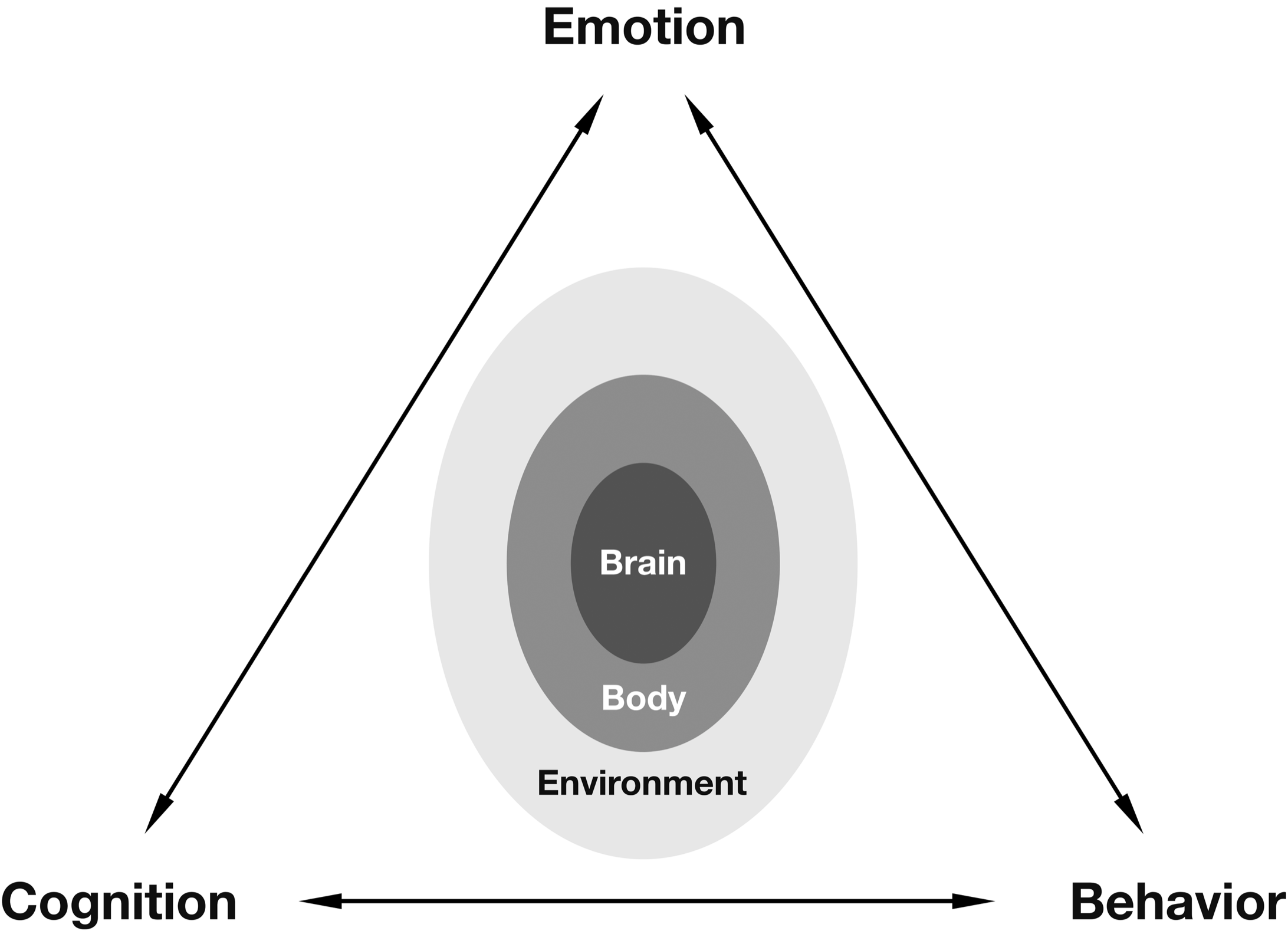
Figure 6-1: Embodied Cognition, Emotion, and Behavior. Cognition, emotion, and behavior depend equally on the brain, the body, and the environment. They influence each other, often simultaneously; but emotion appears to be primary, as it is a strong mediator of both cognition and behavior.
Cognition, emotion, and behavior arise together in the brain and body physiology and can be observed to affect each other in different sequences as they become more recognized as seemingly separate phenomena in the brain. Emotion has a stronger influence on cognition and behavior for two reasons:
- Cognition and behavior are influenced in every moment by the emotional state of the organism.
- It is the unbearability of emotional consequences of cognition and behavior that leads to the brain and the body shutting down, which in turn compromises all three.
Therefore, emotional embodiment work offers the potential for improved regulation and function of cognition, emotion, and behavior, increasing the odds of the person successfully coping with the situation.