Chapter 21. Use method_missing for Flexible Error Handling
My car worries too much. Well it’s not the whole car, it’s just the little embedded computer that lurks behind the door locks. That little processor seems to live in dread that I might someday accidentally leave my car unlocked. Thus, it devotes its whole being to making sure that no door stays unlocked for too long. I’m usually OK if I unlock the car and jump right in. But woe to me if I unlock the car and get a phone call. The time it takes to look at my cell phone to see who’s calling is apparently too long by the exacting standards of Toyota, and the doors relock. They’ll also lock in the time it takes to throw some groceries into the trunk. Or to kiss my wife goodbye. There have even been one or two occasions when the doors have locked on me a second time, in the interval it took for the initial rage to dissipate.
This kind of problem is not confined to cars. Whenever someone builds a system to handle an error condition there is always the chance that they will get it just a little wrong. You certainly see it in all kinds of software systems. People make mistakes often enough that it’s useful to build software that helps deal with those mistakes. The problem is that sometimes the mitigating behavior is not quite right and you can’t change it. Ideally, a good error-handing system will have some default behavior, but will also let you vary that behavior if you need to.
It’s in that spirit that we’re going to spend this chapter looking at method_missing, a feature of Ruby that allows you to handle a particular error condition: Someone has called a method that does not in fact exist. We will see how you can use method_missing to customize the way your code deals with this class of errors. We will also spend some time looking at method_missing’s close cousin, const_missing, and see how we can use it to increase the flexibility of our programs in some surprising ways.
Meeting Those Missing Methods
Imagine that the higher-ups in your company have decided to make the Document class the standard for manipulating text documents. Suddenly your little coding work of art goes from being used by a few departments to being the bytes behind the whole enterprise. For the most part the transition goes well, but you do get a series of bug reports from less-experienced engineers stating that the Document class “doesn’t work” or that it is “utterly broken.” Some of the reports say things like “I tried to get the text out of a Document instance and just got an exception.” You think that the code does work,1 so it seems likely that the cause of the trouble is pilot error, probably by doing something like this:

You think this is what’s going on, but how can you be sure?
One way to find out lies in the details of how Ruby calls a method, and, in particular, what it does when the method it is trying to call is not actually there. Take the previous example where the code tries to call a nonexistent text method on a Document instance. Initially, Ruby will look for the text method in the Document class and, failing to find it there, it will look in the superclass for text, and on up the line. If Ruby finds the method anywhere in the inheritance tree, then that’s the method that gets called.
The real question is, what happens if, as with the phantom text, there just is no such method? The quick answer is that you get an exception. The not-so-quick answer is more interesting: When Ruby fails to find a method, it turns around and calls a second method. This second call, to a method with the somewhat odd name of method_missing, is what eventually generates the exception: It’s the default implementation of method_missing, found in the Object class2 that raises the NameError exception.
The upshot of all of this is that you don’t have to accept this default error-handing behavior. You are free to override method_missing in any of your classes and handle the case of the missing method yourself:
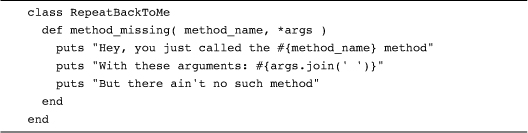
As you can see from this code, method_missing gets passed the name of the original method that was called along with the augments it was called with. If you make an instance of RepeatBackToMe and call some nonexistent methods on the instance, like this:

Then method_missing will eventually fire and give you its cheerful summary of what just happened:

Handling Document Errors
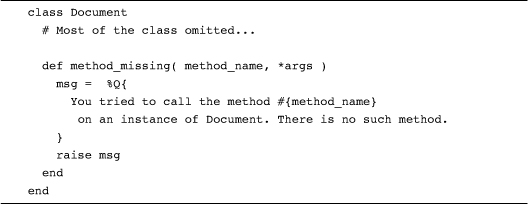
The method_missing method is tailor-made to help with the kind of problems you are having with your new Document users. At the very least, you can give them a customized message if they call a bad method:
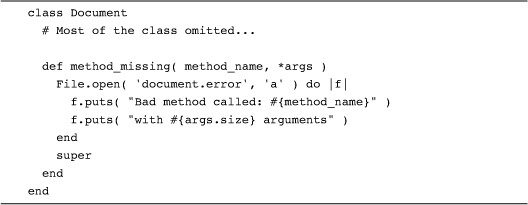
Alternatively, you could return the same old error message, but quietly log the details of the mishap for later analysis:
You might even apply a little of that Ruby style programming customer service and try to help your user figure out which method he or she really meant:
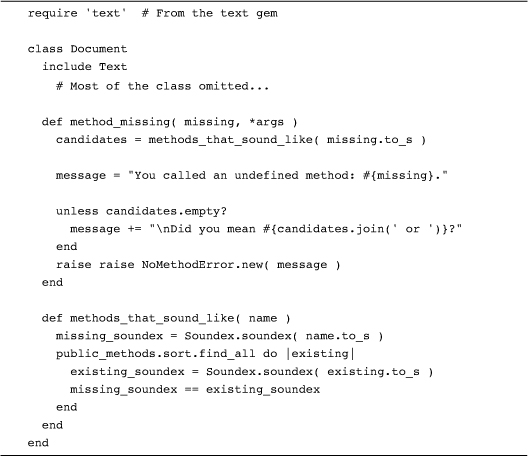
This last method_missing implementation tries to figure out which method the user actually intended, based on the theory that the name of the method the user called is similar to the name of the method that the user meant to call. The code tries to guess the correct method by using the Soundex module (from the text gem) to compute a soundex code. The idea behind soundex is that similar-sounding words tend to generate the same soundex code. Thus, if you mistakenly call document.contnt you will get:

Coping with Constants
Methods are not, of course, the only things that can go missing in a Ruby program. Sometimes coders also misplace constants. In the same way that Ruby provides method_missing to cope with calls to nonexistent methods, it also gives you const_missing to deal with AWOL constants.
As you might guess, const_missing works a lot like method_missing: It gets called whenever Ruby detects a reference to an undefined constant. There are a couple of differences between the two _missing methods, one obvious and one more subtle. The obvious difference is that const_missing takes only a single argument, a symbol containing the name of the missing constant. References to constants, unlike method calls, do not have arguments.
The less obvious difference is that const_missing needs to be a class method:
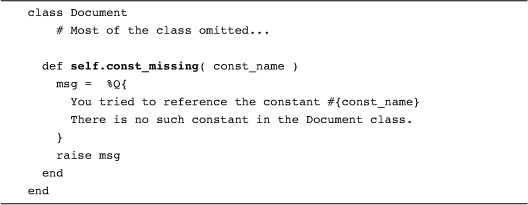
Like our method_missing examples, this example presses const_missing into service to help somewhat shaky Document users.
In the Wild
The best example of applying method_missing to improve error handling is probably the Rails whiny nil facility. The idea behind whiny nils is to help journeyman Rails developers cope with the inevitable situation where they think they have an instance of some object, perhaps an array or an ActiveRecord model, but what they actually have is nil. For example, your Rails application might go looking for a certain Author record in the database:

Unfortunately, Bilbo is a fictional character, not a real author, so book_author ends up being nil. Sadly, your code might not notice the nil and try to save the nonexistent author:
This, inevitably, is going to lead to something painful. The Rails whiny nil feature takes some of the sting out by catching the bad call with a method_missing implementation.3 Like our Document method_missing, the Rails version of method_missing raises a NoMethodError with a customized message:
#<NoMethodError: You have a nil object when you didn't expect it!
Rails puts a cool spin on all of this by comparing the missing method name with the names of the methods supported by arrays and ActiveRecord model classes. If it finds a match, Rails will add a helpful suggestion to the exception it throws:

Similarly, Rake uses const_missing to provide helpful warnings about deprecated names. It seems that earlier versions of Rake defined the core Rake classes at the top level, without any encapsulating modules. In those bygone days the class of a Rake task was simply Task, with no module. Somewhere along the way, however, the Rake classes were all enclosed in the Rake module, so Task morphed into Rake::Task. But what to do about all of those Rakefiles out there that still referred to plain old Task? You pull out const_missing, that’s what:
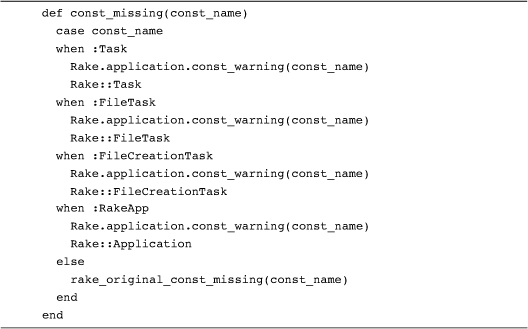
This clever bit of code catches the references to those old, naked class names and returns the correct class, printing out a helpful warning along the way.
Perhaps the most spectacular use of const_missing lies in the way that Rails uses it to load Ruby code as needed. Your ActiveRecord model classes are, for example, all loaded on an as-needed basis, driven by const_missing. The basic idea is to include a const_missing method that figures out what file to require from the name of the missing class, loads that file, and then returns the newly loaded class, something like this:
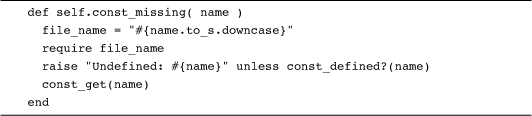
Once you have this const_missing method defined in your class (or some superclass of your class), any reference to the missing constant Wizard will trigger a require 'wizard'.4
Staying Out of Trouble
There are a few things to remember about method_missing- and const_missing-based error handling. First, you don’t want to use it unless you really need it. The garden-variety Ruby error handling will suffice for about 99.9% of all of your misspelled or misplaced methods, and there really is no reason to pepper your classes with method_missing implementations unless, as in our little tale of “the Document class is broken” woe, you really need to. Save the fancy method_missing for those cases where you really do need to do something fancy with the error.
Second, keep in mind that the penalty for screwing up in method_missing and const_missing can be pretty high. Think about it: Ruby executes method_missing any time there is a method call that it can’t locate. Be very, very careful that you don’t inadvertently call a nonexistent method inside your method_missing method. If you do, Ruby will repeat the whole method_missing kerfuffle, eventually arriving back at the method_missing method—which is likely to reach out again for the same nonexistent method, and off you are onto an all-expenses-paid trip to infinite recursion land. If you value your programs, treat your method_missing and const_missing code like anything else that you write. It ain’t done until you’ve written the tests. Only more so.
Wrapping Up
In this chapter we looked at how Ruby deals with references to things that don’t actually exist. We’ve seen that Ruby will call method_missing if you try to call a method that doesn’t actually exist and const_missing if you reference a constant that exists only in your imagination. We saw how you can use method_missing and const_missing to improve the error handling in your code and even how you can use const_missing as a mechanism for auto-loading code.
Although error handling is the most obvious use for method_missing, it is certainly not the only use. In fact, error handling accounts for only a very small fraction of method_missing use in the Ruby code base. The other, more common uses of method_missing are where we now turn our attention.