Chapter 14. Use Class Instance Variables
In the last chapter we saw how you can add methods to your classes, methods that concern themselves with the issues that affect a class as a whole. But wherever you have code, you’re going to want to have data, which raises the question of where to store your class-level data. In this chapter we will look at the two alternatives that Ruby gives us for storing class-level data, the class variable, and the class instance variable.
We are going to start by looking at class variables, those Ruby things that start with @@ and seem to be the easy answer to storing your class-related information. Sadly, we will discover that class variables behave in some unfortunate ways, making them less of a solution and more of a problem. For a real solution to the problem of class-level data we will turn to a class instance variable, a slightly less obvious but much more practical solution.
A Quick Review of Class Variables
Imagine that we decide that our Document class needs some defaults.1 We want to be able to set a default paper size, either the U.S. letter-size paper that is popular in the United States or the similar A4 size that is in vogue almost everywhere else. Since any given user will consistently use either U.S. letter or A4, we want to be able to set the paper size at the Document class level and have any document created from then on default to using that paper size. So how do you store information associated with a Ruby class?
The obvious answer is to use a class variable. Class variables start with two @’s instead of one and are associated with a class instead of an ordinary instance. So here is Document enhanced to use class variables to track its default paper size:
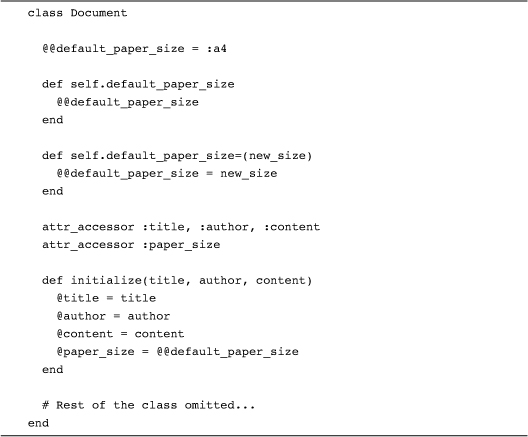
Our new document class starts out by setting the class variable @@default_paper_size to :a4. Since class variables are not visible to the outside world, we also supply a pair of accessor methods. A nice thing about class variables is that they are visible to instances of the class, so inside the initialize method we can pick up the value of @@default_paper_size as the paper size for the new document. On the surface, the class variable seems like an ideal solution to our problem. But all is definitely not well.
Wandering Variables
To understand the problem with class variables, we need to look at how they are resolved. As the name suggests, a class variable is one that is associated with a class. But which class? Therein lies a tale: When you say @@default_paper_size = :a4, Ruby needs to figure out which class will provide the home for the @@default_paper_size variable. Ruby starts by looking at the current class. Does the current class already have an @@default_paper_size class variable? If it does, then the search is over and the @@default_paper_size on the current class becomes :a4.
Here’s where the story gets interesting: If the class variable is not defined in the current class, Ruby will go looking up the inheritance tree for it. So if there is no @@default_paper_size in the current class, Ruby will look for one in the superclass and then the super superclass, until it either finds a @@default_paper_size defined on one of those classes or runs out of classes. If Ruby does find @@default_paper_size somewhere in the inheritance tree, that’s the one that gets set. If Ruby runs out of classes without finding @@default_paper_size, then it will create a new class variable in the current class. Looking up the value of a class variable works pretty much the same way. Ruby starts with the current class and looks up the inheritance tree; it either finds the variable or runs out of classes and throws a NameError exception.
Superficially, this sounds very object oriented and reasonable. The problem is that this method for resolving class variables means they have a tendency to wander from class to class. To see what I mean, let’s play out a scenario very similar to our earlier paper size example, but with a very different—and unpleasant—outcome. Imagine your Document class has become so popular that a number of groups are building systems that use it. In particular, one group is building an application that helps people write resumes.
Since resumes are a very specific kind of Document, the resume group decides they need their own Document subclass:
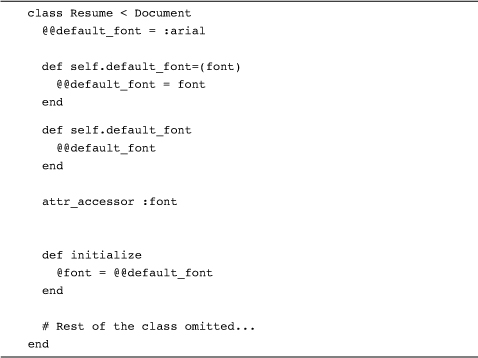
The key feature of the resume class is that it defines a default font as a class variable, along with class methods to set and get the default font. Thinking about how class variables work, we know that when @@default_font = :arial gets run, Ruby will look at the Resume class, and then at Document, and right on up the inheritance tree. Finding no @@default_font defined anywhere, Ruby will set @@default_font on the Resume class. All very reasonable.
Now imagine that there is a second group out there, one that is intent on inflicting yet another PowerPoint or KeyNote clone on the world. They too build a subclass of Document, and, since even mundane minds frequently think alike, they also have a default font class variable, although they pick a different font:
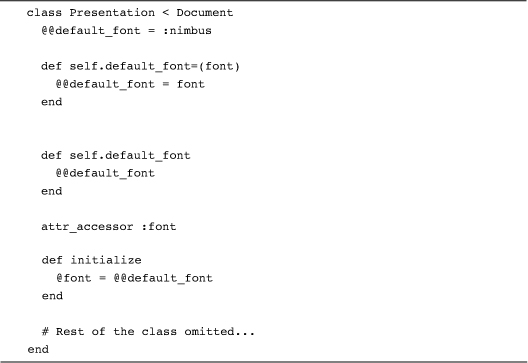
Again, no problem. When Ruby is confronted with @@default_font = :nimbus, it will look at the Presentation class (nope), and then at Document (no again), and so on, and eventually decide to attach @@default_font to the Presentation class. Since there are two @@default_fonts, one on the Resume class and one on the Presentation class, the two classes can live side by side in the same application with no problem.
Now for the punch line: Ignorant of the goings on in Resume and Presentation, you decide to add a @@default_font class variable to your Document class:
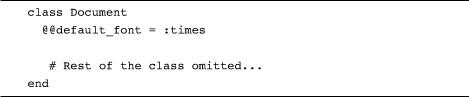
The result of this simple change is that all Hell breaks loose. Here’s how: The Document class needs to be loaded before Resume and Presentation—it’s the superclass after all. This means the Document class @@default_font will get set first, which means that whenever either of the subclasses goes looking for @@default_font, it will find the one in Document. Remember, Ruby looks up the inheritance tree first. So your seemingly low-impact change to the Document class has changed the behavior of both subclasses. Instead of two separate default font variables, one attached to Presentation and the other to Resume, there is now only one variable, one that lives up in the Document class.
To see how nasty that is, consider that this:

Sets the default font for all documents to the Presentation class’s favorite font, :nimbus. But if you change the order of the require statements:

Then the default font for all documents gets set to :arial.
If this “It’s my variable!” versus “No! It’s mine!” argument sounds familiar, it should. This is exactly the kind of situation we run into with global variables—and is also the reason why coders got out of the global variable business a long time ago. The real problem with class variables is that they are not so much variables attached to a specific class as they are global variables with a slightly restricted realm. In fact, Rubyist David Black calls class variables “vertical global variables,” vertical in that they are restricted to a single inheritance tree and global in that they are very visible within that tree.
Getting Control of the Data in Your Class
Clearly, we need an alternative way of associating some data with a class, a technique that is more controllable than class variables. The more controllable alternative to the class variable is the class instance variable. The good news is that class instance variables are not really a new thing. They are in fact garden-variety, single @ instance variables that happen to find themselves attached to a class object.
To see how this might work, recall from the last chapter that inside a class method, self is always the class. Now ask yourself this: What would happen if you set an ordinary instance variable inside a class method? Perhaps like this:
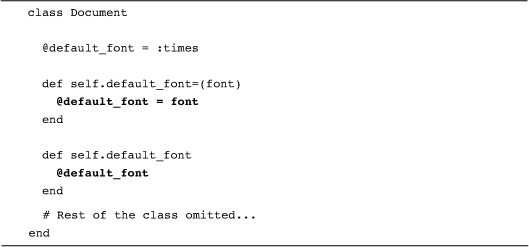
The answer is that since @default_font = font always sets an instance variable on self, the default_font= method above will set the @default_font instance variable on the Document object. This means that armed with the code above we can now set our document-wide default font:
Document.default_font = :arial
To get at the Document default font, all you need to do is call the right class method, which is exactly what the Document initialize method does:

Class instance variables are a very Ruby solution to the problem holding onto classwide values. There is no extra syntax and no elaborate special case rules: @default_font is simply an instance variable on an object. The only remotely interesting thing here is that the object happens to be a class.
Class Instance Variables and Subclasses
To paraphrase my mother, it’s all fun and games until someone starts writing subclasses. Recall that we didn’t have any problems with the @@ class variables until we started messing with subclasses. That was when the class variables started wandering from class to class. Do class instance variables fare any better when the subclasses start flying?
The short answer is that class instance variables do just fine with subclasses. To see how, imagine that we have our Presentation subclass and, Presentation has its own idea of a default font:
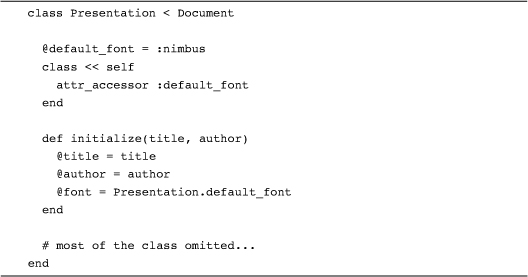
What this code does is create a second class instance variable, this time attached to the Presentation class. The Presentation @default_font is completely separate from the Document @default_font, and as long as you are careful with which one you are talking about, Presentation.default_font or Document.default_font, life will be good.
Adding Some Convenience to Your Class Instance Variables
Since class instance variables are just plain old instance variables that happen to be hanging off a class object, we can use all our Ruby trickery to make living with them more pleasant. For example, there is no reason for us to be writing those boring default_font getter and setter methods given that Ruby supplies us with the nice attr_accessor for just such occasions. So how do you use attr_accessor to get at a class instance variable? After all, if you just do this:

You end up being able to get and set an instance variable called default_font. Fortunately, we already have the answer. Remember that class methods are just singleton methods on a class object. The trick to defining class-level attributes is to make self be the Document singleton class first:
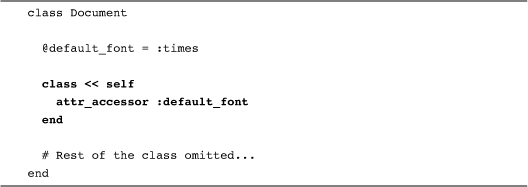
Run this code and you will end up with a Document class that has a couple of class methods, one to get the default font and the other to set it.
In the Wild
Examples of class instance variables are easy to find in the Ruby code base. For example, most Rails programmers know how to set up callbacks, methods that get called at particular moments in the life of their ActiveRecord objects. Here, for example, is a class that has arranged for the handle_after_save method to get called just after a Person instance is saved into the database:
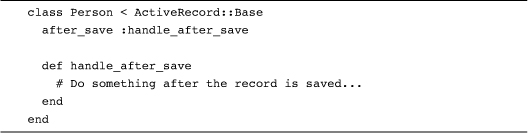
Clearly, the fact that we do want handle_after_save called after each record save is an attribute of the Person class, and that is where ActiveRecord saves this information. Poke around in ActiveRecord and you will find a class instance variable called @after_save_callbacks. Nor is @after_save_callbacks lonely. Dig into ActiveRecord a bit more and you will find a number of similar class instance variables with names like @after_update_callbacks and @after_validation_callbacks.
Despite the amount of space I’ve used in this chapter to cast aspersions on class variables, people do use them successfully. For example, the URI class that comes with your Ruby install and enables you to make sense of things like “http://russolsen.com” and “sendto:russ@russolsen.com” uses an @@ variable quite happily. When you say something like this:
my_uri = URI.parse('http://www.russolsen.com')
The parse method will consult @@schemes, which is a hash that maps each URI scheme—'http' in this case—to the class that knows how to parse URIs with that scheme. The interesting part of @@schemes is the way it gets filled in. Initially, the basic URI code simply sets @@schemes to an empty hash:
@@schemes = {}
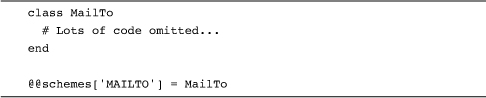
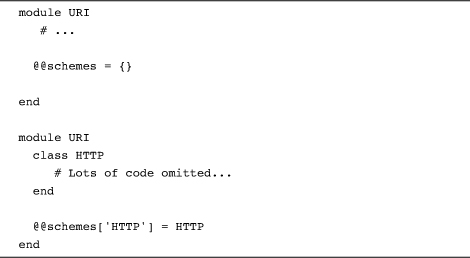
Then the classes that know how to parse the different flavors of URIs get loaded. The last thing each of these classes does is add itself to the master list of schemes, so that in uri/http.rb you will find:

While in uri/sendto.rb you will see:
One other interesting thing about URI is that @@schemes is not actually a class variable—it is in fact a module variable. Ruby modules are a bit like stunted classes, but in the same way that you can hang class variables on classes, you can stick module variables on modules. So if we pull back the camera on the URI code, we see:
We will be seeing a lot more of modules in Chapters 15 and 16.
Staying Out of Trouble
The URI code avoids ending up in class variable Hell by setting @@schemes variable very early on, before any of the individual scheme-parsing code gets loaded. This ensures that there is a single @@schemes variable and that it is properly attached to the URI module where it belongs. If you must use class variables, then this is a good strategy. A better strategy is to reread the title of this chapter and stick to class instance variables.
Wrapping Up
One of the joys of using Ruby is how well the language adheres to the principal of least surprise: If you are wondering how to do something, there’s a good chance that your first guess will be correct. Still no language is perfect, and Ruby does harbor a few unfortunate2 design decisions. The class variable would get my vote as the most unfortunate Ruby feature of all: Class variables seem designed to trip up newcomers to Ruby and even manage to surprise experienced Ruby developers on occasion. The good news is that class instance variables are just waiting there to fill in.