Appendix
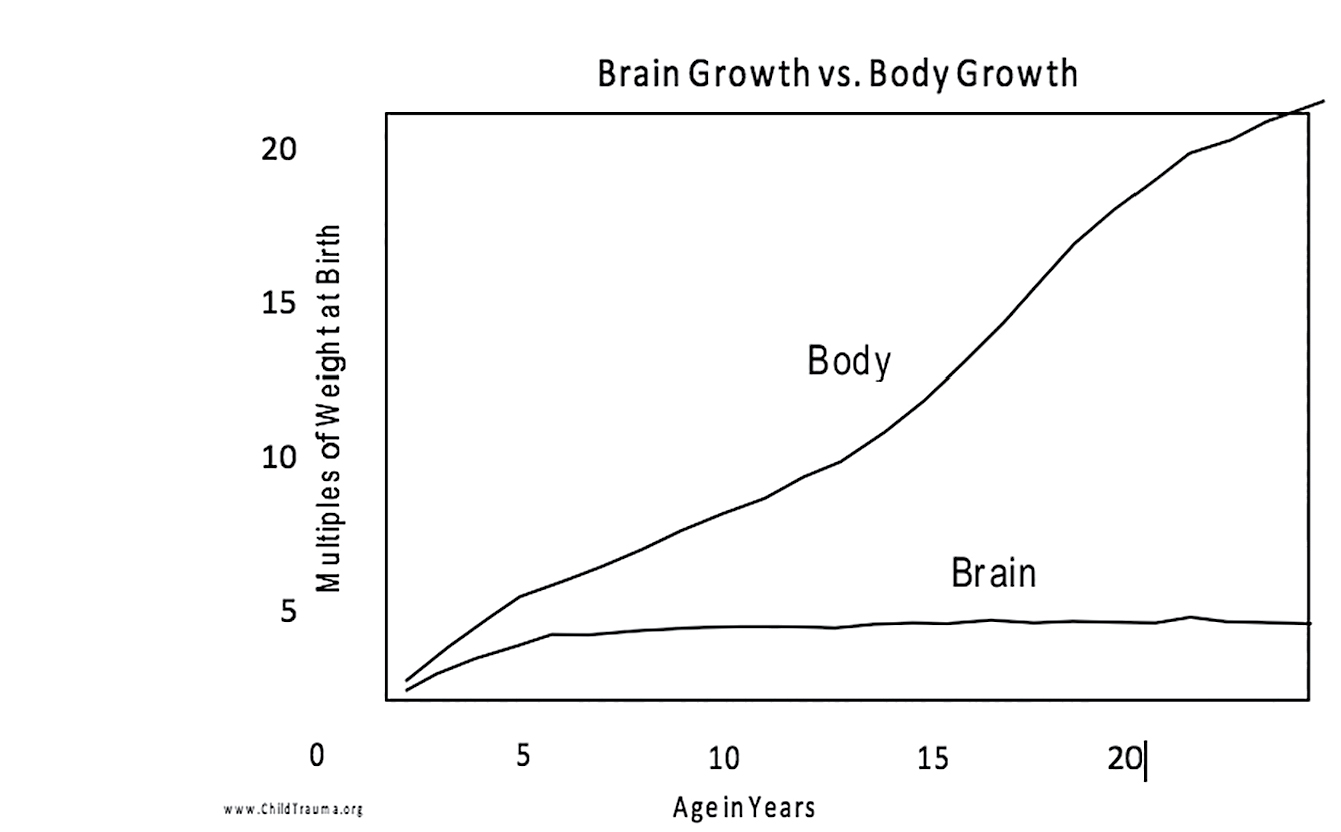
THE PHYSICAL GROWTH OF THE human body increases in a roughly linear manner from birth through adolescence. In contrast, the brain’s physical growth follows a different pattern. The most rapid rate of growth takes place in utero, and from birth to age four the brain grows explosively. The brain of the four-year-old is 90 percent adult size! A majority of the physical growth of the brain’s key neural networks takes place during this time. It is a time of great malleability and vulnerability as experiences are actively shaping the organizing brain. This is a time of great opportunity for the developing child: safe, predictable, nurturing and repetitive experiences can help express a full range of genetic potentials. Unfortunately, however, it is also when the organizing brain is most vulnerable to the destructive impact of threat, neglect and trauma.
However, this early pattern of brain growth does not mean that development or organization of the brain is finished. Indeed, important neurodevelopmental processes continue to take place throughout childhood and adolescence as the brain’s systems become more complex. Major cortical restructuring and myelination continue into early adult life.
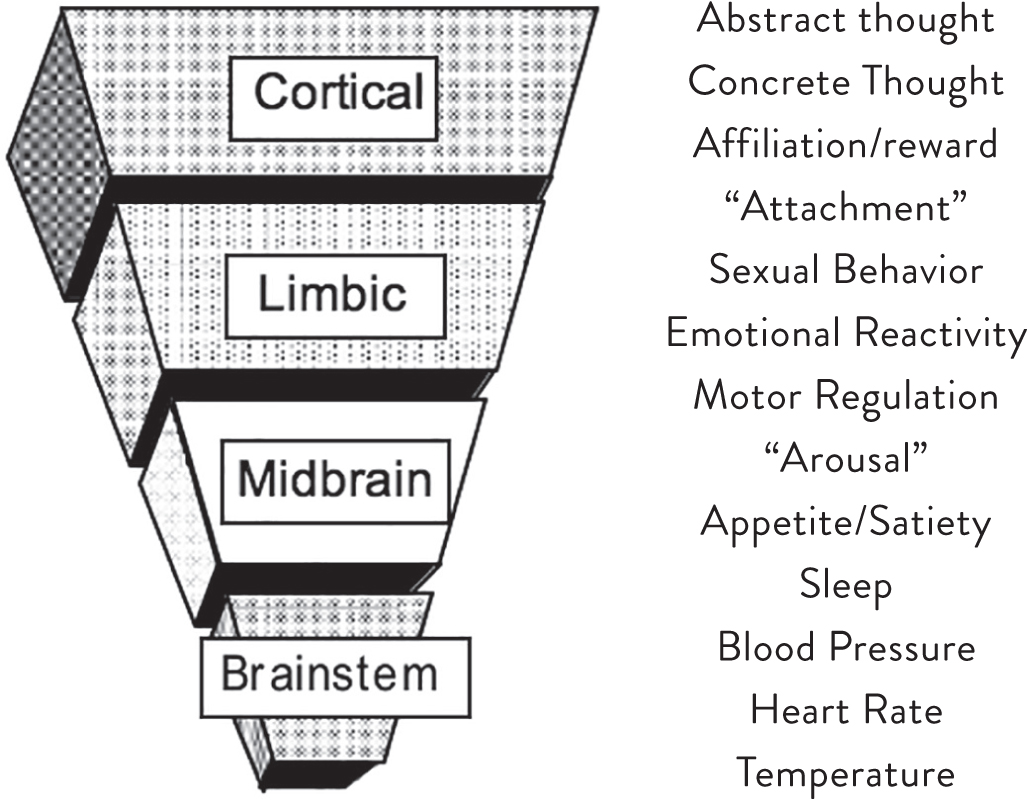
THE HUMAN BRAIN DEVELOPS sequentially in roughly the same order in which its regions evolved. The most primitive, central areas, starting with the brainstem, develop first. As a child grows, each successive brain region (moving out from the center toward the cortex), in turn, undergoes important changes and growth. But in order to develop properly each area requires appropriately timed, patterned, repetitive experiences. The neurosequential approach to helping traumatized and maltreated children first examines which regions and functions are underdeveloped or poorly functioning and then works to provide the missing stimulation to help the brain resume a more normal development.
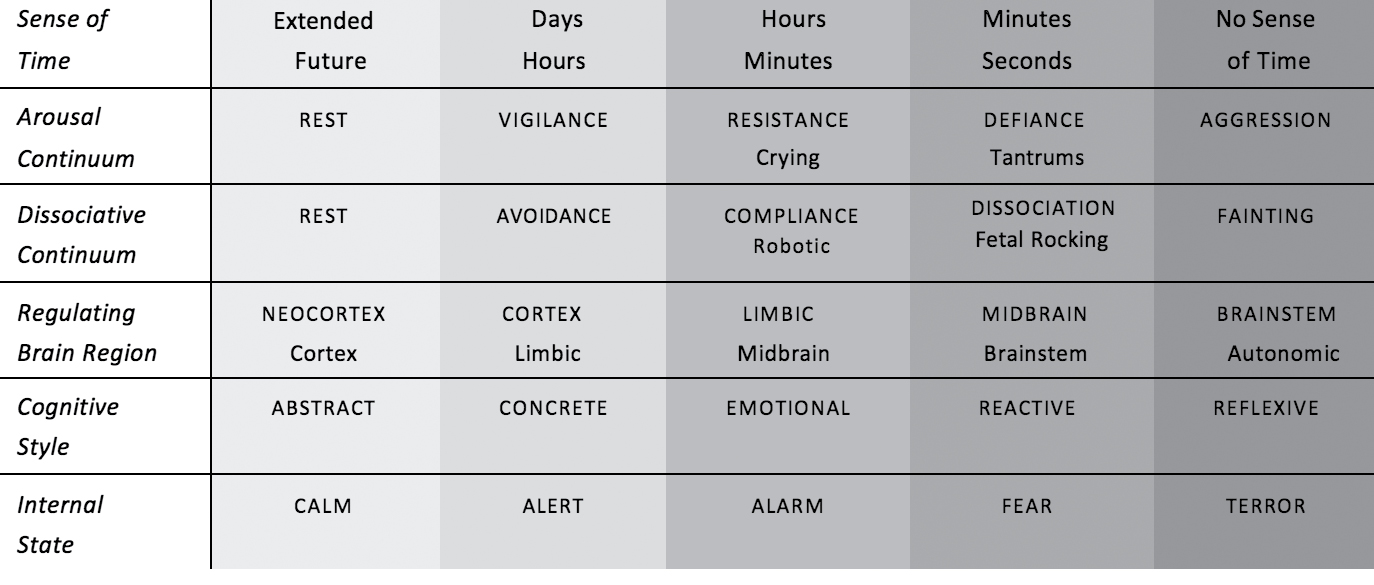
PEOPLE PROCESS, STORE, AND RETRIEVE information and then respond to the world in a manner that depends upon their current physiological state (in other words, their response is “state-dependent”). If a child has been exposed to extreme or pervasive threat or trauma, his stress system may become sensitized and he may respond to ordinary experiences as though they are threatening. Depending on his individual response to stress, he may move primarily along the dissociative or the arousal continuum, but either change will reduce his ability to learn cognitive information, such as schoolwork.
As a result his brain may be in a very different state than that of other children around him in a classroom. As the chart illustrates, a calm child will process information very differently from one who is in an “alarmed” state, whether he tends toward a dissociative or a hyperaroused response. Even if two children have identical IQs, the calmer child can more readily focus on the words of the teacher and, using her neocortex, engage in abstract thought and learning.
In contrast, the child who is alarmed will be less efficient at processing and storing the verbal information the teacher is providing. Subcortical and limbic areas will dominate this child’s cognition. These areas focus on nonverbal information, such as the teacher’s facial expressions, hand gestures, and perceived mood. Further, because the brain learns in a “use-dependent” fashion, this child will already have experienced more selective development of her nonverbal cognitive capacities. The child who has been traumatized or maltreated has learned that nonverbal information is more important than verbal—for example, “When Daddy smells like beer and walks funny, I know he will hurt Mommy.”
As a child moves along the continuum of arousal, the part of the brain in control of his functioning shifts; the more distressed or threatened he is, the more primitive the behaviors and responses. During this state-related shift in cognition the child’s sense of time is altered and the range of future planning is foreshortened. The threatened child is not thinking (nor should she think) about months from now: she is focused on the current threat.
This has profound implications for understanding the thoughts, reactions, and behavior of traumatized children. For these youth immediate reward is most reinforcing; delayed gratification is almost impossible. They are quite literally unable to consider the potential consequences of their behavior because of the physical arousal state of their brains.
As a result considered reflection about behavior—including violent behavior—is impossible for the child in an alarm state. Cut adrift from the internal regulating capabilities of the cortex, the brainstem acts reflexively, impulsively, and often aggressively to any perceived threat.
Due to this state-dependent processing, maltreated children may express a host of puzzling and seemingly insignificant “sensitivities.” Eye contact for too long may be perceived as a life-threatening signal. A friendly touch to the shoulder may remind one child of sexual abuse by a stepfather. A well-intended, gentle tease to one may be a humiliating cut to another, similar to the endless sarcastic and degrading emotional abuse he experiences at home. A request to solve a problem on the board may terrify the girl living in a home where she can never do anything well enough. A slightly raised voice may feel like a shout to the little boy living in a violent home. To help traumatized children these responses must be taken into account and their stress response systems calmed so that they can feel safe enough to rely upon their higher brain functions and reduce the amount of time they spend higher on the arousal continuum.
Adapted from: Perry, B. D. “Fear and learning: trauma-related factors in education.” New Directions for Adult and Continuing Education, 110 (2006, Summer): 21–27.
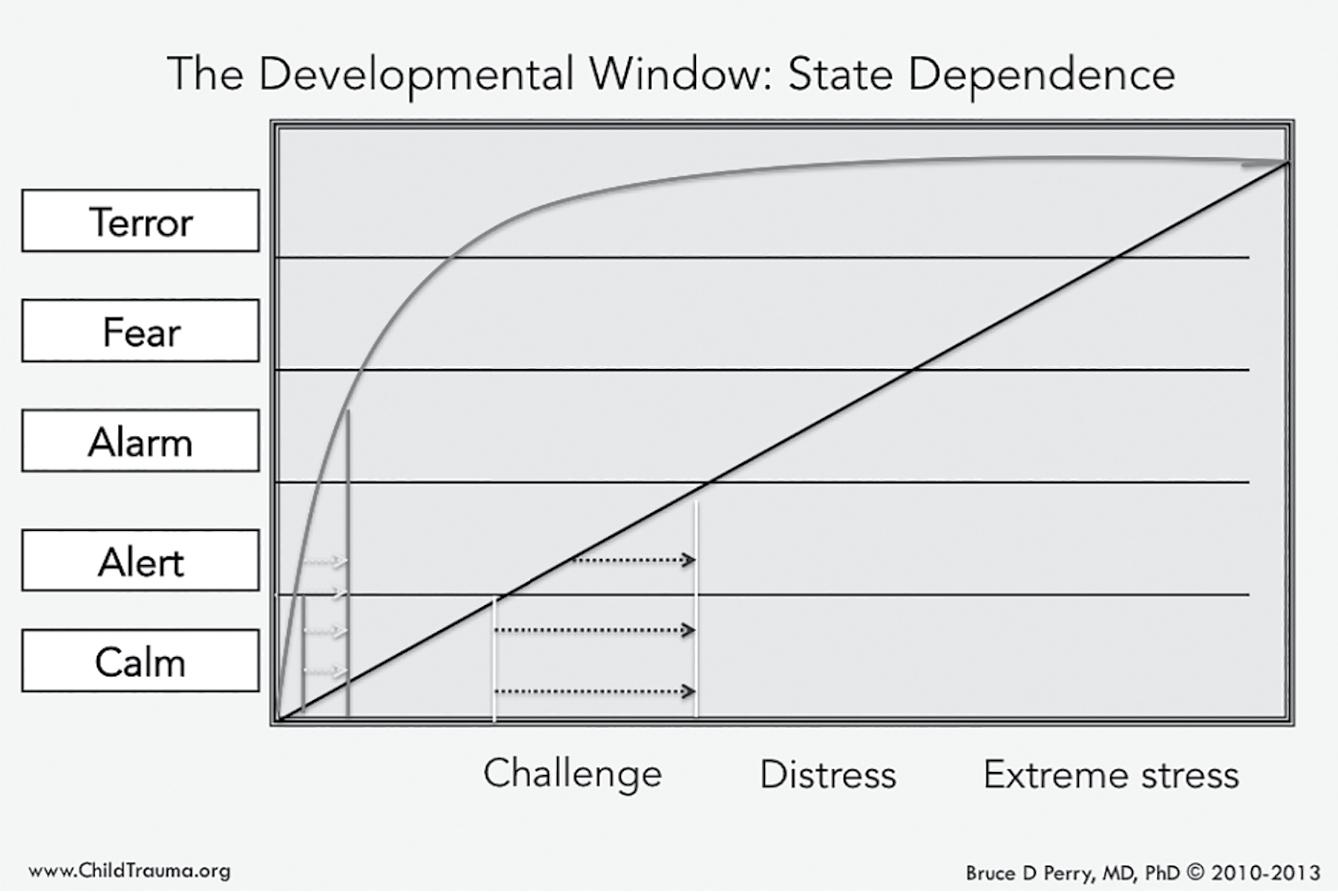
THIS FIGURE ILLUSTRATES TWO stress-reactivity curves; the straight line is the reactivity curve of a “neurotypical” individual. This shows the linear relationship between the level of challenge, stress or threat and the appropriate proportional shift in internal state in the brain required to adapt and cope with the stressor. With minor stressors, there are minor shifts in the internal state—and with major stressors, a larger shift in internal state occurs. The top curved line illustrates the altered, sensitized stress-reactivity curve caused by patterns of extreme, unpredictable or prolonged stress activation. In this case, there is a significant over-activity at baseline and an overreaction even in the face of relatively minor challenges.
The major neural networks involved in the heterogeneous stress responses (see Chapters 2 and 3) can become ‘sensitized’ with patterns of activation that are unpredictable, extreme and prolonged. When this occurs, the major adaptive style used by the infant, toddler or child—either the hyperarousal (activate) or dissociation (shutdown) or, in some cases, both styles—becomes ‘sensitized’—over active and overly reactive (see top curve).
The results are profoundly disruptive for subsequent development, as these over-reactions to novelty and stress will inhibit and distort the accurate processing of new experiences—even if the new experiences are predictable, consistent, nurturing, and enriching.
A major consequence of this sensitization is that it narrows the ‘developmental’ window (see hatched areas). Simply stated, in order to develop, learn or heal (i.e., make new associations in neural networks), the individual has to be exposed to novel experiences that, in turn, create novel patterns of neural activity.
For optimal development (or learning or therapeutic change), this novelty has to have a “Goldilocks” effect—enough novelty to challenge and expand the existing comfort zone (the set of previously acquired and mastered capabilities) but not so much novelty (or demand) that the capacity of the individual to process and assimilate is overwhelmed.
When someone has sensitized stress-response system(s), exposure to any novelty or unpredictability can rapidly move the person from active-alert to a state of fear, thereby interfering with the process of learning. The more sensitized the stress response, the narrower this therapeutic or learning “window” is, the smaller the dose of novelty that can be tolerated, and the less likely it will be that the child can benefit from typical developmental experiences. The end result is a profound frustration in parents and educators, resulting from the seemingly endless number of repetitions required for a child to master a concept or learn a behavior.
The key is to somehow shift this overly-reactive stress response either temporarily, by using some regulatory activity or, ideally, chronically by providing regular opportunities to experience controllable, predicable and moderate (for the individual) activations of their stress response systems.
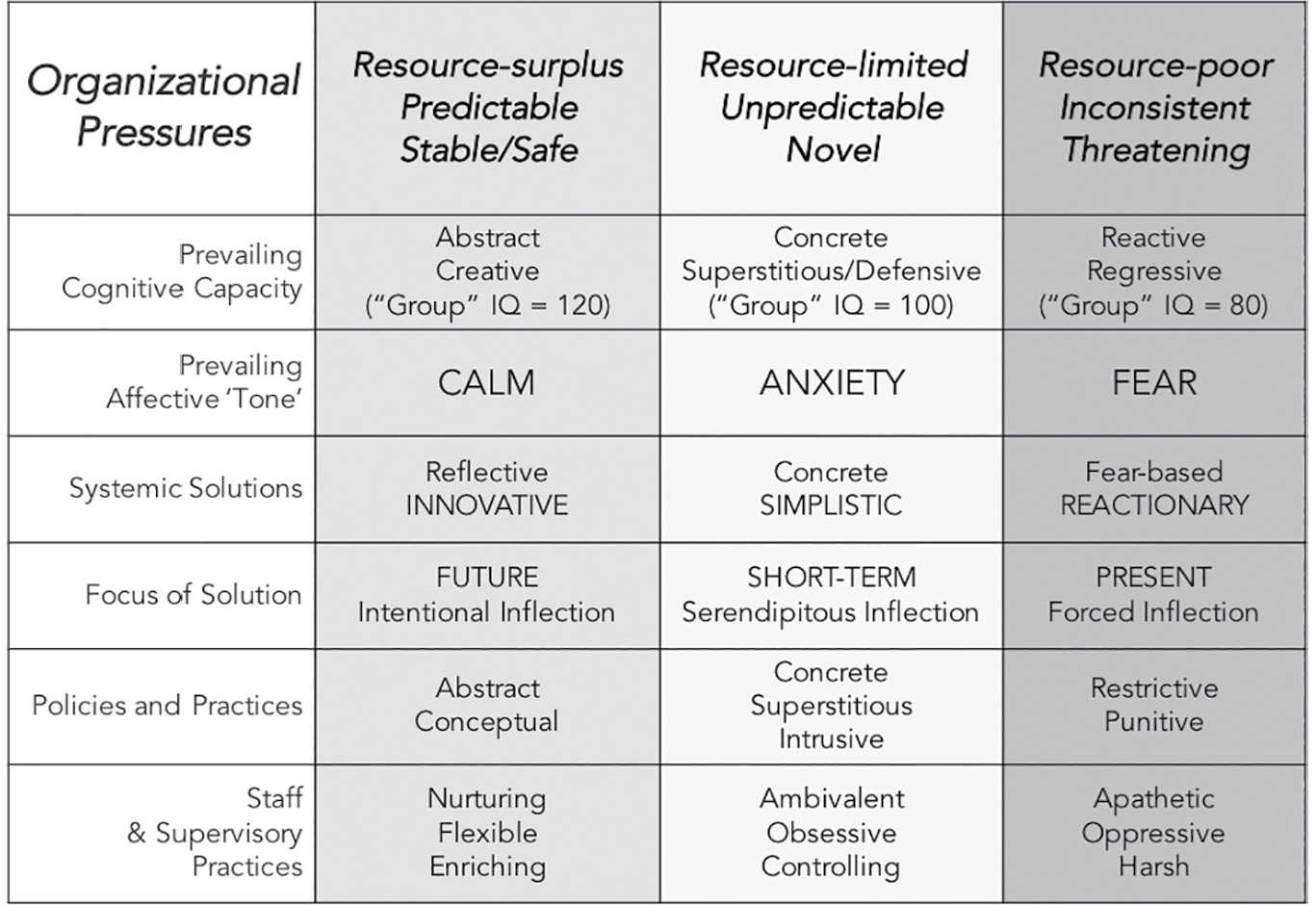
JUST AS THREAT ALTERS THE functioning of the individual (see Appendix, Table 1), it also changes functioning in an organization. Organizations—and the leaders in the organization who often set the emotional or affective “tone” within the organization—can experience a range of challenges. The cognitive capacity (Group IQ) of the group shifts as the affective tone in the organization shifts.
When there are no external threats and resources are plentiful and predictable (Column 1), individuals within the group have the luxury of thinking in abstract ways to solve problems (e.g., Bell Labs from 1940 to 1965). This is a very rare condition for an entire organization; some organizations are able to “protect” a small group (e.g. an R & D division) within the organization to do their “abstract” and creative thinking but even this is very rare. When it does happen, the innovations and problem-solving focus on the future, changes within the organization are intentional (inflections), and the least powerful members of the organization (e.g., front line case workers) can be treated with flexible, nurturing, and enriching approaches.
When resources become limited and there are economic, environmental, or social threats (Column 2), the organization becomes less capable of complex, abstract problem solving. Any “inflections”—major changes in organizational—direction tend to be serendipitous or accidental. All government systems are usually in this state; they stumble into the future, with a focus on self-preservation. The practices and programs are responsive to the immediate future (e.g., the next funding cycle, the next election cycle) and all aspects of functioning in the group regress. The least powerful are ignored or controlled to minimize any excessive drain on the most powerful.
In the organization under direct threat (Column 3), the focus of all problem solving becomes the moment. Organizational inflections are “forced” (e.g., consent decrees, bankruptcy). The solutions to current problems tend to be reactive and regressive. The more out of control the external situation is, the more controlling, reactive, and oppressive the internally focused actions of this group will become. In each of these situations, the supervisory styles will create employees that will reinforce the organization’s structure: in a safe and abstract-thinking group the staff will be more likely to receive and benefit from enrichment and education, thereby optimizing their potential for creativity, abstraction, and productivity. In contrast, staff in organizations under threat will be more likely to reflect their impulsive, concrete, and reactive supervision—and be so dysregulated that their interactions with clients, students, parents, and children will be incapable of helping any of them regulate. They will be ineffective—and sometimes actually destructive, further creating distress and unpredictability for the very people they are charged to engage, respect, help, and heal.
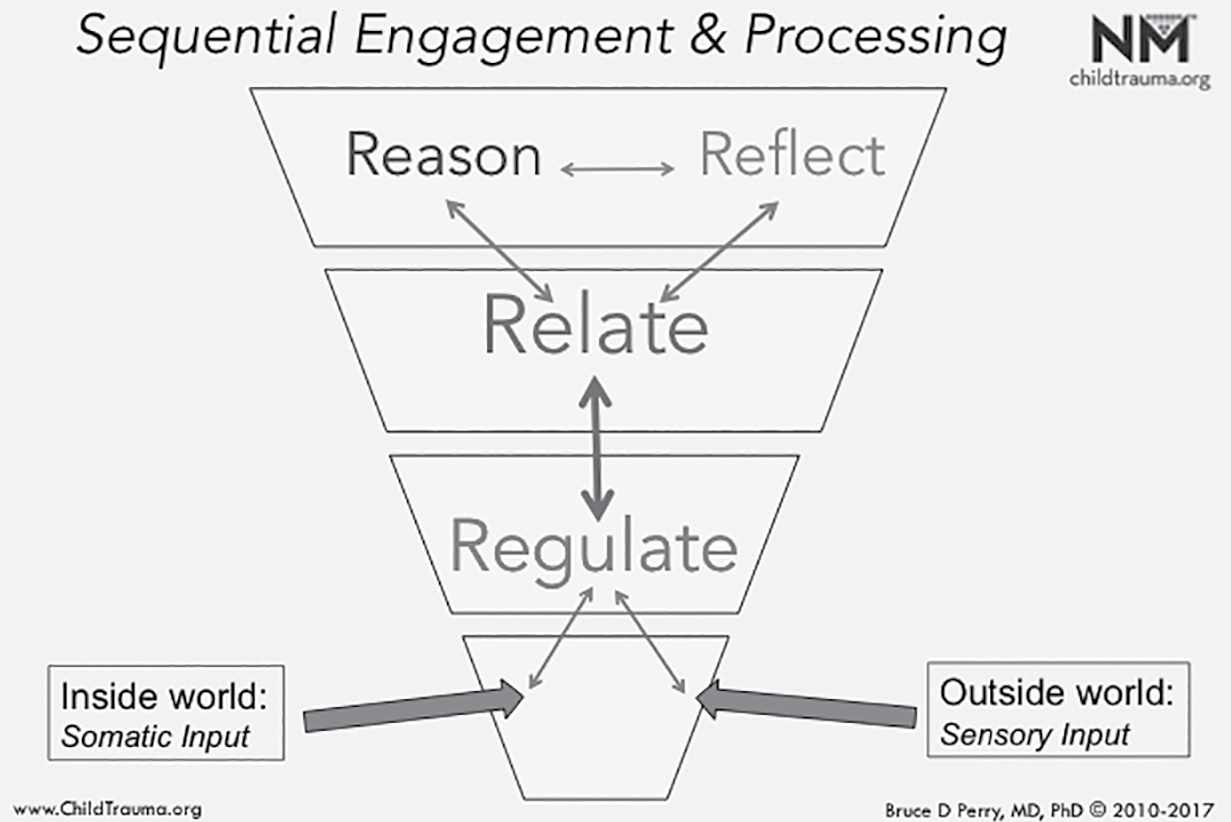
ALL INCOMING SENSORY SIGNALS from the outside world and from our body (the inside world) are first processed in lower areas of the brain. These lower areas of the brain can act on that information and pass it “up” to higher areas of the brain for more complex sorting, integration, and interpretation. If the nature of the incoming neural activity is “familiar” and neutral or familiar and previously categorized as “safe” these lower areas of the brain pass the information up without activating and significant “stress” response. If, however, the incoming information is unfamiliar (novel), or familiar and previously associated with threat, pain, or fear, these lower areas of the brain will activate a stress response—even before the fully integrated and accurately interpreted information can get to the “smart” parts of the brain. This activation will also interfere with the accurate cortical processing by “shutting down” certain areas of the cortex. The result is that the activated stress response will create a host of “state-dependent” shifts in thinking, feeling, and behaving. The sequential nature of processing all sensory experience means that if we want to “get to the cortex” and reason with another person, we must adhere to a sequence of interaction; we and the individual we are interacting with must be regulated enough to connect—and only once there is regulation and connection can we effectively “reason” with them. Connect before you correct; regulate, relate, and then, reason.