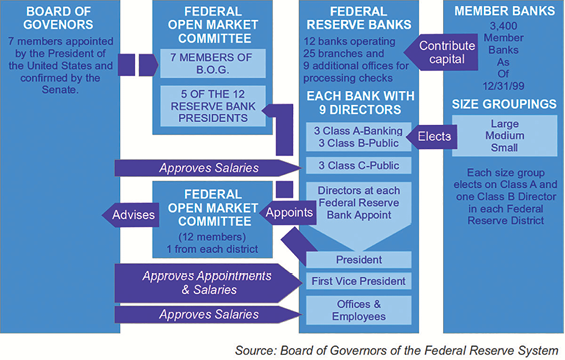
The Federal Reserve is not a single central bank. It is a central banking system. The system is comprised of three main parts: twelve regional Federal Reserve Banks, the Federal Reserve Board, and the Federal Open Market Committee (FOMC). According to Wikipedia:249
The Federal Reserve System is composed of several layers. It is governed by the presidentially appointed Board of Governors or Federal Reserve Board (FRB). Twelve regional Federal Reserve Banks, located in cities throughout the nation, oversee the privately-owned U.S. member banks. Nationally chartered commercial banks are required to hold stock in the Federal Reserve Bank of their region, which entitles them to elect some of their board members. The FOMC sets monetary policy; it consists of all seven members of the Board of Governors and the twelve regional bank presidents, though only five bank presidents vote at any given time: the president of the New York Fed and four others who rotate through one-year terms.
People talk about the ‘big’ Fed and the ‘little’ Feds. When they talk about the ‘big’ Fed, they are usually talking about either the Board of Governors of the Federal Reserve System (‘The Board of Governors’) or the FOMC. The ‘little’ Feds are the twelve regional Federal Reserve Banks.
Big Fed
Board of Governors
According to the St Louis Fed250, the Board of Governors guides the Federal Reserve’s policy actions, and consists of up to seven governors, appointed by the president of the United States and confirmed by the Senate. As of Jun 2018, there are only three governors guiding the Fed251.
Federal Open Market Committee
The FOMC is the body that raises or lowers interest rates. The St Louis Fed describes the committee as:
… the Fed’s chief body for monetary policy. Its voting membership combines the seven members of the Board of Governors, the president of the Federal Reserve Bank of New York, and four other Reserve Bank presidents, who serve one-year terms on a rotating basis with the other Reserve Bank presidents.
According to the Chicago Fed:252
The monetary policy goals of the Federal Reserve are to foster economic conditions that achieve both stable prices and maximum sustainable employment.
What does a stable price mean? The target goal for the FOMC is to set monetary policy to create a 2% per year CPI. 2% seems small but has a significant effect over a lifetime. The maximum stable employment rate is targeted at 95.4% employment, or 4.6% unemployment.
The FOMC oversees and sets policy on open market operations, the principal tool of national monetary policy. The committee meets eight times a year, approximately once every six weeks. As of Jun 2018, out of a maximum of twelve voting members, only eight committee members were appointed253.
Little Feds
The ‘Little Feds’ are the twelve separately incorporated regional Federal Reserve Banks (regional FRBs). They are based in the cities of Boston, New York, Philadelphia, Cleveland, Richmond, Atlanta, Chicago, St. Louis, Minneapolis, Kansas City, Dallas, and San Francisco.
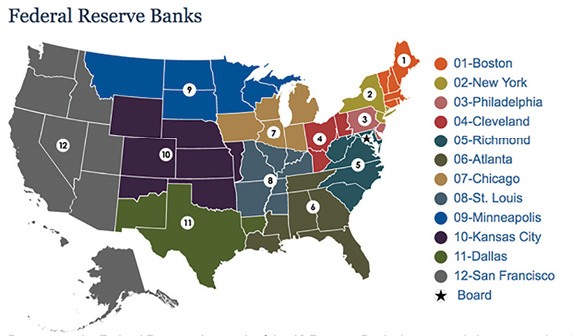
The territories of the Little Feds.254
The regional FRBs are responsible within their territory for supervising and examining state member banks, lending to depository institutions, providing key financial services (e.g., interbank payment systems), and examining certain financial institutions255. They also provide the US Government with a ready source of loans and serve as the safe depository for federal money256.
The regional FRBs are not part of the federal government of the USA, but are set up like private corporations, according to the St Louis Fed257. The shareholders are banks from the private banking sector, who receive a tax-free 6% dividend from the regional FRBs in any year that the regional FRB makes money. In fact, nationally chartered banks must purchase some amount of this stock, with the amount based on their size. It is nice to be a bank and be forced to own the central bank and receive guaranteed dividends risk-free258!
This diagram259 shows how it all fits together today: