11.
Effective Communication: Getting the Message Across
USING EFFECTIVE COMMUNICATION TO CHOOSE THE RIGHT PARTNER
After a few dates with Ethan, Lauren found herself very confused. On their first date, they had gone to a romantic beach bar and spent several hours getting to know each other. At the end of the evening, he said a quick good-bye and disappeared. To her surprise he called again to ask her out, this time to a performance at a waterfront club. They both had a couple of drinks and spent hours dancing together. They even took a stroll along the beach, but again nothing happened, just an abrupt “we’ll talk” when they parted. This pattern repeated itself one more time on their next date. Lauren, who has an anxious attachment style, thought that perhaps Ethan simply wasn’t attracted to her. But then why was he still asking her out? Maybe he just wanted the companionship? She didn’t want to stop seeing him without a bona fide reason, because she really liked him. A close friend encouraged her to stop speculating about the reasons for his behavior and simply ask.
Normally, Lauren wouldn’t have had the courage—she would have been far too afraid of the hurtful response she might get. But she’d reached a point where she was no longer willing to waste precious time on the wrong person. So she did raise the subject with Ethan, tentatively at first, but she found herself speaking very directly as the conversation progressed: “I’m looking for more than something platonic. What is it that you have in mind?” Contrary to her assumption, she learned that he didn’t find her unattractive. He said he really liked her and expressed his desire for finding a partner. But when she went a step further and asked specifically about his “no-touch” policy, he didn’t have an answer and kept beating around the bush. Although she didn’t come out of the conversation with a specific answer as to why he wasn’t interested in physical contact, she did get a clear picture about their future together—there was none!
Lauren gave up thinking of him as a potential partner, but they remained friends. After Ethan confided in her about several other women he was dating who were obviously also becoming frustrated by his puzzling behavior, she finally put two and two together. The mystery around Ethan’s conduct was not so mysterious after all—it became clear that he was having serious doubts about his sexual orientation. Lauren thanked God she’d had the guts to express her concerns early on, saving herself months of false hopes and certain rejection.
Lauren’s story is an excellent example of the importance of effective communication. Expressing your needs and expectations to your partner in a direct, nonaccusatory manner is an incredibly powerful tool. Though it’s used naturally by people with a secure attachment style, it is often counterintuitive for people whose attachment style is anxious or avoidant.
One straightforward conversation with Ethan put an end to all the guesswork and “theories” Lauren had built up in her mind. For Ethan it would have been convenient if Lauren had been willing to simply put up with his behavior indefinitely. He was getting what he wanted—a girlfriend to show off to friends and family (to get them off his back) and time to sort out his sexual orientation. But by expressing her needs, Lauren was able to look out for herself and avoid getting strung along by someone else’s agenda. In this case, attachment style was not the underlying issue, but Lauren had no way of knowing this in advance. If Ethan’s behavior was simply a manifestation of his attachment style, effective communication would have uncovered that as well, and they would have both benefited from discovering early on that their attachment styles were incompatible.
But what would have happened if Lauren had confronted him in this forthright way, causing him great embarrassment, only to discover that his behavior was the result of neither his attachment style nor his sexual orientation but of simple shyness? Well, we know someone who had just such an experience.
Tina’s situation was very similar to Lauren’s. On her third date with Serge, Tina was sitting on the sofa next to him watching a movie and wondering why he wasn’t making a move. She’d also had her share of dead-end relationships and wasn’t willing to waste too much time wondering what Serge’s particular issue might be. So, affecting a coquettish smile, she simply said, “Can I have a kiss?” Though Serge was taken aback for a second and mumbled something under his breath, he collected himself and leaned over to kiss her. That was the last time his shyness was an issue in their relationship, which is still going strong three years later.
In this case, flirtatiously asking for a kiss was an eloquent use of effective communication. Tina expressed her needs, and although there was an awkward moment, her directness gave her relationship with Serge a tremendous push that brought them much closer, not only physically, but also emotionally. Even if Serge had reacted in some other way, and things had worked out differently, it would still have been helpful: People’s response to effective communication is always very telling. It either allows you to avoid getting involved in a dead-end relationship, as in Lauren and Ethan’s case, or it helps bring the relationship to a deeper level, as in Serge and Tina’s case.
Effective communication works on the understanding that we all have very specific needs in relationships, many of which are determined by your attachment style. They aren’t good or bad, they simply are what they are. If you’re anxious, you have a strong need for closeness and have to be reassured at all times that your partner loves and respects you. If you’re avoidant, you need to be able to maintain some distance, either emotional or physical, from your partner and preserve a large degree of separateness. In order to be happy in a relationship, we need to find a way to communicate our attachment needs clearly without resorting to attacks or defensiveness.
WHY USE EFFECTIVE COMMUNICATION?
Effective communication works to achieve two goals:
• To choose the right partner. Effective communication is the quickest, most direct way to determine whether your prospective partner will be able to meet your needs. Your date’s response to effective communication can reveal more in five minutes than you could learn in months of dating without this kind of discourse. If the other person shows a sincere wish to understand your needs and put your well-being first, your future together has promise. If he or she brushes your concerns aside as insignificant, or makes you feel inadequate, foolish, or self-indulgent, you can conclude that this person doesn’t sincerely have your best interests in mind and you are probably incompatible.
• To make sure your needs are met in the relationship, whether it is a brand-new one or one of long standing. By spelling out your needs, you are making it a lot easier for your partner to meet them. He or she doesn’t need to guess whether something is bothering you—or what that something is.
The beauty of effective communication is that it allows you to turn a supposed weakness into an asset. If you need to be reassured a lot that your partner loves you and is attracted to you (at least in the initial phase of a relationship), instead of trying to conceal this wish because it is not socially acceptable to sound so needy, you state it as a given. When presented this way, you don’t come off as either weak or needy but as self-confident and assertive. Of course, effective communication means that you communicate in a way that is inoffensive and does not put your partner on the spot, but allows them to be open with you without feeling attacked, criticized, or blamed.
Another advantage of effective communication is that it provides a role model for your partner. You set the tone for the relationship as one in which you can both be honest and in which each has the sacred responsibility to look out for the other’s well-being. Once your partner sees that you can be so open, he or she will follow suit. As you saw in chapter 8, it’s never too late to start using effective communication to improve your relationship. It’s one of the most powerful tools secure people use in their everyday life, with their partner and kids, and at work. It can really transform the way you handle yourself with the people around you.
JUDGING THE RESPONSE
With effective communication, you might not be able to solve a problem or resolve your differences in one shot. But you can judge
immediately how important your well-being is to your partner:
• Does s/he try to get to the bottom of your concerns?
• Does s/he respond to the issue at hand or does s/he try to dodge you?
• Does s/he take your concerns seriously or does s/he try to belittle you or make you feel foolish for raising them?
• Does s/he try to find ways to make you feel better or is s/he only busy acting defensive?
• Is s/he replying to your concerns only factually (as in a court of law) or is s/he also in tune with your emotional well-being?
If your partner is responsive and genuinely concerned about your happiness and security, you have a green light to go ahead with the relationship. If, however, your partner tries to evade important topics, acts defensively, or makes you feel foolish or needy, you should heed it as a serious warning sign.
WHY IT IS HARD FOR PEOPLE WITH AN INSECURE STYLE TO ADOPT EFFECTIVE COMMUNICATION
Effective communication almost seems like a no-brainer. After all, all people can do it once they set their mind to it, right? Well, yes, as long as they are secure. Often, insecure people cannot get in touch with what is really bothering them. They get overwhelmed by emotions and lash out. Studies show that people with a secure attachment style don’t react so strongly, don’t get overwhelmed as easily, and can thus calmly and effectively communicate their own feelings and tend to the needs of their partners. Secure people also believe that they are worthy of love and affection, and expect their partners to be responsive and caring. With these beliefs, it’s easy to see why they don’t let negative thoughts take over, how they can stay calm and collected and assume the other person will react positively. In fact, this attitude can be infectious. Nancy Collins of University of California-Santa Barbara, whose main research interests include the social and cognitive processes that shape close relationships in adulthood and the impact that these processes have on health and well-being, together with Stephen Read of the University of Southern California, who studies the neural network models of social reasoning and behavior, found that people with a secure attachment style seem to function as effective-communication coaches—they report being good at getting others to open up and talk about personal things. But what happens if you’re not secure?
IF YOU’RE ANXIOUS . . .
When you start to feel something is bothering you in your relationship, you tend to quickly get flooded with negative emotions and think in extremes. Unlike your secure counterpart, you don’t expect your partner to respond positively but anticipate the opposite. You perceive the relationship as something fragile and unstable that can collapse at any moment. These thoughts and assumptions make it hard for you to express your needs effectively. When you finally talk to your partner, you often do it in a way that is explosive, accusatory, critical, or threatening. Rather than giving you the reassurance you’re seeking, your partner may withdraw. In fact, Collins and Read confirmed this in their study: Men who dated anxious partners reported self-disclosing less often and rated their general level of communication as lower than others. The result is that after expressing your needs in a way that pushes your partner away (instead of using effective communication), you then resort to protest behavior—expressing your need for closeness and reassurance by acting out. By doing so, you miss out on all the benefits of this powerful tool—unlike effective communication, protest behavior never gives you the opportunity to unequivocally address your concerns. Your partner may respond negatively, but you’re never sure if he or she is responding to your need or to your protest behavior.
Say, for example, that you call your partner’s cell phone incessantly because you fear he’s cheating. He decides that he’s had enough and breaks up with you. You’re left second-guessing, wondering if you actually pushed him away by acting so clingy or if he decided that you really just weren’t right for him. You don’t get an answer to your original concern, which is whether he cares enough to listen to your worries, reassure you, and do whatever it takes to make you feel safe and loved.
Therefore, despite your understandable fear of getting hurt, we advise you to avoid protest behavior by taking a leap of faith and adopting effective communication. We can honestly say that everyone we’ve known who has used effective communication has been grateful for it in the long run. Often, effective communication brings about huge relief by showing you just how strongly your partner feels about you—and by strengthening the bond between you two. And even though in some instances the response may not be what you hoped for and you’ll be convinced that you’ve ruined everything—if only you had said or done something else, he would surely have come around—we’ve never heard anyone say in retrospect that they regretted raising an important issue in a dating or relationship setting. In fact, they overwhelmingly express gratitude that effective communication got them that one step closer to their long-term goal of either finding the right person or strengthening their existing bond.
Take Hillary, for example. She was planning a romantic walk with Steve across the Brooklyn Bridge on a sunny Saturday morning, but when she called him he told her that he’d started doing his laundry and would call her later. Seeing that Hillary was upset, her friend convinced her to call him back and urge him to finish his laundry after the walk—it was such a beautiful spring day, after all. Reluctantly, Hillary made the call. Not only did Steve restate his decision to finish up the laundry, he decided he didn’t want to get together at all that day! Hillary was devastated. She was furious with her friend for talking her into calling him. She felt that by showing too much interest, she’d ruined her chances with Steve. Months later, a mutual friend told her that Steve was deeply depressed following his bitter divorce and was far from being interested—or able—to start a new relationship. Hillary realized that pushing the issue that morning had saved her from the grief that Steve’s emotional unavailability would have undoubtedly caused her. At the time, Hillary was very upset with her friend and blamed her for ruining her chances with Steve, but she later realized that her friend had taught her one of the most valuable lessons in relationships: how to effectively communicate her needs. This was the first time that Hillary felt certain that she fully and genuinely showed up in a relationship—no games played. Though things didn’t work out with Steve, she knew that she did her best to make it happen. She also began to discover that more often than not, the reasons why people behave unkindly toward her have nothing to do with her attractiveness or desirability.
Here’s another example of how just stating what you want, without any apologies, can be powerfully effective:
For years, Jena, afraid of sounding desperate, wasn’t up front with the guys she dated about her great desire to get married and have children. When she turned 40 and her biological clock took precedence over everything else, she decided to tell potential partners on date number one that she not only wanted to be a mother, but was only interested in dating men who also wanted to have kids as soon as possible. Though she suspected—and rightly so—that most guys who heard this would run in the other direction, fear of rejection was no longer Jena’s main concern. She did drive a few prospects away but ended up meeting Nate, who, far from being threatened, wanted the same thing. He found it refreshing that she knew what she wanted and wasn’t afraid to say it. Using effective communication worked out well for her. Today she and Nate are the happy parents of two.
Like Jena and Hillary, you too can learn how to use effective communication, even though it can be a scary prospect if you have an anxious attachment style.
IF YOU ARE AVOIDANT . . .
Although there is nothing that brings two people closer than understanding and being understood by each other, effective communication has something to offer the avoidant person as well. As someone with an avoidant attachment style, you are often unaware of your need for distance and separateness—you feel the need to get away but don’t understand why. When you get that feeling, you may assume that you’re beginning to be less attracted to your partner, in which case, what is there to talk about? He or she is probably not “the one,” so why prolong the agony? But then you find yourself in one failed relationship after another, repeating the same cycle again and again. If you are avoidant, the first step, therefore, is to acknowledge your need for space—whether emotional or physical—when things get too close, and then learn how to communicate that need. Explain to your partner in advance that you need some time alone when you feel things getting too mushy and that it’s not a problem with him or her but rather your own need in any relationship (this bit is important!). This should quell their worries and somewhat calm their attachment system. They are then less likely to intensify their efforts to draw closer to you (which is what makes you uncomfortable the most). Thus, there is a better chance you’ll avoid a full-blown pursuit-withdrawal dynamic with your partner.
Andres, who has an avoidant attachment style, had been married to Monica for about twenty-five years when he discovered that he had a slowly progressive autoimmune condition. It was incurable, he was told, but given his age, his life expectancy would probably not be severely impaired. It would require periodic lab tests, though. After the initial shock of the discovery, Andres was able to push the thoughts about his condition aside and move on with his life. Monica, however, wasn’t able to do so. She believed that taking the “business-as-usual” approach was wrong. She tried to convince him on several occasions to get a second opinion and do a thorough search on the Internet about his condition. Andres would usually evade these conversations and brush her medical suggestions aside, but sometimes it led to severe clashes between them. Finally, after several months of frustration, he confronted Monica. He knows her involvement stems from worry and concern, but instead of helping, it only serves to remind him again and again of his condition. He trusted his doctor and felt that there was no need for further inquiry. He felt that Monica’s behavior was not only ineffective in improving his health but also harmful to their relationship. Monica realized that she wasn’t helping Andres—it was her way of dealing with such a diagnosis, but it wasn’t his. She understood that she could be a better, more supportive partner by respecting his wishes instead of trying to force her own. Since then, Monica has been able to censor herself more (though not completely), which has allowed the clashes between them to diminish.
USING EFFECTIVE COMMUNICATION TO ENSURE YOUR NEEDS ARE MET IN THE RELATIONSHIP
Monique and Greg have been going out for a couple of months, and the Fourth of July is around the corner. Monique plans to celebrate the event with a group of friends, but she hasn’t invited Greg to join her, at least not yet. Greg is becoming more and more upset by this. He’s worried about what this means. Does Monique only see him as someone temporary in her life? Perhaps she’s embarrassed by him and doesn’t want to introduce him to her friends? Greg doesn’t want to confront her directly for fear it will make him seem too eager and needy. Instead he decides to throw out hints: “I’m not sure yet what I should do on the Fourth. I’ve had a few offers, but I can’t decide if any of them are worthwhile.” In fact, he doesn’t have other plans, but he doesn’t want to sound like he’s fishing for an invitation. Monique doesn’t pick up on his cues; she assumes he really is sizing up his options and tries to help out. At this point Greg decides to just give up, thinking that if, after all these hints, Monique still chooses not to invite him, she obviously doesn’t want him to come. Anger builds up inside him and he decides he will have to think long and hard about whether Monique is really the girl for him.
But what if Greg used effective communication? He has an anxious attachment style, and the kind of dialogue required by effective communication does not come naturally to him. He is more accustomed to turning to protest behavior. He decides, however, to take a different approach. He turns to Monique: “I’d like to spend the Fourth of July together. Would you like to come with me and my friends or would you prefer that I join you?” Monique responds that she hadn’t thought of inviting him because spending an evening with her old crowd from high school didn’t sound like the kind of thing he’d enjoy, but if he was game, why not? A simple question got Greg the answer that he wanted. Even more significantly, after that first successful precedent, they both find it easier to talk openly to each other.
What if Monique responded differently and Greg’s request had been rebuffed? As always with effective communication, you win either way. Even if Monique had ignored his request and quickly changed the subject, he would have learned something very telling. A red flag based on reality—and not on Greg’s anxious assumptions—would have been raised about Monique’s ability to respond to his needs and sensitivities. We’re not suggesting that Greg should leave Monique immediately if she reacted in this way, but it would expose a smoking gun. Two or three such evading tactics would probably inspire Greg to look for love elsewhere.
WHEN SHOULD I USE EFFECTIVE COMMUNICATION?
When asked when to use effective communication, our automatic response is “always!” But then we often hear, “Do I have to bring up every single relationship issue right away? I’m anxious—that would mean expressing every worry and doubt that crosses my mind—and God knows there are plenty of them.” Usually, if you address things that are bothering you from the get-go and receive a positive response, your whole demeanor will change. Worries and fears surface more when you are not communicating your concerns and are letting things build up.
But at least until you feel completely comfortable using effective communication, we suggest following this basic rule of thumb:
• If you are anxious—turn to effective communication when you feel you are starting to resort to protest behavior. When something your partner has said or done (or refrained from saying or doing) has activated your attachment system to the point where you feel you’re on the verge of acting out—by not answering his or her calls, threatening to leave, or engaging in any other form of protest behavior—stop yourself. Then figure out what your real needs are and use effective communication instead. But only after you’ve thoroughly calmed down (which for someone anxious can sometimes take a day or two).
• If you are avoidant—the surefire sign that you need to use effective communication is when you feel an irrepressible need to bolt. Use effective communication to explain to your partner that you need some space and that you’d like to find a way of doing so that is acceptable to him or her. Suggest a few alternatives, making sure that the other person’s needs are taken care of. By doing so, you’re more likely to get the breathing space you need.
IT’S NEVER TOO LATE TO USE EFFECTIVE COMMUNICATION, EVEN IF YOU START OFF ON THE WRONG FOOT
Larry got a disturbing e-mail from work one Saturday while Sheila, his partner of seven years, was out seeing a friend. When she came home to pick up her things for the gym, Larry became anxious and upset: “You’re going out again? You just got home! I never get to see you on weekends!” Even as he was saying this, Larry knew that he wasn’t being fair. Sheila was taken aback by the unwarranted attack—he’d known of her plans, and before confirming them, she had even offered to stay home with him if he had wanted her to. The atmosphere became tense and neither said a word for some time. After reading something to calm down, Larry realized what his behavior was really all about: He was edgy because of the e-mail from work and wanted the security of having Sheila close by, but wasn’t comfortable asking her to change her plans. He’d instinctively launched into protest behavior, picking a fight just to engage her. He apologized to Sheila for not expressing his needs effectively and explained the situation. Once the true message got through, she calmed down as well. She gave him the support that he needed and he insisted that she go to the gym.
Although Larry initially resorted to protest behavior, he discovered that, with a receptive partner, effective communication, even when employed late in the game, can diffuse a stressful situation.
THE FIVE PRINCIPLES OF EFFECTIVE COMMUNICATION
Like the concept of effective communication, the principles are also very straightforward:
1. Wear your heart on your sleeve. Effective communication requires being genuine and completely honest about your feelings. Be emotionally brave!
2.
Focus on your needs. The idea is to get your needs across. When expressing your needs, we are always referring to needs that take your partner’s well-being into consideration as well. If they end up hurting him or her, you’re sure to get hurt too; after all, you and your partner are an emotional unit. When expressing your needs
, it’s helpful to use verbs such as
need,
feel, and
want, which focus on what you are trying to accomplish and not on your partner’s shortcomings:
• “I need to feel confident in the relationship. When you chat up the waitress, I feel like I’m on thin ice.”
• “I feel devalued when you contradict me in front of your friends. I need to feel that you respect my opinions.”
• “I want to know I can trust you. When you go to bars with your friends, I worry a lot that you’ll cheat on me.”
3.
Be specific. If you speak in general terms, your partner may not understand exactly what you really need, which may lower his or her chances of getting it right. State precisely what is bothering you:
• When you don’t stay the night . . .
• When you don’t check up on me every day . . .
• When you said you loved me and then took it back . . .
4. Don’t blame. Never make your partner feel selfish, incompetent, or inadequate. Effective communication is not about highlighting the other person’s shortcomings, and making accusations will quickly lead you away from the point and into a dueling match. Make sure to find a time when you’re calm to discuss things. You’ll find that attempting to use effective communication when you’re on the verge of exploding is a contradiction in terms—you’ll most likely sound angry or judgmental.
5. Be assertive and nonapologetic. Your relationship needs are valid—period. Though people with different attachment styles may not see your concerns as legitimate, they’re essential for your happiness, and expressing them authentically is crucial to effective communication. This point is especially important if you have an anxious attachment style, because our culture encourages you to believe that many of your needs are illegitimate. But whether they are legitimate or not for someone else is beside the point. They are essential for your happiness, and that is what’s important.
A New Miranda’s Law of Dating: Effective Communication Right from the Start
In 1966, Miranda warnings were mandated by the Supreme Court. Police were required to Mirandize those under arrest by reading them their rights: You have the right to remain silent. Anything you say can and will be used against you in a court of law. You have the right to an attorney present during questioning. If you cannot afford an attorney, one will be appointed for you. Do you understand these rights?
A colleague of ours, Diane, used to joke about guys who would “Mirandize” her, i.e., inform her of what she had a “right” to expect when dating them. “I don’t think that I’m ready for commitment,” they would say, meaning, “If it doesn’t work out, don’t say I didn’t warn you.” Apparently, like the police, who are protected legally while they interrogate a suspect, these guys felt absolved of any emotional responsibility toward Diane once they had laid down “the law.”
Using attachment principles, you can create your own secure (rather than avoidant) Miranda rights outlining your belief that when people fall in love, they are all but putting their soul in their partner’s hand for safekeeping, and that you both have the responsibility to keep it safe and make it prosper.
By conveying to your partner a secure working model of love and relationships, you are setting yourself up for a secure connection from the get-go:
• You are wearing your heart on your sleeve.
• You are able to gauge the other person’s response.
• You are allowing both yourself and your partner to strive for a secure, mutually dependent bond.
COMMUNICATING EFFECTIVELY 101
Getting Started
When you are not use to effective communication, it can be extremely helpful to formulate a script of the message you want to convey. It’s best not to attempt this when you are upset, and it’s also important to ignore the advice of friends who suggest indirect methods of trying to get your needs met, such as making your partner jealous. If possible, ask your attachment-designated person—ADP (see chapter 9)—or friend who has a secure attachment style or who is familiar with the principles of effective communication to help you compose the right words. When you are sure of the content, recite it to yourself until you feel comfortable with the way it sounds. Having everything written down can help you get over fears about getting cold feet or forgetting your “lines,” and make it easier for you to address your partner with confidence. Once you get the hang of it and experience the positive effect it has on your life, using effective communication will become second nature.
Exercise: Answer the Following Questions to Determine the Topic of Your Script
Why do I feel uneasy or insecure (activated or deactivated) in this relationship? What specific actions by my partner make me feel this way? (The relationship inventory in chapter 9 can help you with the process.)
1. __________________
2. __________________
3. __________________
What specific action/s by my partner would make me feel more secure and loved?
1. ___________________
2. ___________________
3. ___________________
Which of the above actions do I feel most comfortable bringing up and discussing?
Use your response to this last question to guide you toward the topic of your first effective communication. Now create a short script that focuses on that issue, while adhering to the five principles of effective communication.
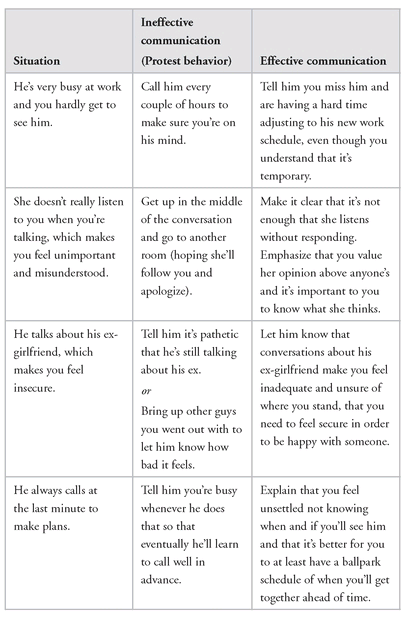
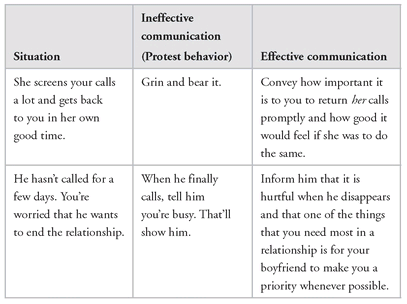
Review the examples that follow. Notice how ineffective communication can be interpreted in different ways while effective communication has only one specific meaning. That’s why your partner’s response to effective communication is much more telling than his or her response to ineffective communication or protest behavior.
It’s important to remember that even with effective communication, some problems won’t be solved immediately. What’s vital is your partner’s response—whether he or she is concerned about your well-being, has your best interests in mind, and is willing to work on things.